
Table of Contents
ToggleAuthor: SmileBottles Editorial Team
Estimated Reading Time: About 12 Minute
When you are planning to launch a new spirit or expanding your liquor brand into international markets, one of the first technical hurdles you will encounter is deciding on your bottle size. It sounds simple, but once you start looking at global standards, you will see labels like 70cl, 700ml, and 750ml. You might even see people searching for 700cl, which can lead to a lot of confusion.
Choosing the right liquor bottle sizes is about more than just how much liquid fits inside. It’s about regulatory compliance, shipping costs, shelf presence, and meeting the expectations of your target consumers. If you choose the wrong size for the wrong market, you could face customs issues or find that retailers refuse to stock your product.
In this guide, Smilebottles will break down everything you need to know about standard liquor bottle sizes, the difference between 70cl and 700ml, and how to choose the right glass liquor bottles for your business.
What Does “cl” Mean on a Liquor Bottle?
If you have spent time in the European market, you have likely noticed that many bottles don’t use “ml.” Instead, they use “cl.” So, what does cl mean?
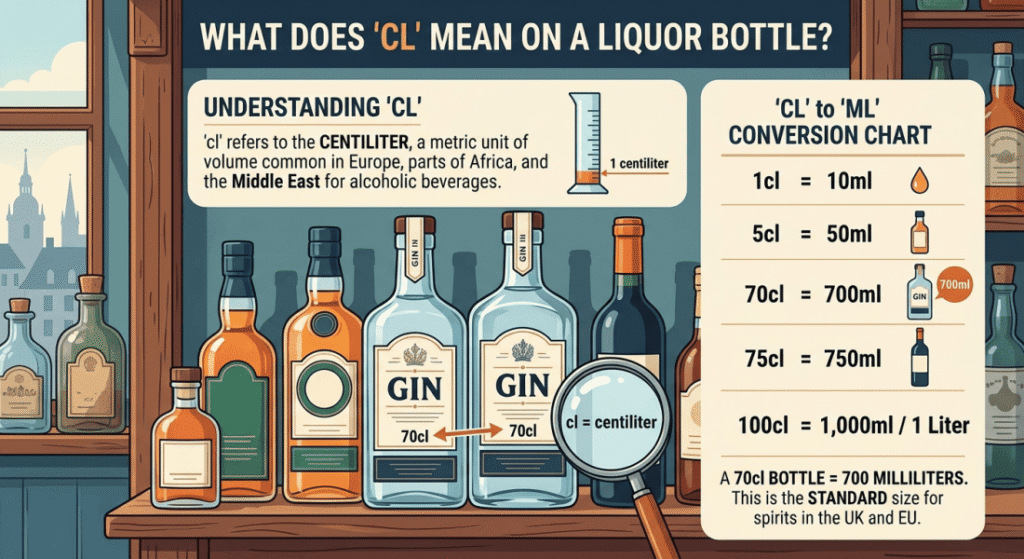
cl meaning refers to the centiliter. This is a metric unit of volume that is very common in Europe and parts of Africa and the Middle East for labeling alcoholic beverages. To understand the scale, you just need a simple centiliter to ml conversion: 1 centiliter equals 10 milliliters.
When you see a 70cl bottle, you are looking at a container that holds 700 milliliters of liquid. Understanding 70cl in millilitres is crucial because while the unit changes, the physical volume remains a standard size for spirits across the UK and the European Union. You might ask, what is 70cl in terms of standard use? It is the go-to volume for most premium spirits like gin, whisky, and vodka in these regions.
To make it easier for your production team, keep this cl to ml or convert cl to ml chart in mind:
1cl = 10ml
5cl = 50ml (Common for miniatures)
70 cl = 700ml
75 cl bottle = 750ml
100cl = 1,000ml (1 Liter)
What Does “ml” Mean on a Bottle?
On the other hand, most of the world—including North America, Asia, and much of Latin America—prefers the milliliter. But what does ml mean exactly? The milliliter meaning is a thousandth of a liter. It is the most widely recognized metric unit for liquid volume globally.
When you are looking for wholesale liquor bottles, you will likely see them listed in ml because it is the standard language of manufacturing and global trade. Whether you are buying a 700ml liquor bottle or a 750ml glass bottle, the “ml” label provides a universal understanding of the capacity.
In many markets, you will find that even if a bottle is technically a 70cl bottle in ml (700ml), the label might still use “ml” to ensure it is understood by a wider audience. However, the milliliter meaning stays consistent: it is a precise measurement used for everything from small 50ml “nips” to massive 1.75L “handles.”
70cl vs 700ml: Are They the Same?
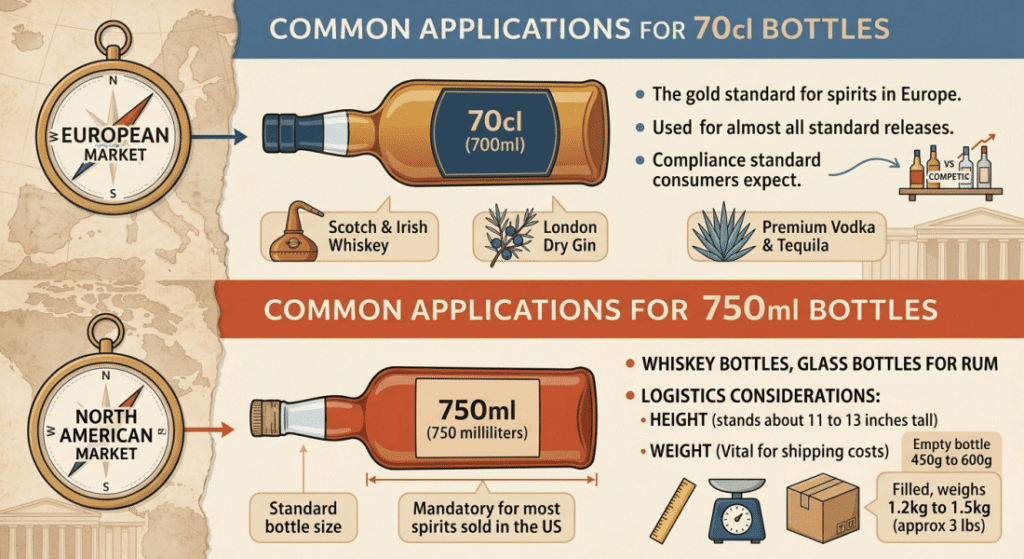
This is the most common question we get from buyers: is 70cl the same as 700ml? The short answer is yes. They represent the exact same volume of liquid.
The difference between 70cl and 700ml is purely a matter of labeling and regional preference.
70cl is the preferred label in the EU and UK.
700ml is the preferred label in most other metric-using countries.
However, there is a major trap you need to avoid: the 700cl mistake. Some buyers accidentally search for or request a 700cl bottle, but 700cl to ml is actually 7,000ml—or 7 liters! That is the size of nearly ten standard bottles. Unless you are looking for a massive display bottle for a promotion, you almost certainly mean 70cl or 700ml. Keeping this distinction clear will help you maintain a professional image with your liquor bottle manufacturer.
70cl, 700ml, and 750ml: What’s the Real Difference?
While 70cl and 700ml are identical in volume, the comparison between 700ml vs 750ml is where things get interesting for a business owner.
For decades, the United States and the European Union had different standards. The US favored the 750ml bottle size, while the EU standardized on the 700ml liquor bottle. This created a headache for global brands who had to maintain two different sets of glass liquor bottles and labels.
Here is a quick 750 ml bottle size comparison to help you visualize the difference:
|
Size Label |
Actual Volume |
Common Markets |
|
70cl |
700ml |
UK, Europe, Australia |
|
700ml |
700ml |
Global (excluding US for many years) |
|
750ml |
750ml |
USA, Canada, South America |
|
1L |
1000ml |
Duty-Free, Travel Retail |
750ml is what we often call a “fifth” in the United States, a term dating back to when it was a fifth of a US gallon. When you ask what size is 750ml, you are talking about 25.4 ounces. Comparing 70cl vs 750ml, the 750ml bottle gives the consumer about 1.7 ounces (or one standard shot) more liquid than the 70cl version.
Common Applications for 70cl Bottles
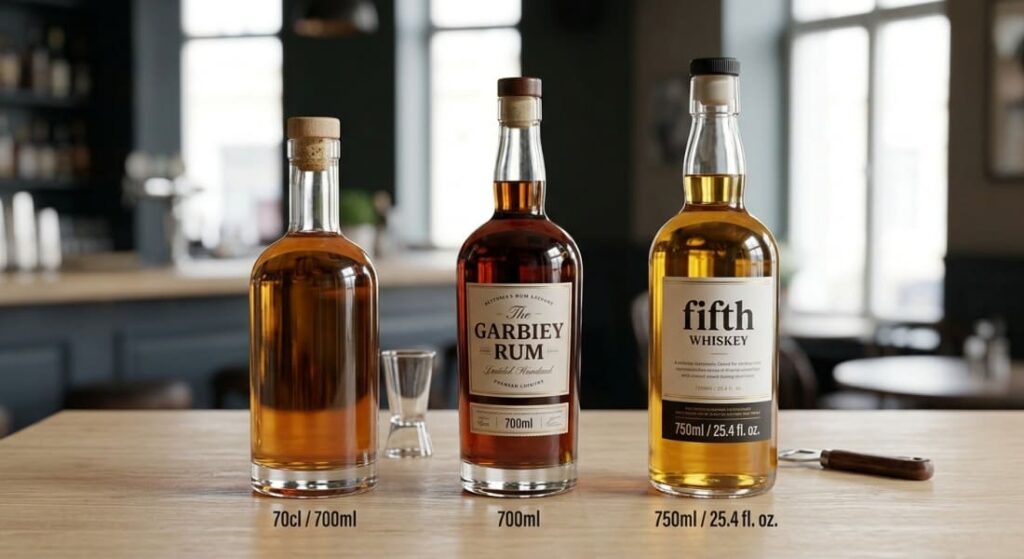
If you are targeting the European market, you will almost certainly be looking for a 70cl bottle. You might wonder, how much is 70cl in practical terms? It is the gold standard for spirits.
You will find 70 cl bottles used for:
Scotch and Irish Whiskey: Almost all standard releases in Europe are 70cl.
London Dry Gin: The classic 70 cl bottle is the staple for retail shelves.
Premium Vodka and Tequila: While luxury brands often use custom liquor bottles, they still stick to the 70cl fill volume for compliance.
Using a 70cl meaning in ml (700ml) bottle in Europe is not just a suggestion; it’s a standard that consumers expect. If you put a larger bottle on the shelf, it might look out of place, or your pricing might seem too high compared to the 70cl competition.
Common Applications for 750ml Bottles
In North America, the 750 ml bottle size reigns supreme. If you ask a bartender in New York, “what is a 750ml bottle called?” they will likely just say “a standard bottle.”
The 750ml bottle of liquor is the mandatory size for most spirits sold in the US. Whether it is a 750ml whiskey bottle or a 750ml glass bottle for rum, this size is what American retailers have built their shelves to accommodate.
When planning your logistics, you need to know how big is a 750 ml bottle. Generally, they stand about 11 to 13 inches tall, but the shape varies wildly. You also need to consider weight. How much does a 750 ml bottle weigh? An empty standard glass bottle usually weighs around 450g to 600g, but premium, heavy-base bottles can weigh over 1kg before they are even filled. When filled, you should ask: how much does a 750ml bottle of liquor weigh in total? Usually, it’s around 1.2kg to 1.5kg (approx. 3 lbs). This is a vital calculation for your shipping costs.
Bottle Size Standards in Different Liquor Markets
Understanding the standard liquor bottle sizes across the globe is the key to a successful export strategy. You don’t want to arrive in a new market only to find your alcohol packaging is non-compliant.
US Market: Why 750ml Is the Standard
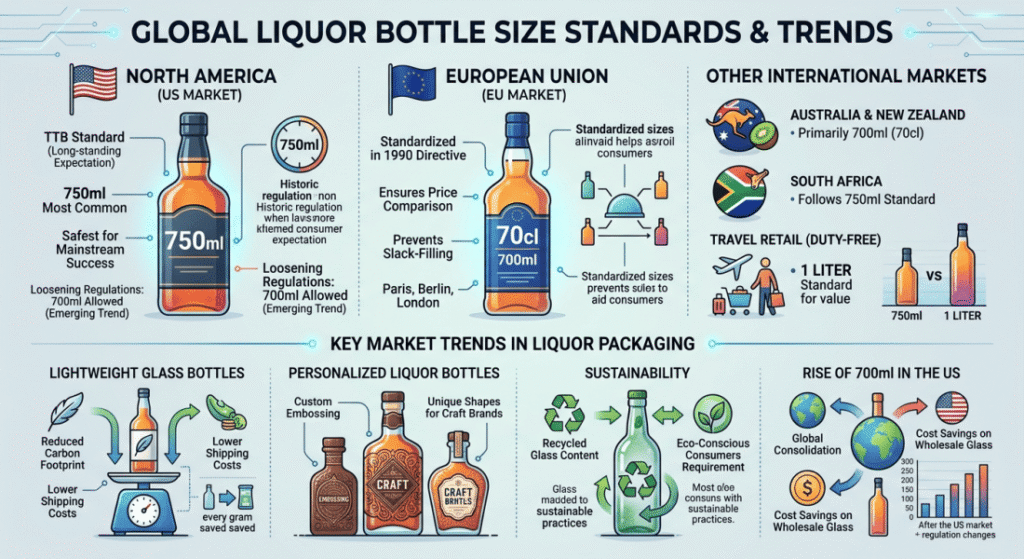
For a long time, the TTB (Tax and Trade Bureau) in the US was very strict. A 750ml bottle of alcohol was one of the few sizes allowed for distilled spirits. While regulations have loosened slightly recently to allow 700ml bottles in some cases, the 750ml 750ml standard is still what consumers and distributors expect. If you are entering the US, a 750ml liquor bottle is your safest bet for mainstream success.
EU Market: Why 70cl Is Common
In 1990, the European Union passed a directive making 700ml (70cl) the standard size for spirits. This was done to prevent “slack-filling” and to make it easier for consumers to compare prices. If you are selling in Paris, Berlin, or London, the 70cl bottle is the industry standard.
Other International Markets
Australia and New Zealand: Primarily use the 700ml bottle or 70cl.
South Africa: Follows the 750ml standard.
Travel Retail (Duty-Free): This is where you will see 750 ml vs 1 liter comparisons. 1-liter bottles are the standard for duty-free shops to offer “more value” to travelers.
Market Trends in Liquor Bottle Sizes
As a liquor bottle manufacturer, Smilebottles has seen significant shifts in alcohol packaging trends. Brands are no longer just looking for a “standard” bottle; they want something that tells a story.
Lightweight Glass Bottles: To reduce carbon footprints and shipping costs, many brands are moving away from heavy glass. This is especially important when you calculate how much does a 750 ml bottle of liquor weigh—every gram saved is money saved in transit.
Personalized Liquor Bottles: Custom embossing and unique shapes are becoming more popular for craft distilleries.
Sustainability: Using recycled glass content is no longer an option; it is a requirement for many modern consumers.
The Rise of the 700ml in the US: Now that the US allows 700ml bottles, some global brands are consolidating their production to a single size to save on wholesale glass liquor bottle costs.
How to Choose the Right Bottle Volume for Your Liquor Brand
Choosing between a 70cl vs 700ml label or a 700ml vs 750ml capacity depends on three main factors:
1. Your Target Sales Market
If 90% of your sales are in the United States, go with the 750ml glass bottle. If you are a European brand, stay with 70cl. If you are a global brand, you might consider the new 700ml allowance in the US to see if you can use one bottle size for both markets.
2. Brand Positioning
How do you want the bottle to feel in the hand? A 750 ml bottle in hand feels substantial. If you are a premium brand, you might choose a bottle with a thick base, even if it adds to the 750ml whiskey bottle weight.
3. Supply Chain and Packaging Efficiency
Buying wholesale liquor bottles in bulk is cheaper if you can use the same mold for multiple products. Consider if you need custom liquor bottles or if a standard “Nordic” or “Boston” round bottle in 700ml or 750ml will suffice.
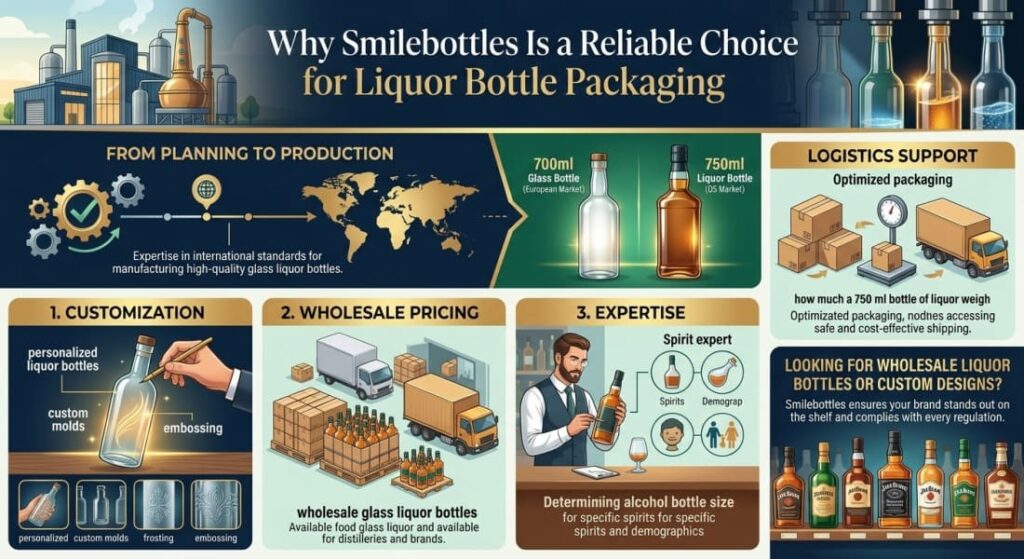
Why Smilebottles Is a Reliable Choice for Liquor Bottle Packaging
When you are ready to move from planning to production, you need a partner who understands the nuances of the global market. At Smilebottles, we specialize in manufacturing high-quality glass liquor bottles that meet international standards.
Whether you need a 700ml glass bottle for the European market or a 750ml liquor bottle for the US, we provide:
Customization: We offer personalized liquor bottles with custom molds, frosting, and embossing.
Wholesale Pricing: We provide wholesale glass liquor bottles to distilleries and brands of all sizes.
Expertise: We can help you determine the best alcohol bottle size for your specific spirit and target demographic.
Logistics Support: We understand how much a 750 ml bottle of liquor weigh and can help you optimize your packaging for safe, cost-effective shipping.
If you are looking for wholesale liquor bottles or need help designing custom liquor bottles, Smilebottles is here to ensure your brand stands out on the shelf and complies with every regulation.
FAQ About 70cl, 700ml, and 750ml Bottles
Q1:Is 70cl the same as 700ml?
A1:Yes, 70cl vs 700ml is just two different ways of writing the same volume. 70 centiliters = 700 milliliters.
Q2:How big is 750 ml?
A2:To visualize how big 750 ml is, it is roughly the size of a standard wine bottle. It is about 1/5th of a gallon.
Q3:How many drinks are in a 750 ml bottle?
A3:If you consider a standard pour to be 1.5 ounces, there are approximately 17 drinks in a 750ml bottle. For a 70cl bottle, there are about 15.5 drinks.
Q4:What is a 750 ml bottle called?
A4:In the US, it is often called a “fifth.” In other places, it is simply a “standard” or “large” bottle.
Q5:How much is 750 ml in alcohol?
A5:In the context of spirits, 750ml of alcohol refers to the total volume of the liquid (the spirit), not the pure ethanol content.
Q6:Can 2 bottles of 750ml equal how many liters?
A6:2 bottles of 750ml equals 1.5 liters.
Q7:How big is a 750 ml bottle of alcohol compared to 1 liter?
A7:A 1-liter bottle is about 33% larger than a 750ml size bottle.
Conclusion
In the world of spirits, details matter. Understanding the cl meaning and the milliliter meaning is the first step toward professional packaging. Remember that while 70cl vs 700ml are the same, the choice between them and the 750ml bottle size will define which markets you can enter and how much you will pay in shipping.
Don’t let the “700cl” confusion or the 75cl ml conversions slow your brand down. By choosing the right liquor bottle manufacturer and the right bottle size, you set your brand up for global success. Whether you are selling a premium whiskey or a craft gin, the right glass bottle is the silent ambassador for your brand.
Ready to find the perfect bottle for your product? Contact Smilebottles today to explore our range of 700ml, 750ml, and custom liquor bottles.
 English