
Table of Contents
ToggleFor juice brands—especially those in the premium, organic, or cold-pressed sectors—choosing the right container is a critical operational decision. As a manufacturer, Smilebottles knows that sourcing juice bottle packaging isn’t just about picking a pretty shape. It’s about line speeds, labeling compatibility, thermal shock resistance, and shelf life.
This guide is written to help you navigate the complex market of different types of juice bottles. Whether you are looking for glass bottles for juice storage in a warehouse or launching a new retail line of cold-pressed shots, this breakdown will help you make the right choice for your production line.
Why Packaging Choice Determines Shelf Success
In the retail environment, consumers buy with their eyes first. When a customer picks up containers for juice they are subconsciously judging the weight, the clarity, and the temperature of the package.
Plastic feels cheap and temporary. Glass feels permanent, cold, and premium. For a juice brand, the packaging serves three distinct roles:
Protection: It must stop oxygen from killing the vitamins and flavor.
Production:It must withstand the filling machine, the capper, and the labeling arm without tipping or breaking.
Promotion: It needs to show off the vibrant color of the juice in glass bottle formats without distortion.
Juice Bottle Materials Overview: Why Glass Wins
When examining the landscape of juice bottle materials, you typically have four options. While we manufacture glass, it is important to honestly compare them so you understand the trade-offs.
Glass Juice Bottles
Glass is the industry standard for high-quality juice. It is the only material that is 100% inert. It doesn’t breathe, meaning oxygen cannot get in, and flavor cannot get out. For acidic products, like cranberry juice in glass bottles, this is vital because the acid won’t interact with the container walls.
Plastic Bottles (PET/HDPE)
Plastic is the volume leader because it is light and cheap. However, plastic is permeable. Over time, air pushes through the plastic walls, degrading the juice inside. Plastic also struggles with heat; you cannot hot-fill standard PET bottles without them warping.
Aluminum Bottles
Aluminum is growing in the water sector, but it has challenges for juice. You can not see the product inside, which is a disadvantage for fresh juice, where color indicates health. Also, aluminum dents easily during shipping, which increases your waste rate.
Stainless Steel Bottles
Stainless steel is durable but far too expensive for single-use retail juice packaging. It is opaque and heavy, making it impractical for supermarket shelves.
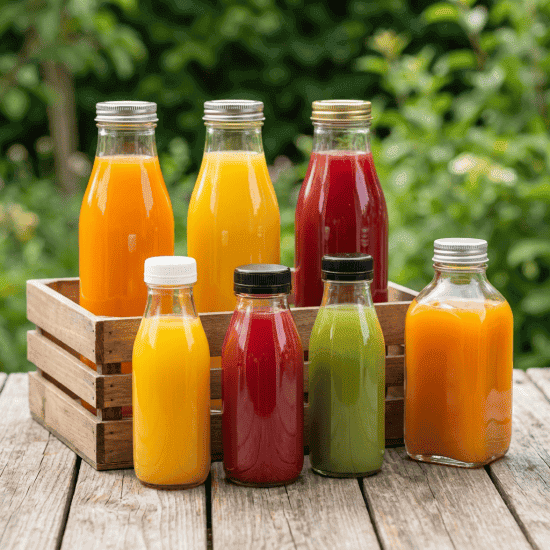
Why Glass Juice Bottle Matters in Packaging?
There is a reason why glass juice bottles have been used for over a century. It isn’t just nostalgia; it’s chemistry and physics.
Preservation and Shelf Life: The biggest enemy of fresh juice is oxidation. Once oxygen touches the juice, enzymes break down, and the color turns brown (especially in apple or green juices). Juice jars glass provide a hermetic barrier. If you use a lug cap with a vacuum seal, you can extend the shelf life significantly compared to plastic.
Non-Toxic Nature, Safety, and Purity: Glass is made from sand, soda ash, and limestone. There are no plasticizers, no BPA, no phthalates—nothing that can leach into the juice. For orange juice containers or any acidic product, this is crucial. Acid can pull chemicals out of lower-quality plastic packaging.
Airtight Seals and Leak Prevention: A bottle is only as good as its closure. Glass is rigid. It does not flex when you tighten the cap. This allows capping machines to apply high torque, ensuring that glass bottles with lids for juicing stay sealed tight even if the box is dropped or shaken during logistics.
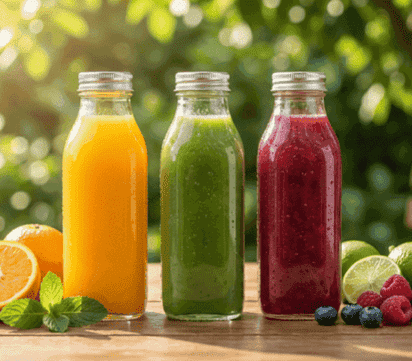
Consumer Appeal and Visual Effect: High-quality flint (clear) glass acts like a lens. It amplifies the color of the juice. When you place 16 oz glass juice bottles filled with bright green kale juice under supermarket lights, the glass makes the product look glowing and fresh. Plastic tends to look slightly hazy or dull by comparison.
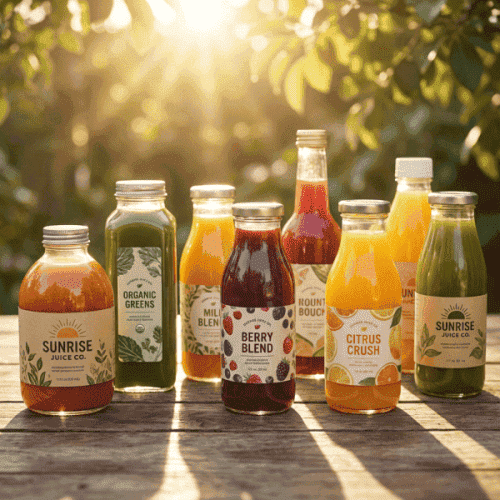
Branding and Marketing Advantages: Glass offers decoration options that plastic can’t match. You can emboss your logo directly into the glass during molding. You can apply ceramic screen printing that won’t scratch off. You can frost the glass for a matte look. You can use colored glass—amber to protect light-sensitive products, green for a natural aesthetic.
Sustainability & Eco-Friendly Solutions: Glass is infinitely recyclable. A bottle you toss in the bin today can be back on the shelf as a new bottle in 30 days. For brands trying to reduce their carbon footprint, switching to glass bottles for juice is a strong marketing message.
Functionality and Convenience: Glass can handle extremes. You can run glass juice bottle packaging through a pasteurization tunnel at high heat, or put it through a High-Pressure Processing (HPP) cold water bath. Plastic often melts or crushes under these conditions.
Customizability: At Smilebottles,with juice glass jars, we can customize the texture. We can emboss your brand name directly into the glass shoulder or base. This prevents counterfeiting and makes your bottle instantly recognizable even if the label falls off.
Customization options include:Unique body shapes, Embossed logos and patterns, Custom base designs, Non-standard neck finishes, Colored glass (flint, amber, green, cobalt blue)
Basic Information of Glass Juice Bottles:What Defines a Glass Juice Bottle?
When you order glass bottles for juice storage, you need to specify more than just a bottle. Here are the technical details that define the product.
Key Specs You Must Confirm: The Anatomy of the Glass Juice Bottle
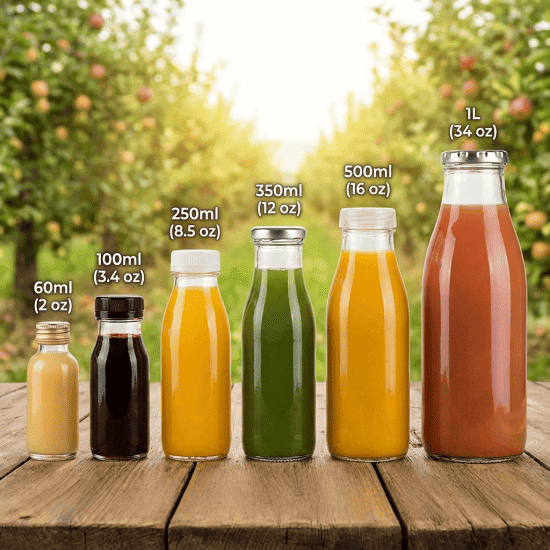
Capacity: Usually expressed in milliliters (ml) or fluid ounces (oz). Common sizes include 12 oz glass juice bottles, 16 oz glass juice bottles, 250ml, 500ml, and 1 liter.
Neck Finish: This is the top part with the threads. Common sizes are 38mm, 43mm, or 48mm.
The Shoulder: The slope from the neck to the body. A sharp shoulder looks modern but can be a weak point in HPP processing.
The Body: The labeling panel.
The Heel/Base: The bottom. A heavy base (often called a “slug”) lowers the center of gravity, making the bottle more stable on your conveyor belts.
Glass Color: A Clear glass bottle is most common for juice because it shows off the product. An amber glass bottle protects light-sensitive contents. Green is sometimes used for organic or natural positioning.
Labeling Considerations
The shape of your glass bottles for juicing dictates your labeling machine speed.
Round bottles: You can spin these through a labeler at high speeds.
Square bottles: These require an orientation system to make sure the label hits the flat panel, not the corner. This usually slows down the production line slightly.
Tapered bottles: If the bottle is wider at the top than the bottom, the label will wrinkle unless it is curved.
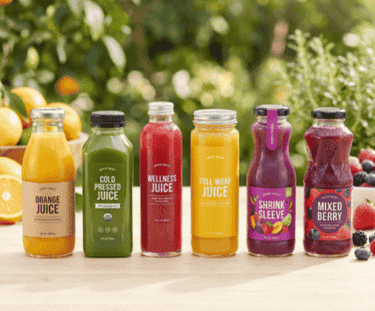
Moisture considerations: If your juice is cold-filled and refrigerated, the bottle will “sweat” when exposed to room temperature. Standard paper labels will peel off. You need plastic film labels with aggressive adhesive or shrink sleeves.
Key Types of Glass Juice Bottles
Not all glass is the same. Here’s what you need to know about the types of juice bottles from a material perspective.
Soda-Lime Glass
This is the standard. 90% of the glass juice bottles you see on the market are soda-lime. It is strong, clear, and cost-effective. It is perfect for juices, sauces, and beverages.
Borosilicate Glass
This is lab-grade glass (like Pyrex). It handles thermal shock very well. However, it is much more expensive. For juice packaging, borosilicate is rarely necessary. It’s more common in laboratory glassware and high-end cookware. Unless your process involves extreme temperature swings, stick with soda-lime glass and save the money.
Wide-Mouth Bottles
Wide-mouth juice jars glass with a wide opening (like a 48mm or 53mm Twist-off), are becoming popular for “spoonable” smoothies or juices with fruit chunks (pulp). The wide mouth makes filling faster because you have a larger target for the filling nozzle, reducing spillage on the line.
HPP-Compatible Glass Bottles
This is a specific category. HPP subjects the bottle to 87,000 psi of water pressure. Standard glass might crack. HPP-compatible glass juice bottles have thicker walls and a specific geometric curve at the neck and base to distribute that pressure evenly. If you use HPP, you must tell your supplier so we can recommend the right mold.
Popular Glass Juice Bottle Shapes and Their Applications
Shape isn’t just about looks; it changes how you pack and ship the product. Here are the most common juice bottle packaging shapes and when to use them.
Round Juice Bottles
The “Boston Round” is the workhorse of the industry.
Pros: Strongest shape structurally. Easiest to label.
Cons: Not space-efficient in a shipping box (lots of air between bottles).
Best For: High-volume apple or orange juice glass bottle lines.
Square Juice Bottles/ French Square Bottles
Pros: They pack tightly together, meaning you can fit more bottles on a pallet and more product on a retail shelf.
Cons: Corners can be fragile during impact.
Best For: Cold-pressed juice brands wanting a modern, dense look.
Slim & Tall Juice Bottles
Pros: They look massive on the shelf. A 250ml slim bottle looks taller than a 300ml stout bottle.
Best For: Premium, expensive blends where you want to emphasize value.
Straight-Sided Round Bottles
These glass juice bottles are cylinders. They offer the clean look of a round bottle but with a full top-to-bottom labeling area. Ideal for brands that have a lot of nutritional information to display.
Curvy or Hourglass Bottles
These glass bottles with curves in the body—narrower in the middle, wider at the top and bottom. These are comfortable to hold and visually distinctive.
Best for: Premium brands seeking differentiation.
Trade-off: Adhesive labels don’t work well on curved surfaces. You’ll likely need shrink sleeves.
Custom Molded Bottles
This is where Smilebottles shine. We can take a standard shape and add a unique grip or an embossed logo. This stops competitors from using the same bottle as you.
Best for: Established brands ready to invest in long-term brand equity, products entering competitive retail environments.
Shape Comparison Table
Shape | Best For | Label Type | Packing Efficiency |
Round | High-volume classic juices | Adhesive wrap | Lower |
Square | Premium cold-pressed | Adhesive panel | Higher |
Slim/Tall | Wellness drinks | Adhesive or sleeve | Medium |
Straight-sided | Maximum graphics | Full wrap | Medium |
Curved | Premium differentiation | Shrink sleeve | Lower |
Custom | Brand building | Varies | Varies |
Glass Juice Bottle Sizes and Their Applications
Different products need different sizes. Here’s how to match your juice type to the right glass bottles for juice capacity.
50ml – 100ml (The Wellness Shot)
These small glass bottles for juice are exploding in popularity. Used for concentrated ginger, turmeric, or probiotic shots. They are single-gulp products.
250ml – 300ml (The Lunch Companion)
This is a standard single serving. It fits in a cup holder and a lunchbox. The glass juice bottle is roughly equivalent to 8-10 oz. It’s enough juice to feel like a complete serving but small enough to drink in one sitting.
350ml – 400ml (12 oz Glass Juice Bottles)
The 12 oz glass juice bottles are the “Goldilocks” size—not too small, not too big. This is the volume driver for most US and European juice brands.
500ml (16 oz Glass Juice Bottles)
16 oz glass juice bottles are for the heavy users. This is a meal replacement size. If you are selling protein smoothies or heavy green juices, this is the standard size.
1 Liter – 1.5 Liter (The Home Fridge)
Large sizes like the 1 gallon apple juice glass bottle are heavy and hard to pour, so they are niche. However, 1 Liter bottles are very common for premium organic juices kept in the home fridge. These bottles often need a lug finish (twist off) so they can be resealed multiple times.
Other Important Parts of Glass Juice Bottles
A bottle by itself is just a container. To make it work in production and protect your product, you need to get the details right.
The glass is just one part of the system.
Neck Finish
You need to speak the language of the “finish.”
38-400: A continuous thread finish common on standard juice bottles. The “38” refers to the diameter in millimeters; the “400” is an industry code for thread style.
43-400: Slightly wider, used on larger bottles or when you want a bigger cap for easier gripping.
48mm Lug: A twist-off finish common on wide-mouth jars. The cap has lugs rather than continuous threads.
38-2000 Lug: Used with metal twist-off caps, common for hot-fill applications.
Tamper Evident (TE): The neck has a special “bead” or ring of glass that catches the plastic band of the cap, snapping it when opened.
When you order glass juice bottles with lids, make sure the bottle finish matches the cap. Mixing suppliers without checking specs is a common way to end up with caps that don’t seal properly.
Closure Types
For juice bottle packaging, you usually choose between:
For juice applications, the most common closures are:
Plastic Screw Caps: Standard for cold-fill juices. Usuall,y HDPE or PP plastic with an inner seal. Tamper-evident versions have a breakaway band that snaps when first opened.
Metal Lug Caps: Used with hot-fill products. The vacuum created as the product cools pulls the center of the cap down, creating the “pop” sound when opened.
Aluminum Screw Caps: Premium look, often used for high-end juices. More expensive than plastic but feels more substantial.
Sports Caps / Flip-Top: Convenient for on-the-go consumption. Common on smoothie bottles.
Seal Integrity
Inside the cap is a liner.
Foam Liner: Good for leak prevention in cold juices.
Plastisol Liner: A rubber ring that melts slightly when hot to form a vacuum seal. Essential for shelf-stable jams or juices.
Induction Seals: A foil liner that is fused to the bottle lip using electromagnetic induction. Provides tamper evidence and leak prevention. Common for products that ship long distances.
Material Compatibility
Juice is acidic. Such as cranberry juice in glass bottles has a pH of around 2.5. Orange juice glass bottle products run 3.5-4.0. This acidity can affect certain liner materials over time. Ensure the liner is acid-resistant. Cheap liners can degrade and fall into the juice.
How to Choose the Right Glass Juice Bottle Supplier
Supplier Capability Checklist
Mold Library: Do they have stock molds for 16 oz glass juice bottles, or do you have to pay for a new mold?
Quality Control: Ask about their thermal shock testing. Can the bottle go from cold wash to hot fill without cracking?
Food Safety: Are the bottles produced in a clean environment suitable for glass bottles for juice storage?
Commercial Checklist
MOQ (Minimum Order Quantity): Some factories require 100,000 units. At Smilebottles, we try to work with growing brands, offering flexible MOQs for stock items.
Palletizing: How are they packed? Bulk pallets (layers of bottles) are good for automated lines. Cartons are better if you fill them by hand.
Development Support
Technical Drawings: Can they provide dimensioned drawings of the bottles for your engineers and designers?
Cap Recommendations: Can they help you select the right closure for your application?
Label Templates: Do they provide label panel dimensions so your designer can create artwork that fits properly?
At Smilebottles, we provide all of this support. We see ourselves as packaging partners, not just bottle vendors.
FAQs about Glass Juice Packaging
**1Q: Are glass juice bottles safe for cold-pressed juice?**
1 A: Yes, they are the best option. Glass maintains the cold temperature well and allows for High-Pressure Processing (if the bottle is designed for it), which extends shelf life without heat.
**2Q: What is the most standard size for retail juice?**
2A: The 12 oz glass juice bottles and 16 oz glass juice bottles are the industry standards for single-serve retail sales.
**3Q: Can I use glass bottles for freezing juice?**
3A: You have to be very careful. Water expands when it freezes. If you use glass bottles for juicing and freeze them, you must leave significant “headspace” (air gap) at the top, or the glass will shatter. We recommend specific freezer-safe designs.
**4Q: Do you sell glass juice bottles with lids included?**
4A: Yes, we provide glass juice bottles with lids as a system. We ensure the cap liner matches your acidity and filling temperature requirements.
**5Q: Is a 1 gallon apple juice glass bottle practical for shipping?**
5A: They are very heavy and prone to breakage if shipped via standard parcel carriers (like FedEx/UPS). They are best suited for palletized freight shipping to retail stores.
**6Q: What is the difference between flint and super flint glass?**
6A: Flint is standard clear glass. Super flint is extra clear and bright, often used for high-end spirits, but it can make your juice glass bottle look ultra-premium.
Conclusion
Choosing the right glass juice bottles isn’t just about picking something that looks nice. It’s a technical decision that affects your production efficiency, your product shelf life, your brand perception, and your shipping costs. Glass offers advantages that other materials can’t match: complete barrier protection, chemical inertness, premium aesthetics, and full recyclability. For juice brands that position themselves as healthy, natural, and premium, glass packaging reinforces that message at every consumer touchpoint.
From small glass bottles for juice shots to large family-size jars, we have the molds and the expertise to help your brand stand out on the crowded shelf. Contact Smilebottles today with your juice type, filling process, and target size. We’ll send you recommended options with samples so you can test before you commit.