
Table of Contents
ToggleAuthor: Smilebottles Team
Category: Product Guide / Packaging Knowledge
Reading Time: About 12 Minutes
In the competitive world of brewing, the liquid inside is only half the battle. The vessel you choose defines your brand’s identity, ensures shelf stability, and determines how your product survives the journey from the filling line to the customer’s hand. While aluminum cans have their place, the classic glass beer bottle remains the gold standard for premium presentation and taste preservation.
At Smilebottles, we understand that for a brewery or beverage brand, choosing the right packaging is a strategic business decision. Whether you are scaling up a craft brewery, managing a large-scale filling operation, or looking for distinct packaging for a limited release, understanding the nuances of glass is essential.
This guide explores the different types of beer bottles, decodes the industry jargon around specific beer container names, and helps you navigate sizes, colors, and closures. If you are looking for bottles for beer that combine aesthetic appeal with manufacturing durability, you have come to the right place.
Why Glass Remains the Brewer’s Choice
Before diving into shapes and sizes, it is worth revisiting why glass is the preferred material for premium brewing.
Taste Integrity: Unlike some plastics or metals, a beer glass bottle is chemically inert. It does not interact with the liquid, ensuring that the flavor profile you brewed is exactly what the customer tastes.
Perception: There is a tactile weight and “clink” associated with glass that communicates quality. When consumers see pictures beer bottles in marketing campaigns, the condensation on a cold glass bottle evokes a specific, refreshing feeling that is hard to replicate.
Sustainability: Glass is 100% recyclable and can be reused endlessly without loss of quality.
Anatomy of a Beer Bottle
To communicate effectively with beer bottle suppliers, it helps to know the technical anatomy of the container. Detailed information can be obtained from our previous article: The popular beer bottle dimensions
The Finish: This is the very top of the bottle, including the lip. It dictates what kind of cap you can use (crown, swing top, or cork).
The Neck: The slender part leading to the body. A long neck aids in pouring and handling.
The Shoulder: Where the neck widens into the body. The slope of the shoulder affects how sediment settles in bottle-conditioned beers.
The Body (Label Panel): The main cylindrical area where you apply your branding.
The Heel & Punt: The bottom corner is the heel. The indentation on the bottom (punt) adds structural strength and stability during the filling process.
Different Types of Beer Bottles (Shapes & Styles)
The types of beer containers you choose should reflect the style of beer (Lager, Ale, Stout, Sour) and your brand identity. Here is a breakdown of the most common profiles we manufacture.
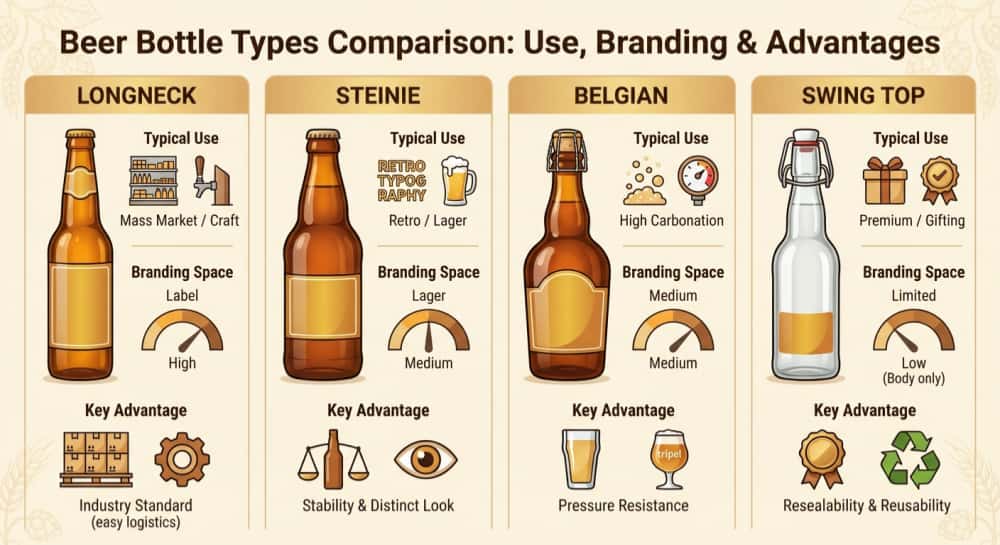
Longneck Beer Bottles
When you think of a standard beer in a glass bottle, you are likely picturing the Industry Standard Bottle (ISB) Longneck.
Description: Features a tall, slender neck and steep shoulders.
Best For: High-speed bottling lines, 6-packs, and standard distribution.
Pros: Easy to source, fits standard master cartons, and consumers instantly recognize it.
Closure: Standard Crown.
The Steinie (or “Stubby”)
These represent the short beer bottles often associated with retro or heritage brands.
Description: A shorter, wider body with a much shorter neck.
Best For: Craft lagers, retro branding, and brands wanting to stand out on the shelf.
Pros: Very stable (harder to knock over), unique “hand-feel.”
Cons: Requires different carton dimensions than longnecks.
Belgian Bottles
Designed for pressure.
Description: These bottles feature a bulbous neck and sloping shoulders. The glass is often thicker to withstand higher carbonation levels common in Belgian Ales and Saisons.
Best For: Bottle-conditioned beers, wild ales, and premium exports.
Closures: Often compatible with a crown cap or a cork-and-cage setup.
Swing Top (Flip Top) Bottles
Swing Top beer bottles are the premium, reusable icons of the beer world.
Description: Features a porcelain or plastic stopper held in place by a wire bail.
Best For: Specialty releases, gifting, and homebrew markets.
Pros: Resealable and perceived as very high value. Consumers love keeping these as empty beer bottles for water or oil after the beer is gone.
Heritage and “Old Style” Bottles
We see a resurgence in old style beer bottles that mimic pre-prohibition designs. These often have embossed lettering or unique shoulder curves that suggest a long history of brewing tradition.
Comparison Table: Beer Bottle Types
Bottle Type | Typical Use | Branding Space | Key Advantage |
Longneck | Mass Market / Craft | High | Industry Standard (easy logistics) |
Steinie | Retro / Lager | Medium | Stability & Distinct Look |
Belgian | High Carbonation | Medium | Pressure Resistance |
Swing Top | Premium / Gifting | Low (Body only) | Resealability & Reusability |
Popular Sizes of Glass Beer Bottles: From Single Serve to Sharing
Understanding the regular beer bottle size for your target market is crucial. While volumes vary by country, these are the global standards.
The 12 oz / 330 ml Standard
North America: The 12 oz beer bottles (approx. 355ml) are the king of the market.
Europe/Asia: The 330ml size is the equivalent of standard beer bottles.
Usage: Sold in 6-packs, 12-packs, and 24-loose cases. This is the volume most consumers expect for a single serving.
The 500 ml (16.9 oz)
Popular in the UK, Germany, and Eastern Europe. It offers a slightly larger serving, often termed a “pint” bottle in some regions, though it is slightly less than a British pint.
Large Formats: Bombers and More
22 oz (650 ml): Known as the “Bomber.” These are large beer containers perfect for limited-release Stouts or IPAs.
750 ml: Often used for barrel-aged beers or sours. These compete visually with wine bottles.
1 Liter / Quart: Quart beer bottles are less common today but still exist in certain “value” segments or traditional German styles.
Growlers
64 oz (1.89 L): The Growler is a jug-like brewing bottle used primarily for draft beer to-go.
Standard size beer bottle dimensions are vital for setting up your labeler. Always request a spec sheet from Smilebottles before ordering labels.
Beer Bottle Colors: Protection and Aesthetics
The color of the glass is not just about looks; it is a shield for your product. When choosing beer bottle colors, you are balancing marketing against science.
Amber Glass Beer Bottles/ Brown Glass Beer Bottles
Why is beer bottled in brown bottles? The answer is UV protection. Ultraviolet light reacts with the hops in beer, causing a chemical reaction that leads to “skunking” (a smell similar to a skunk’s spray).
Protection Level: Blocks over 99% of damaging UV rays.
Best For: IPAs, Hoppy Pale Ales, Stouts, and any beer meant for long shelf life.
Green Glass Beer Bottles
Green glass beer bottles occupy a middle ground.
History: During WWII shortage of brown glass, many premium European brewers switched to green. It became associated with “import quality.”
Risks: Beer with green bottles is more susceptible to light damage than brown, but better than clear.
Famous Examples: Many iconic beer brands in green bottles (like Heineken or Stella Artois) use this color.
Niche: Sometimes used for small green bottle beer formats (7 oz “ponies”).
Old Green Beer Bottles: Vintage collectors often look for old green beer bottles, proving the lasting aesthetic appeal of this color.
Clear Glass Beer Bottles/ Flint Glass Beer Bottles
Description: Transparent glass.
Pros: Shows off the liquid’s color and clarity. Great for bright yellow Mexican lagers or fruit beers.
Cons: Zero UV protection.
Solution: Clear beer bottle brands usually use chemically modified hop extracts that are resistant to UV light to prevent skunking.
Colored & Specialty Glass
Blue glass beer bottle: Rare and striking. Used by a few specific brands (like 1664 Blanc) to denote a premium, modern feel.
Colored beer bottles(Red, Black): Usually achieved through coating/painting rather than colored glass melt, used for very exclusive editions.
Tip from Smilebottles: If your beer is heavily hopped, we strongly recommend Amber glass. If you prioritize beer bottle design and color over shelf-life (or use light-stable hops), clear or green can work.
Closures of Beer Botles: Sealing the Deal
The neck finish of your bottle dictates the cap. You cannot separate the two decisions.
Crown Caps (The Standard)
The beer cap is the unsung hero of packaging.
26mm Crown: The standard for 95% of beer bottles.
29mm Crown: A wider cap used for larger formats (750ml) or some European sour beers.
Material: Usually steel. Note: Plastic beer bottles often use screw caps, but for glass, metal is preferred for seal integrity.
Swing Tops
As mentioned, these use a wire bail. While the stopper often looks ceramic, many modern versions use durable plastic. However, don’t confuse these with cheap plastic beer caps; a swing top mechanism is a complex assembly designed for high pressure.
Twist-Off vs. Pry-Off
Twist-Off: Convenient for consumers. Requires a specific “threaded” glass finish.
Pry-Off: Requires a bottle opener. Generally provides a tighter seal and better oxygen barrier. Most craft beer bottle brands prefer a pry-off to protect the beer quality.

How to Choose the Right Beer Bottles for Your Brand
You are looking for beer bottle suppliers and trying to decide. Here is a checklist to guide your purchase with Smilebottles.
Carbonation Level: If you are brewing a highly carbonated Hefeweizen or Belgian Tripel, a standard lightweight longneck might not hold the pressure. You need a heavier, thicker brewing bottle designed for 3.0+ volumes of CO2.
Filling Equipment: Does your bottling line handle tall/skinny bottles or short/fat ones? Old style beer bottles look great, but might jam a modern rotary filler.
Labeling: Are you using paper glue labels or pressure-sensitive stickers? Ensure the bottle has a straight “label panel” area.
Market Expectation: If you are selling a $20 Barrel-Aged Stout, putting it in a standard 12 oz beer bottle format might lower the perceived value. A 500ml or 750ml format commands a higher price point.
Logistics: How many fit on a pallet? Short beer bottles might allow for an extra layer on a pallet compared to tall ones, saving shipping costs.
Cleaning and Reusing Glass Beer Bottles
For homebrewers or breweries with bottle-return schemes, cleaning is vital.
Rinsing: Always rinse empty beer bottles. Dried yeast is hard to scrub.
Inspection: Check for cracks. Fun Fact: Unlike sugar glass beer bottles (the fake breakaway props used in movies that shatter easily), real packaging glass is tempered and tough. However, if a bottle has a chip in the neck, it must be discarded to ensure a safe seal.
Sanitizing: Use a food-grade sanitizer.
FAQ Frequently Asked Questions About Beer Bottles
1 Q: What is the difference between a “Stubby” and a “Steinie”?
1 A: They are very similar beer container names. Both refer to short beer bottles with reduced necks. The terms are often used interchangeably, though “Steinie” is the historical term derived from the “Stein” shape.
2 Q: Can I use “sugar glass” for bottling?
2 A: No. Sugar glass beer bottles are fragile props made from sugar or resin for stunt work in films. They cannot hold liquid or pressure. You need commercial soda-lime glass for brewing.
3 Q: Are blue bottles safe for beer?
3 A: A blue glass beer bottle offers better UV protection than clear glass but less than amber. It is primarily a marketing choice for shelf differentiation.
4 Q: Do you supply caps?
4 A: Yes, we can advise on the correct beer cap (crown or swing top) to match the neck finish of the bottle you purchase.
5 Q: What is the best bottle for homebrewing?
5 A: Swing-top bottles are the favorite brewing bottle for hobbyists because they don’t require a capping machine and are easy to reseal.
Conclusion
Choosing the right packaging is a blend of art and engineering. Whether you need standard 12 oz beer bottles for a flagship lager, green glass beer bottles for a European-style pilsner, or heavy-duty large beer containers for a special release, the glass dictates the customer experience.
At Smilebottles, we specialize in manufacturing high-quality glass packaging that meets international pressure and durability standards. We don’t just sell glass; we provide the vessel for your craft. Contact Smilebottles today for a quote on our range of types of beer bottles, from the classic Longneck to the premium Belgian styles. Let’s make your beer look as good as it tastes.