
Table of Contents
ToggleAuthor: SmileBottles Editorial Team
Estimated Reading Time: About 16 Minutes
Introduction to Dropper Bottle Sizes
When you are launching a new skincare line, an essential oil brand, or a pharmaceutical product, the packaging is more than just a container—it is the physical embodiment of your brand. As a brand owner or procurement manager, you know that the first interaction a customer has with your product is visual and tactile. At Smilebottles, as a professional glass packaging manufacturer, we understand that selecting the correct dropper bottle size is one of the most critical decisions you will make during product development.
Why does size matter so much? It dictates your price point, the perceived value of the product, the dosing accuracy, and even your shipping logistics. A small bottle dropper might suggest a highly potent, expensive concentrated extract, while a large dropper bottle implies a product meant for daily, liberal application. In this detailed guide, we will walk you through everything you need to know about standard and custom sizes, from the tiny 2ml dropper bottle used for samples to the substantial 100ml dropper bottle used for refills.
You might be searching for a reliable dropper bottle supplier to provide wholesale glass dropper bottles for a startup, or perhaps you are an established brand looking to switch to eco-conscious glass packaging bottles. Regardless of your scale, understanding the nuances of volume—like exactly how big is a 10ml bottle is or how many drops are in a 10 ml bottle—is essential for accurate labeling and customer satisfaction.
Smilebottles is your partner in this journey. We are a dedicated glass bottle factory committed to helping you find the perfect fit. Let’s dive deep into the world of glass dropper packaging.
What Is a Dropper Bottle?
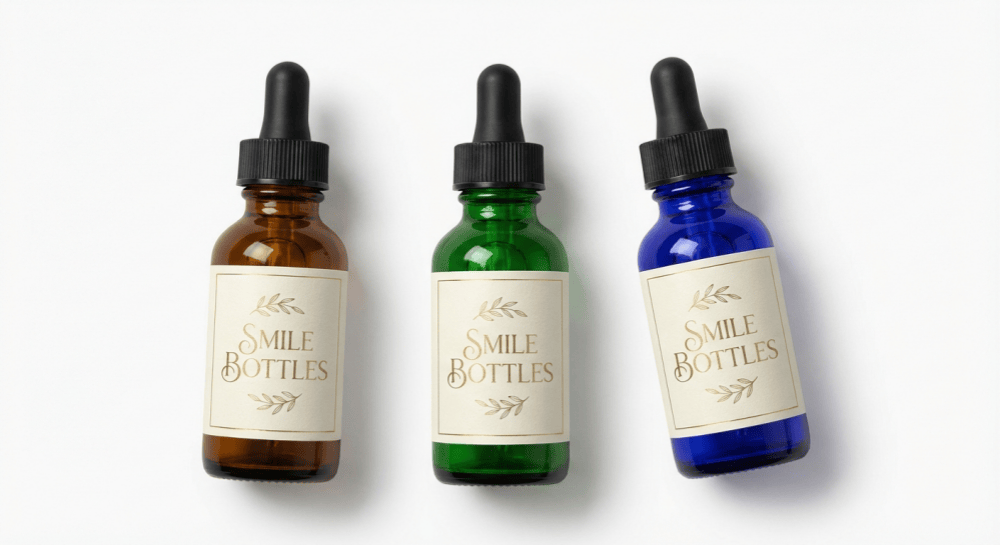
Before we analyze the specific dimensions and capacities, let’s define the vessel itself. A dropper bottle is a specific category of glass packaging for cosmetics, chemicals, and medicines designed to dispense liquids in small, precise quantities—usually drop by drop.
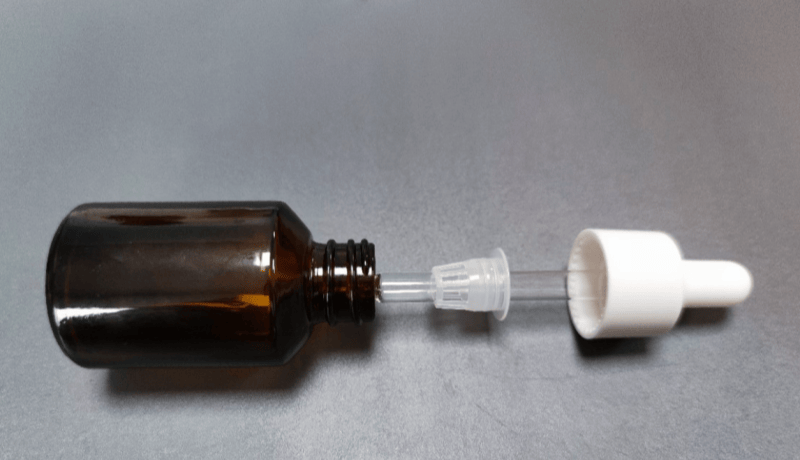
The anatomy of this packaging is simple but highly effective. It consists of the glass container and the closure assembly. The closure typically includes a screw cap (usually plastic or aluminum), a rubber bulb (often called a teat), and a pipette (the glass or plastic tube). This mechanism is vital for products where dosage control is paramount, such as a bottle eye dropper for medication or a medicine bottle with dropper for herbal tinctures.
When you source empty glass dropper bottles from us, you have several choices regarding the material and finish. While we offer custom spraying and coating, the three pillars of the industry are:
Amber glass dropper bottles: These are the gold standard for UV protection. If your formula contains light-sensitive ingredients like Vitamin C or certain essential oils, amber glass is functional, not just aesthetic.
Clear glass dropper bottles: Perfect for colored liquids or oils where you want the product’s natural visual appeal to shine through. It conveys purity and simplicity.
Frosted glass dropper bottles: These offer a premium, soft-touch aesthetic often favored by luxury skincare brands. The matte finish diffuses light and hides fingerprints.
Cobalt Blue and Green: These provide some UV protection and are excellent for specific brand identities, particularly in the pharmaceutical and aromatherapy sectors.
These bottles are versatile. You will see them holding everything from CBD oils, e-liquids, and beard oils to chemical reagents in a laboratory. However, the functionality relies entirely on choosing the right size for the specific application.
Standard Dropper Bottle Sizes vs. Custom Sizes
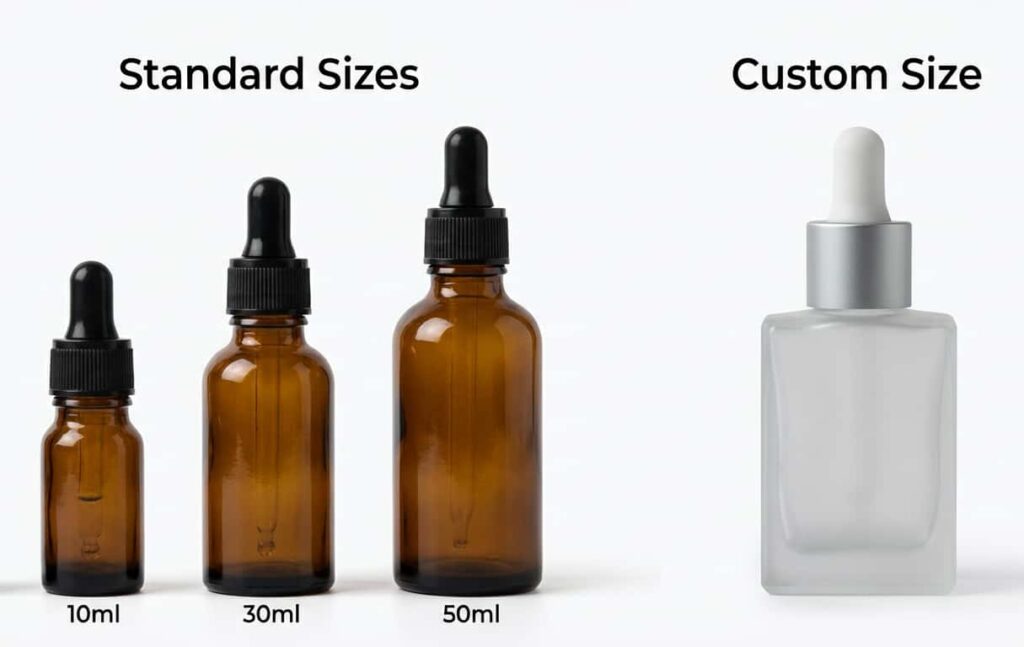
When you browse our catalog or ask for a quote for glass dropper bottles wholesale, you will generally encounter two main categories: Standard and Custom. Understanding the difference in availability and lead time can save you significant time and money.
Common Standard Dropper Bottle Sizes
The glass industry operates on a set of “standard” sizes (often referred to as “public molds”). These are molds that are readily available, meaning shorter lead times and lower Minimum Order Quantities (MOQ).
Here is a breakdown of the most common metric sizes and their approximate imperial equivalents to help you communicate with international markets:
The Tester and Sample Range:
2ml dropper bottle& 3ml dropper bottle: These are tiny vials used for samples, gift with purchase (GWP), or extremely expensive extracts like pure Rose Otto.
5ml dropper bottle: The entry-level retail size, often used for pure essential oils or eye treatments.
The Professional and Travel Range:
10ml dropper bottle: The absolute standard for essential oils and eye drops.
15ml dropper bottle(approx 0.5 oz): Common for eye serums and nail cuticle oils.
20ml dropper bottle: A bridge size, popular in European markets for serums.
The Retail Standard Range:
30ml dropper bottle(approx. 1 oz glass dropper bottle): The universal size for facial serums. If you are launching a face serum, this is likely the size you need.
50ml dropper bottle(approx 1.7 oz): Used for hair oils, beard oils, and larger treatment sizes.
60ml dropper bottle(approx 2 oz glass dropper bottle): Very popular for e-liquids, vape juice, and hair treatments.
The Bulk and Refill Range:
100ml dropper bottle(approx 4 oz glass dropper bottle): Often sold as a “value size,” refill size, or for body oils.
It is important to visualize these sizes to understand the customer experience. For instance, when you hold a 5 ml bottle in hand, it sits comfortably between your thumb and forefinger—it is small, discreet, and highly portable. In contrast, a 50ml bottle size in hand feels substantial, filling the palm, which signals to the customer that they have purchased a product meant for regular, generous use over a longer period.
Advantages of Standard Sizes
Why should you stick to standard sizes like the 10 ml size or 30ml glass dropper bottle?
Speed to Market: We can produce and ship these faster because the molds are ready to go.
Compatibility: Finding a closure for a standard 10 ml bottle size is incredibly easy because neck finishes (like DIN18 or 18/410) are standardized across the industry.
Cost Efficiency: As a glass bottle factory, running standard molds is more efficient, lowering your unit cost.
Secondary Packaging: Buying stock boxes or tubes is easier for a standard 1 oz glass dropper bottle than for an odd custom shape.
Custom Dropper Bottle Sizes and Shapes
Sometimes, standard just isn’t enough. You might want a 15ml glass dropper bottle, but in a square shape to match your logo, or a 5 ml size that is taller and thinner than the usual Boston Round shape.
Customization allows for unique branding. If you need a specific volume, like a 25ml bottle to match a specific 25-day treatment course, Smilebottles can create custom molds. We can adjust the 10ml bottle dimensions to be shorter and wider for better stability, or alter the neck to fit a custom applicator. While this involves mold fees and higher MOQs, it gives your brand a unique silhouette on the retail shelf that competitors cannot copy.
Dropper Bottle Sizes by Industry and Application
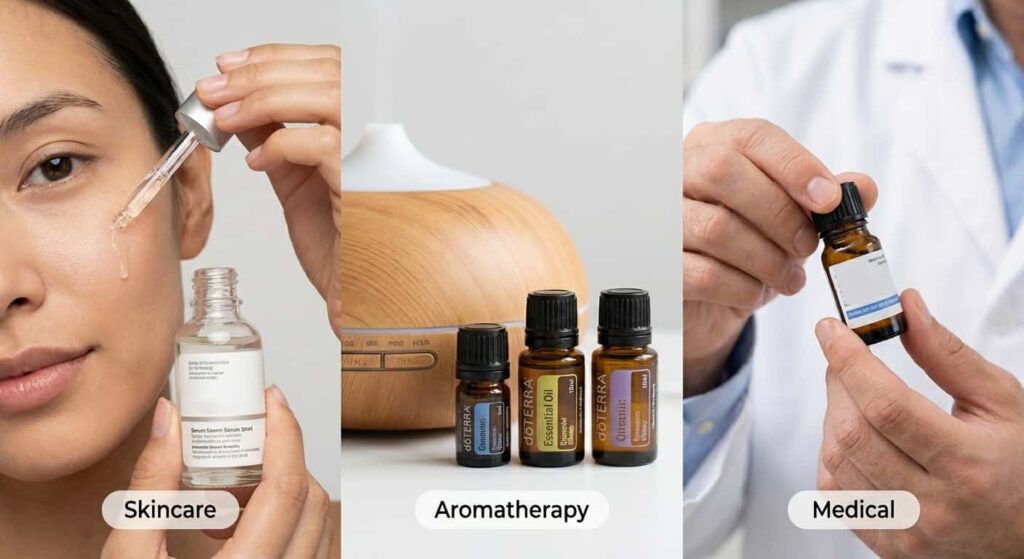
The industry you operate in dictates the volume you need. A customer buying a dropper medicine bottle expects a different volume and dosing mechanism than someone buying a luxury beard oil.
Skincare and Cosmetics
In the beauty world, glass packaging for cosmetics is dominated by the 30ml glass dropper bottle. This is the industry standard for facial serums, retinol treatments, and hyaluronic acid. Why? Because a standard usage rate of 1ml per day means the bottle lasts exactly one month, fitting perfectly into a subscription model or monthly purchasing habit.
However, trends are shifting. High-potency spot treatments (like salicylic acid for acne) often use a 15ml glass dropper bottle or even a 10ml glass dropper bottle. Conversely, body oils, makeup removers, and hair treatments are shifting toward 50ml or 100ml dropper bottles to offer a better value perception.
Essential Oils and Aromatherapy
If you are selling essential oils, you are likely considering the 5ml glass dropper bottle, the 10ml glass dropper bottle, and the 15ml dropper bottle.
Essential oils are extremely potent. A customer rarely needs more than a few drops in a diffuser. A 5ml bottle size is perfect for expensive oils, while the 10ml dropper bottle is the standard for Lavender, Peppermint, or Tea Tree. It is rare to see pure essential oils in a large dropper bottle unless it is intended for professional massage therapists who buy in bulk.
Pharmaceuticals and Medical Use
Precision and hygiene are key here. A bottle eye dropper is almost exclusively found in a 5 ml or 10 ml size. This is partly due to sterility; smaller bottles are used up faster, reducing the risk of contamination over time.
For oral medications and tinctures, you might see a 30ml bottle size for medication. In this sector, the dropper measurement markings on the pipette are just as important as the bottle size itself. You must ensure the pipette is calibrated correctly to the bottle size.
CBD, Tinctures, and Herbal Extracts
The CBD market has embraced the 30ml glass dropper bottle (1 oz) as its primary Stock Keeping Unit (SKU). It provides a good balance of shelf presence and portability. However, for higher concentrations or “extra strength” versions, brands sometimes downsize to a 15ml bottle size in hand to make the product look more concentrated and premium.
E-liquids, Fragrances, and Other Applications
Perfume oils and attars are highly concentrated fragrances. Here, the small bottles with dropper caps reign supreme. You will often see a 3ml dropper bottle or a 6ml dropper bottle (often called a dram) in this niche.
For vape juice and e-liquids, the 60ml dropper bottle is the king, offering enough liquid for frequent refilling while still being portable. For DIY hobbyists mixing their own paints or dyes, a mix of sizes from 10ml dropper bottles to 50ml dropper bottles is common.
How Dropper Bottle Size Impacts Eco-Friendly Packaging
Sustainability is no longer a trend; it is a requirement. Your choice of dropper bottle size plays a huge role in your brand’s environmental footprint.
Material Usage and Resource Efficiency
Opting for a larger size can actually be more eco-friendly. For example, selling one 50ml glass dropper bottle uses less glass, less rubber, and less plastic (for the cap) than selling five separate units of a 10ml glass dropper bottle. If your product is used daily, encouraging customers to buy the large dropper bottle reduces the total packaging waste entering the landfill.
Shipping, Storage, and Carbon Footprint
The physical 10ml bottle dimensions are small, allowing you to fit thousands in a shipping crate. However, glass is heavy. Balancing the weight of glass dropper bottles against the volume of product is a calculation we help our clients make. We can design lightweight glass packaging bottles that maintain strength while reducing the carbon footprint of transport.
Reusability and Refill Systems
A growing trend is the refill model. You sell a high-quality, decorative 30ml glass dropper bottle once, and then sell refills in lighter, aluminum, or larger glass containers (like a 100ml dropper bottle) that the customer uses to refill their smaller daily-use bottle. This justifies investing in premium frosted glass dropper bottles or custom colors, as the customer keeps the bottle for years.
Choosing Sizes for Sustainable Brand Positioning
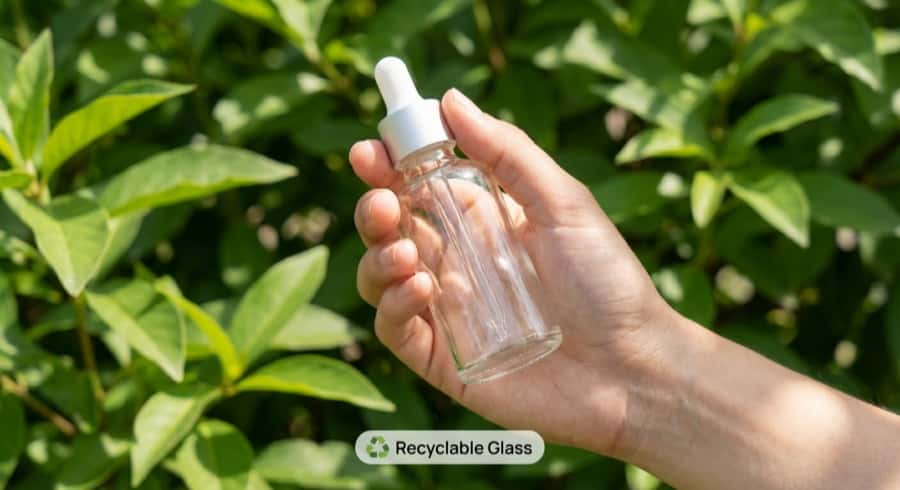
When you choose wholesale glass dropper bottles from Smilebottles, you are choosing recyclable materials. Glass is infinitely recyclable. By selecting the right size to minimize product spoilage and waste, you align your brand with eco-conscious values.
Key Factors to Consider When Choosing Dropper Bottle Size
You have the product formula, and you have the marketing vision. Now, which size do you pick? Here are the factors you must weigh.
Product Formula and Viscosity
Thick liquids (like castor oil or honey-based serums) behave differently than thin liquids (like water-based toners). A thick liquid might require a wider pipette tip. Furthermore, if the product is very thick, a small bottle dropper might be frustrating to use if the pipette doesn’t have enough suction power.
Usage Frequency and Shelf Life
This is a critical calculation regarding product stability.
Oxidation:If your formula oxidizes quickly (like Vitamin C), do not put it in a 50ml dropper bottle. By the time the customer gets halfway through, the product may have turned brown and spoiled. A 10ml glass dropper bottle or 20ml dropper bottle ensures the product is used up while it is still fresh and effective.
Daily Dosage:If the dose is 1ml/day, a 30ml bottle size for medication lasts exactly 30 days. If the dose is 5 drops a day, a 5ml dropper bottle might last a month.
Target Market and Price Point
Size equals perceived value in the consumer’s mind. A 5ml bottle size sold for $100 implies a miracle cure, a rare ingredient, or extreme potency. The same price for a 4 oz glass dropper bottle implies a commodity or a bulk buy.
Travel/Trial: Use the 5 ml size or 10 ml size as low-barrier-to-entry samples to get customers to try your brand.
Professional: Massage therapists and spas prefer the 100ml dropper bottle.
Luxury: A heavy-bottomed 30ml glass dropper bottle feels expensive in the hand and justifies a higher price tag.
Branding, Design, and Label Area
You need space to tell your story and meet legal requirements.
How big is a 5 ml bottle? It is very small. The label area is tiny. You might struggle to fit your logo, ingredients, and barcode on a 5ml bottle size in hand.
How big is a 20ml bottle? It offers significantly more vertical height for branding compared to the squat 15ml sizes.
10 ml bottle dimensionsusually allow for a wrap-around label, but font sizes must be readable.
Regulatory and Industry Requirements
If you are selling a medicine bottle with dropper, regulations might dictate the font size of warning labels or child-safety information. This effectively sets a minimum bottle size for you. You cannot legally sell a product if the required warnings don’t fit on the label of a small bottle dropper.
Logistics, MOQ, and Cost
Buying glass dropper bottles wholesale is cheaper per unit for smaller bottles, but the caps often cost the same regardless of bottle size.
MOQ: We might have a lower MOQ for a standard 30ml glass dropper bottle than for a specialized 60ml dropper bottle.
Shipping: Shipping empty glass dropper bottles involves volume and weight. Smaller bottles pack tighter, saving on freight.
Understanding Capacity: The Math of Drops and Milliliters
One of the most common questions we get from brands regarding labeling and consumer instructions is about dosage. Your customers will ask: “How long will this last?” or “How many drops do I take?”
Here is the technical breakdown you need to know for your dropper packaging instructions.
The Dropper and the Milliliter
First, how much is a ml in a dropper? A standard full squeeze of a rubber bulb typically draws up between 0.6ml and 1.0ml of liquid, depending on the pipette length and bulb size. However, generally, 1 ml in a dropper is considered a full dose.
What does 1 ml look like in a dropper? It usually fills the glass pipette about halfway to three-quarters full. Many of our pipettes come with graduated printing (0.25ml, 0.5ml, 1.0ml), so users don’t have to guess how many milliliters in an eyedropper they are taking.
Questions often arise such as “how many ml in eye dropper?” or “how many ml are in a dropper?” The safe answer for a standard 18mm neck assembly is “roughly 1ml per full squeeze.” If you need precise dropper measurement, we recommend our graduated pipettes.
How Many Drops in a Bottle?
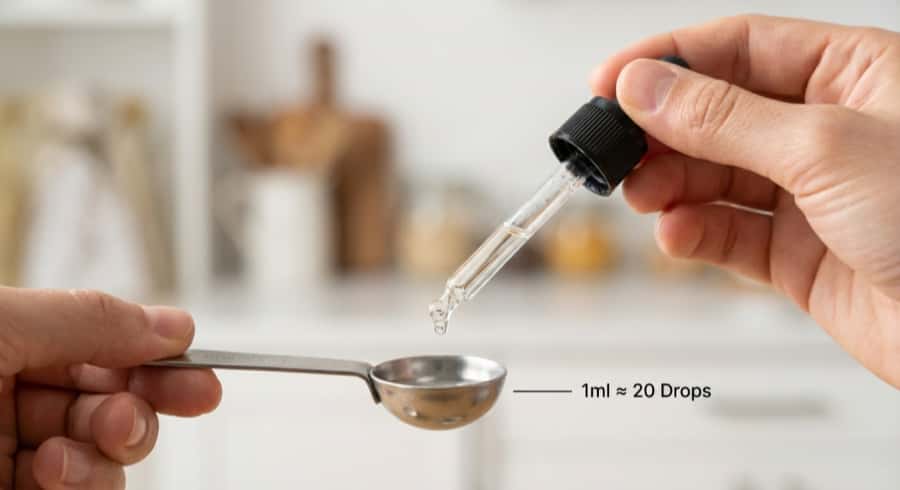
This depends on the viscosity of the liquid and the diameter of the dropper tip, but the industry rule of thumb is that 1ml of water-like liquid equals approximately 20 drops.
Let’s do the math for your labels:
For a 5ml dropper bottle:
How many drops in 5 ml? Approx. 100 drops.
How many drops are in a 5ml bottle if it’s an oil? Oils are thicker, so drops are bigger. It might be closer to 80-90 drops.
How big is a 5ml bottle? It holds roughly 1 teaspoon of liquid.
For a 10ml dropper bottle:
How many drops in 10 ml? Approx. 200 drops.
How many drops are in a 10 ml bottle allows for about 6-8 weeks of use if the dosage is 3-4 drops daily.
How big is a 10ml bottle? It is roughly the size of a standard tube of mascara or a lighter, making it pocket-friendly.
For a 15ml dropper bottle:
15ml bottle size in hand holds roughly 300 drops.
For a 20ml dropper bottle:
Holds approx. 400 drops.
For a 30ml glass dropper bottle:
Holds approx. 600 drops. This is why it is the standard for monthly supplies.
Why Smilebottles Is Your Ideal Dropper Bottle Partner
Choosing a dropper bottle supplier is as important as choosing the bottle itself. You need a partner who understands manufacturing, design, and logistics.
Wide Range of Standard Glass Dropper Bottle Sizes
We stock the full spectrum. Whether you need a 2ml dropper bottle for a sample campaign or a 100ml dropper bottle for a body oil launch, we have the molds ready. We offer amber glass dropper bottles for protection, clear glass dropper bottles for visibility, and frosted glass dropper bottles for elegance. We ensure that the pipette length is perfectly matched to the bottle height to maximize product retrieval.
Custom Design and Branding Support
If you want to know how big a 10ml bottle is if we change the shape to a square or a triangle, our design team can help. We provide custom decoration services, including silk screen printing, hot stamping (gold/silver), spraying, and labeling. We can turn a standard glass packaging manufacturer item into a piece of art that stands out on Instagram.
Quality, Safety, and Sustainability
We are more than just a glass bottle factory; we are quality assurance experts. Our dropper bottle packaging meets food and pharmaceutical grade standards. We ensure the pipette fits the bottle neck perfectly to prevent leakage—a common issue with low-quality suppliers. We use high-quality glass that is durable and less prone to breakage during shipping.
Global Supply and Service
We supply wholesale glass dropper bottles to brands globally. We understand the logistics of shipping heavy glass and offer competitive shipping rates. Whether you are a startup buying one pallet or a multinational corporation needing container loads, Smilebottles supports you with OEM/ODM services, fast sampling, and professional advice.

FAQ About Dropper Bottle Sizes
Q1: What are the most common dropper bottle sizes?
A1: The 5ml glass dropper bottle, 10ml glass dropper bottle, 15ml dropper bottle, 30ml glass dropper bottle, and 50ml dropper bottle are the industry staples.
Q2: How do I choose the right dropper bottle size for my product?
A2: Consider usage rate. If it’s a daily serum, go for 30ml. If it’s a potent eye treatment, a 10 ml size or 15ml bottle size in hand is better.
Q3: Can I get custom dropper bottle sizes with my own design?
A3: Yes! As a factory, we can create custom molds. If you want a 20ml dropper bottle in a unique star shape, we can do it.
Q4: What is the difference between ml and oz in dropper bottles?
A4: 30ml is roughly 1 oz. 15ml is roughly 0.5 oz. 60ml is roughly 2 oz. 100ml is roughly 3.4 oz.
Q5: Which size is best for samples and testers?
A5: The 2ml dropper bottle and 3ml dropper bottle are ideal. A 5 ml size is also great for deluxe samples.
Q6: Are all droppers compatible with all bottle sizes?
A6: No. The collar size (e.g., 18/410 or 20/400) must match the bottle neck, and the glass pipette length must match the bottle height. A pipette designed for a 30ml glass dropper bottle will be too long for a 10ml bottle.
Q7: Do bottle size and color affect product shelf life?
A7: Yes. Amber glass dropper bottles protect against UV light better than clear ones. Smaller bottles reduce the headspace (air) as the product is used, which can help reduce oxidation compared to using a very large dropper bottle for a small amount of liquid.
Q8: How many drops in 1 ml?
A8: Approximately 20 drops of a water-thin liquid.
Q9: What is the minimum order quantity (MOQ) for custom sizes at Smilebottles?
A9: For standard empty glass dropper bottles in stock, MOQs are low. For custom glass dropper bottles wholesale, please contact our sales team for specific details based on your design complexity.
Final Thoughts
Selecting the right size is a balancing act between function, brand image, cost, and sustainability. Whether you settle on the petite 5ml bottle size for an exclusive perfume oil or a robust 100ml dropper bottle for a massage blend, the quality of the glass matters. We invite you to reach out to Smilebottles. Let our team guide you through the options. We can send you samples so you can see exactly how big is a 5 ml bottle or feel the weight of a 50ml bottle size in hand before you commit to a bulk order. We are your trusted dropper bottle supplier.