
Table of Contents
ToggleAuthor: SmileBottles Editorial Team
Estimated Reading Time: About 16 Minutes
For B2B buyers, your choice of mason jar volume directly impacts your product margins, shipping efficiency, production line speed, and ultimately, the customer experience. Choosing a jar based solely on appearance is a common mistake that can lead to blown packaging budgets, excessive freight costs, and inefficient pallet loading. Whether you are wondering how big is a mason jar for a new line of jams, or you need to compare 16 oz vs 32 oz mason jars for wholesale beverage distribution, this guide will serve as your ultimate sourcing handbook. By the time you finish reading, you will understand how to evaluate different sizes of mason jars, match your product to the ideal volume, and source your packaging in bulk efficiently and cost-effectively.
What Is a Mason Jar? Key Features Buyers Should Know
Before diving into a comprehensive mason jar size guide, it is essential to establish exactly what you are purchasing. The basic mason jar definition refers to a molded glass jar originally used in home canning to preserve food. Today, they are utilized across dozens of commercial industries.
If you are evaluating exactly what is a mason jar from a manufacturing standpoint, you must understand its core anatomical features. These jars are constructed from durable, thick glass capable of withstanding high temperatures (crucial for hot-fill processes and pasteurization). You will also find that true food grade glass jars are non-porous, meaning they will not absorb chemicals, odors, or flavors, keeping your product pure.
Mason Jar Structure Explained
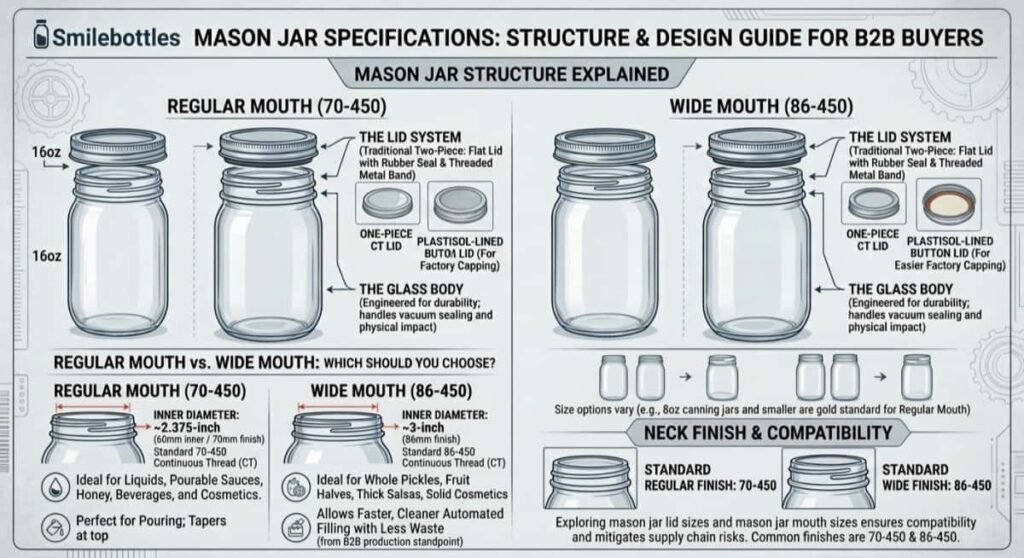
When looking at mason jar specifications, you will notice three main components:
The Glass Body: Engineered for durability, featuring straight or slightly tapered sides. The thickness of the glass directly correlates to its ability to handle vacuum sealing and physical impact during transit.
The Neck Finish: The threaded area at the top of the jar where the lid secures. Understanding your mason jar thread size is vital when sourcing aftermarket lids or custom closures.
The Lid System: Traditionally a two-piece system (a flat lid with a rubber seal and a threaded metal band), though commercial buyers often opt for one-piece continuous thread (CT) lids or plastisol-lined button lids for easier factory capping.
Regular Mouth vs. Wide Mouth: Which Should You Choose?
One of the most frequent questions from procurement teams involves the choice of opening size. When evaluating wide mouth mason jars vs regular, your decision should be based on your filling equipment and the end-user’s experience.
Regular Mouth Jars(70-450): Typically featuring a 2.375-inch (60mm or 70mm finish) inner diameter. These are ideal for liquids, pourable sauces, honey, beverages, and cosmetics. They taper at the top, which can sometimes slow down automated filling lines for thick products but is perfect for pouring. This is the industry gold standard for most 8 oz canning jars and smaller containers. The “70” refers to the diameter in millimeters, and “450” refers to the continuous thread (CT) style.
Wide Mouth Jars(86-450): Typically featuring a 3-inch (86mm finish) inner diameter. If you are packing whole pickles, large fruit halves, thick salsas, or solid cosmetics like bath salts, you need the extra clearance. From a B2B production standpoint, wide mouth jars often allow for faster, cleaner automated filling with less product waste. Understanding the dimensions of a wide mouth mason jar is critical when setting up your factory’s filling nozzles.
Neck Finish & Compatibility
Your choice of jar will dictate your choice of lid. Exploring mason jar lid sizes and mason jar mouth sizes ensures your packaging components align perfectly. The most common commercial finishes are the 70mm (for regular mouth) and the 86mm (for wide mouth). By standardizing your packaging around these standard sizes, you ensure that you can always find compatible lids, which is crucial for mitigating supply chain risks.
Mason Jar Size Chart: Complete Volume Guide (1 oz to 1 Gallon)
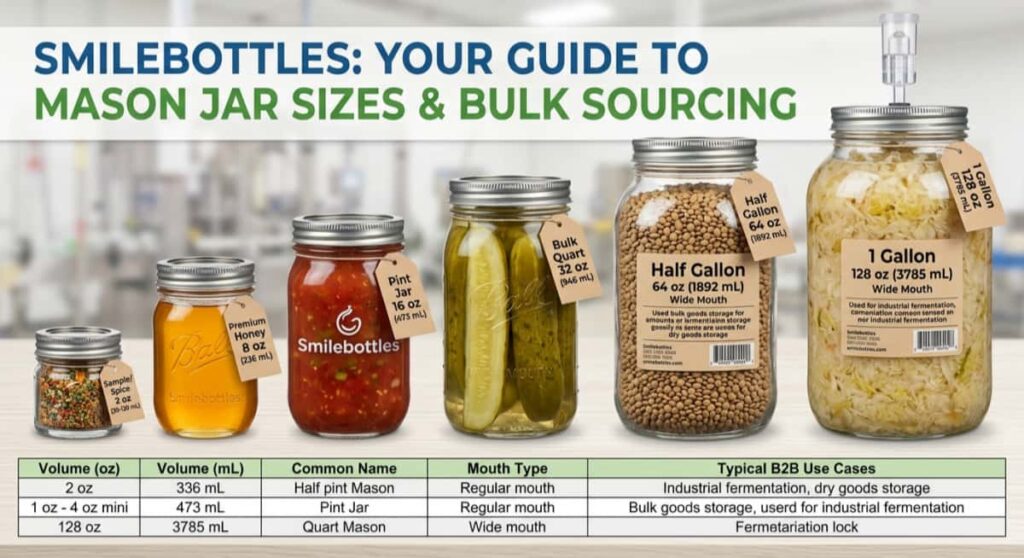
To help you visualize your options, we have compiled a comprehensive mason jar size chart. This chart covers the entire spectrum of standard canning jar sizes, providing a quick reference for procurement teams looking to match volume to industry applications.
|
Volume (oz) |
Volume (mL) |
Common Name |
Mouth Type |
Typical B2B Use Cases |
|
1 oz – 4 oz |
30 – 120 mL |
mini mason jars / Quarter Pint |
Regular |
Cosmetic creams, spice blends, sample sizes, hotel amenities. |
|
8 oz |
236 mL |
half pint mason jars |
Regular / Wide |
Premium jams, jellies, honey, mustard, small candles, retail dips. |
|
16 oz |
473 mL |
pint mason jars |
Regular / Wide |
Beverages, salsas, pickles, meal prep, standard candles, pasta sauces. |
|
32 oz |
946 mL |
quart mason jars |
Regular / Wide |
Bulk food service sauces, large pickle spears, broths, commercial storage. |
|
64 oz |
1892 mL |
half gallon mason jars |
Wide |
Industrial dry goods, fermentation, large-scale juices, bar syrups. |
|
128 oz |
3785 mL |
1 gallon mason jar |
Wide |
Niche industrial storage, massive fermentation batches, bulk dispensing. |
When reviewing this table, keep in mind that the mason jar capacity reflects the fluid volume of the jar filled to the brim. If you require a specific headspace for vacuum sealing or freezing, you will need to account for that when finalizing your mason jar measurements.
Small Mason Jars (1 oz – 4 oz): Sampling & Premium Packaging
If you are targeting the premium retail space or looking to drive trial for a new product, small mason jars are an incredibly effective tool. These jars, ranging from 1 to 4 ounces, are highly sought after by cosmetic companies packaging face creams, lip scrubs, and solid perfumes.
For food manufacturers, these sizes are perfect for high-value items like saffron, artisanal sea salts, and premium spice blends. Sourcing 2 oz glass jars wholesale is also a brilliant B2B strategy for “trial-size marketing.” Allowing customers to purchase a small, low-risk version of your product often leads to full-size conversions. Furthermore, these tiny jars are highly popular in the wedding favor and corporate gifting industries. Because they are lightweight, shipping costs remain relatively low, making them a high-margin packaging choice.
Medium Jars (8 oz): Versatile & Cost-Effective
The 8 oz jar strikes a perfect balance between cost, perceived consumer value, and shelf presence. When you order 8 oz mason jars bulk, you are securing one of the most versatile containers on the market. These are the industry standard for artisan jams, preserves, craft honey, and high-end mustards.
Beyond food, 8 oz mason jars are incredibly popular in the home fragrance market. Candle makers love this size because it offers a respectable burn time while remaining affordable for consumers to purchase multiple scents. From a logistics standpoint, 8 oz jars pack efficiently into standard master cartons, allowing you to maximize pallet space and reduce your per-unit freight costs.
Standard Jars (16 oz): Best-Selling All-Purpose Size
If there is a king of the glass packaging world, it is the 16 oz jar. The standard mason jar size is recognized globally and trusted by consumers. If you are unsure exactly what size mason jars to launch your new brand with, 16 oz is usually the safest and most profitable starting point.
Because they are produced in such massive quantities, sourcing 16 oz mason jars wholesale usually grants you the lowest unit cost in bulk compared to more niche sizes. The 16 oz jar dimensions (typically around 5.2 inches tall and 3.2 inches wide) provide ample surface area for front and back label application, making them a marketer’s dream.
16 oz mason jars are the go-to choice for ready-to-drink beverages, cold-brew coffees, craft salsas, pickled vegetables, and pasta sauces. They feel substantial in the hand, signaling quality and value to the end consumer.
Large Jars (32 oz): Bulk Storage & Food Service
Stepping up in size, we enter the commercial and family-size territory. If you are supplying restaurants, cafes, or big-box wholesale clubs, you will need to consider 32 oz mason jars. These containers hold a full quart and are ideal for bulk food packaging, large-batch marinades, food service pickles, and dry goods like oats and coffee beans.
When sourcing bulk quart canning jars, logistics become a primary concern. The large mason jar size inherently means a heavier empty container. Glass weight adds up quickly on a pallet, which will increase your shipping costs. You must ensure that your pricing model accounts for the freight of shipping heavy, empty glass to your facility, and heavy, filled glass to your distributors. Despite the higher freight, the unit economics for food service customers make 32 oz jars highly profitable.
Extra-Large Jars (64 oz – 1 Gallon): Industrial & Specialty Use
At the top of the spectrum are the industrial giants: 64 oz and 128 oz jars. Sourcing large glass jars bulk at these sizes caters to a very specific, high-value niche segment. You will primarily see these used for commercial fermentation, large-scale restaurant ingredient storage, and specialty bulk retail displays.
While the demand for a 1 gallon mason jar is lower than a 16 oz jar, the profit margin per unit is significantly higher. If your business caters to commercial kitchens or zero-waste refill stores, offering your product in these massive vessels can serve as a massive competitive differentiator.
How to Choose the Right Mason Jar Size for Your Business
Now that you have a firm grasp on the mason jar sizes in oz and their general applications, how do you make the final purchasing decision? Answering the question of exactly what size are mason jars best suited for your specific operation requires looking closely at five key areas of your business model.
Based on Product Type
The physical characteristics of your product should be the first filter in your decision-making process. Are you packaging a liquid, a thick paste, or a solid?
Liquids & Beverages: Stick to regular mouth 16 oz jars. The tapered neck prevents splashing when pouring and drinking.
Thick Foods & Solids: Jams, peanut butters, pickles, and cosmetic creams require wide-mouth jars. Your customers will become frustrated if they cannot fit a spoon or their fingers into the bottom of the jar.
Understanding different mason jar uses guarantees you provide a frustration-free user experience, which leads to repeat purchases.
Based on Target Market
Your audience dictates the volume. If you are selling to high-end boutiques or specialty health food stores, smaller jars (4 oz to 8 oz) position your product as a premium, artisanal good. Conversely, if your target market is wholesale clubs (like Costco or Sam’s Club) or large families, you must explore large mason jars. A budget-conscious consumer is looking for the value provided by 32 oz or 64 oz volumes.
Based on Packaging & Logistics
In the B2B world, packaging decisions are logistics decisions. When you review your mason jar dimensions, you are actually calculating pallet efficiency. How many jars fit into a master carton? How many cartons fit on a standard 48″ x 40″ wooden pallet?
Weight is another crucial factor. Glass is heavy. A pallet of empty 32 oz jars weighs significantly more than a pallet of 8 oz jars, yet holds fewer individual units. This means the freight cost per unit is higher for larger jars. You must work closely with your glass jar supplier to optimize your carton sizes and pallet wrap to minimize breakage and maximize the amount of glass you can move per truckload.
Based on Production & Filling Process
Your factory floor operations cannot be ignored. If your filling process is entirely manual, you have the flexibility to use almost any jar size. However, if you utilize automated filling lines, cappers, and label applicators, your jar choice is restricted by your machine tolerances. Wide mouth jars generally allow for faster automated filling lines because the target area for the fill nozzle is larger, reducing spills and line stoppages. Consult your production manager about the exact mason jar specifications your current machinery can handle before signing a purchase order.
Based on Branding & Customization Needs
The size and shape of the jar dictate your branding real estate. Standard jars offer straight cylindrical sides perfect for easy machine labeling. Small jars, however, may have tight curves that cause standard paper labels to wrinkle, requiring more expensive shrink sleeves or flexible label materials.
If you are looking to build a truly unique brand identity, you may also want to explore custom mason jars. Working with a capable manufacturer allows you to emboss your company logo directly into the glass, customize the color of the lids, or even tweak the shape of the jar to stand out on a crowded retail shelf.
Bulk Sourcing Guide: How to Buy Mason Jars Wholesale
For B2B buyers, understanding sizes is only half the battle. The other half is navigating the complexities of international sourcing and supply chain management. When you transition from buying a few dozen jars from a local distributor to purchasing wholesale mason jars by the container load directly from a manufacturer, the rules of the game change entirely. Here is your guide to sourcing bulk mason jars successfully.
MOQ (Minimum Order Quantity) Explained
The first hurdle you will encounter is the wholesale minimum order quantity (MOQ). Manufacturers cannot afford to spin up their massive glass furnaces and molds for small runs. For standard sizes like 16 oz or 8 oz jars, MOQs typically start around 10,000 to 20,000 units. If you require a custom mold or specialized embossing, the MOQ can jump to 50,000 units or more.
If these numbers seem daunting, do not panic. MOQs are often negotiable, especially if you commit to a long-term purchasing contract, or if you select an off-the-shelf design that the factory is already running for other clients.
Pricing Factors in Bulk Orders
When reviewing quotes for mason jar sizes, you will notice that pricing fluctuates based on several variables.
Raw Material Costs: The cost of silica sand, soda ash, and limestone.
Glass Weight and Thickness: A heavier jar uses more material and costs more to produce and ship.
Volume: The larger the jar, the higher the unit cost.
Customization: Custom molds, frosted glass finishes, or printed lids will increase your unit price.
To get the best price, streamline your packaging. Sticking to standard sizes and universally compatible lids keeps your costs low.
Quality Standards & Certifications
Not all glass is created equal. Because mason jars are primarily used for food and beverages, you must insist on rigorous quality standards. Your supplier must provide documentation proving that they manufacture strictly food grade glass jars. Depending on your market, you may need FDA certifications (for the US) or LFGB compliance (for Europe) to prove the glass and the lid liners are free from heavy metals like lead and cadmium. Furthermore, ask about their thermal shock resistance testing if you plan on hot-filling your products.
Packaging & Shipping Considerations
How your empty jars are shipped is just as important as the jars themselves. You generally have two options:
Carton Packaging: Jars are packed in corrugated cardboard boxes with dividers. This is great if your fulfillment center needs ready-to-use boxes, but it is more expensive and takes up more space.
Pallet Packaging (Bulk Packed): Jars are stacked layer by layer on a wooden pallet, separated by thin cardboard sheets, and heavily shrink-wrapped. This is the most cost-effective and space-efficient method for high-volume factories that have automated depalletizing equipment.
Always factor in a minor breakage rate (usually 1-2%) when shipping glass internationally via ocean freight.
Customization Options for B2B Buyers
To differentiate your product, leverage the customization options offered by top-tier manufacturers. You don’t always need a custom glass mold to stand out. Consider requesting custom-painted lids featuring your brand colors, or screen-printing your logo directly onto the glass body. Even subtle changes can elevate a standard jar into a premium piece of packaging.
Why Choose Smilebottles as Your Mason Jar Manufacturer
When your business scales, you need a partner, not just a vendor. Finding a reliable mason jar manufacturer is the key to uninterrupted supply chains and consistent product quality. This is where Smilebottles excels.
As a premier glass jar supplier, Smilebottles understands the unique pain points of B2B procurement. We offer extensive manufacturing capabilities, ensuring that whether you need 20,000 standard 16 oz jars or 100,000 custom-embossed cosmetic containers, we have the capacity to deliver. Our strict quality control process guarantees that every single jar meets international food-safety standards and thermal shock requirements.
Furthermore, we pride ourselves on our global export experience. We know how to pack shipping containers to maximize space and minimize breakage, saving you thousands of dollars in wasted freight. With competitive factory-direct pricing and an in-house design team ready to support your customization needs, Smilebottles is dedicated to helping your brand succeed on the shelf.
FAQ Frequently Asked Questions About Mason Jar Sizes
Even with a detailed guide, procurement managers often have specific technical questions. Here are the answers to the most common inquiries regarding mason jar volume and specifications.
Q1:Are mason jar lids universal?
A1:Yes and no. Are mason jar lids universal within their specific mouth category? Generally, yes. Any standard 70mm regular mouth lid will fit any regular mouth jar, regardless of whether the jar is 8 oz or 16 oz. Similarly, an 86mm wide mouth lid will fit any wide mouth jar. However, you cannot swap regular lids onto wide mouth jars. Always double-check the exact neck finish code (e.g., 70G450) with your supplier to guarantee a perfect, airtight seal.
Q2:How do I choose between 16 oz and 32 oz jars?
A2:When weighing 16 oz vs 32 oz mason jars, look at your consumer consumption habits. If your product spoils quickly after opening, the 16 oz jar ensures the consumer finishes it while it is still fresh. If you are selling shelf-stable bulk items or targeting food service operations, the 32 oz jar offers better unit economics and requires less frequent purchasing from the buyer.
Q3:What is the volume of a standard mason jar?
A3:When people ask the volume of a mason jar, they are almost always referring to the industry standard pint jar. The capacity is 16 fluid ounces (approximately 473 mL). This is the most versatile and heavily manufactured size worldwide.
Q4:How do I measure a jar’s capacity correctly?
A4:Understanding how big is a mason jar requires knowing the difference between “overflow capacity” and “fill capacity.” The overflow capacity is the absolute maximum amount of liquid the jar can hold if filled to the very brim. The fill capacity accounts for the necessary headspace required for capping, vacuum sealing, or product expansion (like freezing). Always ask your manufacturer for both measurements to ensure your product fits correctly.
Q5:Can I see a mason jar size comparison before ordering?
A5:Absolutely. A reputable supplier should be able to provide a mason jar size comparison chart and, more importantly, physical samples. Never place a bulk order without holding the physical jar, testing your lid fitment, and running it through a trial on your filling line.
Conclusion
Selecting the ideal glass packaging is a strategic business decision that ripples through your entire operation. By taking the time to truly understand what are the sizes of mason jars available, you empower your brand to make cost-effective, market-driven choices.
Packaging is the silent ambassador of your brand. Don’t leave it to chance. If you are ready to streamline your supply chain and source premium glass packaging that perfectly fits your product, it is time to take action. Contact the experts at Smilebottles today to request a quote, order physical samples, and secure the perfect mason jars for your business’s long-term growth.
 English