
Table of Contents
ToggleAuthor: SmileBottles Editorial Team
Estimated Reading Time: About 12Minutes
If you are running a brand in the essential oil, perfume, cosmetics, or skincare industry, you already know that packaging is more than just a container. It is the first physical touchpoint your customer has with your product. Among all the packaging options, glass roller bottles have become a staple. They offer a mess-free, convenient, and elegant way for consumers to apply liquids directly to their skin.
As a trusted manufacturer, Smilebottles has helped countless brands find the perfect fit for their product lines. In this comprehensive guide, we will walk you through everything you need to know about roller bottle sizes, from standard industry options to materials, pricing strategies, and common mistakes to avoid. By the end of this guide, you will know exactly how to choose the right packaging to make your product a success.
Standard Roller Bottle Sizes and Their Uses
When you are planning to purchase a series of products, you need to understand the standard sizes available on the market and what they are typically used for. Let’s break down the most common sizes so you can see where your product might fit.
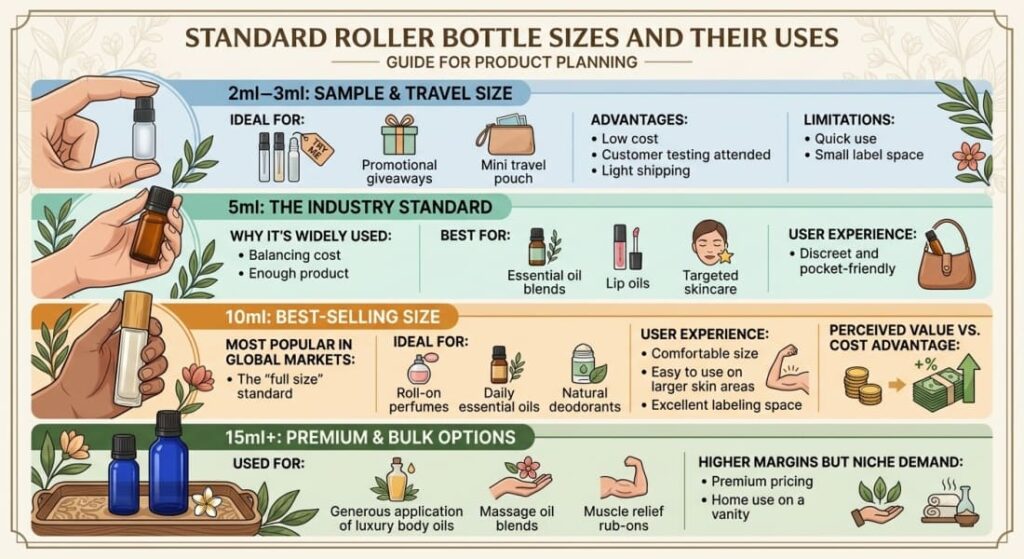
2ml–3ml Roller Bottles (Sample & Travel Size)
The 2ml roller bottle, along with its 3ml counterpart, is the smallest standard size you will find. These tiny bottles are incredibly useful, but they serve a very specific purpose in your business strategy.
Ideal for: Product sampling, promotional giveaways in subscription boxes, and mini travel kits.
Advantages: They are highly cost-effective. If you are launching a new luxury perfume or a highly concentrated essential oil, giving away or selling small samples allows customers to test the waters without spending a lot of money. Because they are lightweight, they cost very little to ship.
Limitations: They are not meant for long-term use. The small capacity means the customer will run out of the product quickly. They also have a very small surface area, which makes branding and labeling a bit of a challenge.
5ml Roller Bottles (The Industry Standard)
The 5ml roller bottle is widely considered the industry standard, especially in the essential oil market. It strikes a fantastic balance between being portable and providing enough product for regular use.
Why it’s widely used: It is small enough to keep costs down but large enough to justify a mid-range retail price.
Best for: Essential oil blends, lip oils, and targeted skincare treatments like acne spot treatments or eye serums.
User Experience: If you imagine a 5ml bottle size in hand, it feels small, discreet, and very pocket-friendly. It is the perfect size for a customer to drop into a purse or a makeup bag without adding bulk.
10ml Roller Bottles (Best-Selling Size)
If you want to know what the most popular size in the global market is, it is the 10ml roller bottle. This size is the absolute favorite for both consumers and brands.
Most popular in global markets: This size is considered the “full size” for most personal fragrance and aromatherapy products.
Ideal for: Roll-on perfumes, daily-use essential oil blends, and natural deodorants. It is also the standard size when you are looking for a 10ml essential oil bottle to sell premium blends.
User Experience: A 10ml bottle size in hand feels substantial. It feels like a real, high-value product rather than a sample. It is comfortable to hold, easy to roll over larger areas of skin (like wrists and the neck), and provides excellent space for beautiful, clear labeling.
Perceived value vs. cost advantage: The manufacturing cost difference between a 5ml and a 10ml bottle is usually quite small. However, the perceived value to the customer is much higher, allowing you to charge a premium price and increase your profit margins.
15ml and Larger Roller Bottles (Premium & Bulk Options)
While less common than the 10ml, the 15ml roller bottle and even larger sizes (like 30ml) have a specific place in the market.
Used for: Luxury body oils, massage oil blends, muscle relief rub-ons, and professional spa use.
Higher margins but niche demand: Because these bottles hold a lot of product, they are typically priced much higher. They are fantastic for products that are meant to be applied generously over larger areas of the body. However, they are less portable, so they are usually kept at home on a vanity or in a bathroom cabinet.
Roller Bottle Size Comparison Chart
To help you visualize these differences quickly, here is a handy comparison chart you can reference when making your purchasing decisions:
|
Size |
Best For |
Pros |
Cons |
|
2ml-3ml |
Samples, Gifts, Travel |
Low cost, great for marketing |
Very limited usage time, hard to label |
|
5ml |
Spot treatments, Travel blends |
Balanced size, very portable |
Might seem small for daily full-body use |
|
10ml |
Perfumes, Daily essential oils |
High perceived value, bestseller |
Slightly higher shipping weight than 5ml |
|
15ml+ |
Body oils, Massage blends |
Premium pricing holds more volume |
Less portable, takes up more shelf space |
Why Roller Bottle Size Matters for Your Product
You might be wondering why spending so much time thinking about the size is necessary. Can’t you just pick one and go with it? As a buyer for your brand, your packaging choices directly impact your product’s success. Here is why the size matters so much.
Application and Usage Frequency
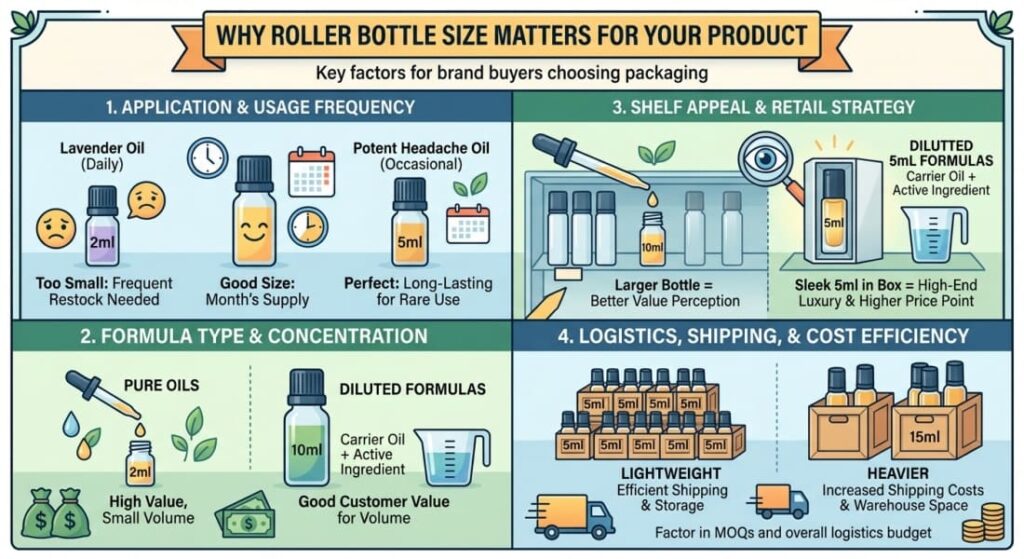
How often will your customer use this product? If you are selling a calming lavender oil meant to be rolled on the wrists every night before bed, a 2ml bottle will run out in a week, leaving the customer frustrated. A 10ml bottle provides enough product for a month or more of daily use. On the other hand, if you are selling a highly potent headache relief oil that is only used occasionally, a 5ml bottle might be the perfect fit. Always think about convenience for your end users.
Formula Type and Concentration
The strength of your liquid formula dictates the size of the bottle. If you are selling pure, undiluted essential oils, you generally want smaller sizes. Pure oils are expensive to produce, and a little goes a long way. Conversely, if you are selling diluted formulas—where the active ingredient is mixed with a carrier oil like jojoba or fractionated coconut oil—you should use larger sizes like 10ml or 15ml so the customer gets enough volume for the price.
Shelf Appeal and Retail Strategy
Packaging is your silent salesperson. When your product is sitting on a retail shelf next to competitors, size plays a huge role in consumer psychology. A larger bottle naturally looks like a better deal. However, a sleek, thick-glass 5ml bottle in a beautiful custom box can communicate high-end luxury. You need to consider the visual presence your product will have and how consumers will perceive its value just by looking at it.
Logistics, Shipping, and Cost Efficiency
As a business owner, you must think about the bottom line. Glass has weight. Shipping 10,000 pieces of 15ml glass bottles will cost significantly more in freight than shipping 10,000 pieces of 5ml bottles. Furthermore, larger bottles require larger boxes, which takes up more space in a warehouse. You also need to factor in the Minimum Order Quantity (MOQ) from your manufacturer and see how the bottle size affects your overall packaging efficiency and logistics budget.
How to Choose the Right Size for Your Product Line
Now that you understand the different sizes and why they matter, how do you actually make the final choice for your brand? Follow these actionable steps to align your packaging with your business goals.
Define Your Formula’s Concentration
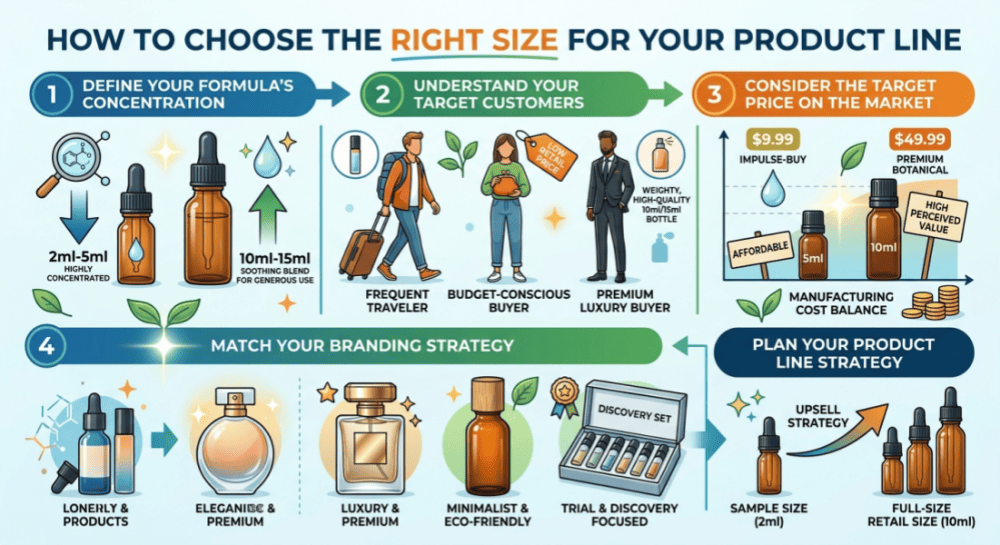
As mentioned earlier, start with the liquid itself. Talk to your formulators. Is the product highly concentrated? Go smaller (2ml to 5ml). Is it a soothing blend meant for generous application? Go larger (10ml to 15ml). Make sure the size matches the functional need of the liquid inside.
Understand Your Target Customers
Who is buying your product? If your target audience consists of frequent travelers or busy professionals who want to freshen up their perfume on an airplane or at the office, portability is key. In this case, 5ml or 10ml is best. If your target buyers are budget-conscious, a smaller size might help you keep the retail price low. If they are premium luxury buyers, they expect a weighty, high-quality 10ml or 15ml bottle.
Consider the Target Price on the Market
Price psychology is a massive factor. If your goal is to sell an impulse-buy product near the checkout counter for $9.99, you cannot afford to put it in a 15ml custom-painted bottle. A 5ml bottle works perfectly here. If you want to sell a premium botanical perfume for $49.99, a 10ml bottle gives the customer the perceived value they demand for that price. Always balance your manufacturing cost with the perceived value.
Match Your Branding Strategy
Your packaging must tell your brand’s story.
Luxury & Premium: Usually leans toward 10ml or 15ml with thick glass, metal caps, and elegant finishes.
Minimalist & Eco-friendly: Might lean toward simple, clear, or amber 10ml bottles with bamboo caps.
Trial & Discovery focused: If your brand relies on customers trying many different scents, offering a “discovery set” of five 2ml bottles is a brilliant strategy.
Plan Your Product Line Strategy
One of the best secrets in retail is that you do not have to choose just one size. You can offer multiple sizes to capture different types of buyers. You can create an upsell strategy. For example, a customer might buy a 2ml sample first. Once they fall in love with the scent, they return to your website to buy the full-size 10ml version. Offering a sample size alongside a retail size is a proven way to increase your overall sales.
Other Factors Beyond the Size (Material & Components)
Choosing the size is only half the battle. The materials you select for your bottles, the roller balls, and the caps will determine the quality and longevity of your product.
Glass Types (Clear, Amber, Frosted)
When looking at the main body of the bottle, you have several choices.
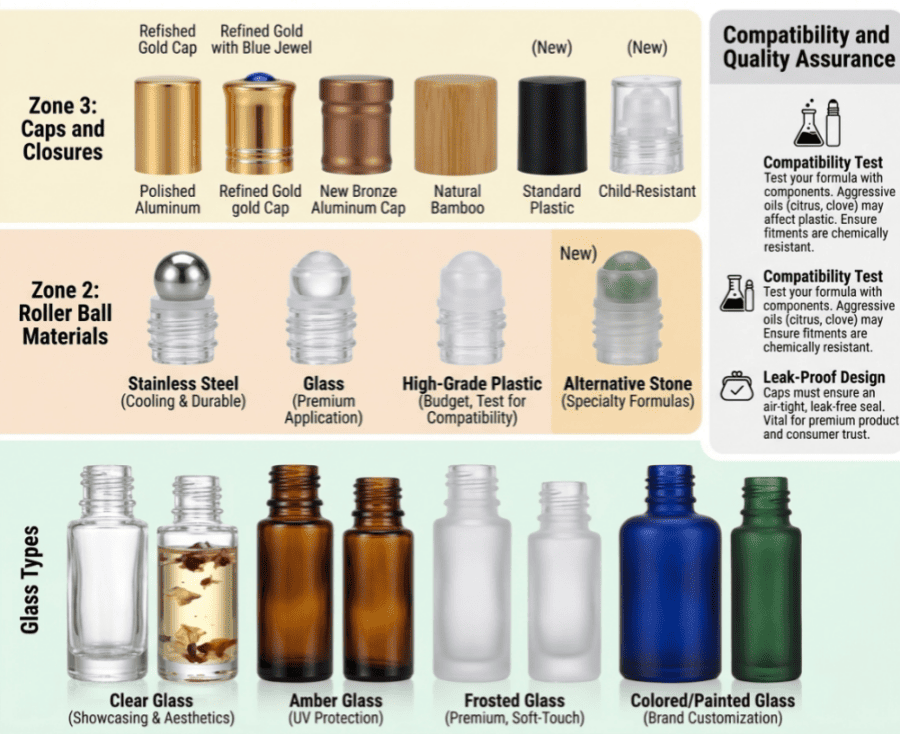
Clear Glass: Beautiful for showcasing the color of your liquid, especially if you have botanical petals floating inside. However, it offers no UV protection.
Amber glass roller bottles: These are the gold standard for essential oils. The dark amber color blocks harmful UV light, preventing delicate natural oils from oxidizing and losing their scent or therapeutic properties.
Frosted Glass: Offers a premium, soft-touch aesthetic that feels very luxurious in the hand.
Colored/Painted Glass: You can customize bottles to match your brand colors perfectly.
Roller Ball Materials
The bottle roller insert—the actual ball that touches the skin—is critical to the user experience.
Stainless Steel: This is highly durable and provides a soothing, cooling effect when rolled onto the skin. It is excellent for under-eye serums or headache oils. It also resists corrosion from strong essential oils.
Glass: A glass roller ball offers a very smooth application and gives a high-end, premium feel. It is chemical-resistant and safe for all formulas.
Plastic: This is the budget option. While it keeps costs down, plastic can sometimes degrade if exposed to highly concentrated, pure essential oils for a long time. It is best used for heavily diluted formulas or inexpensive lip glosses.
Caps and Closures
The cap is the finishing touch. You must ensure that your manufacturer provides a leak-proof design. Nothing ruins a customer’s experience faster than a bottle that leaks expensive oil into their purse. You can choose from standard plastic screw caps, elegant metallic aluminum covers, natural bamboo caps, or even child-resistant caps if your formula requires safety compliance.
Compatibility with Formulations
Never forget to test your specific liquid with the packaging. Some aggressive essential oils (like citrus or clove) can break down cheap plastic fitments over time. Always ensure that the glass, the roller ball, and the plastic housing holding the ball are chemically resistant and fully compatible with your unique oil blends.
Common Mistakes When Choosing Roller Bottle Sizes
Even experienced buyers can make errors when planning a new product line. Here are the most common pitfalls you need to avoid:
Choosing size based only on cost: It is tempting to buy the cheapest 5ml bottle available. But if your customer expects a 10ml size based on your high retail price, you will suffer from bad reviews and a lack of repeat buyers.
Ignoring customer usage habits: Putting a daily-use body oil in a tiny 2ml bottle will annoy your customers. Always design for the end-user’s convenience.
Overlooking shipping weights: Glass is heavy. If you upgrade your whole line from 10ml to 15ml thick glass, your freight costs will spike. Make sure you calculate logistics before placing a massive wholesale order.
Not testing packaging with the formula: Always ask your manufacturer for samples first. Fill them with your liquid, leave them on their side for a week to check for leaks, and test the roller ball to ensure the liquid flows smoothly without getting stuck.
Why Smilebottles is Your Best Choice for Roller Bottles
When you are ready to source your packaging, finding a reliable supplier is just as important as choosing the right bottle. If you are looking for glass roller bottles wholesale, Smilebottles is your ultimate manufacturing partner.
Extensive Manufacturing Experience: We have years of experience producing high-quality glass packaging for global brands. We understand the specific needs of the essential oil, cosmetics, and fragrance industries.
End-to-End Customization: We don’t just sell blank bottles. We offer deep customization options. Whether you need custom PMS color painting, silk-screen printing for your logo, hot stamping, or specialized caps, we can bring your brand’s vision to life.
Strict Quality Control: Leaky bottles can destroy a brand’s reputation. We employ rigorous quality control processes at every stage of production to ensure that every roller ball fits perfectly and every cap seals tightly.
Global Shipping Capability: No matter where your business is located, we have the logistics network to deliver your wholesale orders safely, on time, and cost-effectively.
We know that B2B purchasing requires trust. Our dedicated team is ready to provide you with samples, clear communication, and competitive pricing to help your product line succeed.
FAQ: Frequently Asked Questions About Roller Bottles
As a brand owner, you likely have a few lingering questions. Here are the answers to the most common queries we receive from buyers.
Q1: What is the most popular roller bottle size?
A1: For retail sales in the fragrance and aromatherapy sectors, the 10ml bottle is universally the most popular. It offers the perfect balance of volume, perceived value, and portability.
Q2: Is 10ml better than 5ml?
A2: It depends entirely on your product. A 10ml bottle is “better” if you want to charge a higher retail price and provide enough product for daily use. A 5ml bottle is “better” if you are selling very expensive, highly concentrated formulas, or if you want to create travel-friendly kits.
Q3:Are glass roller bottles better than plastic?
A3: Yes, in almost every scenario. Glass is non-porous, meaning it will not interact chemically with your liquid formula. It also offers a much higher perceived value to the consumer. Furthermore, glass is highly recyclable, appealing to eco-conscious buyers.
Q4: What size is best for essential oils?
A4: For pure, undiluted essential oils, 2ml to 5ml is common. For pre-diluted essential oil blends (mixed with a carrier oil) that are safe to roll directly onto the skin, the 10ml size is the standard choice.
Q5: Can I customize roller bottle sizes?
A5: Yes! While 2ml, 5ml, 10ml, and 15ml are standard, at Smilebottles, we can work with you to create custom molds if your brand requires a highly unique shape or specific capacity. Customization also extends to the color of the glass, the type of roller ball, and the cap design.
Conclusion
Selecting the correct packaging is a strategic business decision that directly affects your brand’s image, customer satisfaction, and profit margins. Whether you choose the sample-friendly 2ml, the highly portable 5ml, the bestselling 10ml, or the luxurious 15ml, your decision should always be based on your formula’s concentration, your target customer’s habits, and your retail pricing strategy.
Always remember to look beyond just the size. Consider the benefits of amber glass for UV protection, the premium feel of stainless steel roller balls, and the importance of leak-proof caps. By avoiding common mistakes like ignoring shipping weights or skipping formula testing, you will set your product up for long-term success.
If you are planning your next product line and are looking for a reliable, high-quality supplier, Smilebottles is here to help. Reach out to our team today to request samples, discuss customization options, and find the perfect glass packaging to elevate your brand.