
Table of Contents
ToggleAuthor: SmileBottles Editorial Team
Estimated Reading Time: About 14Minutes
When you are preparing to launch or scale your condiment brand, choosing the right hot sauce bottle size is one of the most important decisions you will make. Your packaging is the first thing your customers interact with, even before they taste the heat of your recipe. It affects everything from your production line efficiency and shipping costs to your retail shelf presence and ultimate profit margins.
In this comprehensive buying guide, Smilebottles will walk you through everything you need to know to make an informed purchasing decision. From understanding standard sizes and neck finishes to matching your closures and planning your logistics, this guide will help you navigate the sourcing process with confidence.
Understanding the Basic Parts of a Hot Sauce Bottle
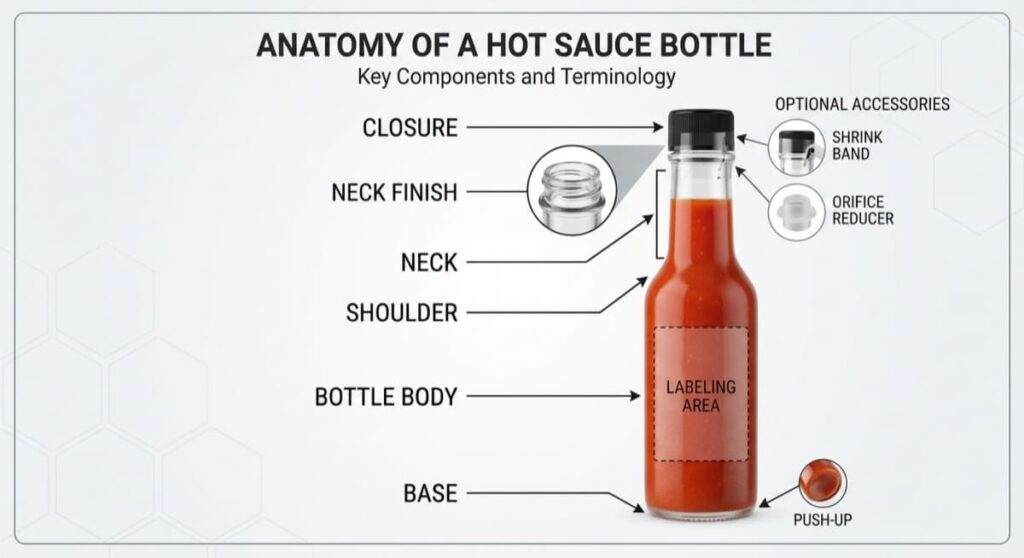
Before you start speaking with suppliers or requesting quotes, it helps to know the exact terminology. Understanding the parts of a glass bottle will ensure you communicate clearly with your manufacturing partner and get exactly what you need for your production line.
Bottle Body
The body is the main container that holds your product. It determines your overall volume and dictates the shape of the bottle. The body is also where you will apply your labels, so its shape directly impacts your branding area.
Neck
The neck is the narrower part that extends from the body to the top opening. A long neck helps control the flow of the sauce, which is especially important for spicy, liquid-based condiments where a customer only wants a few drops at a time.
Neck Finish
The bottle neck finish is the specific design at the very top of the neck, including the threads where the cap twists on and the opening where the sauce pours out. This is a critical measurement because it must perfectly match your chosen cap, dasher insert, or reducer to prevent leaks.
Shoulder
The shoulder is the sloping transition area between the main body and the neck. Depending on the design, a sharp or rounded shoulder can affect how quickly the sauce flows toward the neck when the bottle is tipped upside down.
Base
The base, or the bottom of the bottle, provides stability. A slightly indented base (called a push-up) can add structural strength to the glass, making it more durable during shipping and handling on retail shelves.
Closure
This refers to whatever you use to seal the bottle. There are many different bottle closure types available, ranging from standard continuous thread caps to flip-tops, droppers, and dashers. Your closure dictates how easily the customer can access and dispense your product.
Optional Accessories
To complete your packaging, you might also need accessories like shrink bands for safety seals, orifice reducers to slow down the pouring speed, or custom-printed labels to catch the buyer’s eye.
Standard Hot Sauce Bottle Sizes and Their Business Uses
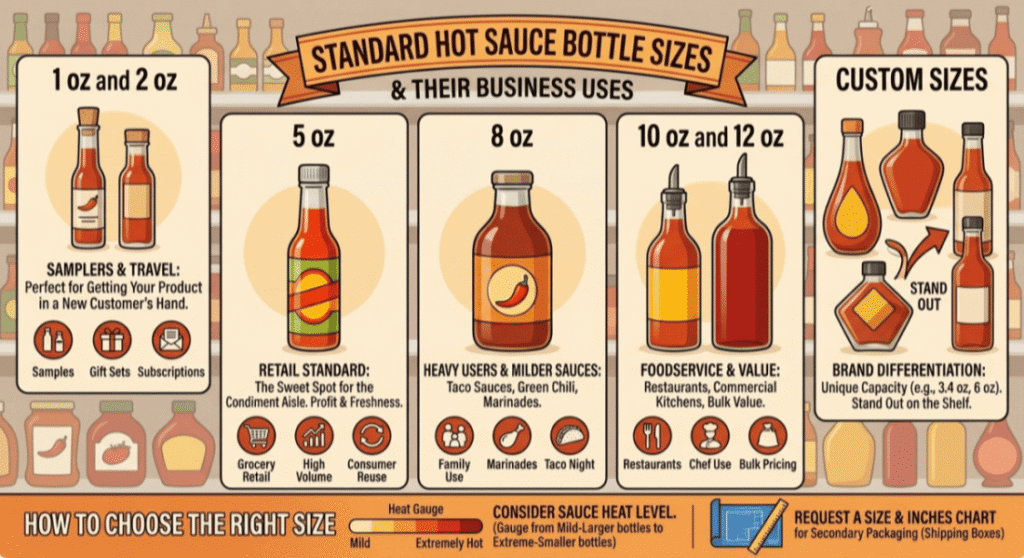
Selecting the capacity of your container depends heavily on your target market, your price point, and how customers use your product. Here is a breakdown of the standard sizes in the industry.
1 oz and 2 oz Hot Sauce Bottles
If you want to offer samples, travel sizes, or promotional items, 1 oz hot sauce bottles are a fantastic choice. They are inexpensive to ship and perfect for getting your product into a new customer’s hands. Similarly, 2 oz hot sauce bottles are widely used for multi-flavor sampler sets, holiday gift boxes, or subscription box inserts.
5 oz Hot Sauce Bottles
When you walk down the condiment aisle of any grocery store, 5 oz hot sauce bottles are what you will see most often. This is the undisputed industry standard for retail. It hits the sweet spot: it holds enough product to justify a profitable retail price, but it is small enough that the consumer will finish it and buy another bottle while the sauce is still fresh.
8 oz Hot Sauce Bottles
For sauces that are less spicy and used more generously—like taco sauces, mild green chili sauces, or cooking marinades—8 oz hot sauce bottles are ideal. This size appeals to families or heavy users who go through your product quickly.
10 oz and 12 oz Hot Sauce Bottles
When you start targeting foodservice businesses, restaurants, or value-oriented retail customers, you will want to look at 10 oz hot sauce bottles and 12 oz hot sauce bottles. These larger formats offer better unit economics for bulk buyers and reduce the frequency of reordering for commercial kitchens.
Custom Bottle Sizes for Brand Differentiation
If standard sizes don’t fit your brand identity, you might consider custom hot sauce bottles. Creating a unique mold with a specific capacity (like 3.4 oz or 6 oz) can help your product stand out from competitors on the shelf, though it requires a higher initial investment in tooling.
How to Choose the Right Bottle Size for Your Product Line
To make the best choice, consider your sauce’s heat level. Extremely hot sauces are used a few drops at a time, making a 5 oz bottle last a long time. Milder sauces need larger bottles. To help you plan your secondary packaging (like shipping boxes), you can request a hot sauce bottle size inches chart from your supplier to get the exact height, diameter, and label panel dimensions for your carton design.
Key Factors to Consider When Choosing a Hot Sauce Bottle for Business
Purchasing packaging for a business requires looking past just the aesthetics. You have to consider how the bottle functions throughout your entire supply chain.
Product Positioning
Are you selling a high-end, limited-batch truffle hot sauce, or a daily-use budget sauce? Premium positioning often calls for heavier glass, unique shapes, and specialized closures, while everyday table sauces benefit from standard, cost-effective packaging.
Sauce Viscosity and Ingredients
Thin, vinegar-based sauces flow quickly and require bottles with narrow necks and flow reducers. Thick, chunky sauces with pepper seeds or fruit puree will get stuck in a narrow neck, meaning you need a bottle with a wider opening.
Filling and Production Requirements
How are you getting your sauce into the bottle? If your recipe requires your sauce to be heated to high temperatures for safe packaging, you must source reliable hot fill glass bottles that can withstand the thermal shock of the filling line without cracking.
Shipping and Logistics
Heavier bottles cost more to ship. You need to calculate the weight of your empty packaging, the filled product, and the cartons. Glass requires proper dividers and sturdy corrugated boxes to minimize breakage during transit.
Branding and Shelf Presence
The shape of your bottle dictates your hot sauce label size. A tall, straight body gives you a large, flat canvas for your artwork, while curved or tapered bottles might require custom-cut labels that can be harder and more expensive to apply automatically.
Cost and Minimum Order Quantity (MOQ)
Standard shapes have lower MOQs and cheaper unit prices. Custom molds require a significant upfront tooling cost and high volume commitments. As a growing business, you must balance your cash flow with your desire for unique branding.
Compliance and Export Requirements
Ensure your packaging materials meet local food safety standards (like FDA regulations in the US). If you plan to export, the materials and closures must maintain the product’s integrity across different climates and altitudes.
Comparing Hot Sauce Bottle Designs: Which Style Fits Your Product Best?
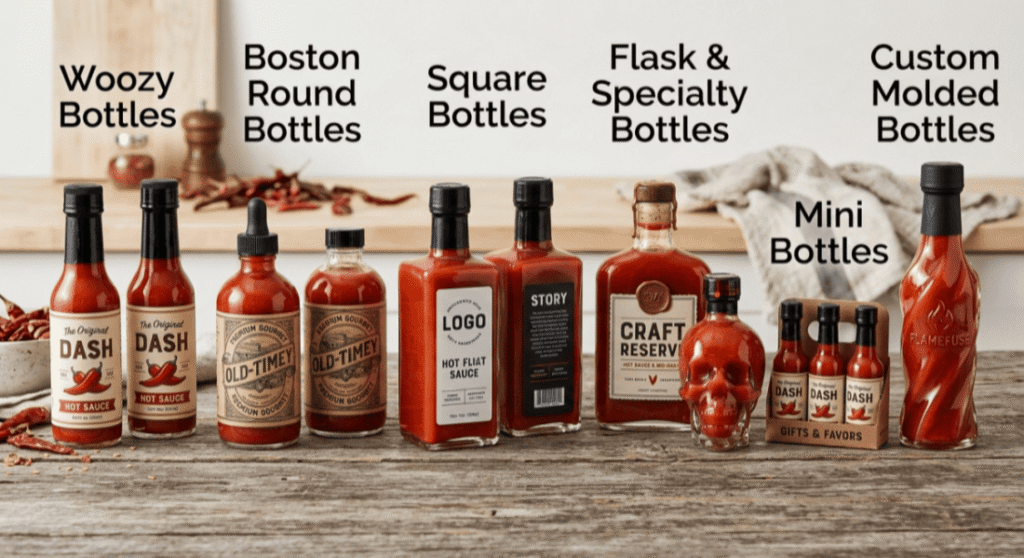
Your hot sauce bottle design plays a massive role in consumer psychology. Let’s look at the most popular shapes on the market.
Woozy Bottles
These are the kings of the hot sauce world. Woozy bottles feature a long, narrow neck and a straight body. They are the classic choice because the long neck naturally slows down the pour, allowing the user to dash the sauce onto their food rather than pouring a heavy stream.
Boston Round Bottles
Boston round bottles have rounded shoulders and a classic, medicinal or vintage look. They are often used for thicker gourmet sauces, BBQ glazes, or marinades. They give off a premium, small-batch vibe that appeals to specialty food shoppers.
Square Bottles
A square bottle is modern and highly efficient for packing. Because they sit flush against one another in a shipping box, they save space. They also offer four distinct flat panels for branding, allowing you to separate your logo, ingredients, and brand story clearly.
Flask or Specialty Bottles
Designed to look like liquor flasks, these bottles are excellent for premium positioning. They command attention on the shelf and are often used for extremely spicy, novelty, or craft hot sauces.
Mini Bottles
As mentioned earlier, mini hot sauce bottles are scaled-down versions of woozy or flask bottles. They are ideal for wedding favors, corporate gifts, and airline meal kits.
Custom Molded Glass Bottles
When you want to be completely unique, investing in custom glass bottles allows you to emboss your brand name directly into the glass or create a shape completely native to your brand (think of the iconic shape of a Coca-Cola bottle, applied to hot sauce).
How Neck Finish and Closure Compatibility Affect Hot Sauce Packaging
You cannot choose a bottle without simultaneously choosing your closure. The two must fit together flawlessly.
What Is a Neck Finish?
A neck finish is indicated by two numbers, such as 24-414 or 28-400. The first number is the diameter of the opening in millimeters. The second number refers to the thread style and depth.
Common Neck Finishes for Hot Sauce Bottles
Standard 5 oz bottles typically use a 24-414 finish. If you have a thicker sauce and need a wider mouth, you might look for bottles that require 28 400 caps. Always confirm the exact finish dimensions with your manufacturer before buying caps from a third party.
Types of Closures Used for Hot Sauce Bottles
You will need to select suitable hot sauce bottle caps. Most brands use plastic or metal continuous thread (screw-on) caps. Depending on your needs, you can also explore flip-top caps or specialized dispensing closures.
Matching the Right Closure to Sauce Viscosity
If your sauce is very runny, you need an orifice reducer—a small plastic insert that snaps into the neck of the bottle, restricting the flow to a few drops at a time (often called a dasher). If your sauce is thick, leave the reducer out so the product can pour freely.
Tamper Evidence and Food Safety Considerations
Commercial buyers and retail stores require your product to be safe from contamination. You must use tamper evident caps (which have a breakaway ring when twisted open) or apply heat-shrink bands around the neck and cap after filling. This proves to the customer that the bottle has not been opened since it left your facility.
Common Compatibility Mistakes to Avoid
The most expensive mistake you can make is buying bottles from one supplier and caps from another without testing them together. Even if the numbers match, slight manufacturing tolerances can lead to loose caps and leaking products. Always request physical samples and test them with your specific sauce and filling process.
Glass vs Other Packaging Materials for Hot Sauce
When exploring container options, you will eventually compare glass hot sauce bottles against plastic hot sauce bottles. While both have their place, glass remains the gold standard.
Why Glass Bottles Remain a Popular Choice
Glass is inert, meaning it will not react chemically with the highly acidic vinegar or the spicy capsaicin in your hot sauce. It preserves the exact flavor profile and color of your recipe over a long shelf life. Furthermore, glass simply feels heavy and premium in the consumer’s hand.
Glass vs Plastic Hot Sauce Bottles
When looking at glass vs plastic bottles, plastic (like PET) is lighter, which lowers shipping costs, and it will not shatter if dropped. However, plastic can sometimes absorb flavors, and it may warp if you are using a high-temperature hot-fill process. Glass, on the other hand, handles high heat beautifully, making it safer for food processing.
When Glass Is the Better Option for Hot Sauce Brands
If you are selling a premium product, aiming for specialty grocery stores, or exporting internationally, glass is strongly recommended. Additionally, consumers increasingly prefer recyclable glass packaging due to environmental concerns, as glass can be recycled infinitely without losing its quality.
Hot Sauce Bottle Size Selection by Sales Channel
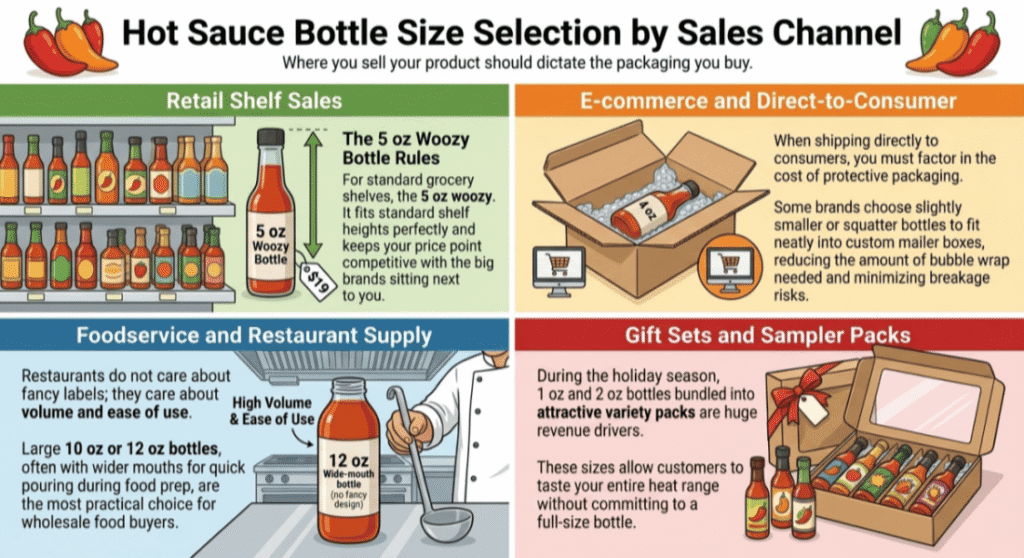
Where you sell your product should dictate the packaging you buy.
Retail Shelf Sales
For standard grocery shelves, the 5 oz woozy bottle rules. It fits standard shelf heights perfectly and keeps your price point competitive with the big brands sitting next to you.
E-commerce and Direct-to-Consumer
When shipping directly to consumers, you must factor in the cost of protective packaging. Some brands choose slightly smaller or squatter bottles to fit neatly into custom mailer boxes, reducing the amount of bubble wrap needed and minimizing breakage risks.
Foodservice and Restaurant Supply
Restaurants do not care about fancy labels; they care about volume and ease of use. Large 10 oz or 12 oz bottles, often with wider mouths for quick pouring during food prep, are the most practical choice for wholesale food buyers.
Gift Sets and Sampler Packs
During the holiday season, 1 oz and 2 oz bottles bundled into attractive variety packs are huge revenue drivers. These sizes allow customers to taste your entire heat range without committing to a full-size bottle.
Smilebottles: Your Reliable Partner for Hot Sauce Bottle Packaging
Finding the right glass bottle manufacturer can make or break your supply chain. At Smilebottles, we understand the specific challenges food and beverage brands face when bringing a product to market.
Wide Range of Hot Sauce Glass Bottle Sizes
Whether you need tiny sample bottles or bulk gallon jugs for foodservice, we manufacture a comprehensive range of capacities to cover your entire product line.
Multiple Bottle Styles and Neck Finish Options
We produce classic woozy shapes, elegant Boston rounds, and unique square designs, all with standardized neck finishes so you never have to guess about cap compatibility.
Closure Matching and Packaging Support
We don’t just sell empty hot sauce bottles; we provide complete packaging solutions. We help you match the perfect cap, reducer, and tamper-evident seal to your chosen bottle, ensuring a leak-proof, retail-ready product.
Customization for Branding
If you want to elevate your brand, we offer custom mold services to create a proprietary bottle shape just for you. We also provide decoration services like screen printing or frosting to make your packaging pop.
Quality Control and Manufacturing Capability
Our facilities maintain strict quality control standards to ensure glass thickness consistency, thermal shock resistance for hot filling, and accurate thread dimensions. We are fully equipped to handle massive orders of wholesale hot sauce bottles while maintaining flawless quality.
How Smilebottles Supports Growing Hot Sauce Brands
We pride ourselves on excellent communication, flexible MOQs for standard items, and deep industry knowledge. When you partner with Smilebottles, you get a dedicated team working to optimize your packaging costs and elevate your brand presentation.
FAQ Frequently Asked Questions About Hot Sauce Bottle Packaging
Q1:what is a woozy bottle?
A1:A woozy bottle is the traditional, widely recognized hot sauce container. It features a long, narrow neck that helps restrict the flow of liquid, making it easy to dash hot sauce onto food, and a straight, cylindrical body that is easy to label.
Q2:What is the most common hot sauce bottle size?
A2:The 5 oz (approximately 150ml) size is the industry standard for retail hot sauce worldwide.
Q3:Can I use the same cap on different bottle sizes?
A3:Only if the neck finish is identical. For example, if your 5 oz bottle and your 8 oz bottle both have a 24-414 neck finish, they can share the exact same caps and orifice reducers.
Q4:How do I prevent leakage during shipping?
A4:Preventing leaks starts with compatibility. You must ensure your bottle neck finish and your cap thread size match perfectly. Additionally, using the correct cap liner (like a foam or foil liner) and applying a tamper-evident shrink band provides extra layers of security against temperature changes and pressure during shipping.
Q5:Are glass bottles safe for hot-filled sauces?
A5:Yes, but you must ensure you are purchasing bottles manufactured specifically to withstand thermal shock. Always inform your supplier about your filling temperatures so they can provide the appropriate glass strength.
Conclusion
By carefully selecting the right bottle style, matching it with a secure closure, and planning your labels and shipping logistics, you can create a product that looks professional, functions perfectly, and keeps customers coming back for more.
If you are currently sourcing packaging and need a trusted manufacturing partner, Smilebottles is here to help. We offer an extensive catalog of standard and custom glass packaging solutions tailored for the condiment industry. Contact us today to discuss your project and let us help you bottle your success.