
Table of Contents
ToggleAuthor: SmileBottles Editorial Team
Estimated Reading Time: About 14 Minutes
Welcome to the complete buyer’s guide from Smilebottles. In this comprehensive article, we will walk you through everything you need to know about glass bottle closures and how they interact with different bottle designs. Whether you are a purchasing manager for a large distillery, a craft winemaker looking for the perfect seal, or a specialty food brand scaling up production, this guide is written specifically for you. We will help you navigate the complex world of packaging compatibility so you can make informed, confident wholesale purchasing decisions for your product lines.
Introduction: Why Bottle Finish and Closure Compatibility Matters
Before you can choose the perfect stopper or cap, you must understand the foundation of bottle sealing. The relationship between your bottle and its closure determines the shelf life, safety, and visual appeal of your entire product.
What is a Glass Bottle Finish?
In the glass manufacturing industry, the term bottle neck finish refers specifically to the top portion of the glass bottle opening. It is called the “finish” because, in the days of hand-blown glass, this was the final part of the bottle to be crafted before the glass cooled. Today, in modern automated glass manufacturing facilities like ours at Smilebottles, the finish is formed first in the mold, but the name has remained.
The finish is engineered to precise structural tolerances. It features specific threads, lips, ridges, or smooth internal bores designed to accept one—and usually only one—type of closure. You cannot simply force a threaded cap onto a smooth cork finish, nor can you secure a traditional cork into a threaded neck without risking leaks.
Why Choosing the Right Closure is Critical to Your Business
Selecting the correct closure for your specific finish is not merely a design choice. It impacts your bottom line in several profound ways:
Leak Prevention and Product Loss: A mismatched or poor-quality closure will fail during transit. Changes in temperature and altitude during shipping can cause liquids to expand. A secure closure prevents costly leaks and product recalls.
Freshness and Preservation: Oxygen is the enemy of many products, particularly wine, cold-pressed juices, and certain oils. The right closure provides the exact Oxygen Transmission Rate (OTR) your product needs to mature properly or stay fresh.
Brand Perception: The tactile experience of opening a bottle is a major part of consumer psychology. The satisfying pop of a cork, the heavy metallic twist of a premium cap, or the traditional snap of wire hardware all tell the consumer exactly what level of quality they hold in their hands.
Tamper Evidence: For spirits, pharmaceuticals, and retail food products, consumers need to know the product is safe and unaltered. Specific finishes and closures are designed to provide this security.
Filling Line Efficiency: If you are bottling thousands of units per hour, your closures must apply smoothly through automated capping or corking machines. The wrong choice can jam your equipment, causing massive production delays.
Understanding the Main Types of Glass Bottle Finishes
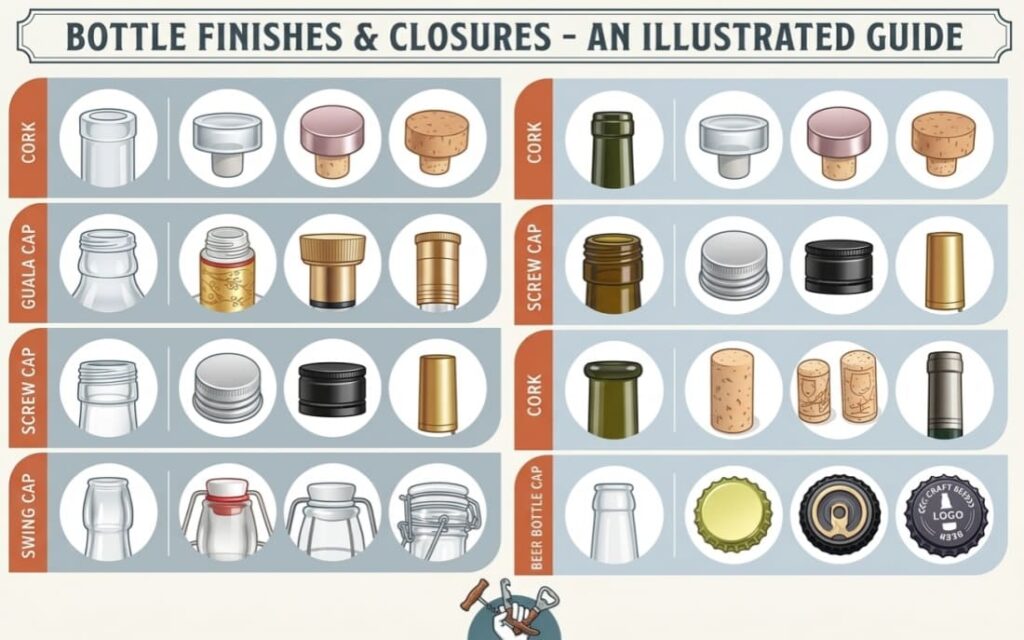
To make the best wholesale purchasing decisions, you must first understand the anatomy of the bottles you are buying. Here are the primary finishes you will encounter in the packaging industry.
The Cork Finish
The cork finish features a smooth, straight, or slightly tapered internal neck bore. The exterior usually features a thicker lip or collar, which adds structural strength to withstand the pressure of a cork being forced into the opening. This finish is the standard for traditional wine bottles, premium spirits, and high-end olive oils.
The Threaded Finish (Screw Finish)
A threaded finish features raised glass ridges spiraling down the outside of the neck. These threads are designed to interlock with the threads of a metal or plastic cap. There are many standardized variations of threaded finishes, such as the GPI (Glass Packaging Institute) standards or MCA finishes, which dictate the exact diameter and thread pitch.
The Guala Finish
The Guala finish is highly specialized. It features specific glass rings and locking ridges on the outside of the bottle neck. These ridges are engineered exclusively to lock into tamper-evident, non-refillable pourer caps. This finish is the global standard for commercial spirits and liquors, protecting brands from counterfeiting and refilling.
The Crown Finish
If you are brewing beer or bottling highly carbonated sodas, you will be looking for a crown finish bottle. This finish features a distinct, rounded protruding lip at the very top of the neck, designed to give a metal crown cap something to crimp onto securely, holding in high-pressure carbonation.
The Swing-Top Finish
This finish features small, precise indentations or holes on opposite sides of the bottle neck, slightly below the lip. These indentations act as anchoring points for the metal wire hardware used in specialized flip-top closures.
Exploring the Different Closures for Different Glass Bottle Finishes
Now that you understand the glass finishes, let us dive into the wide array of glass bottle cap types available on the market. Matching these perfectly to your bottle finish is where the magic happens.
Cork Closures for Cork-Finish Bottles
The traditional cork has been used for centuries, and it remains a symbol of quality and tradition. When you choose a cork finish bottle, you have several closure options:
Natural Cork: Punched directly from the bark of cork oak trees, natural corks are ideal for wines that need to age. They allow microscopic amounts of oxygen to interact with the wine, aiding in the maturation process.
Synthetic Cork: Made from food-grade plastic compounds, synthetic corks look like natural cork but offer a perfectly consistent seal with no risk of “cork taint” (TCA). They are excellent for wines meant to be consumed young.
Micro-Agglomerated Cork: These are made from natural cork granules bound together. They offer the traditional look and feel of cork but with higher structural consistency and a lower price point, making them great for mid-range products.
Considerations for Buyers: If you choose corks, you must ensure your bottling facility has the proper commercial corking equipment. Furthermore, wines sealed with natural corks should be stored on their sides to keep the cork moist and expanded.
Rubber Stoppers and Bar-Top Corks for Premium Spirits
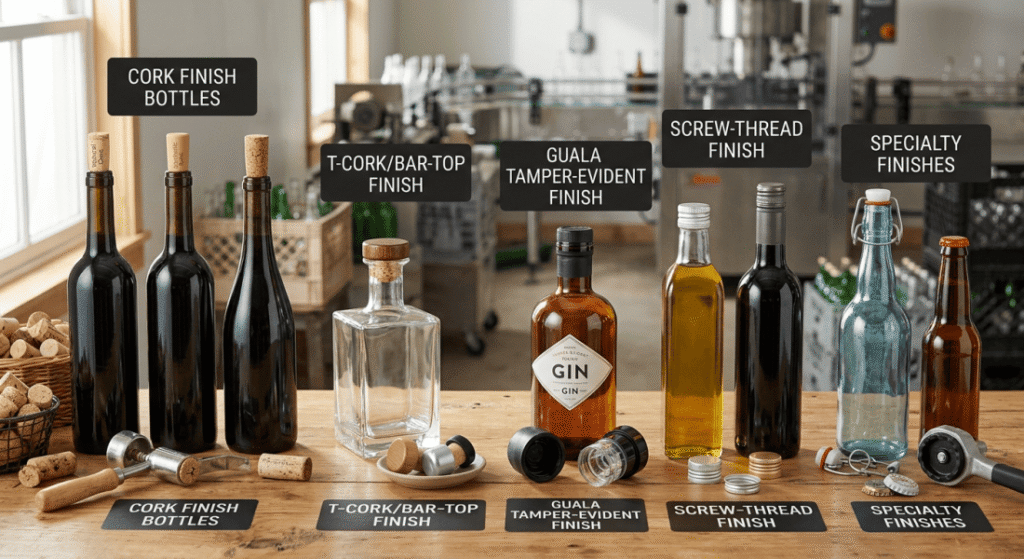
For high-end whiskey, rum, gin, tequila, and fortified wines, you want a closure that the consumer can easily remove and replace by hand. This is where the t cork stopper (also known as a bar-top cork) shines.
Designed like a capital letter “T”, the top portion (the cap) can be made of wood, glass, metal, or heavy plastic. The bottom portion (the shank) fits snugly inside a smooth cork finish bottle. The shank is typically made of natural cork or a food-safe synthetic rubber.
Considerations for Buyers: Because spirits have high alcohol content, natural cork shanks can sometimes dry out or degrade over time if the bottle is stored on its side. For this reason, many premium liquor brands are moving toward synthetic shanks paired with luxurious wooden or metal tops. This provides a flawless seal, a beautiful aesthetic, and acts as an excellent reusable bottle stopper for the consumer’s home bar.
Guala Caps for Tamper-Evident Spirit Packaging
Counterfeiting and unauthorized refilling are major concerns for spirit brands, especially in export markets. To combat this, the industry relies on the guala cap.
A guala closure is a complex piece of engineering. Made primarily of plastic and sometimes covered in a sleek aluminum shell, it snaps permanently over the locking rings of a Guala finish bottle. Inside the cap is a specialized mechanism—often involving a small glass or plastic marble—that allows the liquid to pour out smoothly but instantly blocks the neck if someone tries to pour liquid back into the bottle.
Considerations for Buyers: These closures provide maximum security, excellent tamper evidence, and can be beautifully decorated with your brand’s colors and logos. However, applying them requires specific machinery on your filling line that applies downward pressure to snap the cap over the glass ridges.
Screw Caps for Threaded Bottle Finishes
For convenience, cost-effectiveness, and reliable sealing, it is hard to beat a screw cap glass bottle. Whether you are packaging water, olive oil, sauces, or premium beverages, a threaded bottle cap offers incredible versatility.
One of the most notable shifts in modern packaging is the rise of the screw top wine bottle. In the past, screw caps were associated with cheap wine, but that perception has completely changed. Today, some of the world’s best white wines and light red wines use aluminum screw caps (often referred to as Stelvin closures).
When evaluating screw cap vs cork, there are several things to consider. Screw caps completely eliminate the risk of cork taint. They are incredibly easy for the consumer to open without tools, and they function perfectly as a resealable bottle cap, preserving the product in the fridge for days. Specifically, a screw cap for wine bottles features a specialized liner inside the top of the cap (usually made of Saranex or Saran-Tin) which dictates the exact amount of oxygen allowed into the bottle.
Considerations for Buyers: You must perfectly match the thread standard of the cap to the bottle (e.g., a 31.5mm standard, or an ROPP finish). Roll-On Pilfer-Proof (ROPP) aluminum caps are applied as a smooth metal shell and literally rolled onto the glass threads by a machine, creating a custom fit and a tamper-evident breakaway band.
Swing Caps for Reusable and Specialty Glass Bottles
If you want your product to instantly stand out on a retail shelf with a rustic, vintage, or premium craft feel, you should consider a swing top bottle.
A swing top closure (also known as a flip-top or wire-bail closure) consists of a ceramic or plastic stopper equipped with a rubber gasket, held in place by a framework of tensioned metal wire. The wire snaps securely into the indentations on a specialized swing-top glass finish.
A swing top glass bottle is highly popular for craft kombucha, premium sparkling mineral waters, artisanal lemonades, and homemade syrups. Furthermore, the swing top beer bottle has a rich tradition in European brewing, particularly for premium craft ales and lagers.
Considerations for Buyers: These closures are more expensive than standard screw caps or crown caps. However, they offer a massive advantage: sustainability. Consumers love them because they are robust, completely airtight, and infinitely reusable in the home. It elevates your packaging from a disposable item to a keepsake.
Crown Caps for Carbonated Beverages
For standard beer, hard cider, and carbonated soft drinks, the crown cap remains the undisputed king. Made of thin steel lined with a plastic sealing material, the crown cap is crimped tightly over the lip of a crown finish bottle.
Considerations for Buyers: Crown caps are incredibly cost-effective to buy in bulk. They are designed to withstand the internal pressure of carbonation and are applied easily at very high speeds on automated bottling lines. While they are single-use, they offer a fun branding opportunity, as logos can be printed on the outside, and promotional codes or messages can be printed on the underside of the cap.
Which Closure Works Best for Specific Products?
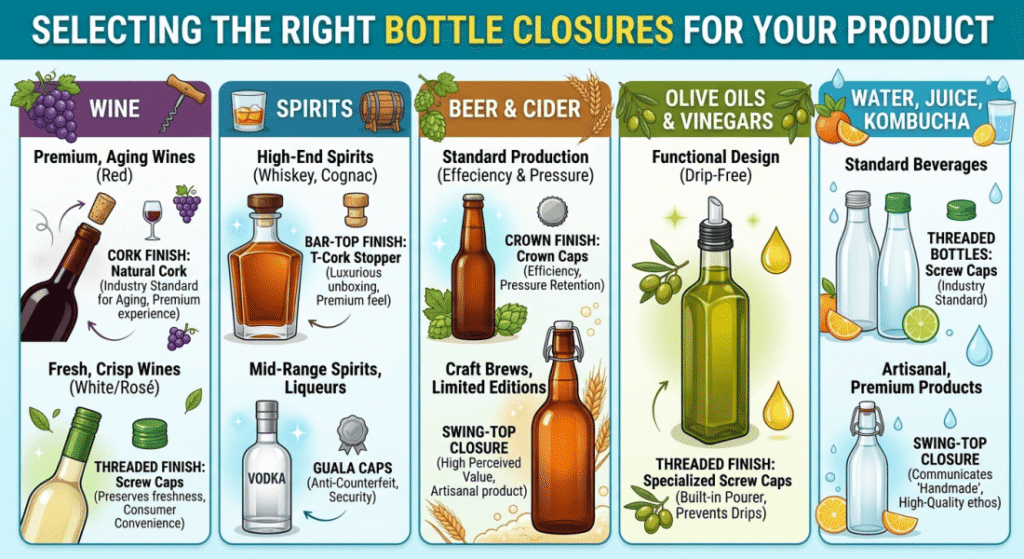
As a wholesale buyer, you are not just buying glass; you are buying a packaging solution for a specific product. Here is how you should align your product type with the right finish and closure:
For Wine: If you are producing premium red wines meant to age for years, a cork finish with a high-quality natural cork is the industry standard. If you are producing crisp, fresh white wines or rosés meant for immediate consumption, threaded finishes with aluminum screw caps will preserve the bright, fruity flavors perfectly and offer great consumer convenience.
For Spirits: High-end whiskey, tequila, and cognac perform best with a bar-top finish and a premium T-cork stopper. It gives a luxurious unboxing and pouring experience. For mid-range spirits, vodka, and liqueurs, Guala caps provide necessary security and anti-counterfeit measures.
For Beer and Cider: Standard production lines require crown finishes and crown caps for efficiency and pressure retention. For limited-edition craft brews or large-format sharing bottles, a swing-top closure adds significant perceived value.
For Olive Oils and Vinegars: While traditional corks look rustic, threaded finishes with specialized screw caps that include built-in plastic pourer inserts are the most functional for the end-user, preventing drips and keeping the product fresh.
For Water, Juice, and Kombucha: Threaded bottles with aluminum or plastic screw caps are standard. For premium, artisanal products, swing-top closures communicate a handmade, high-quality ethos.
How to Choose the Best Closure for Your Product
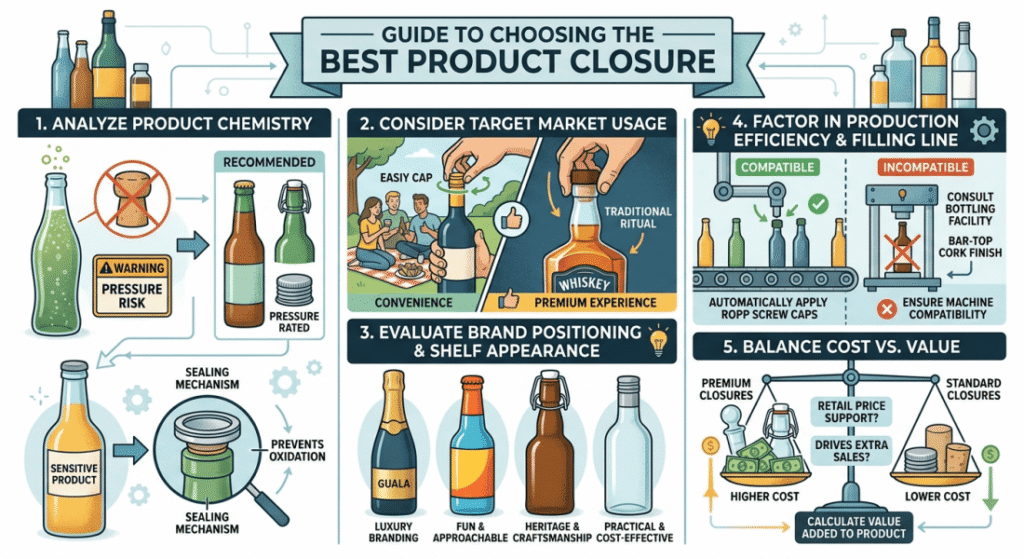
Making the final decision on your wholesale packaging order requires balancing multiple factors. Use this checklist to guide your purchasing strategy:
1. Analyze Your Product’s Chemistry
Is your product carbonated? You cannot use a standard T-cork, as the pressure will slowly push the cork out of the bottle. You must use a crown cap, a swing-top, or a specialized pressure-rated screw cap. Is your product sensitive to oxygen? Choose a closure with an appropriate liner or sealing mechanism to prevent oxidation.
2. Consider Your Target Market’s Usage Habits
Think about how and where your customer will consume the product. If they are opening a bottle of wine at a picnic, a screw cap is much more convenient than a cork that requires a corkscrew. If they are buying a premium whiskey as a gift, they expect the traditional ritual of pulling a heavy wooden T-cork.
3. Evaluate Shelf Appearance and Brand Positioning
Your closure is a major design element. A gold-foiled Guala cap screams luxury. A brightly colored crown cap looks fun and approachable. A ceramic swing-top with a wire bail communicates heritage and craftsmanship. Ensure your closure visually aligns with your brand’s story.
4. Factor in Filling Line and Production Efficiency
This is crucial for B2B buyers. Do not buy a beautiful bar-top cork finish bottle if your co-packer only has machinery equipped to apply ROPP screw caps. Always consult with your bottling facility or production manager before finalizing your glass and closure purchase to ensure compatibility with your automated capping machines.
5. Balance Cost vs. Value
A heavy glass stopper or a swing-top wire closure will cost significantly more per unit than a standard aluminum screw cap. You must calculate if your retail price point supports the premium packaging, and if the enhanced shelf appeal will drive enough extra sales to justify the increased wholesale packaging cost.
Common Mistakes to Avoid When Matching Bottle Finishes and Closures
In our years of manufacturing glass bottles at Smilebottles, we have seen brands make costly mistakes when planning their packaging. Avoid these common pitfalls:
Choosing Based Only on Appearance: Do not fall in love with a cap just because it looks great if it doesn’t match the bottle finish. You cannot force compatibility. The dimensions must be exact.
Ignoring Neck Finish Tolerances: Glass manufacturing involves slight microscopic variances. A premium T-cork must be sized perfectly to the internal bore of the glass neck. If it is 1mm too wide, it won’t fit; if it is 1mm too narrow, your product will leak.
Overlooking Export and Compliance Requirements: If you are exporting spirits to certain international markets, tamper-evident and non-refillable Guala caps may be legally required to pass through customs.
Skipping the Testing Phase: Never order a million units of glass and closures without doing a compatibility test first. Always ask your supplier for samples. Fill the bottles, apply the closures, lay them on their sides, subject them to heat and cold, and simulate shipping vibrations.
Why Smilebottles Is Your Reliable Partner for Wholesale Glass Packaging
Navigating the complexities of bottle finishes and closures can be overwhelming, but you do not have to do it alone. As a premier manufacturer of glass bottles, Smilebottles is dedicated to being the ultimate packaging partner for your wholesale needs.
A Massive Range of Finishes and Closures
We manufacture an extensive catalog of glass bottles designed for wine, spirits, beer, beverages, and gourmet foods. Whether you need an industry-standard GPI threaded neck, a classic cork finish, or a specialized Guala finish, we have the molds and the expertise.
One-Stop Packaging Solutions
You shouldn’t have to buy your bottles from one supplier and spend weeks hunting down a different supplier for matching caps. Smilebottles offers comprehensive, one-stop solutions. When you purchase our bottles, we provide the exact matching closures—guaranteeing perfect compatibility, zero leakage, and a streamlined supply chain.
Uncompromising Quality Control and Customization
Our glass is manufactured to the highest international tolerances. Furthermore, we offer deep customization options. We can customize the color of your glass, emboss your logo directly into the bottle, and provide fully customized closures featuring your brand’s artwork, colors, and premium textures.
Efficient Supply for Wholesalers and Importers
We understand the B2B landscape. You need stable lead times, competitive bulk pricing, and secure shipping. We work with brands to plan long-term sourcing strategies, ensuring you never run out of the packaging you need to keep your production lines moving.
FAQ: Frequently Asked Questions About Glass Bottle Finishes, Closures, and Parts
To help clarify your purchasing journey, here are answers to some of the most common questions we receive from wholesale buyers.
Q1:What exactly is the finish of a glass bottle?
A1:The finish is the specifically shaped top section of the bottle neck (including threads, locking rings, or smooth bores) designed to grip and secure a specific type of closure.
Q2:What is the difference between a bottle finish and a closure?
A2:The finish is the structural glass design on the bottle itself. The closure is the separate piece (the cap, cork, wire bail, or stopper) that attaches to the finish to seal the bottle.
Q3:Which closure is best for wine bottles?
A3:It depends entirely on the type of wine and your target market. For traditional aging, natural cork is best. For fresh, young wines and consumer convenience, screw caps are highly recommended.
Q4:Can one closure fit different bottle finishes?
A4:No. Closures are engineered to lock into precise glass dimensions. A cap designed for an MCA threaded finish will not securely fit a GPI threaded finish, even if they look similar to the naked eye. Perfect matching is mandatory.
Q5:How do I seamlessly match my bottle finish and cap?
A5:The safest and most efficient way is to purchase your bottles and closures together from a reputable manufacturer like Smilebottles, where the compatibility has already been engineered and rigorously tested.
Conclusion
Whether you are seeking the traditional elegance of a natural cork, the robust security of a Guala cap, the convenient seal of a screw cap, or the nostalgic charm of a swing-top, ensuring perfect compatibility is the key to preventing leaks, preserving flavor, and delighting your customers.
Do not leave your packaging to chance. If you are planning your next production run and need expert guidance on sourcing the perfect bottles and matching closures, contact Smilebottles today. Let our team of packaging experts help you customize a wholesale solution that protects your product, elevates your brand, and streamlines your manufacturing process.
 English