
Table of Contents
ToggleAuthor: SmileBottles Editorial Team
Estimated Reading Time: About 15 Minute
To create a successful product, you need a deep understanding of the perfume bottle anatomy. Every single element of your packaging affects how well the fragrance is preserved, how perfectly the spray performs, and how visually stunning the product looks on a retail shelf. Knowing the exact parts of a perfume bottle helps avoid costly manufacturing mistakes, and ultimately choose packaging that delights your customers.
In this comprehensive guide, Smilebottles will walk you through everything you need to know about perfume bottle components. We will explain how each part functions, the materials used, how the design impacts your fragrance, and how you can choose the right manufacturing partner. Let us help you navigate the world of perfume packaging so you can make confident, informed purchasing decisions.
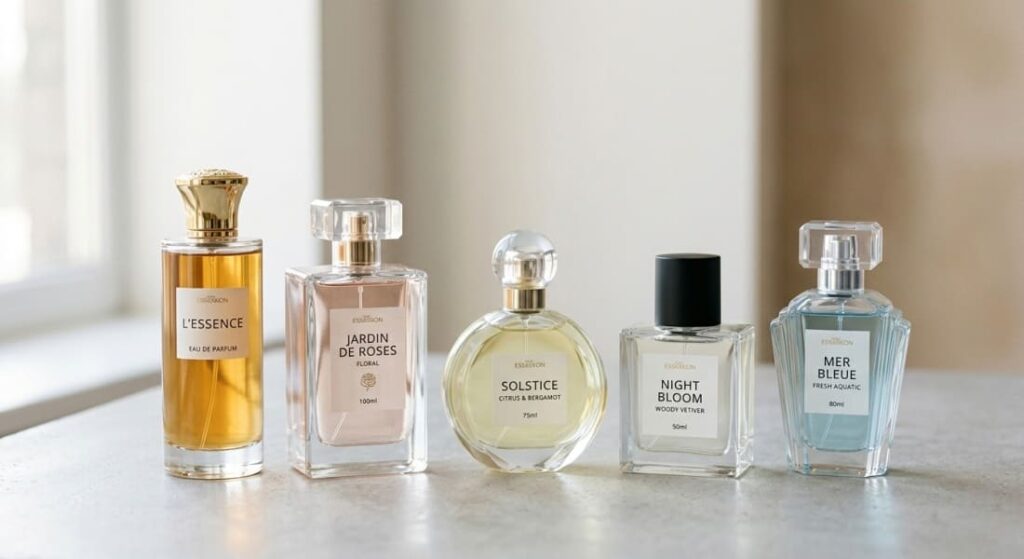
What Are the Main Parts of a Perfume Bottle?
Before diving into the intricate details of manufacturing and design, it is helpful to have a clear roadmap of the packaging structure. Even a minimalist design relies on multiple engineered components working together in perfect harmony.
Quick Overview of Perfume Bottle Components
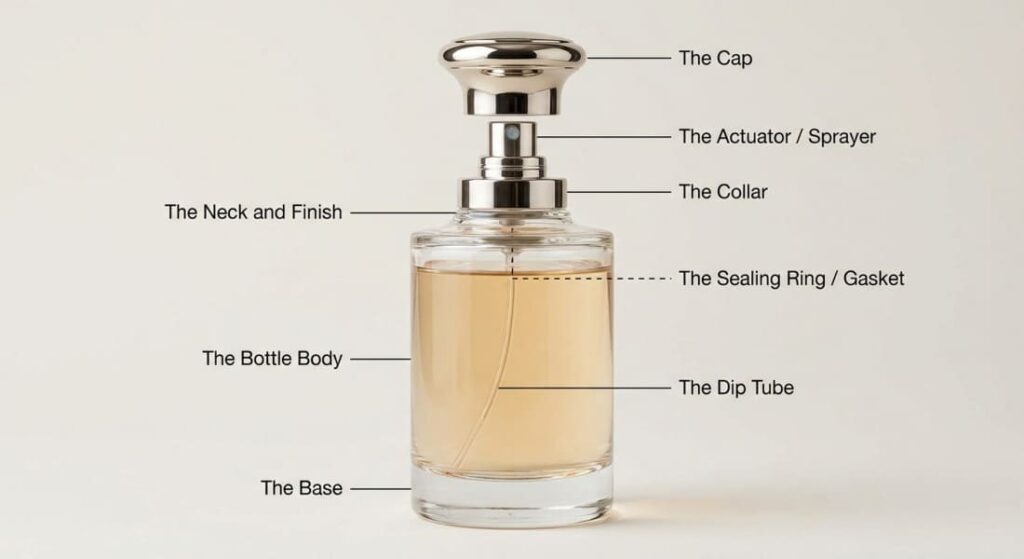
A standard fragrance container is made up of several distinct perfume bottle parts. Working from the top down, these include:
The Cap: The protective and decorative closure at the very top.
The Actuator / Sprayer: The mechanism you press down to release the scent.
The Collar: The decorative metal or plastic ring that hides the crimped or screwed connection.
The Neck and Finish: The top portion of the glass where the pump is attached.
The Bottle Body: The main vessel holding the liquid.
The Dip Tube: The slender internal tube that draws the liquid upward.
The Sealing Ring / Gasket: The hidden hero that prevents leaks and evaporation.
The Base: The bottom foundation that provides stability and visual weight.
Why Understanding Perfume Bottle Anatomy Matters
You might wonder why you need to know all these technical terms. Understanding these components is critical for a few reasons. First, it helps you choose better packaging that aligns with your brand’s price point. Second, it improves product functionality; a beautiful bottle is useless if the pump leaks or the cap falls off. Third, knowing these details supports fragrance protection, ensuring your carefully crafted scent doesn’t oxidize or evaporate. Finally, when you understand the anatomy, you can make smarter customization and manufacturing decisions, saving you time and money during the production phase.
Anatomy of a Perfume Bottle: Each Part Explained
To truly master your purchasing process, you need to understand the function, materials, and options available for each specific component. Let us break down the anatomy step by step.
The Cap
Many new brand owners ask, what is the top of a perfume bottle called? It is simply known as the cap or closure. However, its role is anything but simple. The perfume bottle cap serves a dual purpose: it protects the sprayer from dust and accidental pressing during transit, and it serves as a primary canvas for your brand’s identity.
When you are designing a high-end product, you might opt for a luxury perfume bottle cap. These are often heavier and crafted with precision. You can choose from a variety of materials, including lightweight plastics (like PP or ABS), durable aluminum, natural wood for organic brands, or heavy Zamac (a zinc alloy) for a premium, weighty feel. Acrylic and Surlyn are also popular because they can mimic the clarity of crystal.
You also need to consider the style of the closure. A magnetic perfume cap offers a deeply satisfying “click” when closed, which consumers heavily associate with luxury. Other options include snap-on caps, which are standard for most mass-market brands, screw caps for refillable models, and heavily decorative caps that feature intricate moldings or jewels. If you want your brand to stand out, investing in custom perfume bottle caps with your logo debossed or embossed on the top is a brilliant strategy.
The Neck, Finish, and Collar Design
Just below the cap lies the neck of the bottle. The “finish” refers to the specific shaping of the glass neck—this dictates how the pump will attach. Standard perfume bottles usually use a crimp finish (like FEA 15), which requires a machine to permanently attach the pump, ensuring an airtight perfume bottle.
To hide this mechanical crimping, you use a perfume bottle collar. The collar connects the bottle and the sprayer visually and structurally, providing a seamless transition between the glass and the cap. If the neck size and the collar do not match perfectly, your cap will either be too loose or impossible to snap on. Decorative collar materials are typically made of stamped aluminum or rigid plastic and can be treated with metalized finishes in gold, silver, rose gold, or custom colors to match your branding.
The Sprayer or Atomizer
The engine of your packaging is the perfume bottle sprayer. You might hear different terminology in the industry and ask, what is a perfume atomizer? An atomizer is simply the mechanical device that turns liquid perfume into a fine, airborne mist.
When analyzing spray bottle components, you are looking at an intricate system. The main types include the standard pump spray perfume bottle, the vintage-style squeeze bulb atomizer (often used for highly decorative purposes), the compact travel perfume atomizer, and the fine mist sprayer used for body splashes.
The essential parts of a spray bottle include the actuator (the button you press), the internal pump mechanism (which contains tiny springs and ball valves), and the housing. When examining spray nozzle perfume bottle parts, you must consider the dosage—how much liquid is dispensed per pump (usually between 0.05ml and 0.12ml). You also need to test the spray pattern; luxury consumers expect a wide, soft, continuous mist rather than a harsh, direct squirt. Leak prevention and user comfort are paramount here.
The Bottle Body
The perfume bottle body is the main container, the protective vault for your fragrance, and the core visual identity of your brand on the shelf.
Common Materials Used for Perfume Bottle Bodies
When you source packaging, you have several perfume bottle materials to choose from.
Glass perfume bottle: This is the industry standard. Glass offers a premium look, absolute chemical stability (meaning it won’t react with the perfume oils), and endless recyclability.
Crystal perfume bottle: Used for ultra-luxury or limited-edition releases, crystal offers unmatched clarity, heavy weight, and brilliant light refraction.
Plastic perfume bottle: While less common for high-end fragrances, high-grade plastics like PET or Surlyn are excellent for body mists, travel kits, and brands looking for lightweight, shatterproof, and lower-cost options.
You might hear customers ask, why are perfume bottles made of glass? Glass is non-porous and impermeable. It prevents oxygen from entering and the volatile alcohol and perfume oils from escaping, keeping the scent pure for years.
Common Bottle Shapes
The silhouette of your product matters. There are various perfume bottle shapes to consider, and knowing perfume bottle shaped names can help you source exactly what you need.
Geometric shapes: Squares, rectangles, and cylinders convey modernity, cleanliness, and sophistication.
Organic shapes: Curved, flowing, or tear-drop silhouettes feel elegant, feminine, and natural.
Artistic shapes: Sculptural and high-design forms stand out as art pieces on a vanity.
Novelty shapes: Themed designs (like shoes, stars, or human figures) are often used for celebrity fragrances or bold, disruptive brands.
Decorative Options for the Bottle Body
To create unique perfume bottle designs, you must utilize surface treatments. Perfume bottle decoration is where a standard glass shape becomes uniquely yours. You can opt for a frosted perfume bottle for a soft, matte, tactile feel. Other techniques include screen printing for crisp logos, hot stamping for metallic foils, and color coating to create beautiful colored glass perfume bottles. You can also explore gradient finishes, full metallization, bespoke labeling, or custom embossing directly into the glass mold. Mastering custom perfume bottle design allows you to capture your brand’s exact essence.
The Dip Tube
Hidden inside the liquid is the perfume dip tube. This is a small, flexible plastic straw that draws the perfume from the bottom of the bottle up into the sprayer pump. While it seems insignificant, its engineering is vital. The length must be calculated perfectly—if it is too short, the consumer won’t be able to spray the last few milliliters of the expensive perfume. If it is too long, it will bend awkwardly, looking cheap and potentially blocking the flow. Modern luxury brands often use “invisible” dip tubes, which are made of a special polymer that perfectly matches the refractive index of the perfume, making the tube disappear entirely when immersed in the liquid.
The Sealing Ring or Gasket
Tucked inside the pump assembly is a tiny sealing ring or gasket. This component is crucial for preventing leakage and maintaining airtightness. It protects the volatile fragrance oils from air exposure and premature evaporation. Commonly made from rubber or specialized polymers, the sealing quality must be rigorously tested. If this tiny part fails, the perfume will leak during air freight transportation due to pressure changes, leading to ruined shipments and unhappy customers.
The Base of a Perfume Bottle
The base is the structural foundation of your bottle. It provides stability and deeply affects the perceived value of the product. In luxury perfume bottle design, a thick glass base (sometimes called a “heavy sham”) is highly desirable. It pushes the center of gravity downward, giving the bottle a heavy, premium feel in the hand and ensuring excellent anti-tip performance on retail shelves. The design of the base must balance glass volume distribution evenly to avoid visual distortions or structural weaknesses.
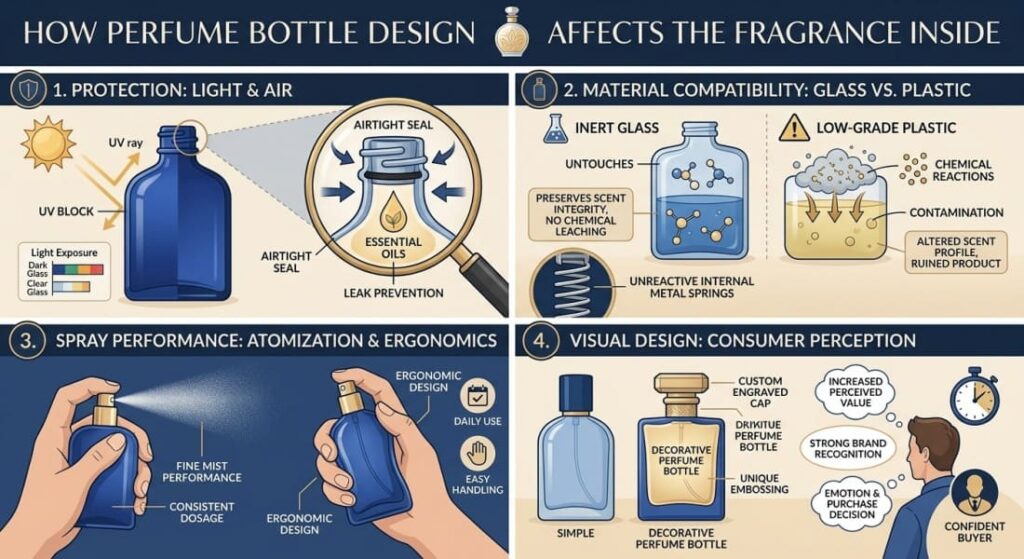
How Perfume Bottle Design Affects the Fragrance Inside
Your packaging does not just hold the product; it actively protects and preserves it. Let us look at how the physical design impacts the cologne or perfume inside.
Protection from Air, Light, and Leakage
Fragrance formulas are delicate. Exposure to ultraviolet light and oxygen can break down essential oils, altering the scent profile and changing the liquid’s color. This is why many brands opt for opaque or heavily tinted colored glass. Furthermore, a perfectly crimped neck and a high-quality gasket offer leak prevention and control air exposure, locking the scent’s integrity inside.
Material Compatibility and Scent Preservation
The materials you choose interact with your liquid. Glass is inert, meaning it will never leach chemicals into the fragrance, preserving scent quality over time. Poor packaging choices—such as using low-grade plastics or cheap metal internal spring components—can lead to chemical reactions, contamination, and a ruined product.
Spray Performance and User Experience
The functional parts of your bottle directly impact consumer satisfaction. A high-quality pump ensures fine mist performance, delivering a consistent dosage every single time. Easy handling, ergonomic bottle shapes, and comfort during daily use are what turn a first-time buyer into a loyal, repeat customer.
Visual Design and Consumer Perception
In the fragrance industry, you are selling an emotion as much as a scent. Decorative perfume bottles increase perceived value. A beautifully executed custom design strengthens brand recognition. Ultimately, the visual impact of your packaging strongly influences the consumer’s split-second purchase decision.
Perfume Bottle Materials and Design Options for Different Brand Styles
Different target audiences require different packaging strategies. Here is how you can tailor your perfume bottle parts to match your brand positioning.
For Luxury Perfume Brands
If you are targeting the high-end market, your focus should be on luxury perfume bottles. You want heavy, brilliantly clear glass, thick bases, and high-quality metal components. Zamac or heavy magnetic caps are practically mandatory. Custom decoration, such as deep glass embossing, 24k gold hot stamping, and custom-tooled molds, will justify a premium retail price.
For Minimalist and Modern Brands
Niche and modern brands often prefer clean geometric shapes. Clear or softly frosted glass paired with simple, unbranded wooden or matte plastic caps works beautifully. Understated screen printing—perhaps just a simple, elegant font—allows the color of the perfume itself to take center stage.
For Travel and Mass-Market Products
When convenience and cost are priorities, lightweight designs are key. You might incorporate high-grade plastic components or slim, cylindrical glass shapes that fit easily into a handbag. Using standard molds and lower-cost decoration methods (like simple labeling or standard color coating) helps maintain healthy profit margins while keeping the product attractive.
For Eco-Conscious Brands
Sustainability is a massive trend. If your brand is eco-conscious, look into sustainable perfume packaging. This means prioritizing highly recyclable glass and utilizing a refillable perfume bottle design. Refillable bottles use screw-neck finishes rather than crimped necks, allowing the consumer to unscrew the pump and top up the liquid. You can also source caps made from recycled plastics or sustainably harvested wood to reduce your environmental footprint.
How to Choose the Right Perfume Bottle Manufacturer
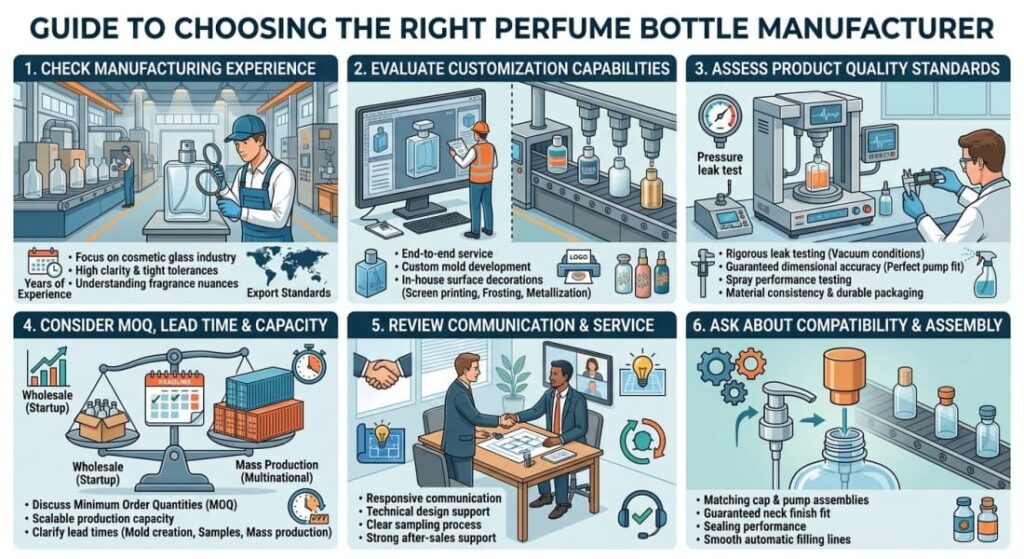
Knowing what you want is only half the battle; finding a factory that can produce it reliably is the other half. When you are searching for a perfume bottle manufacturer, you need to evaluate them on several strict criteria to ensure your supply chain remains unbroken.
Check Manufacturing Experience
Not all glass factories can make perfume bottles. The cosmetic glass industry requires much higher clarity and tighter tolerances than the food or beverage glass industry. Look for a glass perfume bottle manufacturer with years of specific experience in the fragrance packaging industry. They must understand international export standards and the nuances of working with volatile liquids.
Evaluate Customization Capabilities
A strong custom perfume bottle manufacturer should offer an end-to-end service. Can they develop custom molds based on your 3D drawings? Do they have an extensive catalog of caps and collars to perfectly match the neck finish? Make sure they offer in-house surface decoration options like screen printing, frosting, and metallization, as well as logo printing and comprehensive branding services.
Assess Product Quality Standards
Quality control is non-negotiable. Your perfume packaging manufacturer should conduct rigorous leak testing under vacuum conditions. They must guarantee dimensional accuracy (so the glass neck perfectly fits the metal pump), conduct spray performance testing, ensure material consistency across different batches, and provide packaging durable enough to survive global shipping.
Consider MOQ, Lead Time, and Production Capacity
Whether you are a startup buying wholesale perfume bottles or a multinational brand ordering millions of units, you must discuss Minimum Order Quantities (MOQ). Ask if the supplier can scale with your business. Clarify their standard lead times for mold creation, sample production, and mass manufacturing to ensure they can meet your launch schedules.
Review Communication and Service
A great perfume bottle factory acts as a partner, not just a vendor. Evaluate their responsiveness, their ability to provide technical design support, and the clarity of their sampling process. Good after-sales support is crucial in case any issues arise during the filling process.
Ask About Compatibility and Assembly Support
A common headache for buyers is receiving bottles from one supplier and pumps from another, only to find they don’t fit. Ask your supplier if they provide matching cap and pump assemblies. They should guarantee the neck finish matching and sealing performance, ensuring everything runs smoothly on your factory’s automatic filling lines.
Why Smilebottles Is a Reliable Perfume Bottle Supplier
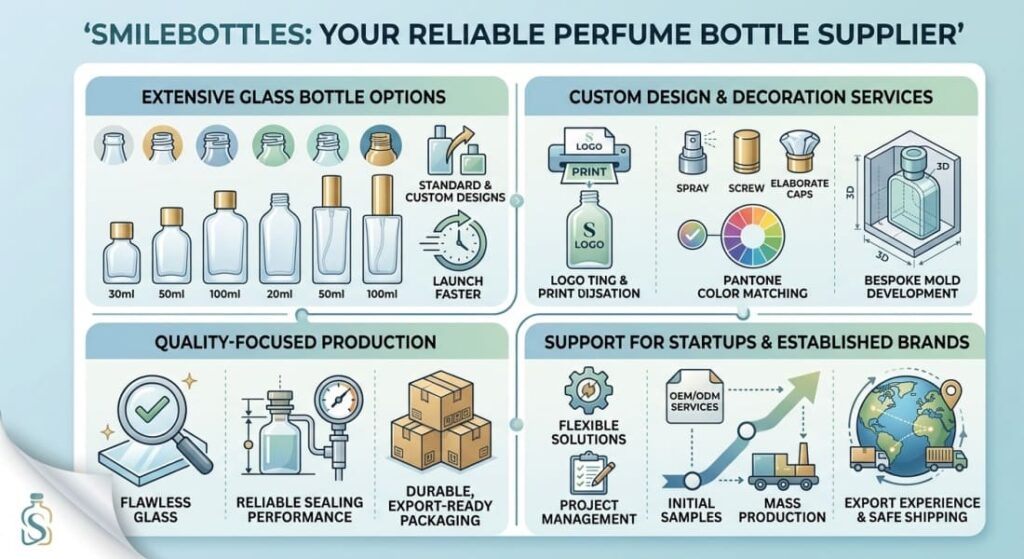
If you are looking to source empty glass perfume bottles that meet all the rigorous standards mentioned above, Smilebottles is your ideal manufacturing partner. We understand that buyers need a seamless, stress-free purchasing experience combined with premium quality.
Extensive Glass Bottle Options
As a leading perfume bottle supplier, we offer a massive range of standard and custom designs. Whether you need 30ml, 50ml, or 100ml capacities, we have multiple shapes and finishes ready for production, allowing you to launch your product faster.
Custom Design and Decoration Services
We excel at helping brands stand out. We provide comprehensive customization, from bespoke bottle decoration and a huge variety of cap options to precise logo printing and exact Pantone color matching. If you want a completely unique silhouette, our engineering team will help you develop custom molds that bring your vision to reality.
Quality-Focused Production
We pride ourselves on our strict quality control. When you buy high quality perfume bottles from Smilebottles, you are guaranteed reliable sealing performance, flawless glass clarity, and durable, export-ready packaging that ensures your products arrive at your filling facility safely.
Support for Startups and Established Brands
We believe in supporting growing perfume brands. We offer flexible solutions, comprehensive OEM/ODM services, and professional project management. From initial sample development to massive scale mass production, our export experience ensures your supply chain is in safe hands.
FAQ: Frequently Asked Questions About Perfume Bottle Parts
To further assist you in your packaging journey, here are clear answers to some of the most common questions buyers and brand owners ask us.
Q1:What are the parts of a perfume bottle called?
A1:The main components are the cap, the sprayer (or actuator), the collar, the glass neck/finish, the main bottle body, the internal dip tube, the sealing gasket, and the bottle base.
Q2:What is the top of a perfume bottle called?
A2:The very top piece that you remove before spraying is called the cap or closure. Beneath that is the actuator (the button you press).
Q3:What is the sprayer part of a perfume bottle?
A3:It is called the atomizer or the pump. It includes the button (actuator), the internal spring mechanism, and the dip tube that draws the liquid up.
Q4:Why are most perfume bottles made of glass?
A4:Glass is non-porous, chemically inert, and impermeable. It prevents the alcohol and delicate perfume oils from evaporating, oxidizing, or reacting with the container, thereby perfectly preserving the scent.
Q5:What is the difference between a cap, collar, and sprayer?
A5:The cap is the removable protective lid. The sprayer is the mechanical pump that dispenses the mist. The collar is the decorative metal or plastic ring that sits over the neck to hide the crimped mechanism of the sprayer.
Q6:What is a perfume bottle neck finish?
A6:The finish is the specifically shaped top of the glass neck (e.g., a crimp finish or a screw thread) that determines how securely the pump and cap will attach to the bottle.
Q7:How does a perfume bottle prevent leakage?
A7:Leakage is prevented by a combination of a perfectly matching neck finish, a tightly crimped pump assembly, and a high-quality internal rubber or polymer sealing ring (gasket) that blocks liquid from escaping.
Q8:What materials are used for perfume bottle caps?
A8:Caps can be made from a wide variety of materials, including plastics (ABS, PP, Surlyn), metals (aluminum, Zamac/zinc alloy), and even natural materials like polished wood.
Q9:Why does the base of a perfume bottle matter?
A9:The base provides structural stability to prevent tipping on shelves. A thicker glass base (heavy sham) also significantly increases the perceived weight, value, and luxury appeal of the product.
Q10:Can custom glass perfume bottles be personalized for a brand?
A10:Absolutely. You can customize the shape with a private mold, and personalize standard bottles via frosting, color coating, screen printing, hot stamping, and custom cap designs.
Conclusion
If you are planning your next product launch and are looking for a reliable factory to produce high-quality perfume bottles, Smilebottles is here to help. With our extensive manufacturing experience, strict quality control, and deep customization capabilities, we can turn your packaging vision into reality. Reach out to our team today, and let us build the perfect bottle for your brand.
 English