



Table of Contents
ToggleAuthor: SmileBottles Editorial Team
Estimated Reading Time: About 15 Minute
When you are developing a new skincare line, essential oil collection, or liquid supplement brand, the packaging you choose is just as important as the formula itself. As a brand owner or buyer, you likely find yourself asking exactly how many mL in a dropper? This is one of the most common questions in the cosmetic and pharmaceutical packaging industry. Precision matters, and understanding dropper measurements ensures your customers get the exact dosage they need while experiencing the premium feel of your product.
As an experienced glass bottle manufacturer, Smilebottles knows that choosing the right packaging goes far beyond just aesthetics. This comprehensive guide will walk you through everything you need to know about dropper bottle measurements. We will explore what a dropper is, detail the specific capacities like the standard 1 ml dropper, break down the difference between a single drop and a full pipette, and guide you on how to select the perfect custom glass dropper bottles for your brand’s unique needs.
What Is a Dropper?
Before you decide on the size of your packaging, it is crucial to understand the basics. The term dropper meaning refers to a specialized dispensing tool designed to transfer small, carefully measured amounts of liquid from a container. But what exactly makes up this tool, and how does a dropper work?
Basic Definition of a Dropper
If you are looking for a formal medicine dropper definition, it is a tool consisting of a small tube with a vacuum bulb at one end, used to draw up and release liquid in drops. People often ask, what is a dropper used for? In packaging, it is used for precise dispensing of essential oils, serums, tinctures, cbd oils, and heavy liquid cosmetics. Whether it is meant for a health supplement or you are curious what is a dropper used for in chemistry laboratories, the core function remains the same: accurate, controlled liquid transfer.
Main Parts of a Glass Bottle Dropper
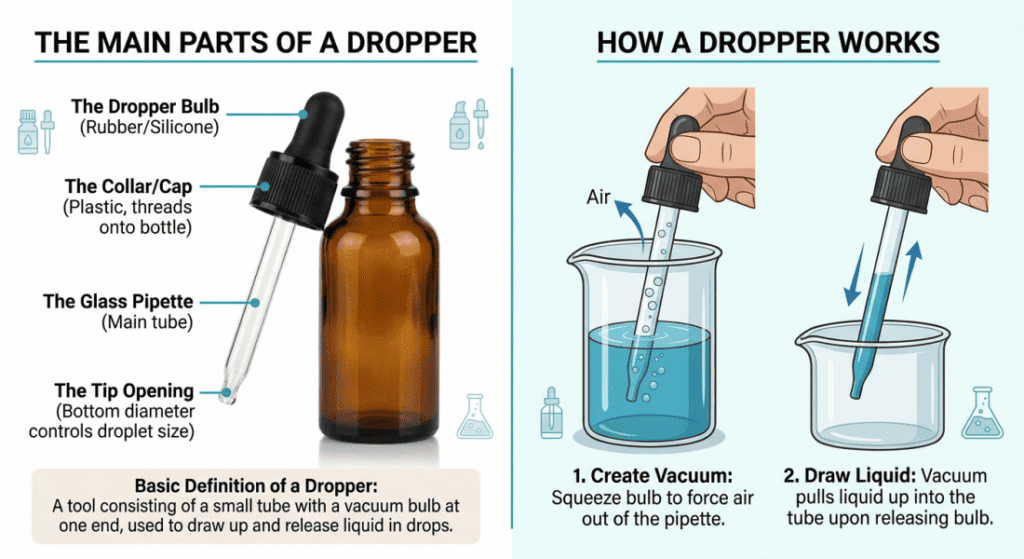
To understand how much does a dropper hold, you must first know the parts of a dropper. A standard dropper consists of four main components:
The dropper bulb: Typically made of rubber, silicone, or nitrile. This is the squeezable top part that creates the vacuum.
The Collar/Cap: The plastic or metal ring that threads onto the bottle to seal it.
The Glass Pipette: The long tube that drops into your bottle container.
The Tip Opening: The bottom of the glass tube. Its diameter directly impacts the size of the liquid droplets.
How a Dropper Works
It operates on a simple principle of suction and vacuum. When you squeeze the rubber bulb, you force air out of the glass pipette. When you submerge the tip into your liquid and release the bulb, the vacuum pulls the liquid up into the tube. When you squeeze the bulb again, the liquid is pushed out in small, controlled amounts.
Types of Droppers Used in Glass Dropper Bottles
As a buyer looking for wholesale dropper bottles, you will quickly notice there are many types of droppers available. Each serves a distinct purpose depending on your formula and consumer base.
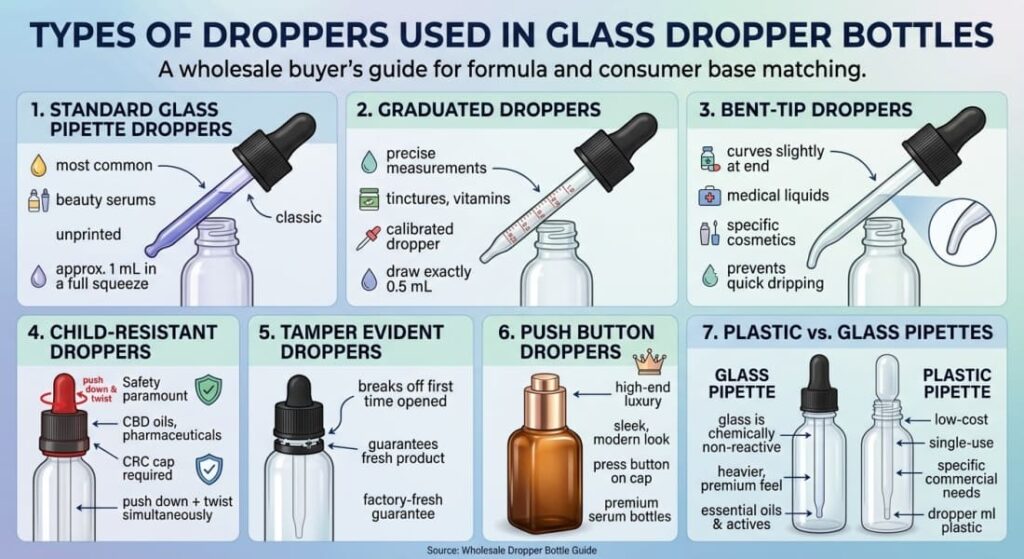
Standard Glass Pipette Droppers
The standard type is most common for beauty serums and basic essential oils. When buyers search for a glass pipette dropper, they are usually looking for this standard, unprinted version. The classic standard dropper volume typically pulls up around 1 mL of liquid in a single full squeeze.
Graduated Droppers
A graduated dropper features precise measurement markings printed directly on the glass tube. This is also called a calibrated dropper. These are essential for tinctures, liquid vitamins, and potent skincare activities where users must measure exact doses, answering questions like “how can I draw exactly 0.5 mL?”
Bent-Tip Droppers
Unlike straight pipes, a bent-tip dropper curves slightly at the very end. This prevents liquid from dripping too quickly and is often used in medical liquid applications or specific cosmetic formulas where slow, deliberate drops are required.
Child-Resistant Droppers
Safety is paramount in certain industries. If your brand sells CBD oils, potent essential oils, or certain pharmaceuticals, a child-resistant cap (CRC) is legally required in many regions. These require users to push down and twist simultaneously to open the bottle.
Tamper Evident Droppers
A tamper evident dropper features a plastic ring that breaks off the first time the bottle is opened. This guarantees to your customer that the product is factory-fresh and has not been opened since it left your manufacturing facility.
Push Button Droppers
For high-end luxury cosmetics, a push button dropper offers a sleek, modern look. Instead of squeezing a standard rubber bulb, the user presses a cylindrical button on the top of the cap. These are highly desirable if you are sourcing from a premium serum bottle manufacturer for luxury skincare lines.
Plastic vs. Glass Pipettes
While searching for a reliable dropper bottle manufacturer, you will have to choose between plastic and glass tubes. When evaluating a dropper vs pipette made of plastic (often seen in disposable droppers), consider your product. Most essential oils and active cosmetic ingredients require a glass tube because glass is chemically non-reactive and provides a heavier, premium feel that customers expect. Plastic tubes (like a dropper ml plastic) are primarily used for low-cost, single-use, or highly specific commercial needs.
How many mL are in a Dropper?
This is the most critical section for your formulation guidelines.
How Much Does a Full Dropper Hold?
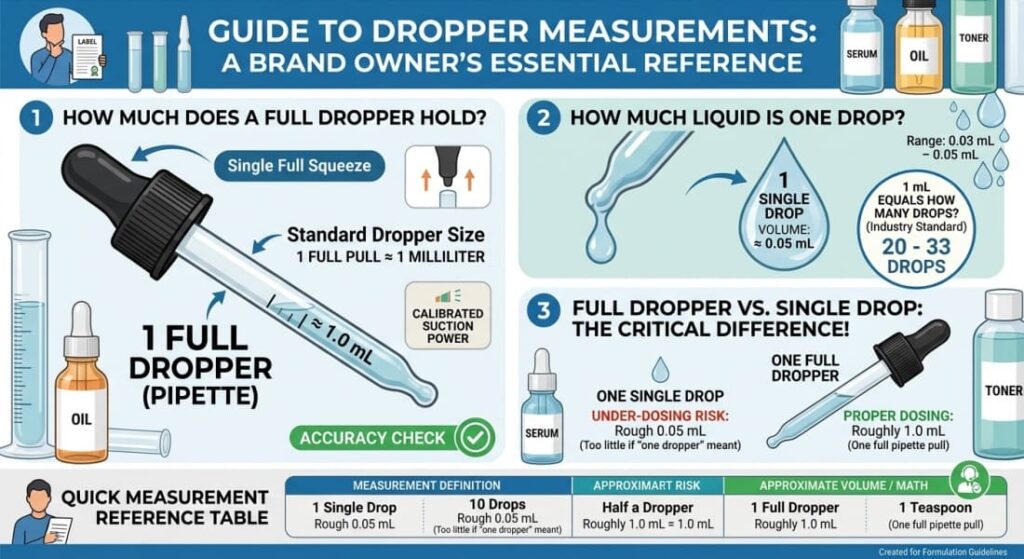
If you are asking how many ml is a dropper naturally, the answer heavily depends on standard conventions. In the cosmetic and pharmaceutical packaging world, a standard 1 ml dropper is the industry norm. When asking how much is a dropper full or how much is a full dropper, consider that a single full squeeze of a standard rubber bulb will pull up approximately 1 mL of liquid.
However, it is important to understand that the glass tube itself might visually hold more space. But the actual amount drawn up by the suction power of standard bulbs is usually calibrated so that 1 milliliter equals 1 full pull. Therefore, the standard dropper size and standard dropper ml generally equate to 1 mL.
How Much Liquid is One Drop?
Many buyers confuse a full dropper with a single drop. If your customers are asking you what does 1 ml look like, they need to know that 1 mL is not just a single drop. So, how many ml 1 drop?
Generally, a single drop equals between 0.03 mL and 0.05 mL. If you want to know one ml equals how many drops, or if you regularly face questions about how many drops in 1 ml, the standard industry conversion is about 20 to 33 drops per milliliter.
Full Dropper vs. Single Drop: What is the Difference?
You must clarify the dropper’s meaning in your user instructions.
One Drop: A single droplet (roughly 0.05 mL).
One Full Dropper (Pipette): A full squeeze of the bulb (roughly 1.0 mL).
If your label says “apply one dropper,” and the customer thinks that means a single liquid droplet, they are severely under-dosing your product.
Common Dropper Measurements Explained
When sourcing wholesale glass dropper bottles, you will encounter various capacity requests. Not every product utilizes a 1.0 mL dose. Understanding the different sizes helps ensure accurate dosage functionality.
0.25 mL Dropper Size
A 0.25 ml dropper mark is typically used for extremely potent, concentrated formulas. This is only a quarter of a standard pull and is common in specialized liquid medications or highly reactive skincare active ingredients where overuse could cause skin irritation.
0.5 mL Dropper Size
So, how much is 0.5 ml in a dropper? It is exactly half of a standard 1 mL pull. Taking a 0.5 ml dropper dosage equates to about 10 to 15 drops. If your users are asking how many drops in 0.5 ml, this is the figure you should provide. It is a very common dose for daily facial serums.
1 mL Dropper Size
The classic 1 ml dropper is the backbone of the industry. When a consumer asks how much is 1 ml in a dropper, you can confidently tell them it is generally one full squeeze of the bulb. If you want a visual of what does 1 ml look like in a dropper, just picture the glass tube filled about halfway to two-thirds of the way to the top. Manufacturers specifically design the bulb capacity to draw exactly this much liquid.
1.5 mL and Above
A 1.5 ml dropper, 1.8ml dropper, or even a 2 ml dropper exists for larger dosage needs. You might wonder, how much is 2 ml in a dropper? For a standard bottle, obtaining 2 mL usually requires pulling two full 1 mL dropper squeezes. However, some larger bottles with specialized heavy-duty bulbs can draw up more. When dealing with large capacity needs like a dropper 5 ml or 10ml dropper tool, you are typically stepping out of standard cosmetic glass packaging and into specialized culinary, agricultural, or veterinary tools.
Marked vs. Unmarked Droppers
When precise measurement is critical, an unmarked pipette is not enough. You will need a graduated pipette. These have visual lines indicating exactly how much is a millileter or fractions of it.
Dropper Length vs. Actual Capacity
An essential concept to grasp as a buyer is that the length of the glass tube does not drastically change the volume it sucks up. The amount of liquid a dropper holds is dictated by the volume of air inside the rubber bulb. Using a longer pipette for a taller bottle simply allows the tube to reach the bottom of the container; it does not turn a 1 mL dose into a 2 mL dose.
What Affects Dropper Measurement Accuracy?
Even if you buy a precise precision dropper bottle from a reliable manufacturer, your end customer might experience varying drop sizes. Several factors influence the exact milliliter drop volume.
Liquid Viscosity
This is the biggest factor. Thick products like heavy carrier oils, castor oil, and thick gel serums create much larger drops than thin, watery liquids like alcohol-based tinctures. In thick liquids, a single drop might be closer to 0.05 mL, meaning there are fewer drops per mL.
Surface Tension
Different liquids have different surface tensions, altering how the droplet clings to the glass tip before fully breaking away in a single droplet medicine release.
Pipette Tip Diameter
The physical opening at the bottom of the pipette strongly affects drop size. A wider glass opening will produce a larger, heavier drop compared to a narrow, fine-tip opening.
Bulb Pressure
How hard does the user squeeze the bulb dropper? A fast, aggressive squeeze pulls up liquid differently and dispenses drops with different velocity than a slow, gentle pressure.
Temperature
Your formula’s physical state changes with temperature. Warm essential oils flow much faster and thinner than cold oils. This alters both how many drops fall in a given second and the volume of each drop itself.
Graduations and Calibration
Accuracy is ensured through high-quality markings. Using a poorly manufactured unmarked glass tube leaves the dosage entirely up to user guesswork. Using clearly marked tools resolves the issue of users asking how to measure 2 ml (they simply fill exactly to the 1 mL line twice).
User Handling
The angle at which the consumer holds the bottle changes the drops. Holding a dropper perfectly vertically produces more uniform droplets. Holding it at a 45-degree angle will cause the liquid to slide down the side of the glass tip, creating inconsistent drop sizes.
How Dropper Measurements Affect Glass Dropper Bottle Performance
Why does diving this deep into dropper measurements matter for your brand? The relationship between a dropper and bottle directly impacts your brand equity and customer satisfaction.
Product Dosage Accuracy
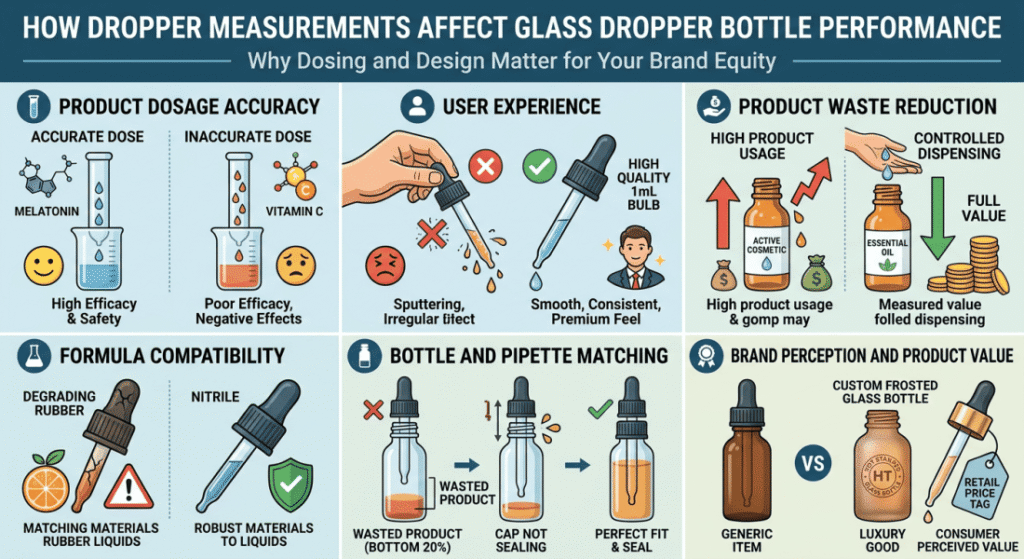
If you are formulating a sleep tincture containing melatonin or a potent Vitamin C facial serum, accuracy is critical. Overdosing or under-dosing leads to either poor product efficacy or negative side effects. Guaranteeing exact dosing protects your brand reputation.
User Experience
Consumers associate smooth, consistent functionality with high quality. A dropper that sputters, leaks, or varies wildly in drop size feels cheap. Conversely, a robust, high-quality 1ml dropper bottle with a firm rubber bulb feels intensely premium in the hand.
Product Waste Reduction
Essential oils and active cosmetics are very expensive per ounce. If your dropper dispenses randomly, customers will overuse the product, run out rapidly, and feel they didn’t get their money’s worth. Controlled dispensing reduces waste.
Formula Compatibility
Certain aggressive liquids (like high-concentration citrus essential oils) can degrade rubber bulbs over time. Matching your specific formula’s needs with the right packaging materials prevents chemical breakdowns and ruined products.
Bottle and Pipette Matching
When you buy bulk glass dropper bottles, the pipette length must exactly match the bottle height. If the pipette is too short, your customer can never reach the bottom 20% of your expensive product. If it is too long, the bottle cap won’t seal, leading to massive leakage.
Brand Perception and Product Value
Ultimately, custom frosted glass, hot-stamped logos, and a perfect-functioning push-button dropper elevate your product from a generic item into a luxury good that can command higher retail prices.
How to Choose the Right Glass Dropper Bottle for Your Product
Knowing how many ml in a dropper is just the starting point; you must also carefully select the bottle that houses it. Here is how you can effectively mix and match to find the perfect packaging.
Choose the Right Bottle Capacity
First, decide on your overall container volume. An average 1 oz container (which is approximately 30 mL) is the industry standard for daily facial facial serums and beard oils.
10 mL – 15 mL: Typically used for potent essential oils or sample sizes. A standard dropper vial format.
30 mL (1 oz): The absolute gold standard for skincare.
50 mL – 100 mL: Used for larger-volume formulas like body oils, wholesale liquid ingredients, or large-capacity tinctures.
Select the Right Dropper Volume
Align the dispense rate to the usage instructions. If your instructions say “apply 5 drops daily,” a standard 1 mL fine-tip dropper works perfectly. If your customer requires exactly 1 mL per day, you must invest in graduated droppers. Use the answers to questions like how much is a ml in a dropper to guide this choice.
Match Pipette Length to Bottle Height
Once you decide to buy a 30 mL bottle, tell your essential oil bottle manufacturer that the glass tube must be specifically cut to fit the 30 mL internal dimensions.
Consider Bottle Material and Color
If you are working with light-sensitive ingredients, clear glass is dangerous. You must use Amber glass, Cobalt Blue glass, or Emerald Green glass to block UV rays that degrade your formula. Clear or frosted glass works beautifully for non-sensitive cosmetics where you want the liquid’s natural color to shine through.
Think About Closure and Sealing Options
Aside from deciding between standard squeeze bulbs and the push button dropper style, evaluate your security needs. Do you need a tamper-evident seal for retail store shelves? Do you legally need child-resistant closures (CRC) for your concentrated formulations?
Evaluate Decoration and Branding Needs
As a brand, you don’t just want a plain 1 ml bottle. You need decoration. Silk screen printing, custom color coating, hot stamping in gold or silver, or custom labeling all contribute to making your final product look breathtaking.
Smilebottles Is Your Best Choice For Glass Dropper Bottles
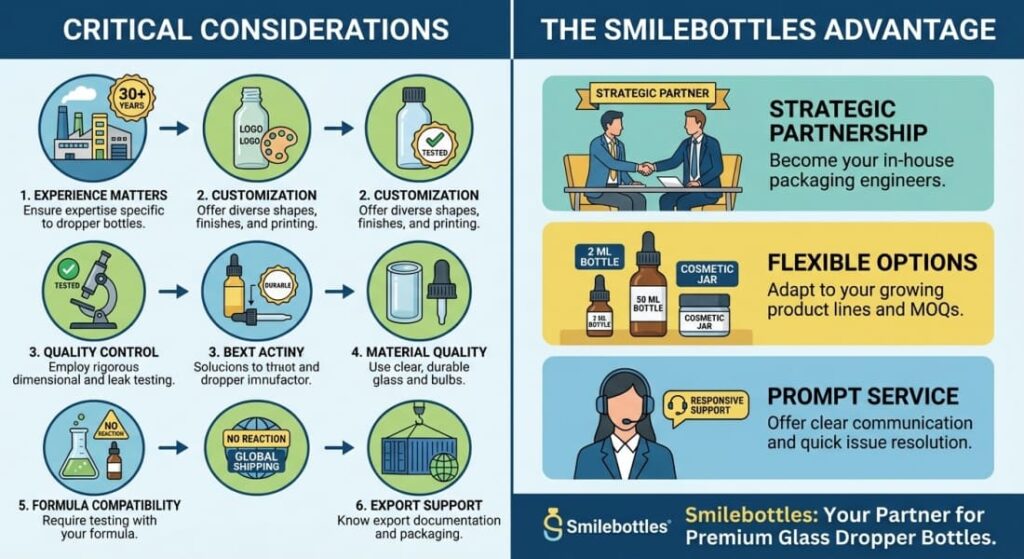
Choosing a dedicated cosmetic glass bottle manufacturer like Smilebottles over a generic trading company is the first step towards ensuring you receive the best prices, higher quality products, and unmatched customization options.
Experience You Can Trust
Smilebottles boasts specific experience as a dropper bottle manufacturer. We understand that producing glass bottles for the skincare industry, particularly precise medicine dropper and bottle sets, requires a level of expertise and attention to detail that sets us apart from general glass manufacturers.
Customization Options to Suit Your Brand
We offer fully custom glass dropper bottles to help your brand stand out. This includes customizing the bottle shape (Boston round, square, flat), tweaking the neck finish, matching the plastic cap color to your Pantone brand colors, and printing your logo directly onto the glass.
Commitment to Quality Control
We understand that glass can break and bottles can leak, which is why we employ rigorous dimensional inspection, vacuum leak testing, and dropper-fit testing. If taking a single milliliter dropper full of liquid causes a leak, we consider it a failure of quality control.
Superior Material Quality
We use only high clarity glass, ensuring consistent and thick wall thickness to prevent breakage during transit. Our dropper bulbs are made from durable rubber or silicone materials that won’t tear after repeated use by the consumer.
Formula Compatibility Testing
We encourage you to test samples of our bottles with your actual formula. Put your liquid into our eye dropper and bottle and let it sit for 30 days to check for any adverse reactions, such as oil eating away at the rubber or liquid causing the glass color coating to peel.
Flexible MOQs and Clear Lead Times
If you are looking to buy wholesale dropper bottles, we provide clear Minimum Order Quantities (MOQs) and production lead times to help you plan your product launch effectively. We work with businesses of all sizes, from startups requiring smaller quantities to established brands looking for larger orders.
Export and Logistics Support
Shipping delicate glass globally requires expertise, and our team knows how to safely pack pallets, navigate customs, and provide all necessary export documentation.
Responsive Service and Technical Support
If a problem arises, you can count on us for clear communication and quick issue resolution. We pride ourselves on being a reliable partner who stands by our products.
A Long-Term Packaging Partner
Choosing Smilebottles is more than just a transaction; it’s a strategic partnership. As your business grows and you launch new products, such as a 2 ml bottle line or different cosmetic jars, we act as your in-house packaging engineer, providing consistent quality and support.
FAQ: Frequently Asked Questions About Glass Dropper Bottles and Dropper Measurements
In the world of packaging, B2B buyers and end-consumers alike have many specific, long-tail questions. Below, we address these detailed queries, including specialized terminology and conversions.
Q1:Is a full dropper always 1 mL?
A1:In most standard cosmetic and pharmaceutical packaging, yes. When buyers ask how many ml is a dropper, the general rule is that one full squeeze reaches the 1 mL mark. However, specialized sizes exist, so it is always best to confirm with your supplier.
Q2:How many drops are in 1 mL?
A2:There are about 20 to 33 drops in 1 mL, depending heavily on the liquid’s thickness. If someone asks how many drops are in 1 milliliter, 20 is a safe, conservative answer for thicker serums and oils. If they want to know the reverse, how many ml in a drop, it is about 0.03 – 0.05 mL.
Q3:How many mL is half a dropper?
A3:Half a dropper, or half a single squeeze pull, is 0.5 mL. It contains roughly 10-15 drops.
Q4:What does 1 ml look like?
A4:If you are asked what does a milliliter look like inside a glass pipette, it visually fills the long glass tube roughly halfway to two-thirds of the way to the top rubber bulb.
Q5:Does oil have the same drop size as water?
A5:No. Because of differing viscosity, oil generally produces larger, heavier drops than water. The drops in ml count for oil is usually slightly lower than water because each physical droplet contains a bit more volume.
Q6:1 drop to ml: what is the math?
A6:For the 1 drop ml equation, 1 drop equals roughly 0.05 mL of liquid. Therefore, it takes 20 drops to equal 1 full mL. This helps consumers who ask how many mls are in a drop or how many ml in eye dropper.
Q7:What is 2ml in drops?
A7:If you are wondering what is 2 ml in a dropper or answering a customer asking what is 2ml in drops, you simply multiply your formula. 2 mL equals roughly 40 to 60 drops. Customers often ask highly specific questions for health food products, such as how many drops is 2 ml of chlorophyll (or how many drops is 2ml of chlorophyll)—the answer remains approximately 40 to 60 drops. To measure this amount out, a user would need a standard 1 mL dropper pulled twice, or they could extract liquid into a larger liquid 2ml container like a 2ml microcentrifuge tube used in labs, or use a larger custom 2 ml in dropper (also searched as 2ml in dropper). Additionally, to visualize 2ml of liquid or consider how much is 2 ml in drops, think of it as exactly double the standard daily dose of a typical tincture.
Q8:Are graduated droppers more accurate?
A8:Absolutely. Without printed lines on the glass, measuring is just guesswork. Graduated droppers are essential if your customer needs to know exactly how much is 1 ml dropper .
Q9:How to measure mg to ml?
A9:Frequently, consumers get confused about weight versus volume, asking things like how many mg in a ml dropper. Mg (milligrams) is a measure of weight (often active ingredient strength), while mL is volume. A 1 mL dropper holds 1 mL of liquid, but the mg depends on your specific product formulation and concentration.
Q10:Can I customize droppers and bottles together?
A10:Yes. Using an experienced factory allows you to buy both the bottle and the custom dropper cap. They are perfectly matched so the threads lock seamlessly and the pipette length reaches the absolute bottom.
Q11:What do international buyers call these droppers?
A11:In Spanish-speaking markets, buyers sourcing a 1 mL dropper will often request a gotero de 1ml. When sourcing globally, knowing local nomenclature is helpful.
Conclusion
Understanding the details of packaging is what separates a novice brand from a professional enterprise. Knowing exactly how many ml in a dropper ensures you can formulate your active ingredients safely, advise your consumers correctly, and source the exact type of packaging your line demands.
If you are currently launching a new line and searching for reliable, premium packaging, you do not have to figure it all out alone. If you are looking for custom glass dropper bottles for your essential oils, or pharmaceutical tinctures, Smilebottles is here to assist you. With extensive manufacturing expertise, rigorous quality control, and deep customization options, we can help you design, scale locally or globally, and confidently select the perfect packaging fit for your products. Reach out to our team today to start designing your next best-seller.


