Table of Contents
ToggleAuthor: SmileBottles Editorial Team
Estimated Reading Time: About 15 Minute
If you are reading this guide, you are likely in the planning stages of launching a new beverage, cosmetic line, food product, or spirits brand. You know that packaging is one of the most critical elements of your product’s success, and you are asking the ultimate question: how much does it cost to make a glass bottle?
The basic glass bottle cost typically depending on the size, weight, mold fees, decoration, order quantity, and the manufacturing location.
In this comprehensive guide, Smilebottles will break down the average manufacturing costs, the hidden fees you might not expect, the difference between the factory price and the final landed cost, and actionable strategies to help your business save money.
What Is the Average Cost to Manufacture a Glass Bottle?
When you reach out to a factory for a quote, the initial numbers you see will vary widely. The total cost depends heavily on the type of bottle, the volume of your order, and how much customization you require.
Average Cost Range for Standard Glass Bottles
Standard bottles use existing molds that the factory already owns. Because you do not have to pay for a new mold to be cut, the barrier to entry is much lower.
Small bottles (10ml – 50ml): Usually the lowest cost, often ranging from $0.05 to $0.15 per unit. These are common for essential oils and small cosmetic serums.
Medium bottles (250ml – 500ml): Moderate cost, typically between $0.20 and $0.45. These are the standard sizes for sodas, kombucha, and sauces.
Large or heavy bottles (750ml – 1000ml+): Higher cost, generally ranging from $0.40 to $0.90+. These are standard for wine, premium liquors, and bulk storage.
Average Cost Range for Custom Glass Bottles
Custom bottles require new molds, special setups, and often slower production runs. Because of the design complexity and added decoration, the unit cost is inherently higher. You can expect to pay anywhere from $0.50 to over $3.00 per bottle. The upfront mold fee alone can range from $2,000 to $5,000 or more, depending on the intricacies of the design.
Typical Cost by Bottle Type
Different industries have different packaging standards, which directly impacts the glass bottle price.
Beverage bottles: Usually produced in massive volumes, keeping costs low.
Wine and Beer bottles: Often utilize colored glass (like green or amber) and require specific neck finishes.
Liquor bottles: Often feature thick glass bases (called the “punt” or “heel”) to give a premium, heavy feel, which increases the cost.
Perfume and Cosmetic bottles: These require pristine, flawless glass with heavy customization, making them some of the most expensive bottles per ounce of capacity.
What Factors Affect the Cost of Making a Glass Bottle?
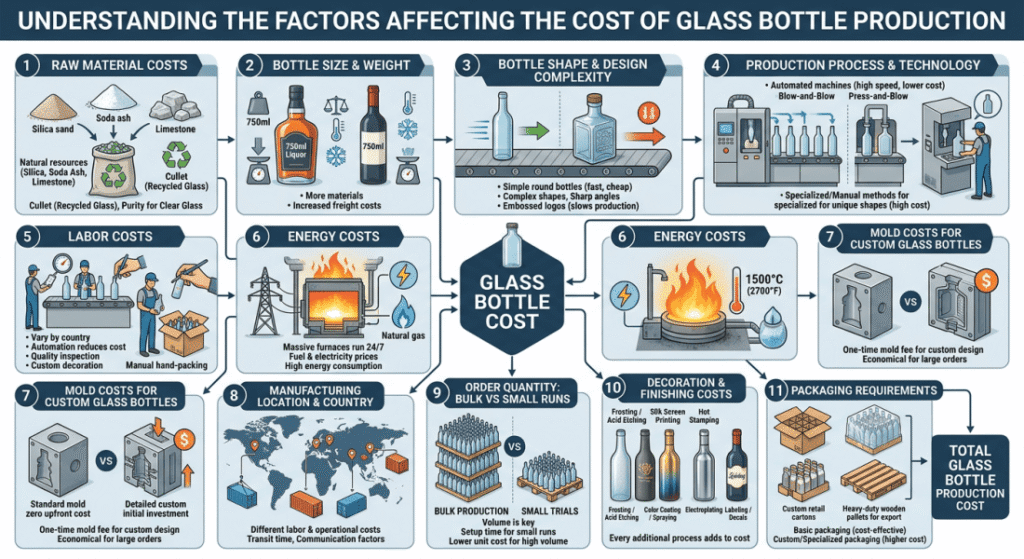
To truly understand your quote, you must look behind the curtain. The glass bottle production cost is not just a random number pulled out of thin air; it is the sum of several complex, interconnected factors.
Raw Material Costs
Glass is made from abundant natural resources, primarily silica sand, soda ash, and limestone. People often ask, is glass expensive? While the raw materials themselves are relatively cheap, the purity and quality required for clear (flint) glass can drive up the price.
Additionally, manufacturers use “cullet”—which is recycled, crushed glass. Using cullet lowers the melting temperature in the furnace, saving energy. If you are looking at the price for recycled glass bottles, you will find that incorporating a high percentage of cullet can actually help stabilize manufacturing costs while boosting your brand’s eco-friendly credentials.
Bottle Size and Weight
This is a simple equation: larger bottles require more raw material, and heavier bottles take longer to cool down in the mold. If you want a 750ml liquor bottle with an ultra-thick glass base to signify luxury, you will pay significantly more than you would for a standard, lightweight 750ml wine bottle. Furthermore, heavier bottles drastically increase your shipping and freight expenses.
Bottle Shape and Design Complexity
During the glass bottles creation process, the shape of your container matters immensely. Simple, round bottles are the cheapest to produce because they release easily from the molds and travel smoothly down automated conveyor belts.
If your design includes square corners, asymmetrical shapes, sharp angles, or heavy embossed logos, the factory must slow down the production line to ensure the glass distributes evenly and does not crack. Slower production means higher costs per unit.
Production Process and Manufacturing Technology
Understanding how to make bottle glasses helps you see where the money goes. Most factories use one of two main methods: Blow-and-Blow (ideal for narrow-neck bottles like wine) or Press-and-Blow (ideal for wide-mouth jars).
Modern, fully automated IS (Individual Section) machines can pump out hundreds of bottles per minute, bringing the unit cost down significantly. If your bottle requires specialized, semi-automatic, or manual production methods due to its unique shape, your costs will skyrocket.
Labor Costs
Labor rates vary dramatically depending on the country and the specific factory. While the actual forming of the glass is highly automated, labor comes into play during quality inspection, custom decoration, and packaging. If your bottle requires manual application of decals or special hand-packing into premium custom cartons, labor costs will become a major line item on your invoice.
Energy Costs
Glass production requires massive furnaces that run 24 hours a day, 7 days a week, reaching temperatures over 1,500°C (2,700°F). Fuel and electricity prices strongly affect the final price. When global energy prices surge, factories are often forced to pass those costs onto buyers through energy surcharges.
Mold Costs for Custom Glass Bottles
If you want a bottle that is 100% unique to your brand, you must pay for a custom mold. Standard molds carry zero upfront cost for you. A custom mold, however, is a high initial investment. You must pay a one-time mold fee before production begins. However, once that mold is paid for, the per-unit cost drops. For massive, long-term orders, a custom mold becomes incredibly economical.
Manufacturing Location and Country Differences
Where your bottles are made changes everything. Sourcing from regions like China, India, or Southeast Asia generally offers lower labor and operational costs compared to the US or Europe. However, you must factor in the transit time and communication differences. A lower factory price does not always guarantee a lower total cost once logistics are factored in.
Order Quantity: Bulk Production vs Small Runs
In glass manufacturing, volume is king. Factories operate on incredibly tight margins, and changing a mold on a machine takes hours of downtime. Therefore, high-volume orders drastically reduce your unit cost. Conversely, small trial runs have higher per-unit pricing due to the setup time and lower production efficiency. If you are buying amber bottles bulk, for instance, you will secure a much better price than ordering a few pallets at a time.
Decoration and Finishing Costs
A plain, clear bottle is just the beginning. Most brands want to stand out on the shelf, and that requires decoration. Every additional process adds to your cost:
Frosting / Acid Etching: Gives a premium, matte finish.
Silk Screen Printing: Printing your logo directly onto the glass.
Hot Stamping: Adding metallic gold or silver foils.
Color Coating / Spraying: Painting the outside of the bottle.
Electroplating: Giving the bottle a shiny, metallic look.
Labeling and Decals: Applying physical stickers or water-transfer decals.
Packaging Requirements
How do you want your bottles packed? Standard cardboard boxes with simple dividers are the most cost-effective. If you require shrink-wrapping, custom-printed retail cartons, heavy-duty wooden pallets, or specialized protective packaging for overseas export, your factory will charge accordingly.
What Additional Costs Should Businesses Consider?
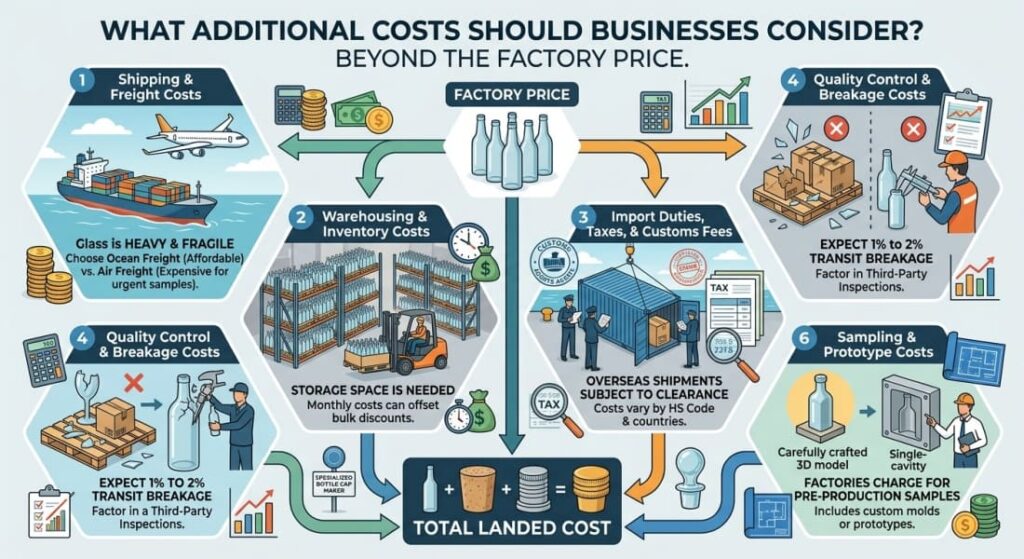
One of the biggest mistakes new buyers make is confusing the “factory price” with the “total landed cost.” When calculating your budget, you must look at the full picture.
Shipping and Freight Costs
Glass is incredibly heavy and fragile, making logistics a massive part of your budget. Whether you use ocean freight (which is standard and more affordable) or air freight (which is exorbitantly expensive and only used for urgent, small samples), transportation will add a significant percentage to your total cost.
Warehousing and Inventory Costs
Once the bottles arrive, where will you put them? Storing empty glass bottles takes up a lot of square footage. You need to calculate your monthly warehousing costs. Ordering too much inventory to get a cheaper unit price can sometimes backfire if storage fees eat up your savings.
Import Duties, Taxes, and Customs Fees
If you are buying from an overseas manufacturer, your shipment will be subject to customs clearance. Import duties vary wildly depending on the destination country, the origin country, and the specific HS (Harmonized System) code of the glass bottles. Always consult with a freight forwarder to calculate these taxes beforehand.
Quality Control and Breakage Costs
Glass breaks. It is a simple fact of the business. You need to factor in the wine bottle breakage rate shipping statistics when you plan your budget. While a good manufacturer will pack the bottles securely, standard industry allowances expect a 1% to 2% breakage rate during long-haul transit. You should also consider the cost of hiring third-party inspection agencies to check the quality before the containers leave the factory.
Closure and Accessory Costs
A bottle is useless without a way to seal it. You need to source caps, corks, or pumps, often from a specialized bottle cap maker. Whether you need an aluminum screw cap for a water bottle, a natural cork for wine, a high-end glass stopper for tequila, or a fine mist sprayer for perfume, closures must be calculated into your per-unit cost.
Sampling and Prototype Costs
Before committing to an order of 50,000 bottles, you need to see a sample. Factories charge for pre-production samples. If you are doing a custom mold, you will likely pay for an acrylic prototype or a single-cavity sample mold run to test the design before full mass production begins.
Standard Bottles vs Custom Bottles: Which Is More Cost-Effective?
Many business owners debate whether they should pick an off-the-shelf design or invest in a proprietary mold. The answer depends on your brand’s stage of growth, your budget, and your marketing strategy. Let’s look at the true glass bottle worth in both scenarios.
When Standard Bottles Are the Better Choice
If you are a startup, launching a pilot product, or testing a new market, standard bottles are your best friend.
Zero Mold Investment: You save thousands of dollars upfront.
Faster Lead Time: The molds are ready, so production can begin quickly.
Lower MOQ: Factories are much more willing to accept smaller Minimum Order Quantities for standard shapes.
When Custom Bottles Are Worth the Cost
If you are an established brand looking to dominate a shelf, standard bottles might blend in too much.
Brand Identity: A custom shape instantly communicates your brand’s unique identity. Think of the iconic Coca-Cola contour bottle.
Premium Positioning: Consumers naturally perceive custom, heavy, uniquely shaped bottles as higher quality, allowing you to charge a premium retail price.
Counterfeit Protection: A custom mold with your logo embossed into the glass makes it incredibly difficult for counterfeiters to copy your product.
Cost Comparison Between Standard and Custom Glass Bottles
When doing a cost comparison, look at the timeline. A standard bottle has a lower upfront cost and a faster time to market. A custom bottle requires a few thousand dollars upfront and adds 4 to 8 weeks to your timeline for mold development and sampling. However, if your brand sells hundreds of thousands of units, the branding value and market differentiation far outweigh the initial mold fee.
How to Reduce Glass Bottle Manufacturing Costs
Now that you know what drives the glass bottle manufacturing cost up, how can you strategically bring it down? Here are actionable ways to save money without sacrificing the quality of your packaging.
Choose the Right Bottle Mold
If you don’t strictly need a custom shape, don’t pay for one. Browse your manufacturer’s catalog thoroughly. Often, you can find a standard mold that looks unique, and you can differentiate it with beautiful custom labels and unique caps instead of paying for a new glass mold.
Optimize Bottle Weight and Size
“Lightweighting” is a massive trend in the packaging industry. By redesigning a bottle to use 10% to 20% less glass while maintaining its structural integrity, you save money on raw materials and drastically reduce your shipping freight costs. Selecting a slightly smaller, more efficient capacity can also yield huge savings.
Increase Order Volume Strategically
Consolidate your orders. Instead of ordering 10,000 bottles every two months, plan your cash flow so you can order 60,000 bottles at once. Factories will almost always offer you a significantly lower unit price for larger, continuous production runs.
Optimize Shipping and Packaging
Work with your manufacturer to improve pallet loading efficiency. The goal is to fit as many bottles as safely possible into a 40HQ shipping container. Less “dead space” means you are paying less freight per bottle. Also, choose cost-efficient but highly protective cardboard dividers rather than overly expensive custom retail boxes for the transit phase.
Work With an Experienced Manufacturer
Partnering with a veteran factory means better process control, a lower defect rate, and more reliable lead times. An experienced partner will warn you if a bottle design is prone to cracking, saving you from a costly manufacturing disaster.
Balance Customization With Budget
Focus your budget on the features that matter most to your target audience. Do you really need the entire bottle spray-painted, or would a high-quality silk-screened logo on clear glass achieve the same elegance? Avoid overengineering the design.
Source From the Right Country or Region
Compare the total landed cost. Once you add ocean freight, import duties, and warehouse transport, the gap closes. Weigh the logistics, communication ease, and reliability before making a decision based solely on the cheapest factory quote.
Why Smilebottles Is a Reliable Partner for Cost-Effective Glass Bottles
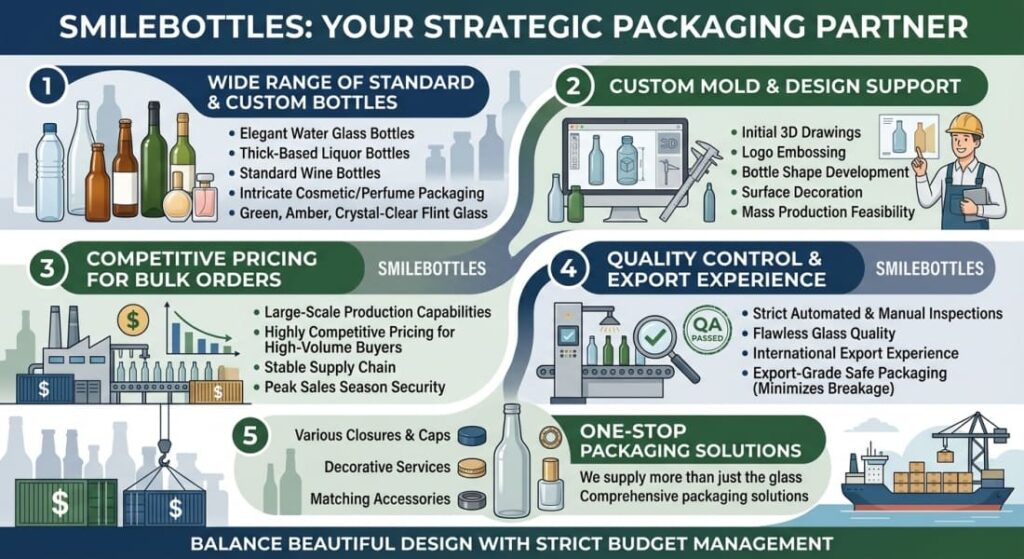
When you are searching for a custom glass bottle manufacturer, you need more than just a factory; you need a strategic packaging partner. At Smilebottles, we focus on helping brands balance beautiful design with strict budget management.
Wide Range of Standard and Custom Glass Bottles
Whether you need an elegant water glass bottle for a premium hospitality brand, thick-based liquor bottles, standard wine bottles, or intricate cosmetic and perfume packaging, our catalog spans across all major industries. We help you choose the right green glass bottles, amber bottles, or crystal-clear flint glass to match your exact product requirements.
Custom Mold and Design Support
Our engineering team specializes in bottle shape development. From the initial 3D drawings to logo embossing and surface decoration options, we guide you through the entire custom mold process, ensuring your design is both stunning and structurally sound for mass production.
Competitive Pricing for Bulk Orders
Because of our large-scale production capabilities, we offer highly competitive pricing for high-volume buyers. We provide stable, reliable supply chains so you never have to worry about running out of packaging during your peak sales seasons.
Quality Control and Export Experience
With years of international export experience, we understand the rigors of global shipping. We utilize strict automated and manual inspection procedures to ensure flawless glass, and we use export-grade safe packaging to minimize transit breakage.
One-Stop Packaging Solutions
We don’t just supply the glass. We offer comprehensive solutions, including matching your bottles with the right closures, caps, and accessories, along with full decoration services.
If you are planning a glass bottle project, Smilebottles can help you evaluate the most cost-effective option based on your design, quantity, and target market.
FAQ: Frequently Asked Questions About Glass Bottle Manufacturing Costs
To round out your knowledge, here are answers to some of the most common questions buyers ask when planning their packaging budgets.
Q1:How much does it cost to make a water bottle?
A1: It depends on the volume and whether it includes a specialized screw-cap or swing-top mechanism.
Q2:Why are custom glass bottles more expensive?
A2:Custom bottles require the creation of unique metal molds, which require high-precision engineering. Additionally, custom shapes often run slower on the production line and require customized packaging dividers, all of which increase the final unit cost.
Q3:What is the cheapest type of glass bottle to produce?
A3:The cheapest bottles are small, standard-shaped, clear (flint) or amber glass bottles produced in massive quantities. Small essential oil bottles or standard beverage bottles bought in bulk offer the lowest price per unit.
Q4:Does recycled glass reduce bottle manufacturing cost?
A4:Yes, using cullet (recycled glass) lowers the melting temperature in the furnace, which reduces energy consumption. While it may not drastically slash your unit price, it helps stabilize costs against rising energy prices and makes your brand more sustainable.
Q5:How much does a custom glass bottle mold cost?
A5:Mold fees typically range from $1,500 to $5,000+, depending on the size of the bottle, the complexity of the design, and how many mold cavities the production machine requires.
Q6:Is it cheaper to manufacture glass bottles in China?
A6:Generally, yes. Manufacturers in China and other parts of Asia benefit from lower labor costs, robust supply chains, and massive economies of scale, often making the ex-factory price much cheaper than domestic production. However, buyers must always factor in shipping and import duties.
Q7:What is the MOQ for custom glass bottles?
A7:For standard bottles, MOQs can be as low as 10,000 units. For custom glass bottles, factories usually require a Minimum Order Quantity of 30,000 to 50,000 units to justify the machine setup and downtime.
Q8:How can I reduce shipping costs for glass bottles?
A8:To lower freight costs, optimize your bottle’s weight (lightweighting), maximize the number of bottles that fit on a single pallet, and order in full container loads (FCL) rather than less-than-container loads (LCL).
Q9:Are lightweight glass bottles cheaper?
A9:Yes. Lightweight bottles use less raw silica and soda ash, process faster, and significantly reduce your shipping weight, leading to savings in both manufacturing and logistics.
Q10:What is included in the total cost of a glass bottle?
A10:The total landed cost includes the factory unit price, mold fees (if custom), decoration/printing fees, closures/caps, packaging materials, quality inspection, ocean/air freight, warehousing, and import taxes.
Conclusion
Whether your brand requires standard, eco-friendly green glass or a fully customized luxury spirit bottle, balancing cost, quality, and branding is the key to retail success.
If you are looking for affordable, high-quality standard or custom glass bottles, Smilebottles can help you find the perfect packaging solution tailored to your business needs. Reach out to our team today to get a detailed, transparent quote for your next project.
 English