
Table of Contents
ToggleAuthor: SmileBottles Editorial Team
Estimated Reading Time: About 15 Minute
The right glass bottle sprayer transforms a simple liquid into a luxurious experience. If you are sourcing packaging for your product line, you have probably asked yourself: what are the different types of spray bottle closures available? Which one will work best with my formula? How do I avoid costly mistakes when ordering thousands of units?
This comprehensive guide answers all these questions and more. Smilebottles will walk you through everything you need to know about glass bottle sprayers—how they work, the main types available, their advantages and disadvantages, and exactly how to choose the right one for your specific needs. By the time you finish reading, you will have the knowledge to make confident purchasing decisions and find the perfect packaging solutions for your brand.
What Is a Sprayer for a Glass Bottle?
A sprayer is a dispensing closure that attaches to the opening of a bottle. Its job is simple but essential: it takes liquid from inside the bottle and converts it into a spray, mist, stream, or foam that your customer can easily apply.
When you think about it, the sprayer is the interface between your product and your customer. Every time they use your perfume, toner, or room spray, they interact directly with this small mechanical device. That is why choosing the right one matters so much.
Sprayers are commonly used across many industries, including:
Perfume and cologne
Facial mists and toners
Body sprays
Essential oil blends
Hair care products
Room and linen sprays
Household cleaning products
Skincare serums and essences
Each of these products has different requirements. A luxury perfume needs an ultra-fine mist that feels invisible on the skin. A cleaning spray needs powerful output to cover large surfaces quickly. A serum needs precise dosage control so customers do not waste expensive product.
Why Sprayers Matter in Product Packaging
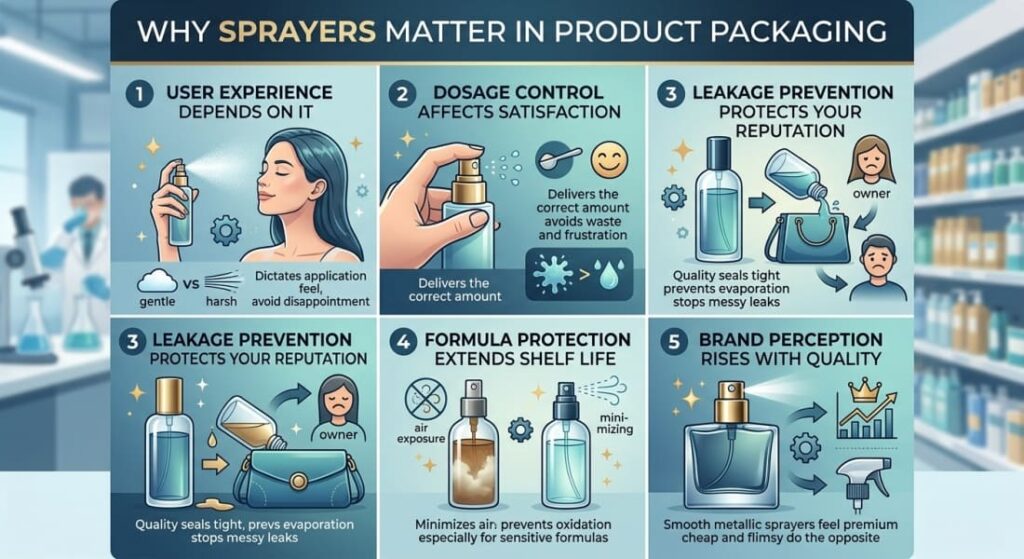
You might wonder why you should spend so much time thinking about sprayers when you have dozens of other business decisions to make. Here is why this component deserves your attention:
User experience depends on it. Imagine your customer purchases your premium facial mist. If the sprayer shoots out a harsh stream instead of a gentle cloud, they will be disappointed—regardless of how good your formula is. The sprayer dictates how your product feels during application.
Dosage control affects product satisfaction. The right sprayer delivers the correct amount of product with each pump. Too much output wastes the formula and frustrates customers. Too little makes them pump repeatedly, which feels tedious. Getting this balance right matters.
Leakage prevention protects your reputation. A leaky sprayer can ruin handbags, shipping boxes, and customer trust. Quality sprayers seal tightly to prevent evaporation of alcohol-based products and stop messy leaks during shipping.
Formula protection extends shelf life. Some sprayers are designed to minimize air exposure, which helps preserve sensitive formulas. This is especially important for skincare products that can oxidize or degrade when exposed to air repeatedly.
Brand perception rises with quality. When your customer picks up a heavy glass bottle with a smooth, metallic sprayer that clicks satisfyingly, they perceive your product as premium. Cheap, flimsy sprayers do the opposite.
How Does a Bottle Sprayer Work?
Before you choose a sprayer, it helps to understand the mechanics behind it. Many buyers wonder, how do spray bottles work? Once you understand the basic mechanism, you will find it much easier to evaluate different options.
At its core, a sprayer is a simple pump. It uses pressure and suction to move liquid from the bottom of the bottle up through a tube and out through a nozzle. The spray bottle pump mechanism involves several components working together seamlessly.
The Pump Mechanism
The pump is the heart of any sprayer. When you press down on the actuator (the button on top), you compress a small spring inside. This pushes a piston downward, which forces liquid that is sitting in the pump chamber out through the nozzle.
When you release the actuator, the spring pushes the piston back up. This upward movement creates a vacuum inside the chamber. Because liquids always flow toward lower pressure, the vacuum pulls fresh liquid up from the bottle to refill the chamber. This is why the first few pumps of a new sprayer sometimes produce nothing—you are “priming” the pump, filling the chamber for the first time.
The Dip Tube
The dip tube is the long, thin plastic straw that extends from the bottom of the pump down into the liquid. It acts as the transport pathway for your formula. Getting the dip tube length right is critical.
If the tube is too short, it will not reach the liquid when the bottle is nearly empty, leaving unusable product at the bottom. Your customers will think the bottle is empty when there is still product inside—frustrating for them and wasteful for your brand reputation.
If the tube is too long, it will bend against the bottom of the bottle, potentially restricting flow or causing the pump to malfunction. When ordering sprayers, always specify your exact bottle dimensions so the supplier can provide the correct tube length.
The Spray Nozzle Design
The spray nozzle design determines what kind of output your sprayer produces. Inside the tiny nozzle, there are microscopic channels and openings that force liquid to spin, break apart, or combine with air as it exits.
By changing the shape and size of these internal channels, manufacturers can create:
Ultra-fine mists for perfume
Soft, gentle mists for facial toners
Wider, wetter sprays for room fresheners
Powerful, direct streams for cleaning products
Rich foams for cleansers
The nozzle is often the most precisely engineered part of the sprayer because it directly controls the user experience.
Ball Valve or One-Way Valve
Inside the pump, there is usually a small ball valve (often made of metal or glass) or a one-way valve. This component serves an important purpose: it allows liquid to flow up into the pump chamber but prevents it from flowing back down into the bottle.
This one-way flow keeps the pump “primed” with liquid at all times. Without it, the liquid would drain back down after each use, and users would have to pump several times before getting any spray.
The valve also helps prevent leakage. When the sprayer is not in use, the valve seals the pathway, keeping liquid inside the bottle where it belongs.
Closure and Neck Finish Compatibility
Here is something many first-time buyers overlook: sprayers are not universal. They must match the specific “neck finish” of your glass bottle. The neck finish refers to the diameter and thread style of the bottle opening.
Common screw thread sizes include:
18/410 (18mm diameter, 410 thread style)
20/410
24/410
28/410
For perfume bottles, crimp necks are common. These are smooth glass necks (often 13mm, 15mm, or 18mm) where the metal collar of the sprayer is mechanically crimped onto the glass using a machine.
If your sprayer does not perfectly match your bottle’s neck finish, it will not seal properly. This leads to leaks, evaporation, and unhappy customers. Always confirm compatibility before placing bulk orders.
Main Types of Sprayers for Glass Bottles
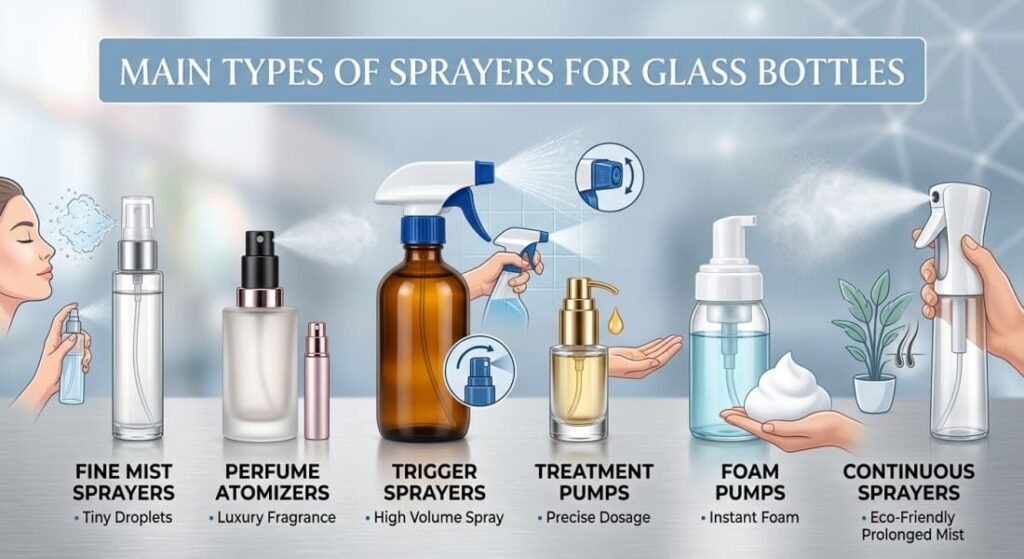
Now that you understand how sprayers work, let us explore the main types available. Each type is engineered for specific applications, and understanding the differences will help you make the right choice for your product.
Fine Mist Sprayers
Fine mist sprayers are among the most popular closures in the beauty and personal care industries. They are designed to break liquid into tiny droplets, delivering a soft, even cloud that settles gently on the target surface.
Best applications:
Facial mists and toners
Body sprays and body mists
Hair detanglers and light styling sprays
Diluted essential oil blends
Cosmetic setting sprays
Key features:
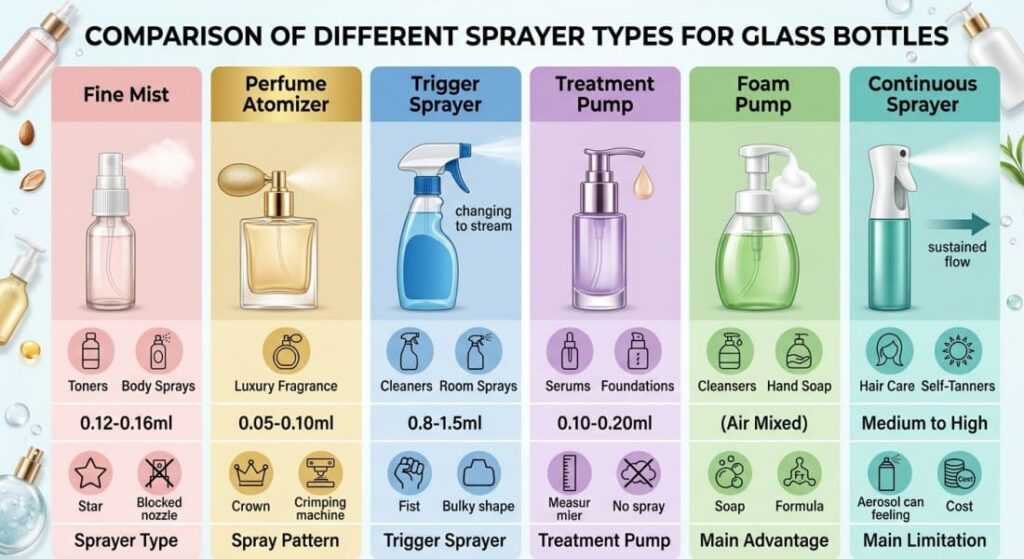
Fine mist sprayers typically dispense a small amount of liquid per pump—usually around 0.12ml to 0.16ml. This low output is intentional because facial and body products require light, controlled application. The actuator is usually smooth and easy to press with one finger, and most fine mist sprayers come with a clear or colored overcap to prevent accidental spraying.
Advantages:
Delivers a controlled, elegant application experience
Works perfectly with lightweight, water-like formulas
Creates a premium feel for beauty products
Prevents product waste through precise dosage
Disadvantages:
Will clog if your formula is too thick or contains particles
Not suitable for viscous liquids like lotions or heavy oils
Requires compatibility testing with your specific formula
Perfume Atomizer Sprayers
When you are searching for a perfume bottle sprayer, you are most likely looking at atomizers. These are specialized, premium sprayers designed specifically for fragrance products.
A good perfume spray pump produces an ultra-fine, almost invisible mist that distributes fragrance evenly across the skin. This is exactly what fragrance customers expect.
Best applications:
Fine perfumes and colognes
Luxury fragrance mists
Breath fresheners
Key features:
Most perfume atomizers use a crimp-on design rather than a screw-on design. The crimped closure creates a permanent, airtight seal that prevents alcohol from evaporating. The outer components often feature premium metallic finishes—shiny gold, matte black, brushed silver, or rose gold—to match the luxury positioning of fragrance products.
Advantages:
Creates the ultimate premium appearance
Delivers exceptional atomization for even fragrance distribution
Enhances the perceived value of your product significantly
Provides excellent protection against evaporation and tampering
Disadvantages:
Requires a crimping machine during the filling process
More specialized than standard sprayers
Needs compatibility testing with fragrance oils to ensure internal components do not degrade
If you are a perfume packaging supplier or brand owner, investing in high-quality atomizers is essential. Your customers expect perfume packaging to look and feel luxurious, and the atomizer is a big part of that experience.
Trigger Sprayers
A trigger sprayer bottle features a much larger, more robust closure than fine mist or atomizer sprayers. Instead of pressing down with a finger, users pull a trigger with multiple fingers. This lever action generates more force, which pulls a larger volume of liquid through the pump.
Best applications:
Household cleaning products
Room sprays and air fresheners
Plant care and garden mists
Auto care products
Professional hair care products in large bottles
Key features:
Trigger sprayers dispense a high volume of liquid per pull—often 0.8ml to 1.5ml or more. Most feature an adjustable nozzle that allows users to twist between a fine mist, a direct stream, and an off position for safety during storage.
Advantages:
Powerful, high-output spray covers large areas quickly
Ergonomic design is comfortable for repeated use
Adjustable nozzles add versatility
Durable construction handles heavy use
Disadvantages:
Bulky appearance is not suitable for luxury cosmetics or small bottles
Takes up more shipping space due to size and shape
Generally not appropriate for products meant to feel premium or delicate
Treatment Pumps
Treatment pumps are technically pumps rather than sprayers, but they belong in this discussion because buyers often compare them when choosing closures for glass bottles.
Instead of creating a mist, a treatment pump dispenses a precise, controlled drop of liquid. This makes it ideal for high-value products where dosage control matters.
Best applications:
Skincare serums and essences
Liquid foundations and concealers
Eye creams and treatments
Pharmaceutical topical liquids
Key features:
Treatment pumps deliver a very small amount per pump—usually around 0.10ml to 0.20ml. They are designed to dispense a clean drop into the user’s hand without splashing, dripping, or spraying.
Advantages:
Excellent dosage control for expensive formulas
Minimizes product waste
Keeps the product sanitary by reducing air exposure
Creates a premium user experience
Disadvantages:
Does not create a mist or spray pattern
Only suitable for direct application to hands or skin
Not appropriate for products that need wide coverage
Foam Pumps
Foam pumps are unique closures that mix liquid with air as the product is dispensed, instantly transforming a thin liquid into a rich, fluffy foam.
Best applications:
Foaming facial cleansers
Hand soaps
Shaving products
Lash and brow cleansers
Key features:
The internal mechanism contains a mesh screen that aerates the liquid as it passes through, creating foam instantly. This means users get ready-to-use foam without having to work the product between their hands.
Advantages:
Creates a luxurious, ready-to-use foam experience
Significantly reduces product consumption (a small amount of liquid makes a lot of foam)
Very convenient for customers
Disadvantages:
Your formula must be specifically designed to foam (typically water-thin with high surfactant content)
The closure is bulky and requires a wider bottle neck
Not all formulas are compatible
Continuous Sprayers
Continuous sprayers represent a modern evolution in dispensing technology. Unlike traditional sprayers that stop misting the instant you release the actuator, continuous sprayers deliver a prolonged, steady mist for several seconds after a single press.
Best applications:
Hair styling mists
Facial beauty water
Self-tanning sprays
Plant misting
Large-area room fresheners
Key features:
These sprayers provide an aerosol-like experience without using pressurized propellant gases. They are increasingly popular as brands look for eco-friendly alternatives to traditional aerosol cans.
Advantages:
Delivers extremely smooth, even coverage
Modern and user-friendly experience
More environmentally friendly than aerosol cans
Great for products that need wide, even distribution
Disadvantages:
Higher cost per unit than standard sprayers
More complex internal mechanism
May require more rigorous testing
Comparison of Different Sprayer Types for Glass Bottles
To help you quickly compare your options, here is a summary table:
Pros and Cons of Each Sprayer Type: A Buyer’s Perspective
When you are sourcing packaging for perfume bottles or other cosmetic products, you need to consider both the end-user experience and your business operations.
Fine Mist Sprayers offer the best balance of cost and performance for most beauty applications. They are easy to source, come in many colors and finishes, and fit standard screw-neck glass bottles. However, they will clog if your formula contains any particles or becomes too viscous—a problem that can lead to mass returns if not caught during testing.
Perfume Atomizers are non-negotiable if you want to be taken seriously in the fragrance market. They signal luxury instantly. The tradeoff is operational complexity: you need crimping equipment or must partner with a contract filler who has it. This adds a step to your production process.
Trigger Sprayers are workhorses for cleaning products, room sprays, and large-format hair care. They are durable and functional but take up significant shipping space. When you calculate freight costs for thousands of units, the bulky shape can make a noticeable difference.
Treatment and Foam Pumps position your product as premium skincare, but they have narrower applications. Make sure your formula is appropriate before committing.
How to Choose the Right Sprayer for Your Glass Bottle
Making the wrong sprayer choice can result in returns, customer complaints, and wasted inventory. Here is a systematic approach to choosing correctly.
Based on Product Formula
Your liquid’s thickness (viscosity) is the most important factor. Water-like liquids work perfectly with fine mist sprayers and atomizers. Thicker formulas need treatment pumps. If your product contains suspended particles like shimmer or exfoliating beads, you need specialized nozzles with wider channels.
If you are filling an essential oil spray bottle, be extra careful. Essential oils can degrade certain plastics over time. Make sure your supplier confirms that the internal components are chemically resistant.
Based on Spray Pattern
Consider how your customer will apply the product. A delicate facial mist needs a soft, gentle spray pattern. A room freshener needs wider coverage. A targeted treatment might need a more focused output.
Based on Output Volume
How much product should come out with each pump? A concentrated, expensive serum should have very low output (around 0.10ml) to prevent waste. An air freshener needs higher output (around 1.0ml or more) to effectively scent a room.
Based on Bottle Neck Finish
This is critical. Confirm that the sprayer’s closure dimension matches your bottle’s neck finish exactly. If you are ordering custom perfume bottles, decide on a standard neck finish during the design phase so you have plenty of sprayer options.
Based on Material Compatibility
High-alcohol perfumes and concentrated essential oils require sprayers with resistant internal components. Request material specifications from your supplier and conduct compatibility testing before committing to large orders.
Based on Brand Positioning and Appearance
Your sprayer should match your brand image. If you sell luxury products, choose metallic finishes and heavy-feeling components. If you are an eco-conscious brand, ask about PCR (post-consumer recycled) plastic options or matte, natural-looking finishes.
Based on Performance Testing
Never skip testing. Any reputable cosmetic packaging supplier will provide samples. Fill your actual bottles with your actual formula, attach the sprayers, and test thoroughly:
Does the spray pattern remain consistent?
Does it leak when stored upside down?
Does it still work after sitting for a month?
Does the formula degrade the internal components?
Common Applications of Sprayer Glass Bottles
Different industries have different packaging expectations. Here is what typically works best for each application.
Perfume and Fragrance
When creating custom glass spray bottles for fragrance, atomizers are the standard. Customers expect luxury glass bottles paired with metallic, crimp-on sprayers that deliver invisible, even mists. If you are looking for perfume bottles wholesale or working as a perfume bottle manufacturer, investing in quality atomizers is essential.
Many brands also offer refillable perfume spray bottle options as sustainability becomes more important to consumers.
Skincare and Cosmetics
For facial mists, setting sprays, and toners, fine mist sprayers are standard. For serums and liquid foundations, treatment pumps are preferred because they offer precise dosage and keep products sanitary.
Essential Oils and Aromatherapy
Glass is the only acceptable material for essential oils because they degrade plastic over time. For diluted aromatherapy blends, fine mist sprayers work well. For pure concentrates, treatment pumps or Euro droppers are more appropriate.
Room Spray and Home Fragrance
Smaller, upscale room sprays (100ml or less) often use high-output fine mist sprayers. Larger volumes (250ml to 500ml) typically require trigger sprayers to push enough liquid into the air.
Household and Cleaning Products
More consumers are seeking attractive glass bottles for their cleaning products. These are almost always paired with durable trigger sprayers for maximum efficiency.
Why Partner with Smilebottles for Sprayer Glass Bottles
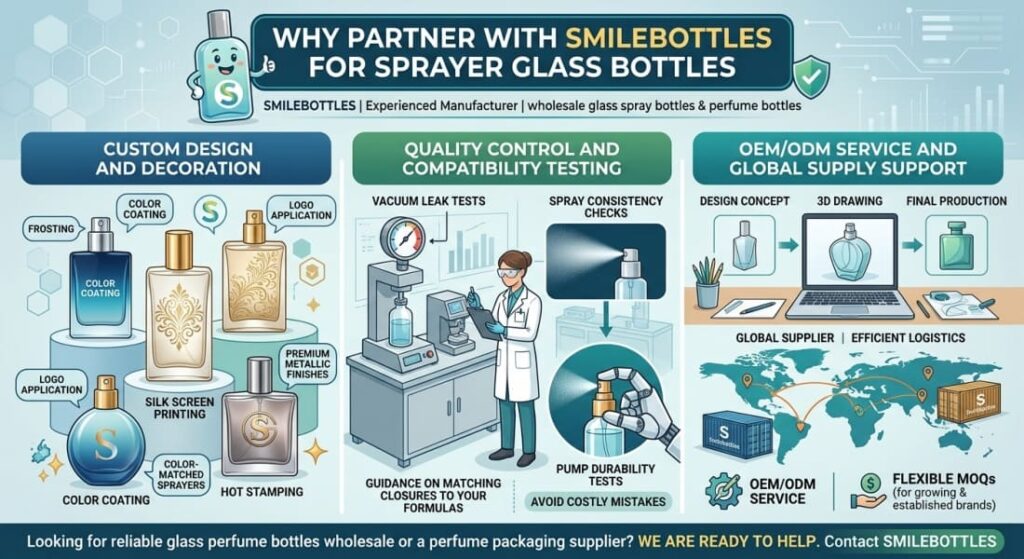
When you source packaging, finding the right partner makes everything easier. As an experienced glass bottle manufacturer, Smilebottles understands the relationship between glass containers and their closures.
Whether you need wholesale glass spray bottles for a new product launch or empty perfume spray bottles wholesale for an established line, we provide the expertise and infrastructure to support your business.
Custom Design and Decoration
We help you build a distinctive brand. Our customization options include color coating, silk screen printing, hot stamping, frosting, and logo application for glass bottles. We also offer color-matched sprayers and premium metallic finishes.
Quality Control and Compatibility Testing
We perform vacuum leak tests, spray consistency checks, and pump durability tests. We also provide guidance on matching closures to your specific formulas, helping you avoid costly mistakes.
OEM/ODM Service and Global Supply Support
If you have a unique design concept, our OEM/ODM services can bring it to life—from 3D drawings to final production. As a global supplier, we handle logistics efficiently and offer flexible MOQs for both growing brands and established corporations.
If you need glass perfume bottles wholesale or are searching for a reliable perfume packaging supplier, we are ready to help.
FAQ: Frequently Asked Questions About Glass Bottle Sprayers
Q1:What is the difference between a fine mist sprayer and a trigger sprayer?
A1:A fine mist sprayer is small, operated with one finger, and delivers a gentle cloud of mist. A trigger sprayer is larger, operated with multiple fingers, and delivers a higher volume of liquid. Fine mist sprayers are ideal for cosmetics; trigger sprayers are better for cleaning products and room sprays.
Q2:Can all sprayers fit any glass bottle?
A2:No. Sprayers must match the bottle’s neck finish—both diameter and thread style. Using an incompatible sprayer causes leaks and poor performance.
Q3:How do I choose a sprayer for a custom glass bottle?
A3:If you are designing custom bottles, select a standard neck finish (like 18/410 screw or 15mm crimp) during the design phase. This ensures you have many compatible sprayer options available.
Q4:Why does a bottle sprayer stop working?
A4:Common causes include clogged nozzles (from thick or sticky formulas), incorrect dip tube length, chemical incompatibility with the formula, or mechanical failure of internal components.
Q5:Are glass bottle sprayers reusable?
A5:Many screw-on sprayers can be reused, making them suitable for refill programs. Crimp-on atomizers are permanently attached and cannot be removed without breaking the bottle.
Q6:What is the most common sprayer for perfume glass bottles?
A6:Crimp-on perfume atomizers are most common for luxury fragrances. They provide secure sealing against evaporation and deliver the ultra-fine mist that fragrance customers expect.
Q7:Which sprayer is best for essential oil glass bottles?
A7:For diluted essential oil sprays, fine mist sprayers with chemically resistant components work well. Always conduct compatibility testing because essential oils can damage standard plastics.
Conclusion
Choosing the right sprayer for your glass bottles is one of the most important packaging decisions you will make. From delicate perfume atomizers to powerful trigger sprayers, from precise treatment pumps to innovative continuous sprayers, each type serves specific needs.
The perfect match depends on your formula’s viscosity, your desired spray pattern, your dosage requirements, your bottle’s neck finish, and your brand positioning. Take the time to understand these factors, request samples, and test thoroughly before committing to bulk orders.
When you get it right, your packaging becomes a seamless extension of your product—protecting your formula, delighting your customers, and elevating your brand with every spray.
If you are ready to source high-quality glass bottles and sprayers, Smilebottles is here to help. Contact us today to discuss your project requirements and find the perfect packaging solutions for your brand.