Table of Contents
ToggleAuthor: SmileBottles Editorial Team
Estimated Reading Time: About 15 Minute
If you’re sourcing fragrance packaging for your brand, you’ve probably noticed something — there are way more options out there than most people realize. Walk into any perfume shop and you’ll see tall slim ones, chunky square ones, frosted ones, gold-capped ones, tiny rollers, big spray bottles. It can get overwhelming fast.
This guide breaks down the different types of perfume bottles, the sizes you’ll come across, and how to pick the one that actually fits your product. Whether you’re launching a new fragrance line, restocking your inventory as a wholesaler, or just trying to figure out what works for your customer base — this should help.
Why Your Choice of Glass Perfume Bottle Actually Matters
Let’s be honest — the bottle isn’t just a container. It’s the first thing your customer touches. It sits on their dresser. It goes in their bag. It says something about your brand before they even smell what’s inside.
Glass perfume bottles do a few jobs at once. They protect the fragrance from light and air (which is huge for shelf life), they show off your brand, and they affect how the perfume actually feels to use. A cheap-feeling bottle can ruin a great formula. A beautiful bottle can elevate an average one.
So when you’re picking fragrance glass bottles, you’re really making three decisions at the same time: how the perfume gets dispensed, what size makes sense for your customer, and what the design says about your brand.
What Are the Main Types of Perfume Bottles?
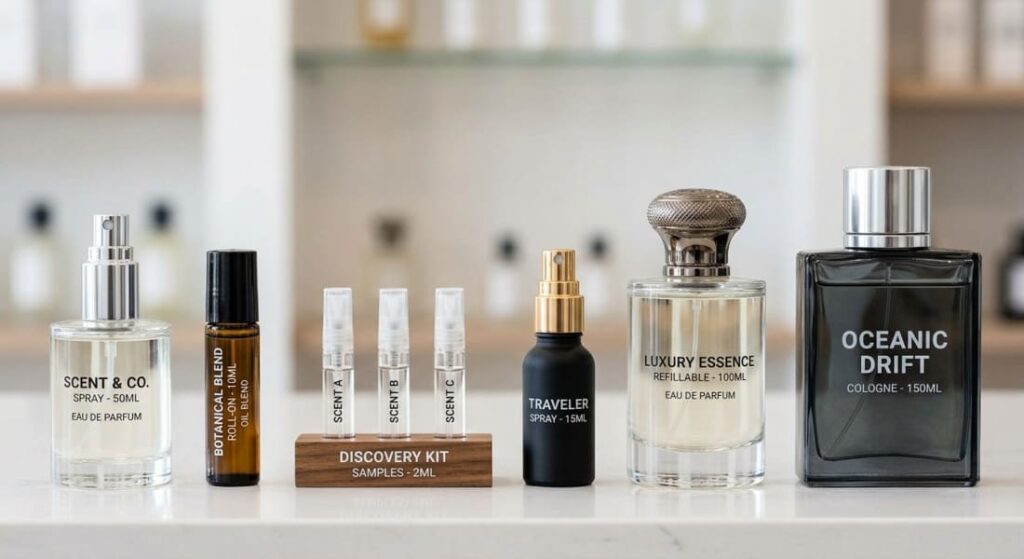
Here’s a quick answer if you’re skimming: Glass perfume bottles are mainly classified by how they dispense the fragrance — spray bottles, roll-on bottles, sample vials, travel-size bottles, and refillable bottles. They also vary by size (from 1ml samples up to 200ml luxury editions) and by design style.
Now let’s go deeper into each one.
Spray Perfume Bottles
These are what most people picture when they think “perfume bottle.” A glass body with an atomizer perfume bottle pump on top that turns the liquid into a fine mist when you press down.
Spray perfume bottles are the standard choice for alcohol-based perfumes — eau de parfum, eau de toilette, body mists, and pretty much any mainstream fragrance you’d find at a department store. The atomizer breaks the liquid into tiny droplets, which spreads the scent evenly and uses less product per application.
Common sizes you’ll see in retail:
10ml (purse size)
30ml (entry-level retail)
50ml (the most popular full-size)
100ml (large/value option)
If you’re building a fragrance line for general retail, this is almost certainly what you need. The perfume spray pumps can be customized too — crimp pumps for a more secure, premium feel, or screw-on pumps for refillable designs.
Roll-On Perfume Bottles
Roll on perfume bottles have a small ball at the top that rolls across your skin to apply the fragrance directly. They’re popular for oil perfume bottles because oil-based formulas don’t atomize well — spraying oil-based perfume just makes a sticky mess.
You’ll find perfume oil roller bottles mostly in these sizes: 3ml, 5ml, 8ml, and 10ml. They’re compact, leak-resistant, and easy to throw in a bag. A lot of indie perfume brands and aromatherapy companies use them because they’re affordable to produce and very travel-friendly.
Roll-ons work well for:
Perfume oils and attars
Essential oil blends
Sample-size offerings
Travel and on-the-go customers
Skin-application aromatherapy
Mini Perfume Bottles and Sample Vials
Mini perfume bottles and perfume sample bottles are tiny — usually 1ml, 2ml, 3ml, or 5ml. They might come as small spray bottles or as simple vials with a dab applicator.
These are gold for marketing. Perfume tester bottles let customers try a fragrance before committing to a full bottle. Discovery sets, subscription boxes, gifts-with-purchase, wedding favors — sample bottles do a lot of heavy lifting in the fragrance industry.
If you’re a brand owner, having glass perfume sample bottles in your lineup is almost essential now. People want to try before they buy, especially online where they can’t smell the product first.
Travel-Size Perfume Bottles
Travel size perfume bottles are designed to be portable and often refillable. Common sizes are 8ml, 10ml, 15ml, and 20ml. They’re small enough to pass airport security (anything under 100ml is generally fine) and sturdy enough to handle being tossed in luggage.
Some come as sprays, some as roll-ons. Many are refillable, which is a big plus for travelers who don’t want to buy a whole new bottle every time they go somewhere. Portable perfume bottles in this size range are especially popular for the gift market.
Refillable Perfume Bottles
Refillable perfume bottles are getting bigger every year. With sustainability becoming a real purchasing factor — not just a buzzword — more brands are launching refill programs.
The bottle itself is usually a higher-quality piece (heavier glass, premium cap) that the customer keeps. They buy refills in simpler, cheaper packaging and pour or pump the fragrance back into the original bottle.
This works well for:
Eco-conscious brands
Premium and luxury lines wanting to add value
Building long-term customer loyalty
Reducing packaging waste
For B2B buyers, refillable designs often need a little more thought — you’ll want pumps that come off cleanly, wide enough necks for refilling, and bottles built to last through multiple refill cycles.
Cologne Bottles
A cologne bottle is technically just a perfume bottle, but the term usually refers to bottles designed for men’s fragrances. These tend to be larger (75ml–200ml is common), often with squarer or more angular shapes, and frequently use darker glass — black, dark blue, smoky gray.
The best cologne bottles balance masculinity with elegance. Heavy glass bases, metal accents, and bold typography work well here. If you’re sourcing for a men’s grooming line, the best bottles perfume in this category often look noticeably different from women’s fragrance bottles.
Glass Perfume Bottle Sizes: A Complete Breakdown
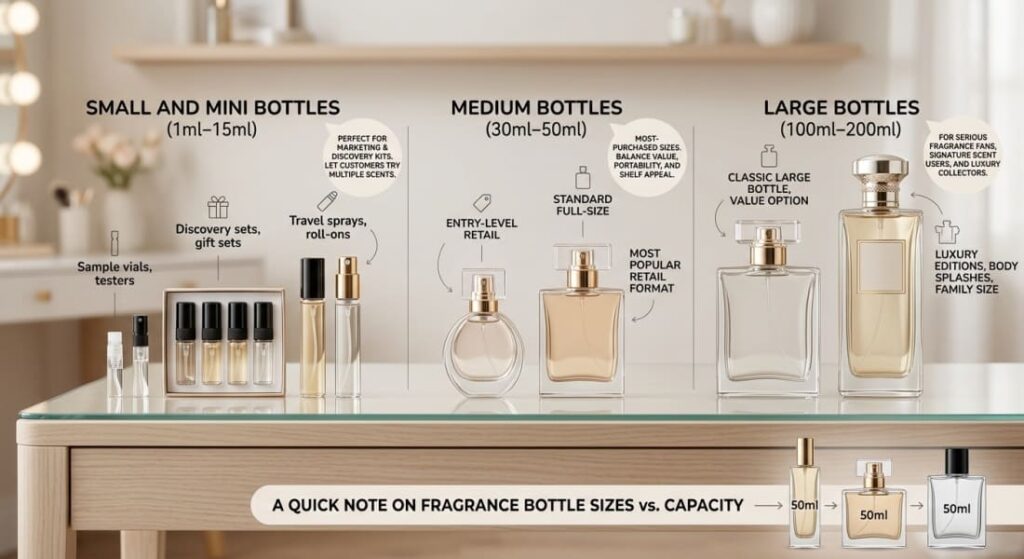
Size matters a lot when you’re planning your product line. Here’s a breakdown of standard perfume bottle sizes and what each one is typically used for:
Small and Mini Bottles (1ml–15ml)
Small glass perfume bottles in this range are mostly for samples, travel, and gift sets. They’re affordable to produce in bulk, perfect for marketing campaigns, and let customers try multiple scents without a big commitment.
If you’re running promos or building discovery kits, this is your range.
Medium Bottles (30ml–50ml)
This is the sweet spot for most retail fragrance brands. Perfume bottles 30ml and perfume bottles 50ml are the most-purchased sizes in the industry. They balance value, portability, and shelf appeal really well.
A 50ml bottle gives the customer enough product to feel like they got their money’s worth, but it’s still small enough to look elegant on a vanity or in a display.
Large Bottles (100ml–200ml)
Large perfume bottles are for serious fragrance fans, signature scent users, and luxury collectors. They have more surface area for branding and decoration, look impressive on a shelf, and often justify a premium price point.
100ml is the classic “big bottle” size you see in most department stores. 150ml and 200ml are usually reserved for special editions or body splash products.
A Quick Note on Fragrance Bottle Sizes vs. Capacity
Sometimes the “size” of a bottle and its actual fill capacity aren’t quite the same. Fragrance bottle sizes are typically labeled by the volume of liquid inside, not the external dimensions of the glass. A 50ml bottle might look pretty different depending on the design — tall and slim vs. short and wide — even though they hold the same amount.
Glass Perfume Bottles by Design and Style
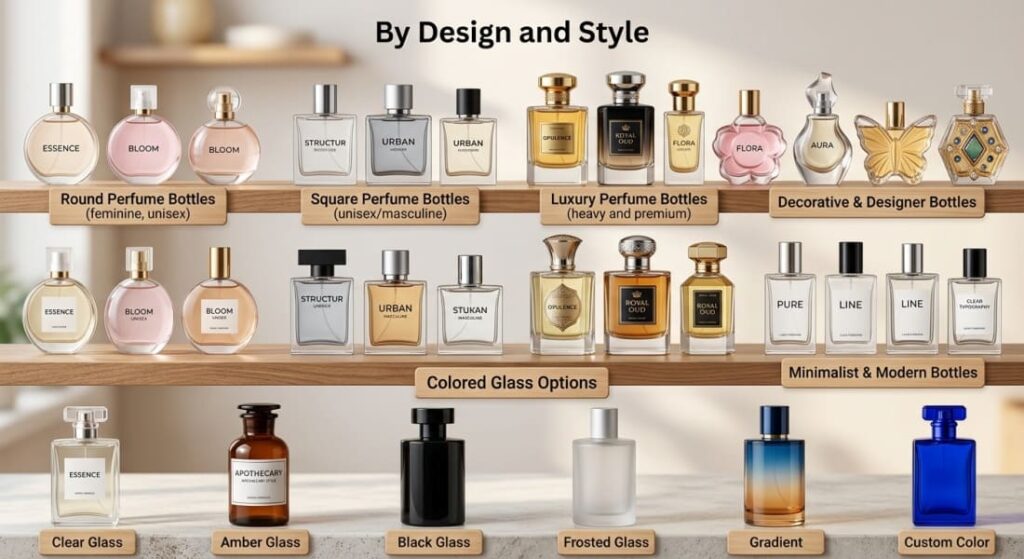
Beyond function, design is huge. The look of your bottle is part of your brand identity. Here are the main style categories you’ll be choosing between.
Round Perfume Bottles
Round perfume bottles are timeless. They feel soft, classic, and approachable. They’re easy to hold, easy to label, and work for almost any kind of fragrance — feminine, unisex, even some masculine designs.
If you want something safe and universally appealing, round is a good starting point.
Square Perfume Bottles
Square perfume bottles feel more modern and structured. They’re popular for unisex and men’s fragrances because of the cleaner geometry. They also stack and ship more efficiently, which is a small but real benefit if you’re moving a lot of inventory.
Square bottles give you flat surfaces for printing logos and labels — easier for perfume bottle printing and decoration.
Luxury Perfume Bottles
Luxury perfume bottles and luxury glass perfume bottles are about weight, finish, and detail. Thick glass bases, premium metal caps, polished surfaces, and sometimes hand-applied finishes. When a customer picks one up, it should feel substantial — like quality.
These bottles cost more to make and often involve specialty molds, but for high-end brands they’re essential. The unboxing experience matters at this price point.
Decorative and Designer Perfume Bottles
Decorative perfume bottles and designer perfume bottles push the design further — sculptural shapes, embedded details, themed elements. Think bottles shaped like flowers, animals, abstract forms, or featuring elaborate decorative elements.
These unique perfume bottles make strong shelf statements. They cost more (you usually need a custom mold), but they create memorable products.
Minimalist and Modern Bottles
On the other end, minimalist bottles strip everything down — clean lines, simple geometry, often clear glass with subtle branding. This style appeals to younger demographics, niche brands, and lifestyle-focused fragrance lines.
Colored Glass Options
Colored glass perfume bottles add a whole layer of branding. Common color options:
Clear glass perfume bottles — show off the liquid color, modern and clean
Amber — classic, protective against UV light, popular for natural and apothecary brands
Black — bold, often used for masculine or edgy fragrances
Frosted glass perfume bottles — soft, elegant, slightly diffused look
Gradient — eye-catching, premium feel
Custom colors — full brand customization
Why Glass Is the Standard for Perfume Bottles
You might wonder why fragrance is almost always packaged in glass. There are real reasons.
Glass is chemically inert. It doesn’t react with the perfume’s alcohol or essential oils, which means it won’t change the scent or break down over time. Plastic can leach chemicals into the fragrance and degrade with exposure to certain ingredients. Glass just sits there and protects the product.
It also blocks light better (especially with darker tints), looks and feels more premium, holds up to manufacturing processes like printing and frosting, and — importantly — is recyclable.
Speaking of which: yes, glass perfume bottles are recyclable. Most municipal recycling programs accept clean glass bottles. Customers should remove the pump or roller mechanism (those are usually plastic and metal mixed) before recycling, but the glass body itself goes right in the bin.
For brands focused on sustainability, glass is one of the easier wins.
How to Choose the Right Glass Perfume Bottle for Your Brand
Okay, so now you know what’s out there. How do you actually pick?
1. Start with Your Formula
This is the first filter. What’s in your bottle?
Alcohol-based perfume: Use spray bottles with quality atomizers. The alcohol carries the scent, the atomizer disperses it evenly.
Oil-based perfume or attar: Roll-on bottles work better. Oil doesn’t spray well and tends to clog atomizers.
Body mist or splash: Larger spray bottles or splash bottles with simple closures.
If you’re not sure what your formula needs, talk to your packaging supplier — they should be able to recommend compatible options.
2. Match the Size to Your Market
Think about how your customer actually uses the product:
Are they a daily user wearing the same scent? They want 50ml or 100ml.
Are they a fragrance collector who rotates a lot? Smaller bottles, 30ml or 50ml.
Are they buying gifts? 30ml–50ml is the gift sweet spot.
Are they trying you for the first time? Samples and 10ml minis.
3. Align Design with Brand Position
A luxury brand needs to look luxury. A fun, youthful brand can take more design risks. A clean, modern brand needs clean, modern packaging. Don’t fight your positioning — your bottle should reinforce it.
4. Think About the Practical Stuff
It’s easy to fall in love with a beautiful bottle and forget about logistics:
Does it ship without breaking too often?
Is the spray pump reliable across thousands of units?
Can it be filled efficiently in production?
Does the cap stay on during transport?
Can customers actually open and use it easily?
These boring questions matter. A gorgeous bottle that breaks 5% of the time in shipping is going to cost you.
5. Plan Your Customization
Will you need printing? Frosting? Custom colors? Hot stamping? Decide early because each adds time and cost. Working with a perfume bottle manufacturer that handles decoration in-house usually saves money compared to using separate vendors.
6. Understand MOQ and Lead Times
Minimum order quantities (MOQ) vary a lot. Stock bottles often have low MOQs — sometimes 500 or 1,000 units. Custom molded bottles usually require 5,000–10,000 units minimum and 60–90 days lead time.
Plan ahead. The most common mistake new brands make is underestimating lead times and ending up rushed.
Customization Options for Glass Perfume Bottles
Working with a glass perfume bottle manufacturer opens up a lot of customization paths. Here are the main ones.
Shape Customization
Custom glass perfume bottles with unique molds give you complete shape freedom. This requires creating a new mold (an investment of usually a few thousand dollars), but the result is a bottle that’s 100% yours. Great for brands that want to be visually distinctive on shelves.
Custom perfume bottle design can range from small tweaks to existing molds (changing height or width slightly) to fully original sculptural pieces.
Color and Finish
You can specify almost any color — solid, gradient, frosted, metallic. Common options:
Spray coating (full color or gradient)
Frosting (sandblasted or chemical)
UV coating (high-gloss or matte)
Tinted glass (color in the glass itself)
Decoration Techniques
Decoration brings your brand to life on the bottle:
Silk screen printing — flat or curved surface logos and text
Hot stamping — metallic foil effects (gold, silver, custom colors)
UV printing — full-color images
Engraving — etched designs
Decals and labels — for smaller runs or detailed graphics
Caps, Pumps, and Components
Don’t underestimate the importance of perfume bottle caps. The cap is what the customer sees first and often what they touch most. Options include:
Plastic caps (lightweight, affordable, can be customized)
Metal caps (premium feel, more weight)
Wooden caps (natural, eco-friendly look)
Magnetic caps (luxury feel, satisfying close)
Custom-shaped caps (full brand expression)
The parts of perfume bottle all need to work together. Perfume bottle components include the bottle, the inner shaft (the dip tube inside), the pump or roller mechanism, the collar (the metal or plastic ring around the neck), and the cap. Quality matters at every level.
Full Packaging Solutions
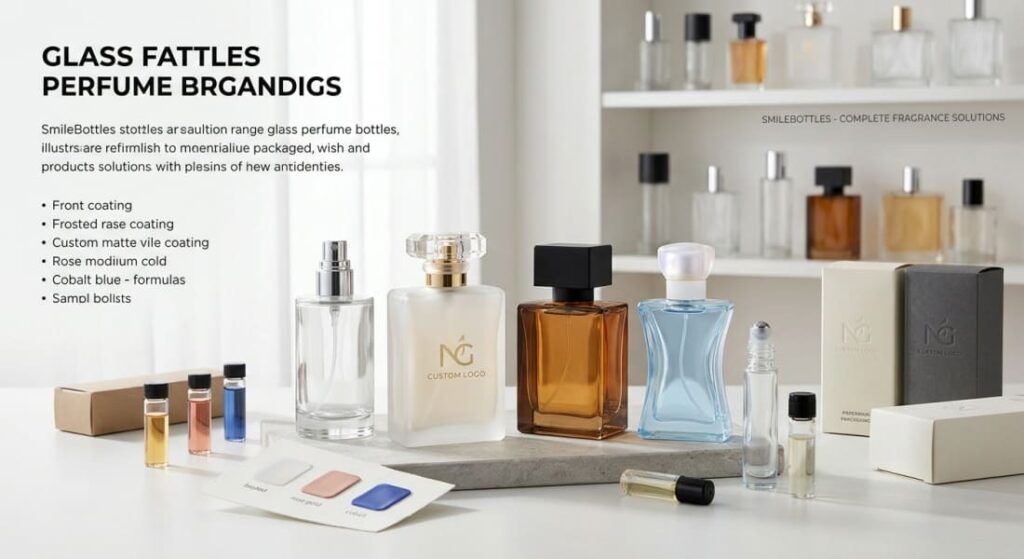
Perfume bottle packaging and fragrance bottle packaging go beyond the bottle itself. Custom fragrance packaging typically includes:
Outer rigid boxes
Inner inserts or cradles
Cellophane wrapping
Branded tissue paper
Sample cards or inserts
Tester boxes for retail
A good perfume packaging manufacturer can coordinate all these elements so your final product feels cohesive.
Sourcing: Wholesale and Custom Perfume Bottles
If you’re buying in volume, you have two main paths.
Wholesale Stock Bottles
Wholesale perfume bottles that are already manufactured and stocked are faster, cheaper, and good for testing the market. Most perfume bottle suppliers keep a range of standard empty fragrance bottles and empty glass perfume bottles in inventory. You buy them in cases, add your decoration, and you’re ready to fill.
This is the right path when:
You’re launching a new product and need to test demand
You don’t have huge volumes yet
You need fast turnaround
You don’t need a fully unique shape
Custom Manufacturing
If you want a one-of-a-kind bottle, you go custom. A glass perfume bottle supplier with manufacturing capabilities can develop new molds, but you’re committing to higher MOQs and longer timelines.
This is the right path when:
Your brand needs to be visually distinctive
You’re ordering at scale (10,000+ units)
You have time to plan (3+ months)
You want full control over the design
Many brands start with stock bottles and move to custom once they’ve proven the market.
How Smilebottles Helps You Choose the Right Bottle
Whether you call us a glass perfume bottle supplier — what really matters is whether the partner can support what you’re trying to build.
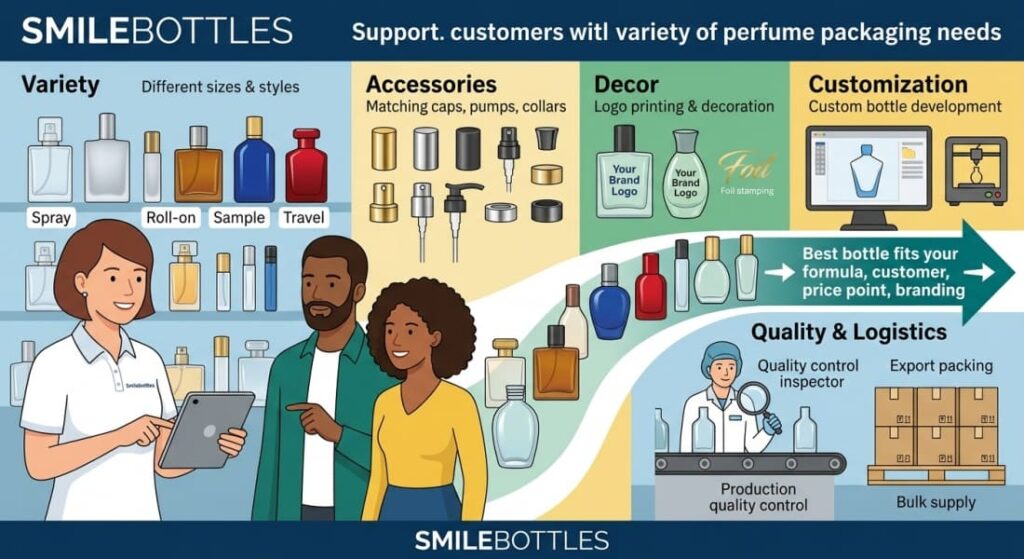
At Smilebottles, we produce a wide range of glass perfume bottles in standard and custom designs. We support customization including printing, frosting, color coating, and custom molds. We can match bottles with the right perfume spray pumps, caps, collars, and packaging for a complete solution.
Whether you’re ordering wholesale perfume bottles in stock styles, developing a custom perfume bottle design, or building out a full fragrance line, the right manufacturer should make the process easier — not harder.
FAQ: Frequently Asked Questions About Perfume Bottles
Q1:What are the most common kinds of perfume bottles?
A1:The most common perfume bottle types are spray bottles (for alcohol-based perfume), roll-on bottles (for oil-based perfume), sample vials (for testers and trials), travel-size bottles (for portability), and refillable bottles (for sustainability). Within each category there are countless design variations.
Q2:What’s the difference between roll-on and spray perfume bottles?
A2:Spray bottles use an atomizer pump to mist the fragrance over a wide area — best for alcohol-based perfumes. Roll-on bottles use a ball applicator to apply the fragrance directly to the skin — best for oils and concentrated formulas. Roll-ons are usually smaller and more travel-friendly; sprays are the standard for retail fragrance.
Q3:What’s the most popular perfume bottle size?
A3:50ml is the most popular perfume bottle size in retail. It’s big enough to feel substantial, small enough to be portable, and priced in a range most customers are comfortable with. 30ml is the second most popular for entry-level products.
Q4:What size perfume bottle is best for travel?
A4:8ml to 20ml is ideal for travel. These sizes of perfume bottles fit easily in a bag, pass airport liquid restrictions (under 100ml), and last for a typical trip. Refillable travel bottles are especially popular because users can take their favorite scent without bringing a full-size bottle.
Q5:Why are perfume bottles made of glass?
A5:Glass is chemically stable, so it doesn’t react with the alcohol, oils, or aromatic compounds in fragrance. It also blocks light better than plastic, looks and feels more premium, supports a wide range of decoration techniques, and is recyclable. Plastic can leach chemicals or break down over time, which can alter the scent of a strong-smelling perfume — something you definitely want to avoid.
Q6:Are glass perfume bottles recyclable?
A6:Yes. Most local recycling programs accept clean glass containers. Customers should rinse out the bottle and remove the pump mechanism (which often contains mixed materials) before recycling. The glass body recycles well and can be remelted into new products.
Q7:Can perfume bottles be customized with logos and colors?
A7:Absolutely. Standard customization options include silk screen printing, hot stamping (for metallic finishes), UV printing, engraving, color coating, and frosting. Personalized perfume bottles can be ordered in smaller batches with simple decoration, or fully custom-designed with unique molds for larger orders.
Q8:What ingredients are in a perfume bottle?
A8:A typical perfume bottle’s contents include three main components: aromatic oils (essential oils, absolutes, or synthetic aroma compounds — the actual scent), a solvent (usually ethanol/perfumer’s alcohol, which carries and disperses the scent), and water (to dilute the alcohol to the right strength). The exact ratios determine whether it’s a parfum, eau de parfum, eau de toilette, or eau de cologne — each with different concentration levels and longevity.
Q9:What type of glass is used for perfume bottles?
A9:Most glass perfume bottles are made from soda-lime glass or higher-quality flint glass. Premium bottles often use a glass with higher clarity and lower iron content for that crystal-clear look. Some luxury bottles use crystal glass for extra weight and brilliance.
Conclusion
If you’re ready to source glass perfume bottles for your line and want to talk through options, get in touch with us at Smilebottles. We’re happy to help you figure out what fits — whether that’s a stock bottle you can have next month or a fully custom design that takes a bit longer but gives you something truly unique.
 English