



Table of Contents
ToggleAuthor: SmileBottles Editorial Team
Estimated Reading Time: About 15 Minute
If your product contains active ingredients, volatile oils, plant extracts, or fragrance compounds, light is not a small packaging issue. It can slowly weaken the formula, change the smell, affect the color, and shorten shelf life long before the customer finishes the bottle. Once that happens, your product does not just look worse. It feels less effective, and your customer may not come back.
This is why so many brands start looking at dark glass bottles when they need better protection. Among all the tinted options on the market, black glass bottles stand out for two simple reasons. They block light very well, and they look more premium than most other packaging choices in the same category. If you are trying to choose the right bottle for a light-sensitive product, black glass is worth serious attention. But the best decision comes from understanding where it works best, where amber still makes sense, and what questions you should ask before placing a bulk order.
Why Does Light Protection Matter for Sensitive Products?
When you buy packaging, it is easy to focus on shape, capacity, decoration, and cost. Those things matter. But if the formula inside is sensitive to light, protection comes first.
How light changes product stability
Light does more than brighten a shelf. It can start chemical reactions inside the bottle. UV rays are the biggest problem, but visible light can also affect certain ingredients over time. Once those reactions begin, the formula can oxidize, break down, or lose strength.
You may see that damage in obvious ways. A serum may turn darker than it was supposed to. An oil may smell flat or slightly rancid. A botanical extract may lose some of its original color. In other cases, the damage is less visible but more serious. The product still looks fine, but the active ingredients are no longer performing as they should.
That matters a lot if you sell products that promise results. If your customer is buying a vitamin C serum, a retinol treatment, a concentrated herbal extract, or a premium essential oil blend, they expect consistency from the first use to the last. Once light starts to interfere, consistency becomes harder to protect.
Which products are most likely to need extra protection
Some products can live comfortably in clear or lightly tinted packaging. Others really should not.
If you buy bottles for essential oils, facial serums, tinctures, fragrance oils, liquid supplements, or pharmacy-related liquids, you are already dealing with categories that often need stronger light control. Products rich in plant actives, volatile aromatic compounds, or oxidation-prone ingredients usually benefit from darker packaging.
That is one reason essential oil glass bottles have traditionally been amber or another dark color. It is also why so many skincare brands moving into high-performance formulations are shifting away from clear presentation packaging.
Why packaging matters more than many buyers first think
A bottle is not just a container. It is part of the preservation system.
Your formula may sit in a warehouse for weeks, travel through different climates, spend time in customs, move to a distributor, then sit under retail lighting or in a customer’s bathroom. Every stage adds exposure. The longer that journey is, the more important the bottle becomes.
If your formula is light-sensitive, the packaging choice affects product quality just as much as the filling process or the closure system. Buyers who understand this usually treat bottle color as a technical decision first and a branding decision second.
How Black Glass Bottles Help Protect Light-Sensitive Products
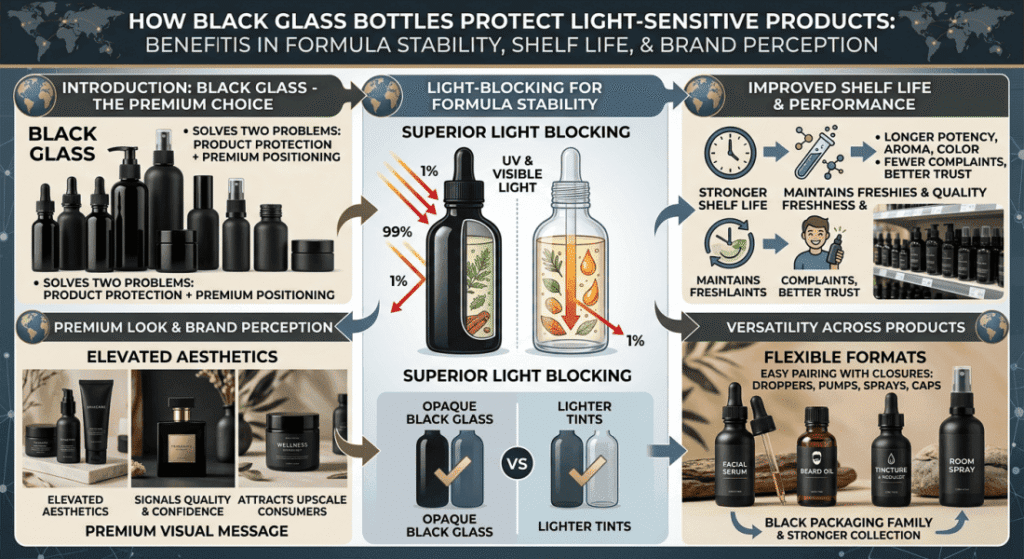
Black glass has become a go-to choice in several industries because it solves two problems at once. It protects the product, and it supports premium positioning.
Stronger light blocking for sensitive formulas
The biggest advantage of black glass is simple. It blocks a great deal of light.
Compared with clear glass, a black bottle creates a much darker environment for the formula inside. Compared with lighter tints, it usually offers stronger shielding from both UV and visible light. That makes it especially useful when your product contains ingredients that are easily affected by exposure.
For buyers comparing tinted packaging options, this is where opaque glass bottles have a real edge. When you need to reduce light penetration as much as possible, a darker and less transparent package usually gives you more control over stability.
Better support for shelf life and product performance
When less light gets through the bottle, the formula has a better chance of staying close to its original condition for longer. That means you have a better shot at protecting potency, aroma, color, and overall user experience.
This is not just about lab performance. It affects the business side as well. Longer-lasting stability can mean fewer complaints, fewer returns, and better customer trust. If you are supplying retailers, it can also help you feel more comfortable about how the product behaves on shelf over time.
In categories where product quality is tied closely to repeat purchase, that matters a lot. A buyer may not always see the science, but they will notice when one product stays fresh and another does not.
A premium look that changes how customers read your brand
Protection is the technical reason many buyers choose black glass. Perception is the commercial reason.
Black packaging feels serious. It looks cleaner, more modern, and more upscale than many standard bottle colors. That makes it especially attractive if your brand sits in skincare, wellness, fragrance, or other image-driven categories.
For that reason, many brands use black when they want the product to look elevated before the customer even reads the label. Done well, it signals quality, focus, and confidence. In the premium market, that visual message matters. It is one reason luxury glass bottles are so often finished in black, whether the style is glossy, matte, minimalist, or heavily decorated.
Easy to pair with different closures and formats
Black glass also works across many bottle styles. If you need a dropper, pump, reducer, spray, or screw cap, black glass usually gives you plenty of options. That flexibility matters if you manage several product lines or want one visual language across different SKUs.
A facial serum, a beard oil, a tincture, and a room spray may all need different closures, but they can still sit in the same family of black packaging. That helps you build a stronger collection without giving up function.
Which Industries Benefit Most from Black Glass Bottles?
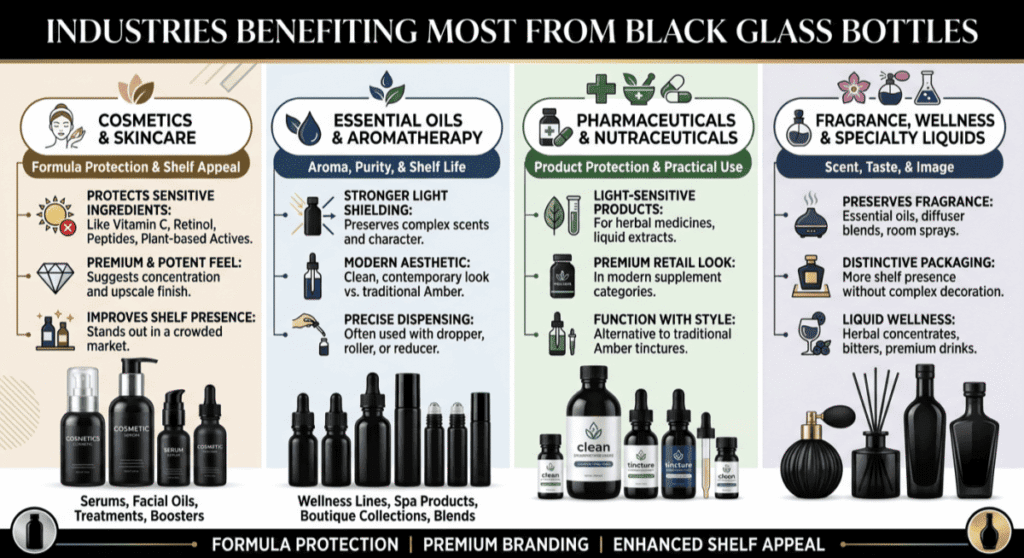
Black glass is not limited to one market. It works best in industries where formula protection and shelf appeal both matter.
Cosmetics and skincare
Skincare is one of the clearest examples.
If you sell serums, facial oils, active treatments, or concentrated botanical formulas, you already know how unstable some ingredients can be. Vitamin C, retinol, certain peptides, and many plant-based actives do not love light. The more sensitive the formula, the more useful a darker bottle becomes.
That is why many brands choose black cosmetic bottles for treatment products instead of clear presentation bottles. The bottle feels more premium, but it also protects the formula better. In a crowded beauty market, that balance matters.
You see the same logic in black glass cosmetic bottles made for oils, boosters, ampoule-style treatments, and intensive repair products. And if your line includes performance-driven facial treatments, black serum bottles often fit the category naturally because they already suggest concentration, potency, and a more upscale finish.
From a buyer’s point of view, this is also where packaging identity matters. In skincare, the bottle is part of how customers judge the product before trying it. A strong-looking pack can support the value of your formula in a way standard cosmetic packaging bottles often cannot.
Essential oils and aromatherapy
This category has always cared about protection because essential oils are sensitive by nature.
If you buy glass bottles for essential oils, you are not just shopping for appearance. You are trying to protect aroma, purity, and shelf life. Essential oils can lose character when exposed to light and air, and some blends shift faster than others depending on the ingredients.
That is why dark packaging remains standard in the category, and why more premium brands are moving toward black instead of staying with amber. Black essential oil bottles give you stronger visual impact and often stronger light shielding at the same time.
You see this in wellness lines, spa products, and boutique oil collections where the brand wants a more elevated look. Aromatherapy glass bottles in black often feel more modern than the old apothecary style, which can help if your target customer prefers cleaner, more contemporary packaging.
This is also a category where closure choice matters. Many oils are sold in black glass dropper bottles for controlled dispensing, while others use reducers or roller assemblies. Smaller black dropper bottles are especially common for blends sold in retail or online because they feel precise and giftable without being over-designed.
Pharmaceuticals and nutraceuticals
In the health sector, bottle choice has to do more than look professional. It has to support product protection and practical use.
That is where pharmaceutical packaging bottles come in. If the liquid inside is light-sensitive, black glass may offer a useful advantage over lighter packaging options. This can apply to certain herbal medicines, nutritional liquids, extracts, and specialty pharmacy products.
Some buyers also choose pharmaceutical glass bottles in black for products that need both protection and a cleaner, more premium retail look. This is more common in modern supplement and wellness categories than in traditional over-the-counter pharmacy products, but the trend is growing.
You see the same shift with black tincture bottles. They are increasingly used by brands that want the function of a traditional tincture pack without the old-fashioned appearance of amber. For wellness, botanical, and high-end supplement lines, that can be a smart move.
Fragrance, wellness, and specialty liquids
Black glass also works well in products where scent, taste, or image carries the sale.
Fragrance oils, diffuser blends, room sprays, herbal drink concentrates, bitters, and premium liquid wellness products often benefit from darker packaging because the contents can be sensitive to both light and presentation. In these categories, black glass protects the formula while giving the product more shelf presence.
That is one reason buyers in niche markets often look at black glass packaging when they want something that feels more distinctive than a standard clear bottle. If your goal is to make the product feel more premium without moving into very complex decoration, black glass can do a lot of that work for you.
Black Glass vs. Amber Glass: Which One Is Better?
This is the comparison most buyers make, and it is the right one to make.
Amber has been the standard for a long time. Black is becoming more common. Neither is automatically right for every product.
Where black usually wins
If your main concern is stronger light blocking, black often has the advantage. It tends to reduce transmission more aggressively than amber, especially when the finish is truly dark and dense.
That can be useful if your formula contains unstable actives, high-value oils, or ingredients that degrade quickly once exposed. If your product spends a long time in bright storage or retail conditions, the extra protection may be worth it.
Black also wins when you want a more premium visual identity. If your brand is modern, minimalist, luxury-driven, or performance-focused, black usually communicates that message better than amber.
Where amber still makes sense
Amber is still a very good packaging choice. It has a long track record, strong market recognition, and a practical image that many customers already trust.
If you sell products in traditional herbal, pharmaceutical, or apothecary-style categories, amber may actually support your brand better than black. It feels familiar. It signals function. And for many formulations, it may provide enough protection without the stronger visual statement of black.
In other words, black is not automatically better because it is darker. It is better when the formula, the brand, and the market all line up with what black offers.
What buyers usually compare in the real world
When you compare amber and black as a buyer, you are usually balancing five things at once: formula sensitivity, brand image, customer expectations, cost, and stock availability.
If your formula is highly sensitive and your brand is premium, black can be the stronger choice. If the formula is moderately sensitive and your customer expects a more classic look, amber may be the more natural fit.
This is also where you should think beyond the bottle itself. A product sold mainly online, packed inside a carton, and stored in controlled conditions may not face the same exposure risk as a bottle sitting under retail lighting for months. That difference should influence the choice.
How to Choose the Right Bottle Color for Your Product
Good packaging decisions usually come from asking the right questions early.
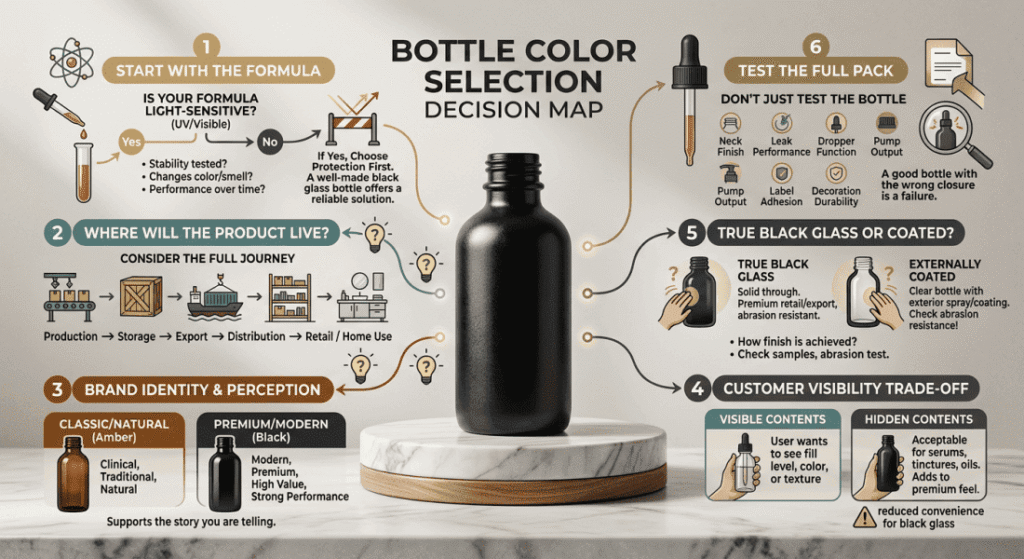
Start with the formula, not the trend
Before you decide on bottle color, look closely at the product itself. How sensitive is it to UV or visible light? Has stability testing been done? Do you already know that the formula changes color, smell, or performance over time?
If the answer is yes, start from protection and work outward. Do not choose the bottle because it looks good on a mood board. Choose it because it suits the chemistry first.
If you find that your product needs stronger shielding, a well-made black glass bottle may give you a more reliable solution than lighter packaging options.
Think about where the product will actually live
A lot of packaging mistakes happen because buyers only think about the factory stage.
Your product may move from production to storage, from storage to export, from export to distribution, and from distribution to retail or home use. If it is exposed to bright light at multiple points, the bottle needs to work harder.
This is why two similar formulas may not need the same packaging. One may sell mostly direct to consumer and move quickly. Another may sit in retail for months. One may ship locally. Another may cross continents. Those conditions matter.
Match the bottle to the brand you are building
Packaging is not only technical. It also tells the customer what kind of product they are holding.
If your brand is clinical, traditional, or natural in a classic sense, amber may fit well. If your brand is modern, premium, or more design-led, black may feel more natural. In some categories, customers already associate black with higher value and stronger performance.
That does not mean appearance should override function. It means the best packaging choice is the one that protects the formula and supports the story you are trying to tell at the same time.
Decide how much visibility matters to your customer
Black glass protects well, but it hides the contents.
That may be fine for a serum, tincture, or essential oil. In fact, it may even add to the premium feel. But if your customer wants to see fill level, color, or texture, black can be less convenient. That is one trade-off you should think about early.
For some categories, that loss of visibility is small. For others, it changes the user experience enough to matter.
Ask whether the bottle is true black glass or externally coated
This is one detail many buyers miss, and it is worth checking before you order.
Not every black bottle is made the same way. Some are produced as true black glass. Others are clear or flint bottles with an exterior spray or coating. Both can look good, but they may behave differently in transport, scratch resistance, and long-term appearance.
If you are buying for premium retail or export, ask the supplier how the black finish is achieved. Ask for samples. Check abrasion resistance. Make sure the outside finish holds up through packing, shipping, and repeated handling.
This one step can save you a lot of trouble later, especially if your products are positioned as premium.
Test the full pack, not just the bottle
A bottle may look right on its own and still fail once the full package is assembled.
You need to test neck finish, closure fit, leak performance, dropper function, pump output, label adhesion, and decoration durability. If the product contains oils, alcohol, or active ingredients, test the full pack under realistic storage conditions.
This is especially important when you are buying for high-value categories. A good bottle with the wrong closure is still a packaging failure.
Are There Any Limitations of Black Glass Bottles?
Black glass has clear strengths, but it is not perfect for every product.
You lose visibility
The biggest drawback is simple. Customers cannot easily see how much product is left, and they cannot view the natural color of the formula.
For some brands, that does not matter. For others, it does. If the color of the liquid is part of the product story, or if your customer expects to track fill level, fully black packaging may feel less convenient. That is one reason some buyers still prefer partially visible formats or different tints.
It is also why some brands use black only for certain items while keeping other products in more transparent packaging.
Maximum light blocking is not always necessary
Some formulas really do need stronger shielding. Others do not.
If your formula is relatively stable, black may be more than you need. In that case, amber may do the job while giving you a different visual language and sometimes a broader stock range.
The best packaging choice is not always the most protective one on paper. It is the one that makes sense for the product, the market, and the budget.
Black does not fit every brand identity
A black bottle can look premium, but it can also feel heavy, severe, or less natural depending on the brand.
If your image is soft, organic, transparent, medical, or very nature-led, black may not be the strongest fit. Some brands simply look more honest in amber, clear, or frosted packs. This is not a weakness of black glass. It just means packaging has to match the personality of the product.
That is also why some buyers use black only in hero lines or treatment products, while keeping the wider range in other finishes.
Why Smilebottles Is a Trusted Choice for Black Glass Bottles
If you decide black glass is the right direction, the next question is not just what shape to buy. It is who you buy from.
Consistent quality matters more than appearance alone
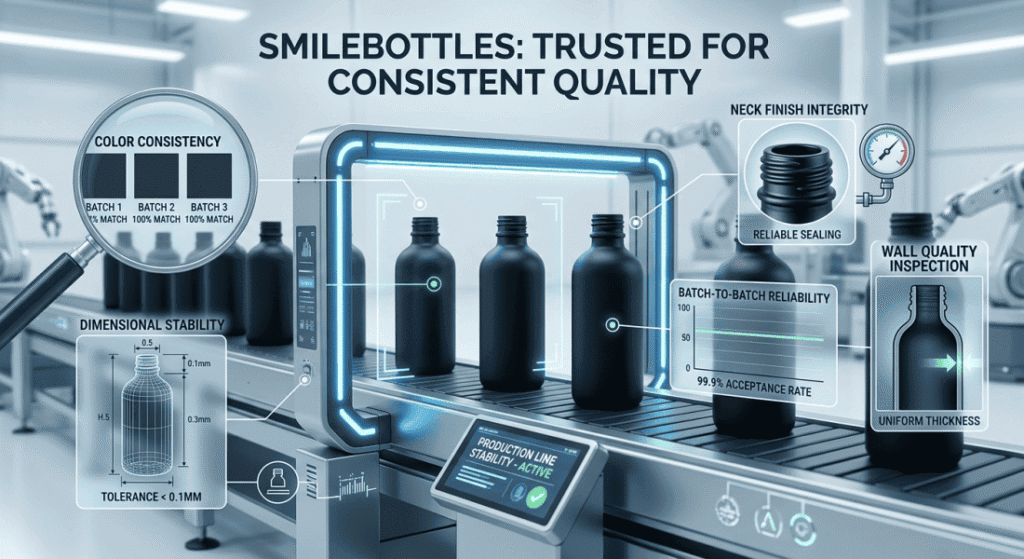
A bottle that looks good in a photo is not enough. You need consistent color, stable dimensions, good wall quality, clean neck finish, and reliable production from batch to batch.
That matters even more when you are buying at scale. If one shipment looks slightly different from the next, your shelf presence suffers. If the closure fit changes, your filling line suffers. If the finish marks too easily, the product looks cheaper than it should.
For buyers in premium categories, those details are not small details.
Range and format flexibility make sourcing easier
If you manage more than one SKU, you probably do not want to source every bottle family from a different supplier.
A good manufacturer should be able to support multiple capacities, different closure systems, and several product categories without making the whole process complicated. That is especially useful if you buy for skincare, oils, tinctures, or wellness products at the same time.
Whether you are looking for small treatment bottles, pipette formats, pump bottles, or specialist packs, the goal is to make sourcing smoother and keep the line visually consistent.
Customization helps you stand out without changing the whole bottle
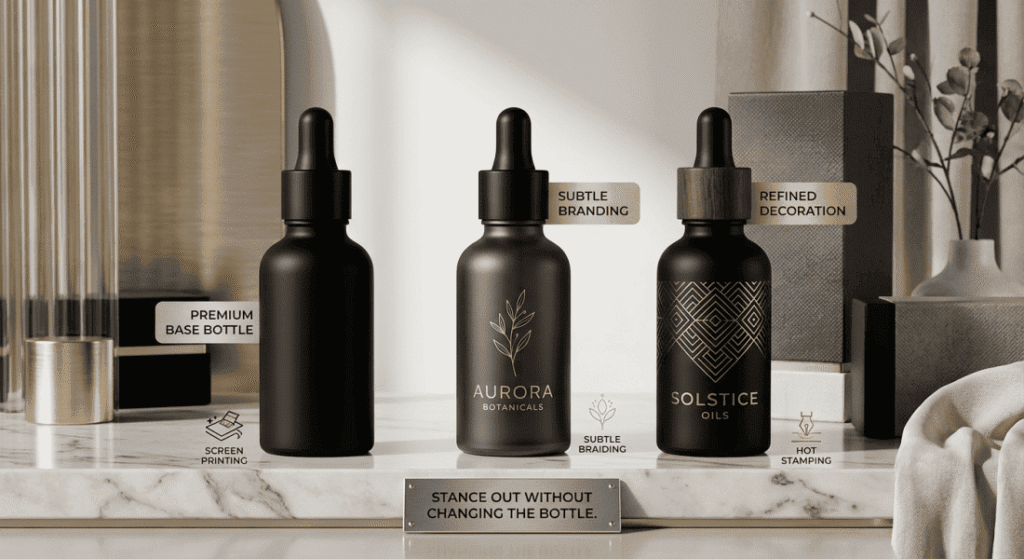
A strong base bottle gives you room to build branding through decoration.
That may mean screen printing, hot stamping, coating, frosting, custom closures, or a cleaner labeling approach. If the base bottle already looks premium, you do not need to overwork the design. That is one of the reasons black bottle packaging works so well for higher-end products. The bottle already carries some of the visual weight on its own.
You see the same effect with categories that need a more refined look without overly complex shapes. In those cases, simple black glass containers can often feel more expensive than highly decorated clear packs.
FAQ:Frequently Asked Questions About Black Glass Bottles
Q1:Do black glass bottles block UV light completely?
A1:No glass blocks 100% of all light, but high-quality black glass blocks the vast majority of UV and visible light. That’s why it’s one of the most effective packaging choices for sensitive products.
Q2:Are black glass bottles better than amber for essential oils?
A2:Black glass generally provides stronger overall light blocking, while amber has been the traditional standard. If you want maximum protection and a premium look, black is a great pick. If you want a classic apothecary feel, amber still works well.
Q3:Can black glass bottles be used for pharmaceuticals?
A3:Yes. As long as the glass meets pharmaceutical grading standards (like Type II or Type III), black glass is excellent for medicines that need light protection. Just be sure to pair it with compliant closures.
Q4:Are black bottles recyclable?
A4:Yes, glass is fully recyclable. Just keep in mind that opaque colored glass is sometimes sorted differently at recycling facilities, so encourage customers to reuse or properly recycle their bottles.
Q5:What products should be stored in black glass bottles?
A5:Any product that’s sensitive to light—vitamin C serums, retinol creams, essential oils, herbal tinctures, perfumes, and wellness drinks. If light damages your formula, black glass keeps it safe.
Conclusion
If you are buying packaging for sensitive formulas, black glass bottles gives you a strong mix of protection and presentation. It helps reduce light exposure, supports product stability, and gives your range a more premium look. That combination is hard to ignore if you sell skincare, oils, tinctures, wellness liquids, or fragrance-based products.
But perfect is a strong word. Black is not automatically the best choice for every formula or every brand. Amber still makes sense in many cases. Clear or frosted may still work when visibility matters more and the formula is stable enough to handle it.
The smart choice comes from looking at the product honestly. If the formula is sensitive, the shelf conditions are demanding, and the brand needs a stronger visual presence, black glass is often one of the best answers you can buy.


