
Table of Contents
ToggleAuthor: SmileBottles Editorial Team
Estimated Reading Time: About 16 Minute
In this guide, you’ll learn whether perfume bottles are recyclable, how to prepare them the right way, what to do when they’re empty, and how refillable and sustainable packaging is changing the fragrance industry. By the end, you’ll have a clear picture of how to make smarter choices — whether you’re a consumer with a shelf full of empties or a brand looking for a trusted perfume bottle supplier.
Are Perfume Bottles Recyclable? The Short Answer
Yes — in most cases, glass perfume bottles are recyclable. Glass itself is one of the most recyclable materials on the planet. It can be melted down and reformed again and again without losing quality. That’s the good news.
The tricky part? A perfume bottle isn’t just glass. It usually comes with a plastic cap, a metal collar, a spray pump, sometimes a decorative overcap, and a bit of leftover fragrance inside. All of these things affect how (and whether) your local recycling program will accept the bottle.
So when someone asks, “can glass perfume bottles be recycled?” — the honest answer is: yes, but you may need to do a little prep work first. We’ll walk you through it.
What Are Perfume Bottles Actually Made Of?
Before you can figure out how to recycle perfume bottles, it helps to understand what you’re working with. A single fragrance bottle is often made from four or five different materials.
The Glass Body
The main body is usually made from soda-lime glass — the same family of glass used for wine bottles and food jars. Some higher-end brands use thicker, heavier glass or crystal-style glass for a more premium feel. Either way, the glass itself is fully recyclable in most municipal systems.
The Cap
Caps can be plastic, metal, wood, or a combination. A plastic cap might not always be accepted in curbside recycling because it’s small and often made from mixed resins. Wooden caps generally aren’t recyclable at all through standard programs.
The Spray Pump and Collar
This is the trickiest part. The pump mechanism usually contains a small spring, a plastic tube, a metal outer collar, and sometimes a rubber seal. Because it’s made of multiple materials fused together, most sorting facilities can’t process it. This is why removing the pump matters so much when you’re recycling.
Labels, Coatings, and Decorations
Painted finishes, metallic coatings, printed logos, and glued-on labels can sometimes affect recyclability. A small paper label usually burns off during the recycling process. Heavy metallic coatings or plastic sleeves are more of an issue.
Once you see all the parts laid out, it makes sense why recycling perfume bottles takes a bit more effort than tossing a soda bottle into the bin.
Can You Recycle Perfume Bottles Through Your Local Program?
Here’s where things get local. The rules for recycle perfume bottles aren’t the same everywhere, and that surprises a lot of people.
It Depends on Where You Live
Some cities have strong recycling infrastructure and will accept perfume glass along with regular container glass. Others treat cosmetic packaging as a separate category. A few programs won’t take it at all if there’s any leftover product inside.
Before you toss anything, take two minutes to check your local recycling website. It’s usually easy to find, and it’ll save you the guilt of thinking you’re recycling when you’re actually contaminating the batch.
Why Some Programs Refuse Perfume Bottles
There are a few common reasons a bottle might get rejected:
Leftover fragrance: Perfume contains alcohol and oils that can contaminate recycled glass.
Attached pumps: Mixed-material pumps jam sorting machines.
Decorative coatings: Heavy metallic or plastic coatings can lower the quality of recycled glass.
Small size: Very small bottles (like sample vials) sometimes fall through sorting equipment and get lost.
Is Perfume Glass the Same as Bottle Glass?
Mostly, yes. But if you’re dealing with a heavy crystal-style luxury bottle, it might contain lead or other additives that regular recycling doesn’t handle well. If you’re not sure, contact your local facility or hold onto it and reuse it instead.
How to Prepare Your Perfume Bottles for Recycling
If you want to do this right, follow these steps. This is also useful information to share with your customers if you’re a brand building a sustainability page on your site.
Step 1: Use It Up First
Sounds obvious, but it matters. If there’s still perfume inside, don’t just pour it down the drain in large amounts. Fragrance contains alcohol and essential oils that shouldn’t go into water systems in big quantities. If you have a bottle you’ll never finish, consider gifting it, using it as a room spray, or letting it evaporate in a well-ventilated area.
This is honestly the most common question when people ask how to dispose of perfume — and the answer is: try not to dispose of it at all. Use it up or pass it on.
Step 2: Remove the Cap and Pump
The pump is the hardest part. Most perfume bottles have crimped metal collars that hold the pump in place, and they’re designed to stay on. You can usually pry them off with a small flathead screwdriver or a pair of pliers. Slide the tool under the metal edge, work your way around, and gently lift.
Be careful — the glass can crack if you apply too much pressure, and you don’t want to cut yourself on the metal edge. If you can’t get it off safely, don’t force it. Some recycling programs will still accept the bottle with the pump attached, so check first.
Step 3: Rinse the Bottle
A quick rinse with warm water helps remove any remaining fragrance oil. You don’t need to sterilize it — just get most of the residue out.
Step 4: Sort the Parts
Once the bottle is empty and rinsed:
Glass body → glass recycling
Plastic cap → plastic recycling (if accepted)
Metal collar → metal recycling (if accepted)
Pump mechanism → usually trash, unfortunately
Step 5: Follow Your Local Guidelines
Curbside bin, drop-off center, or specialty program — put each part where it belongs. If you have a lot of perfume empties built up, it might be worth checking whether any nearby beauty retailers run take-back programs.
How to Dispose of Empty Perfume Bottles You Can’t Recycle
Sometimes recycling just isn’t an option. Maybe the bottle is too decorative, maybe you don’t have curbside pickup, maybe the pump won’t come off. So how do you dispose of old perfume bottles in those cases?
You’ve got a few options:
Drop them off at a specialty recycler. Some companies handle mixed-material beauty packaging that curbside programs won’t touch.
Return them to the brand. More fragrance houses are launching take-back programs. Check the brand’s website.
Reuse them (we’ll get into this in a minute).
As a last resort, wrap them safely and put them in the trash. It’s not ideal, but sometimes it’s the only realistic option.
Knowing how to dispose of perfume bottles the right way is a small thing, but multiplied across millions of consumers, it makes a real difference.
Creative Ways to Reuse Perfume Bottles
Here’s the fun part. If you’re wondering what to do with empty perfume bottles — or what to do with old perfume bottles that are just too pretty to throw away — there are dozens of options. This is also a great angle for brands to build content around, because customers love this kind of thing.
Turn Them Into Home Décor
Perfume bottles are literally designed to look beautiful. A cluster of empty bottles on a shelf, a vanity, or a windowsill makes a great display. Add a single stem flower to one and you’ve got a mini vase.
Refill Them with Your Own Blends
If you’re into essential oils or you make your own room sprays, empty perfume bottles are perfect containers. Just wash them thoroughly first so old scents don’t mix with your new blend. That’s really all it takes to reuse perfume bottles in a practical way.
Use Them for Travel
Small perfume bottles are ideal for decanting a splash of your favorite fragrance for travel. You can also use them for small amounts of skincare or hair oils.
Give Them as Gifts
A cleaned, refilled perfume bottle wrapped with a ribbon makes a thoughtful, personal gift. Some people even use them as wedding favors filled with sand, dried flowers, or a signature blend.
Craft Projects
Paint them, add fairy lights, turn them into oil diffusers, use them in resin art — a quick search on Pinterest will give you hundreds of ideas. If you’re teaching kids about how to reuse perfume bottles, this is a great starting point (with adult supervision, of course).
Keep the Luxury Ones as Collectibles
Some perfume bottles are genuinely collectible. Vintage Guerlain, Lalique, and Baccarat bottles can hold significant resale value. Even more recent luxury glass perfume bottles from major fashion houses have collector followings.
The Real Challenges of Recycling Perfume Bottles
Let’s be honest — perfume bottle recycling isn’t perfect, and it helps to know why.
Mixed Materials
Most perfume bottles combine glass, plastic, metal, and sometimes rubber or wood. Recycling systems are built for single-material items. When multiple materials are fused together, they’re harder to process.
Small Components Get Lost
Pumps, springs, and small caps often fall through sorting equipment. Even when consumers do everything right, some parts just don’t make it through.
Fragrance Residue
Alcohol and oils in leftover perfume can contaminate a whole batch of recycled glass. That’s why rinsing matters.
Decorative Coatings
Heavy metallic paint, plastic sleeves, and thick coatings can lower the quality of the recycled material. Some facilities reject these bottles altogether.
Inconsistent Rules
What’s recyclable in one city might not be in the next. It’s frustrating for consumers, and it’s a real challenge for brands trying to communicate consistently.
None of this means recycling is pointless — far from it. It just means the packaging industry has work to do, and that’s where sustainable design comes in.
Refillable Perfume Bottles: The Smarter Way Forward
If you really want to reduce waste, the best answer isn’t just recycling — it’s not creating the waste in the first place. That’s why refillable perfume bottles have become such a big deal.
What Are Refillable Perfume Bottles?
They’re exactly what they sound like: bottles designed to be refilled instead of thrown away after one use. Some have detachable pumps so you can pour new perfume in directly. Others work with cartridge systems or brand-specific refill pouches.
Why They Matter
Less packaging waste going to landfill
Lower demand for virgin materials
Longer product life
Better customer experience (a beautiful bottle you keep is better than one you toss)
Supports circular packaging models
Why Brands Are Making the Switch
The shift toward sustainable perfume packaging isn’t just about doing the right thing — it’s what customers want. Younger buyers especially expect brands to take sustainability seriously. Offering reusable perfume bottles or a refill program can genuinely set your brand apart.
What to Look For in a Good Refillable Design
If you’re a brand considering this direction, here’s what actually matters:
Durability — the bottle needs to survive multiple uses
Leak-proof refilling — the refill process should be easy and clean
Compatibility — pumps and sprayers need to work reliably over time
Look and feel — a refillable bottle should still feel premium
Refill availability — there needs to be a clear system for customers to actually refill
This is where working with an experienced glass perfume bottle manufacturer makes a huge difference. Good design isn’t just about looking pretty — it’s about function, longevity, and sustainability all working together.
Sustainable Beauty Packaging and Where the Industry Is Heading
Zoom out for a second. The fragrance industry, like the wider beauty world, is under real pressure to clean up its packaging act. Sustainable beauty packaging is no longer a niche interest — it’s a mainstream expectation.
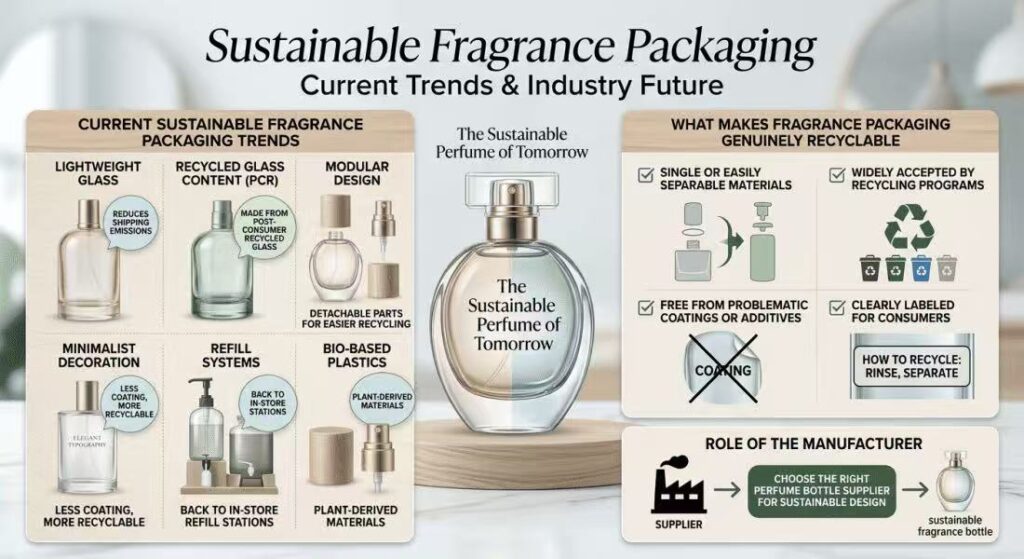
Current Perfume Packaging Trends
Looking at the perfume packaging trends shaping the industry right now:
Lightweight glass: Uses less material and reduces shipping emissions
Recycled glass content: More brands are using PCR (post-consumer recycled) glass
Modular design: Detachable parts make recycling easier
Minimalist decoration: Less coating, easier to recycle
Refill systems: In-store refill stations are making a comeback
Bio-based plastics: For caps and pumps, though this is still developing
What Makes Packaging Genuinely Recyclable
For packaging to count as recyclable cosmetic packaging, a few things need to line up:
Single or easily separable materials
Widely accepted by recycling programs
Free from problematic coatings or additives
Clearly labeled so consumers know what to do
Not every “eco” bottle actually meets these standards. It’s worth digging into the details when you’re sourcing.
The Role of the Manufacturer
Honestly, a lot of the sustainability decisions get made way upstream — long before a customer ever holds the bottle. When brands work with a supplier who understands sustainable design, the whole product ends up better. That’s where choosing the right perfume bottle supplier actually matters more than most people realize.
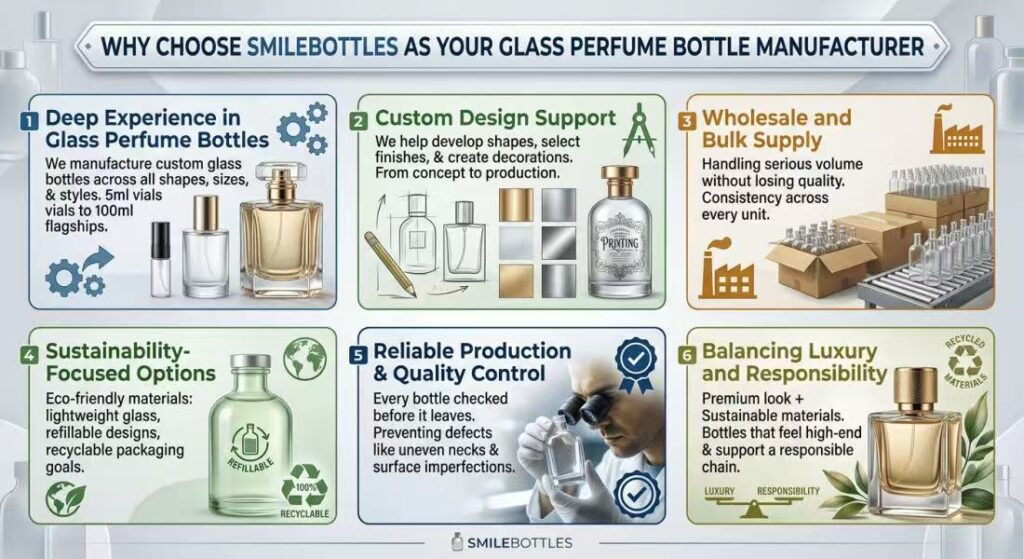
Why Choose Smilebottles as Your Glass Perfume Bottle Manufacturer
We’ve been in this industry long enough to see the trends come and go, and to know what actually works. Here’s what we bring to the table if you’re looking for a partner.
Deep Experience in Glass Perfume Bottles
We manufacture custom glass perfume bottles across a wide range of shapes, sizes, and styles — from minimalist modern pieces to ornate luxury designs. Whether you need 5ml sample vials or 100ml flagship bottles, we can produce them at the quality your brand deserves.
Custom Design Support
Your bottle is part of your brand identity. We help you develop shapes, choose finishes, add printing and decoration, and match your design vision. If you’re launching a fragrance line, we’ll work with you from concept to production.
Wholesale and Bulk Supply
If you need wholesale glass perfume bottles at scale, we’ve built our production capacity to handle serious volume without losing quality. Consistency across every unit matters, and we take that seriously.
Sustainability-Focused Options
We offer eco friendly perfume bottles made with lightweight glass, refillable designs, and options that support recyclable perfume packaging goals. If sustainability is part of your brand story, we can help you make it real, not just marketing talk.
Reliable Production and Quality Control
Every bottle goes through checks before it leaves the factory. Uneven necks, weak points, surface defects — we catch these things so you don’t have to deal with returns later.
Balancing Luxury and Responsibility
You shouldn’t have to choose between a premium look and a sustainable one. We help brands land in the middle: bottles that feel high-end, look beautiful, and support a more responsible supply chain.
FAQ: Frequently Asked Questions About Glass Perfume Bottles
Q1:Can you recycle perfume bottles through curbside collection?
A1:In most areas, yes — but the bottle should be empty and, ideally, the pump should be removed. Check your local guidelines to be sure. Some areas treat cosmetic packaging as a separate category.
Q2:Do I need to remove the spray pump before recycling?
A2:Usually, yes. The pump is made of mixed materials and can’t be recycled with the glass. Pry it off with a small tool, and put just the clean glass in the recycling.
Q3:Can perfume bottle caps be recycled?
A3:It depends on the material. Plastic caps might be recyclable if your program accepts small plastic items. Metal caps often go into metal recycling. Wooden or mixed-material caps usually go in the trash.
Q4:What should I do with leftover perfume in the bottle?
A4:Try to use it up first — as a room spray, on clothes, or gifted to someone else. If you must dispose of it, let small amounts evaporate in a ventilated area rather than pouring large quantities down the drain.
Q5:Are refillable perfume bottles actually better for the environment?
A5:Yes, generally. Reusing the same bottle multiple times cuts down significantly on packaging waste and material use, as long as the refill system itself doesn’t create excessive waste.
Q6;Can broken perfume bottles be recycled?
A6:Sometimes, but many programs won’t accept broken glass for safety reasons. Wrap broken pieces and check with your local facility before including them.
Q7:Are decorative or colored perfume bottles recyclable?
A7:Colored glass is usually fine, though it may be sorted separately. Bottles with heavy metallic coatings or plastic sleeves are harder to recycle and might be rejected.
Q8:Where can I recycle perfume bottles if my local program won’t take them?
A8:Try specialty recyclers, brand take-back programs, or drop-off points at beauty retailers. Some cities also run periodic collection events for hard-to-recycle items.
Conclusion
Whether you’re a consumer trying to figure out how to recycle perfume the right way, or a brand building your next fragrance line, small choices add up. Choose smarter packaging. Support brands that take sustainability seriously. And if you’re the one making those decisions on the manufacturing side, work with a supplier who gets it.
If you’re looking for high-quality, recyclable, and refillable options, Smilebottles is here to help. From custom glass perfume bottles to wholesale glass perfume bottles and sustainable design support, we work with fragrance brands who want their packaging to be as thoughtful as their scent. Reach out to us — we’d love to help you build something worth keeping.
 English