Table of Contents
ToggleAuthor: SmileBottles Editorial Team
Estimated Reading Time: About 12 Minute
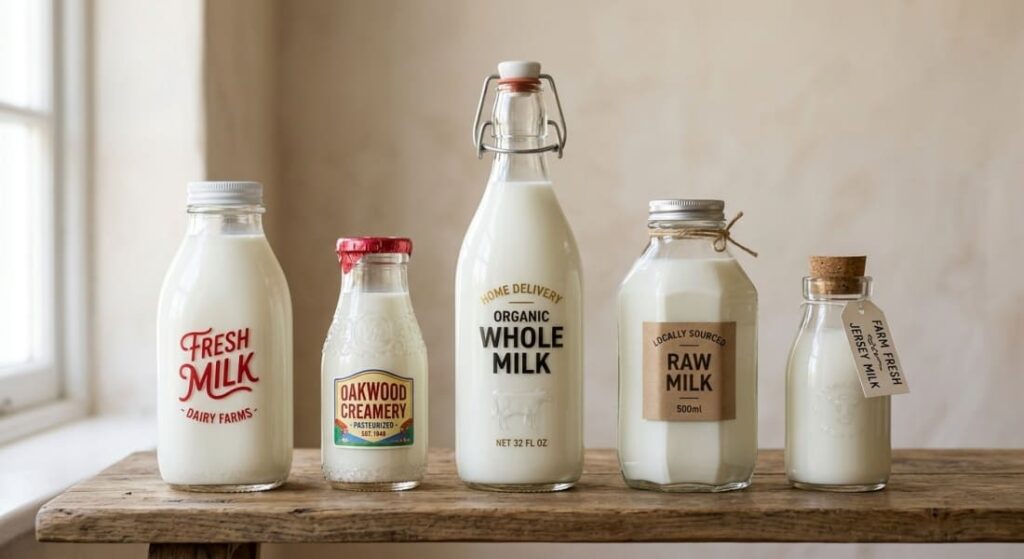
If you run a dairy brand, a café, a delivery service, or you’re sourcing packaging for a beverage line, picking the right bottle is a bigger decision than it looks. Size affects your shelf presence, your shipping cost, how customers hold your product, and even how they feel about your brand the moment they see it on a shelf.
At Smilebottles, we’ve been making glass bottles for milk for years, and we’ve noticed that most buyers come to us with the same question: “What size should I actually go with?” So this guide walks you through everything you need to know about milk bottle sizes, shapes, ounces, and customization — written for real buyers, not for search engines.
Why Glass Milk Bottle Size Matters for Dairy Packaging
You might think a bottle is just a bottle. But once you start selling, filling, shipping, and stocking shelves, size decisions show up everywhere.
Size affects how your product is positioned
Small bottles feel premium. Large bottles feel like value. That’s just how buyers read them.
Small glass milk bottles (around 100–250ml) work well for tasting samples, coffee creamers, probiotic drinks, kids’ drinks, and hotel service.
Medium bottles fit daily household use.
Large glass milk bottles are usually for families, bulk buyers, or refillable home-delivery programs.
If you sell an organic single-origin milk, a heavy 1.5L jug sends the wrong signal. If you sell farm-fresh family milk, a tiny 250ml bottle undersells you. The container shapes the story.
Size influences storage and transportation
Every extra centimeter of bottle height changes your pallet count. Bigger bottles mean fewer units per case but more weight per case. Smaller bottles mean more units, more labels, more caps, more filling time.
If you’ve ever wondered how much does a milk jug weigh, the answer depends on the bottle wall thickness and capacity. A standard 1-liter glass milk bottle usually weighs somewhere between 450g and 600g empty. Filled, you’re looking at around 1.5kg. That matters when you’re calculating shipping and shelf load.
Size shapes the customer experience
Your customer has to pour it, carry it, store it in the fridge, and eventually recycle or return it. Skinny 1L bottles fit fridge doors. Wide bases don’t tip over easily. Small bottles fit into lunch bags. These small details drive repeat purchases more than most brands realize.
Size supports your branding
A distinctive bottle silhouette is one of the cheapest branding tools in the dairy business. Once buyers recognize your bottle from across the aisle, you don’t need to work as hard on the label.
Common Glass Milk Bottle Sizes and Their Typical Uses
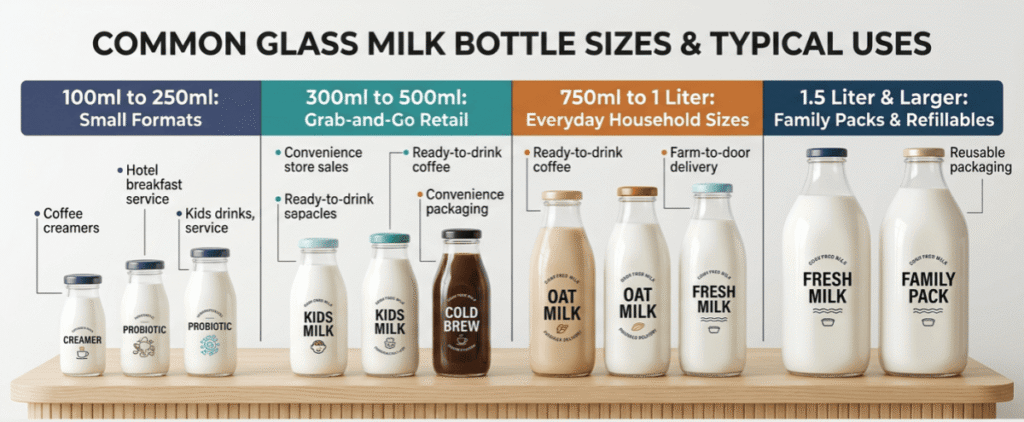
Different markets prefer different sizes of milk, so here’s how the common capacities actually get used in real dairy business.
100ml to 250ml glass milk bottles
These small formats are popular for:
Coffee creamers
Probiotic and yogurt drinks
Kids’ flavored milk
Hotel breakfast service
Airline and premium café use
Tasting samples for new product launches
They look premium, they photograph well for social media, and they’re a favorite for hotels that want to add a touch of quality to the breakfast tray.
300ml to 500ml glass milk bottles
This is the sweet spot for grab-and-go retail. If you’re launching a flavored milk, cold brew coffee, or plant-based drink, a 500ml milk bottle is one of the safest bets.
Sizes here include 330ml, 350ml, 450ml, and 500ml. These work well for:
Convenience store sales
Cafés with a takeaway program
Single-serve fresh milk
Ready-to-drink coffee and tea
750ml to 1 liter glass milk bottles
These are your everyday household sizes. In many markets, 1 liter is the default milk container size — it fits a family’s daily use without being too heavy to carry.
If you’re wondering how many liters in a milk jug for the standard household format: 1 liter is the answer in most countries, though the U.S. still uses gallon and half-gallon sizes for plastic jugs. In glass, 1L is king.
Great for:
Fresh milk
Organic milk
Oat, almond, and other plant-based milks
Farm-to-door delivery
1.5 liter and larger glass milk bottles
Bigger formats are usually for family packs, farm delivery, or refillable systems. They’re heavier and need thicker glass to handle repeated use, so they work best when your logistics are set up for reusable packaging.
How Many Ounces Are in a Glass Milk Bottle?
If you sell into the U.S. market, you’re going to hear the milk bottle oz question constantly. Buyers there tend to think in ounces, not milliliters.
Quick ounce conversions
250ml = about 8.45 oz
330ml = about 11.2 oz
500ml = about 16.9 oz
750ml = about 25.4 oz
1 liter = about 33.8 oz
Why both units matter
Most bottle manufacturers, including us, produce by milliliters. But if you’re exporting to the U.S., Canada, or the UK, you’ll need to show ounces on your label or marketing material. Having both units clearly listed keeps buyers from getting confused, and it makes cross-border sourcing easier.
If you’re negotiating with a milk bottle supplier, always confirm whether the capacity they quote is brimful or fill capacity. Brimful is the total volume; fill capacity is how much milk actually goes in with headspace. The gap is usually 5–10%.
Glass Milk Bottle Shapes, Dimensions, and Technical Specs
Volume is only part of the story. Milk bottle shapes and milk bottle dimensions affect nearly every part of how the bottle performs on your line and on the shelf.
Popular milk bottle shapes
Round milk bottles — classic, easy to fill, easy to label
Square milk bottles — better shelf packing, modern look
Slim-neck bottles — elegant, often used for premium dairy
Vintage-style dairy bottles — the traditional bulged-shoulder shape you see in old-fashioned home delivery. A vintage glass milk bottle design is still one of the most popular styles we produce.
Wide-mouth bottles — easier cleaning, good for yogurt drinks
How shape affects function
Pouring: a narrow neck controls pour rate; a wide mouth pours faster
Grip: taller bottles need a defined waist for hand comfort
Label area: square bottles give you more flat surface for branding
Shelf efficiency: square and rectangular bottles waste less shelf space
Line compatibility: your bottle has to match your filling machine’s neck finish and base diameter
Key glass milk bottle dimensions to specify
When you order, you’ll need to lock in:
Bottle height
Body diameter
Neck finish (this determines which caps fit)
Mouth diameter
Weight
Brimful and fill capacity
If you’re not sure about the exact dimensions of a milk jug, share your filling line specs with your manufacturer and let them recommend a compatible bottle.
Closure options
Your bottle is only as good as its seal. Glass milk bottles with caps come with several closure choices:
Screw caps (aluminum or plastic)
Lug caps for pasteurized products
Tamper-evident closures
Reusable swing-top or crown caps
Foil seals under the cap for extra freshness
Food safety and durability
For dairy, food-grade glass is a must. If you’re building a refillable program, you’ll also want thicker walls and thermal shock resistance so the bottles survive repeated washing.
How to Choose the Right Glass Milk Bottle Size for Your Product
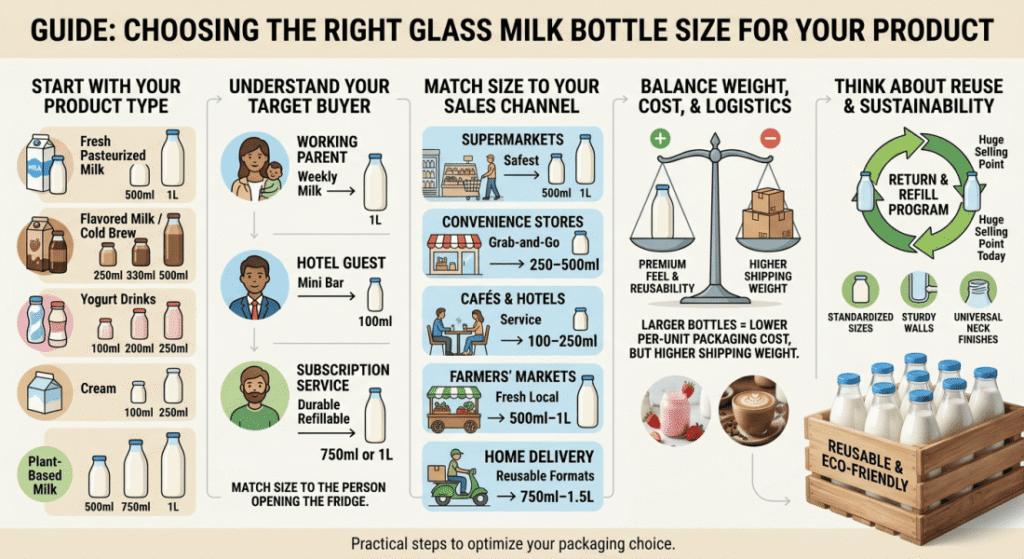
Let’s make this practical. Here’s how we usually walk buyers through the decision.
Start with your product type
Fresh pasteurized milk → 500ml, 1L
Flavored milk or cold brew → 250ml, 330ml, 500ml
Yogurt drinks → 100ml, 200ml, 250ml
Cream → 100ml, 250ml
Plant-based milk → 500ml, 750ml, 1L
Understand your target buyer
A working parent buying weekly milk wants 1L. A hotel wants 100ml. A subscription delivery service wants 750ml or 1L in a durable refillable glass milk bottles format. Match the size to the actual person opening the fridge.
Match size to your sales channel
Supermarkets: 500ml and 1L are safest
Convenience stores: 250–500ml grab-and-go
Cafés and hotels: 100–250ml
Farmers’ markets: 500ml–1L
Home delivery: 750ml–1.5L in reusable formats
Balance weight, cost, and logistics
Glass is heavier than plastic. That’s the trade-off you accept for the premium feel and reusability. Larger bottles reduce your per-unit packaging cost but raise your shipping weight. Run the numbers for your own market before locking anything in.
Think about reuse and sustainability
Reusable glass milk bottles are a huge selling point today. If you want to build a return-and-refill program, pick standardized sizes with sturdy walls and universal neck finishes. It makes collection, washing, and refilling much easier down the road.
Custom Glass Milk Bottles: Size, Shape, Logo, and Packaging
If a standard bottle doesn’t fit your brand, you have options. Custom glass milk bottles are one of the fastest ways to stand out on a crowded shelf.
Custom capacity
You can either tweak an existing mold (say, adjusting a 500ml to a 480ml) or develop a fully custom volume. Small adjustments are cheap. A brand-new capacity means a new mold.
Custom shapes
Exclusive silhouettes
Embossed shoulder or body
Vintage or modern lines
Signature curves that customers recognize by touch alone
Logo and decoration
There are several ways to put your brand on the bottle:
Embossed logo (raised on the glass itself)
Screen printing for printed glass milk bottles with sharp colors
Decals and ceramic labels
Frosted finish for a soft matte look
Color coating for full-bottle color
Paper or shrink-sleeve labels for flexibility
Closure and outer packaging
You can customize cap color, material, tamper-evident bands, and even the carton dividers used for shipping. If you’re planning a gift set or subscription box, the outer packaging is part of the customer’s first impression.
What we need from you before starting a custom project
To quote a custom project quickly, share:
Target capacity
Product type (milk, yogurt drink, etc.)
Filling process (hot fill, cold fill, pasteurization)
Preferred closure
Order quantity
Destination market
Branding and decoration needs
MOQ, mold cost, and lead time
This is where a lot of new buyers get surprised, so let’s be straight with you:
Custom molds have an upfront cost. Depending on complexity, plan for a mold investment.
Standard bottles ship faster. Custom bottles need 30–60 days including sampling.
MOQ for custom is usually higher than stock items.
If your volume isn’t there yet, start with a stock bottle and add custom decoration. You get a branded look without the mold investment.
Why Work with an Experienced Glass Milk Bottle Manufacturer:Smilebottles
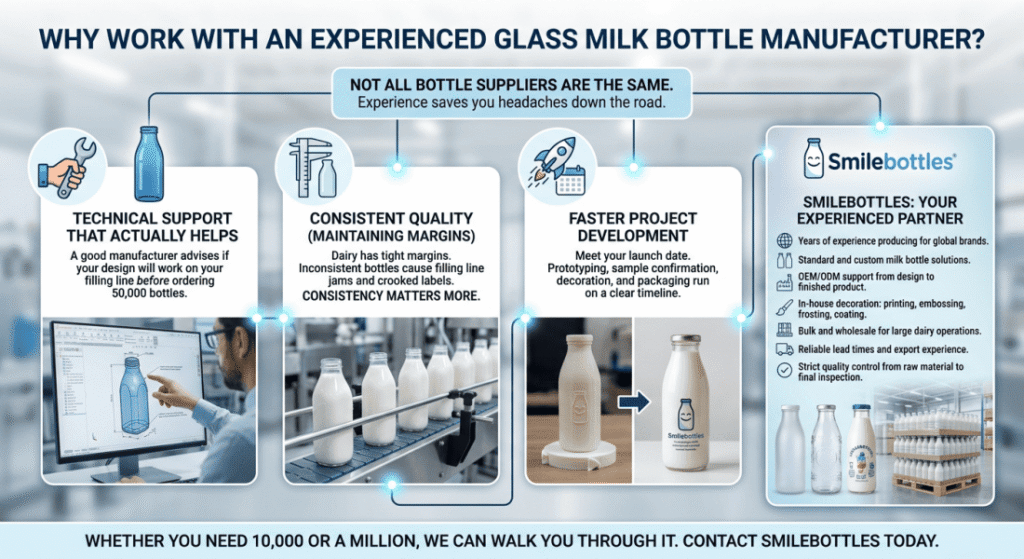
Not all bottle suppliers are the same. Working with an experienced glass milk bottle manufacturer saves you from a lot of headaches down the road.
Technical support that actually helps
A good manufacturer will tell you if your design won’t work on your filling line, before you order 50,000 bottles. That kind of advice is priceless.
Consistent quality
Dairy has tight margins. If bottles vary in height by even a few millimeters, your filling line jams and your labels sit crooked. Consistency matters more than price on paper.
Faster project development
If you’ve got a launch date, you need a supplier who can move. Prototyping, sample confirmation, decoration, packaging — all of it should run on a clear timeline.
Smilebottles’ capabilities
Since you’re reading our guide, here’s what we bring to the table:
Years of experience producing glass dairy bottles for brands around the world
Standard and custom milk bottle solutions
OEM/ODM support from design to finished product
In-house decoration: printing, embossing, frosting, coating
Bulk and wholesale glass milk bottles for large dairy operations
Bulk glass milk bottles with reliable lead times and export experience
Strict quality control from raw material to final inspection
Whether you need 10,000 bottles or a million, we can walk you through it.
FAQ: Frequently Asked Questions About Glass Milk Bottle Sizes
Q1:What is the most common glass milk bottle size?
A1:500ml, 750ml, and 1 liter are the most common, depending on the market. In the U.S., 16 oz (about 500ml) and 32 oz (about 1L) are the most familiar.
Q2:How many ounces are in a 1 liter glass milk bottle?
A2:About 33.8 fluid ounces.
Q3:Are glass milk bottles reusable?
A3:Yes. Most glass milk bottles can be washed and reused many times if the glass is thick enough and the closure system supports it.
Q4:What size glass bottle is best for single-serve milk?
A4:250ml to 500ml is ideal for single-serve and grab-and-go products.
Q5:Can I customize the shape and logo of a glass milk bottle?
A5:Yes. Custom molds, embossed logos, screen printing, frosting, and color coating are all available.
Q6:Are glass milk bottles suitable for pasteurized milk?
A6:Yes, as long as the bottle is designed for thermal processing and paired with the correct closure.
Q7:What closure is best for a glass milk bottle?
A7:Screw caps and tamper-evident closures are the most common. For refillable systems, swing-top or crown caps also work well.
Q8:What should I consider before ordering custom milk bottles?
A8:Capacity, dimensions, neck finish, closure compatibility, MOQ, mold cost, lead time, and shipping logistics.
Conclusion
Choosing the right glass milk bottle isn’t just about picking a number off a size chart. It’s about matching your product, your buyer, your sales channel, and your brand story to a bottle that works on every level.
Start by locking in your capacity. Then think about shape, closure, and decoration. Finally, look at your logistics and decide whether standard or custom is the right path for you.
If you’re still weighing your options — or you have a specific project in mind — reach out to Smilebottles. We’ll help you find the right glass milk bottle sizes, closures, and packaging for your product, whether you’re launching a new dairy line, upgrading an existing one, or building a reusable delivery program.
 English