Table of Contents
ToggleAuthor: SmileBottles Editorial Team
Estimated Reading Time: About 15 Minute
Walk into any beauty store, liquor shop, or skincare aisle and take a second to notice what actually pulls your eye. Nine times out of ten, it’s the bottle. The product inside might be amazing, but if the packaging is forgettable, most shoppers keep walking. That’s the reason more and more brands are getting serious about custom glass bottles instead of grabbing whatever generic option is on the shelf at the packaging warehouse.
If you’re sourcing bottles for your brand right now, this guide is for you. I’ll walk you through how the whole thing works, what OEM and ODM actually mean once you strip away the jargon, what you can customize, and how to pick a glass bottle supplier without getting burned. No fluff, just what you actually need to know before you place an order.
What Are Custom Glass Bottles?
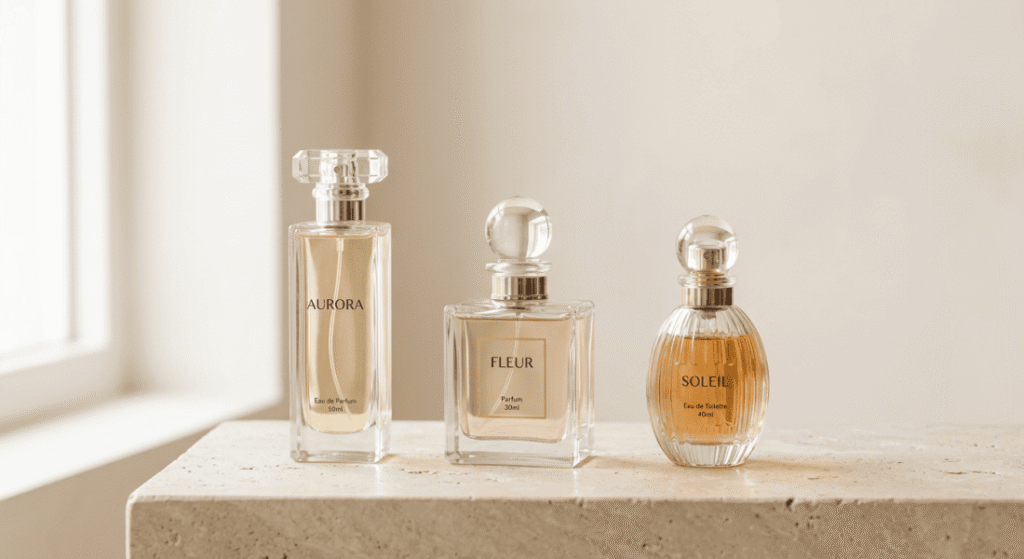
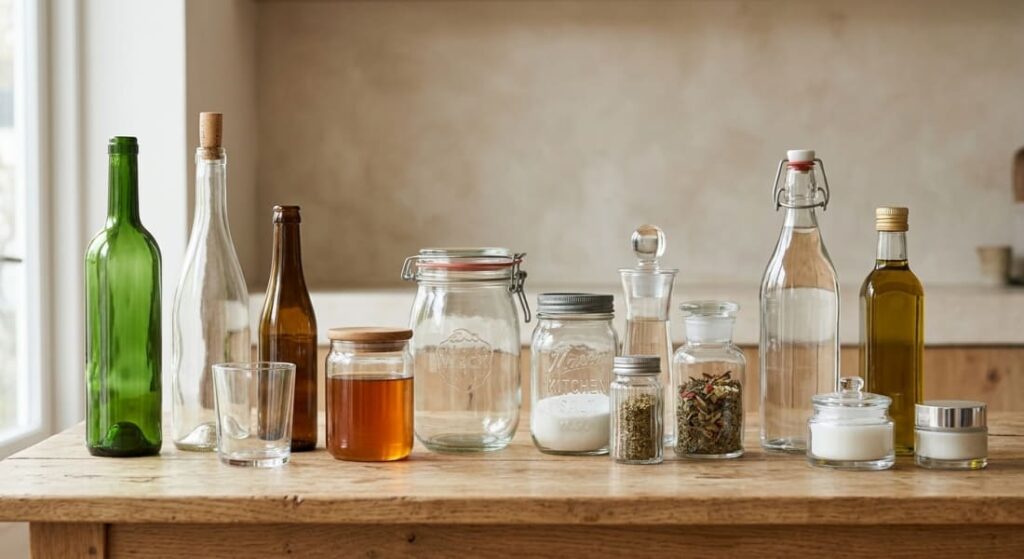
A custom glass bottle is basically any glass container that’s been shaped, colored, decorated, or adjusted to fit what your brand needs. Instead of pouring your product into the same bottle five other brands are using, you get something that feels like yours.
Customization runs on a wide spectrum. Some brands only add a printed logo on a stock shape and call it a day. Others go the full distance — new mold, custom color, frosted finish, matching pump, custom box. Both approaches work. It really comes down to your budget, timeline, and how much your bottle needs to stand out.
Things Buyers Usually Customize
The shape of the bottle
Capacity, anywhere from small sample sizes to large retail volumes
Glass color, including colored glass bottles in amber, green, blue, or black
Surface treatments like frosting, matte, or high gloss
Logo printing on glass bottles using silk screen, hot stamping, or UV printing
Embossed glass bottles with raised patterns or debossed details
Matching caps, droppers, pumps, and sprayers
Boxes, inserts, and outer packaging
Who Actually Uses Custom Glass Bottles?
Glass shows up in a lot of industries because it’s clean, premium-looking, and safe with most formulas:
Cosmetics and skincare — creams, serums, toners
Perfume and fragrance — from tiny testers to statement flacons
Essential oils and aromatherapy
Beverages and spirits — juices, cold-pressed drinks, whiskey, gin
Food packaging — sauces, honey, condiments
Pharma and health products
So whether you’re after glass bottles for cosmetics, glass bottles for skincare, custom liquor bottles, or custom beverage bottles, the customization process is pretty similar. What changes is the technical detail behind it.
How Are Custom Glass Bottles Made?
Knowing how bottles are actually made helps you talk to your glass bottle manufacturer without feeling lost, and it saves you from surprises down the line.
The Raw Materials
Glass bottles come from silica sand, soda ash, and limestone, mostly. A lot of factories also mix in recycled glass, called cullet, which is one of the reasons glass is such a strong option when you care about sustainable glass packaging. If you want colored glass, the color pigments go in at the batch stage, not after.
The Steps, Roughly
Raw materials get weighed and mixed
The mix melts in a furnace at very high heat until it turns into molten glass
Molten glass is pressed or blown into molds to form the bottle
Bottles pass through a cooling tunnel called annealing, which relieves internal stress
Then comes any surface treatment — frosting, coating, printing, hot stamping
Every bottle gets inspected for defects and dimensions
Finally, packing for shipment
Why the Mold Is Such a Big Deal
The custom glass bottle mold is honestly the make-or-break part of any OEM project. It controls the bottle’s shape, weight, wall thickness, and how well it works with your filling line and closure. A bad mold means leaky caps, uneven glass, and a lot of rejected bottles once production starts. Experienced buyers slow down at the mold stage on purpose. It saves headaches later.
What Is OEM Glass Bottle Packaging?
OEM means the factory makes bottles based on your design. You bring the idea, drawing, or sample. The factory builds the mold and turns it into real glass.
How OEM Usually Goes
You share a concept, sketch, sample, or 3D file
The factory checks if it’s producible and gives feedback
A new mold gets built
Samples come to you for approval
Once you sign off, production runs
When OEM Makes Sense
Go OEM when you already have a clear picture of what your bottle should look like, when you want something no competitor can copy, or when you’re building a premium product that deserves its own identity. This is the route most custom perfume bottle manufacturer clients take when they want an exclusive flacon, and it’s common with spirits brands that need a signature shape on the shelf.
The Trade-Offs
OEM gives you exclusivity and strong branding, but you pay for it with higher mold costs, longer development time, and usually higher minimums. If you’re building for the long haul, that investment pays back. If you’re just testing the waters, it might not.
What Is ODM Glass Bottle Packaging?
ODM means you pick from the factory’s existing bottle designs and customize the finishing details — color, printing, closures, decoration. The mold is already made, so you skip the biggest cost and the longest wait.
How It Works
You look through the factory’s catalog and pick a bottle
You choose your color, decoration, and closure
Samples get made for you to sign off
Production runs
When ODM Is the Smarter Move
ODM works well when speed matters, when your budget won’t stretch to a new mold, or when you’re testing a product before going all-in. A lot of indie skincare brands and startup beverage companies begin here, then switch to OEM once they know the product sells.
The Downside
The main issue is you don’t own the shape. Another brand could use a similar bottle. But if you nail the color, finish, and printing, your bottle can still look completely different from theirs.
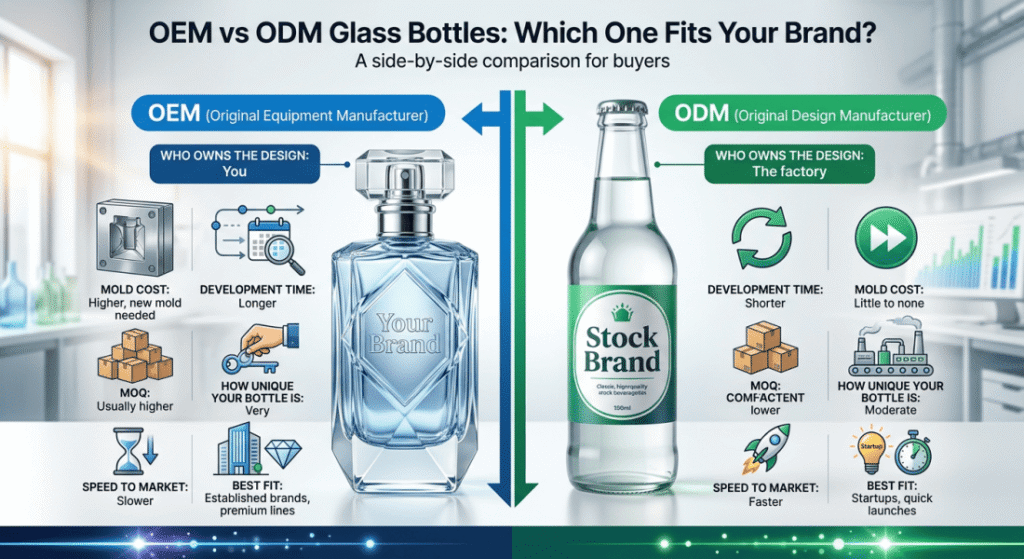
OEM vs ODM Glass Bottles: Which One Fits Your Brand?
Buyers ask about the difference between OEM and ODM all the time, so here’s a quick side-by-side:
|
Factor |
OEM |
ODM |
|
Who owns the design |
You |
The factory |
|
Mold cost |
Higher, new mold needed |
Little to none |
|
Development time |
Longer |
Shorter |
|
MOQ |
Usually higher |
Usually lower |
|
How unique your bottle is |
Very |
Moderate |
|
Speed to market |
Slower |
Faster |
|
Best fit |
Established brands, premium lines |
Startups, quick launches |
Go OEM If…
You want a signature bottle nobody else has
Your brand sits in the premium or luxury space
You’ve got the budget and time for mold development
Go ODM If…
You need to launch fast
You want to keep upfront costs down
You’re testing a market before committing hard
Honestly, neither is “better.” They just solve different problems. Plenty of brands run both — ODM for supporting products and OEM for their hero SKU.
Custom Glass Bottle Options: Shape, Color, Finish, Closure, Decoration
This is where most buyers spend the most time, and rightly so. These decisions shape how your bottle looks and feels in a customer’s hand.
Shape
Round, square, oval, tall, short, minimal, sculptural. The shape sets the whole tone. Skincare tends to go clean and minimal. Perfume swings between elegant and bold. Spirits often go heavy and architectural because weight in the hand reads as premium.
Size
You can order anything from 5ml sample bottles up to 1L or more. For custom skincare bottles and custom essential oil bottles, 10ml, 15ml, 30ml, 50ml, and 100ml are the most common. For beverages and spirits, 200ml to 750ml covers most cases.
Color
Clear, amber, green, blue, and black are the standards. Amber and green block light better, which matters for essential oils and some drinks. If none of the standard colors work, custom coating can hit almost any shade.
Surface Finish
Frosted glass bottles — soft matte look, feels premium, huge in skincare and craft spirits
Spray coating — solid color across the whole bottle, gradients too
Electroplating — metallic finishes for luxury lines
Matte finish — modern and quiet
Polished — clean and glossy
Decoration
Silk screen printing
Hot stamping in gold, silver, or custom foils
Decal printing when you need multi-color artwork
UV printing
Embossing and debossing
Labels
Printed glass bottles are probably the best value-for-money way to get strong branding without paying for a new mold.
Closures
The bottle is only half the package. The closure decides how the product gets used and whether it seals properly:
Screw caps in aluminum, plastic, or wood
Cork and T-cork for spirits
Droppers for custom dropper bottles, common in serums and oils
Lotion pumps for custom pump bottles
Mist sprayers and trigger sprayers
Crimp necks for perfume
Child-resistant caps where the product needs it
Matching the closure to the neck finish sounds obvious, but this is where a lot of first-time buyers run into leaking problems. Test it.
Boxes and Outer Packaging
Gift boxes, custom cartons, insert trays, and drop-tested shipping cartons all matter, especially for luxury glass bottles where unboxing is part of the customer’s experience.
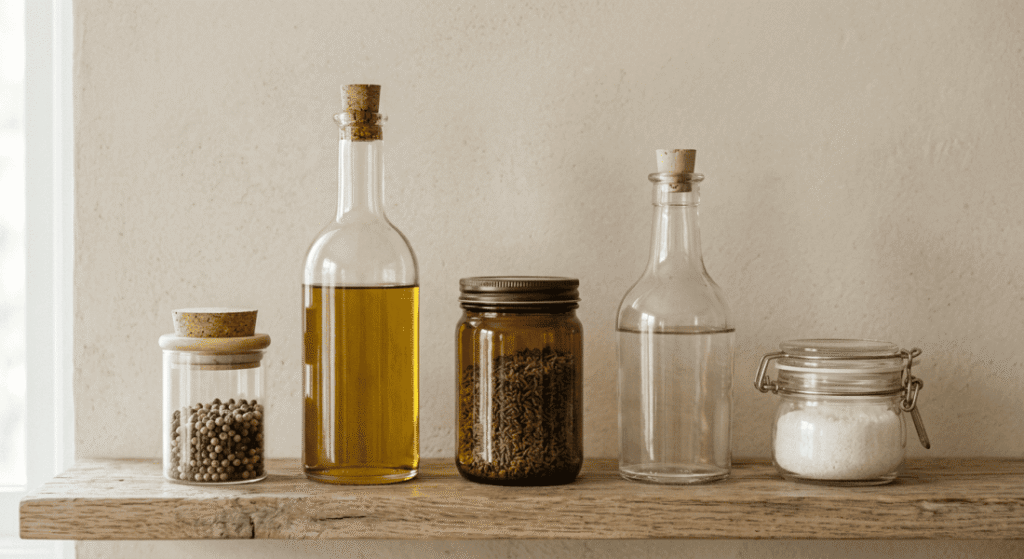
The Custom Glass Bottle Development Process
Here’s what a typical project looks like from start to finish.
Step 1: Tell the Supplier What You Need
Product type, capacity, market, shape ideas, decoration, closure. The more detail you give upfront, the fewer surprises later.
Step 2: Design or Bottle Selection
For OEM, this is where drawings and 3D files come in. For ODM, you pick from the catalog.
Step 3: Sampling
Samples get made and shipped over. Check dimensions, look, closure fit, and — really important — whether the bottle actually works on your filling line.
Step 4: Mold or Adjustments
For OEM, the mold gets built or fine-tuned after you review the sample. Trial runs happen before full production.
Step 5: Production
Bottles get formed, annealed, inspected, decorated, and assembled with closures if that’s part of the order.
Step 6: Packing and Shipping
Everything gets packed with dividers, palletized, and shipped by sea, air, or rail depending on where you are and how urgent it is.
Things to Think About Before Customizing
Will the Bottle Work With Your Product?
Not every bottle suits every formula. Perfume needs glass that won’t react with alcohol. Essential oils generally want darker glass. Skincare needs closures that seal against active ingredients without breaking down.
Does It Match Your Brand Positioning?
The bottle should match your price point. A clean, minimal frosted bottle fits clean beauty. A heavy, embossed bottle fits premium spirits. When packaging and positioning don’t match, customers get confused fast.
MOQ and Mold Costs
MOQ depends on whether the mold exists and how much decoration is involved. Ask your supplier for a clear breakdown early so you don’t get blindsided.
Lead Time
Add sampling, mold time (for OEM), production, and shipping together. Realistic OEM projects usually run 2–4 months. ODM is faster.
Closure Fit
Test the neck, thread, pump, and sealing before mass production. This one step alone saves most leakage complaints.
Quality Standards
Dimensions, visual defects, stress resistance, sealing, and how well the bottle survives transport all belong on the QC checklist.
Sustainability
Glass is one of the most recyclable glass bottles materials out there, and more buyers are asking for eco-friendly glass packaging. Lightweighting, using recycled content, and keeping decoration simple all help.
Common Problems in Custom Glass Bottle Projects (and How to Skip Them)
Vague design briefs. Vague briefs get you samples that miss the mark. Send drawings, reference photos, and specs.
Bottle and closure that don’t match. Test the pairing before production, not after.
Underestimating how long things take. Molds and samples take real weeks. Plan backward from your launch date.
Ignoring shipping risks. A beautiful bottle that arrives broken is a lost sale. Insist on drop-tested packing.
Chasing the cheapest quote. The cheapest supplier often turns into the most expensive project once you count rejects, delays, and reorders.
How to Pick the Right Custom Glass Bottle Manufacturer
When you’re comparing a custom bottle manufacturer, look past the quote. Think about:
Design and engineering — can they help you refine your idea?
Mold experience — how many custom projects have they actually completed?
Range of customization — printing, coating, frosting, embossing, all in-house
QC system — inline checks and final inspection
MOQ flexibility and sampling process
Export experience and how they pack
Communication — do they respond clearly and on time?
A good glass packaging manufacturer feels more like a partner than a vendor. You’ll be working together through sampling, revisions, production, and shipping. If communication is rough at the start, it usually gets worse, not better.
Why Smilebottles Works Well for Custom Glass Bottle Projects
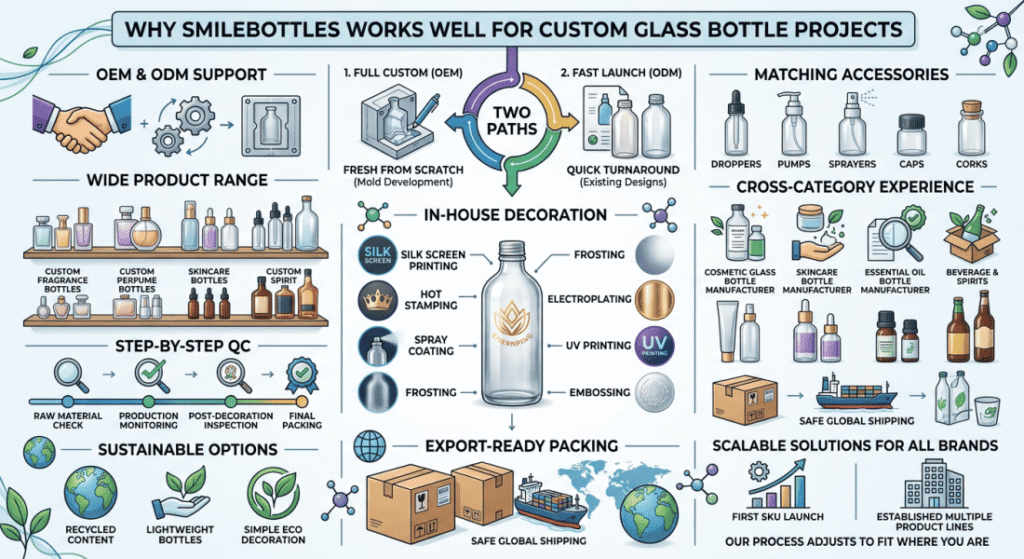
At Smilebottles, we build our work around helping brands develop packaging that actually fits their product and their market. Whether you want a fresh bottle from scratch or a fast ODM launch, we cover both.
What we bring:
OEM and ODM support — full mold development or quick turnaround from existing designs
Wide product range — custom fragrance bottles, custom spirit bottles, custom perfume bottles, skincare bottles, dropper bottles, and more
Decoration in-house — silk screen, hot stamping, spray coating, frosting, electroplating, UV printing, embossing
Matching accessories — droppers, pumps, sprayers, caps, corks
QC at every step — from raw material check through final packing
Experience across categories — as a cosmetic glass bottle manufacturer, skincare bottle manufacturer, essential oil bottle manufacturer, and supplier for beverage and spirits brands
Sustainable options — recycled content, lighter bottles, simpler decoration when eco goals matter
Export-ready packing for safe global shipping
We work with startups launching their first SKU as well as established brands running multiple product lines. The process adjusts to fit where you are.
FAQ: Frequently Asked Questions About Custom Glass Bottles
Q1:What’s the difference between OEM and ODM glass bottles?
A1:OEM means the bottle is made from your design and your mold. ODM means you customize a bottle the factory already has by choosing color, decoration, and closures.
Q2:Can I create a completely unique bottle shape?
A2:Yes, that’s what OEM is for. You share a drawing or 3D file, and a new mold gets built for you.
Q3:What’s the MOQ for custom glass bottles?
A3:It depends on whether you use an existing mold or a new one, plus the decoration involved. Stock bottles start lower. New custom molds need higher volumes to make sense economically.
Q4:How long does production take?
A4:ODM usually runs 4–6 weeks. OEM with a new mold typically takes 2–4 months from concept to delivery.
Q5:Do I need to pay for a mold?
A5:Yes, if you go OEM. It’s a one-time cost, and the mold stays available for your reorders.
Q6:Can I customize color and logo printing?
A6:Yes. You can pick colored glass, coating, frosting, and various printing methods like silk screen, hot stamping, and UV printing.
Q7:Can you provide matching caps, pumps, and droppers?
A7:Yes. Matching accessories are usually part of the project, and compatibility testing happens during sampling.
Q8:Are custom glass bottles suitable for cosmetics, perfume, and beverages?
A8:Yes. Glass is one of the most versatile packaging materials and works across cosmetics, perfume, essential oils, skincare, beverages, and spirits.
Q9:How do I know if the bottle will work with my product?
A9:Share your formula details with the supplier and ask for compatibility testing samples before you commit to production.
Q10:How are custom glass bottles packed for export?
A10:Bottles get packed with dividers inside reinforced cartons, then palletized and secured for sea, air, or rail shipping.
Conclusion
Custom glass packaging is one of the strongest tools you’ve got for building a brand that stands out. Whether you go OEM for a signature bottle or ODM for a quick, budget-friendly launch, the key is finding a partner who gets both the technical side and the business side of what you’re trying to do.
If you’re planning your next packaging project and looking for a custom glass bottle supplier who can help you go from idea to finished product, Smilebottles is ready to help you develop the right OEM or ODM glass bottle packaging solutions for your brand — from custom glass bottle design and mold development to decoration, closures, and export packing.
Reach out when you’re ready to talk it through. We’ll help you figure out the smartest path forward for your product and your budget.
 English