


Table of Contents
ToggleAuthor: SmileBottles Editorial Team
Estimated Reading Time: About 15 Minute
Picking the right packaging is one of those decisions that can quietly make or break a product. You can have the best whiskey, the finest perfume, or the cleanest skincare formula in the world, but if the bottle it comes in feels ordinary, most shoppers will just walk past it. That is why more and more brands are moving away from stock packaging and choosing custom glass bottles and custom glass jars instead.
If you are new to this world, or if you have looked into it before but felt overwhelmed by the process, this guide is written for you. Smilebottles is going to walk through what customization actually means, what you can change, how the design and manufacturing process works step by step, and what to think about before starting your own project.
Introduction to Custom Glass Bottles and Jars
What are custom glass bottles and jars?
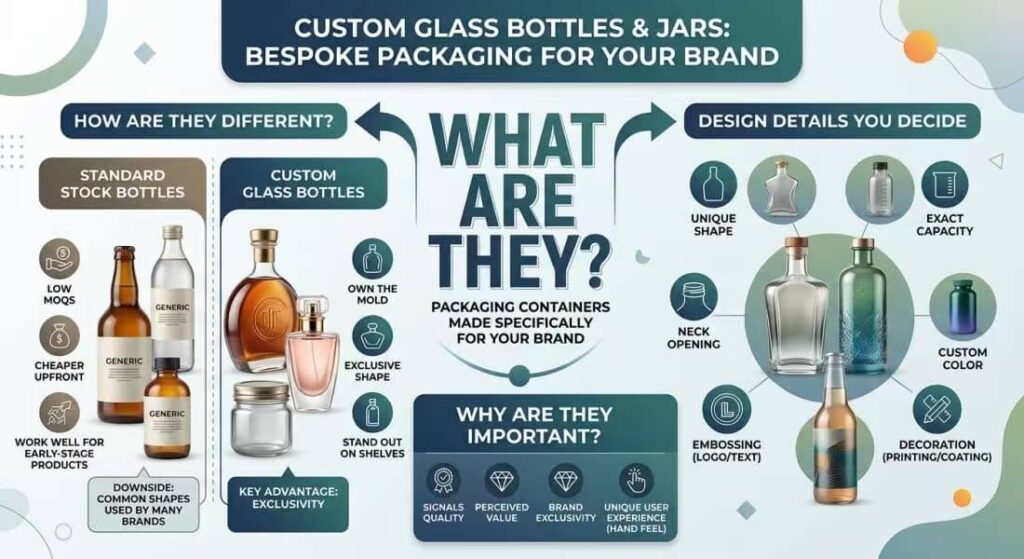
In simple terms, custom glass bottles and jars are packaging containers made specifically for your brand. Instead of choosing from a catalog of shapes that already exist, you decide the details — the shape, capacity, neck opening, color, embossing, and decoration. Everything is built around your product and how you want it to be seen.
You will hear people use different words for the same idea. Some call them bespoke glass bottles, others call them personalized glass bottles or customized glass bottles. The meaning is the same: containers designed just for you, produced from a mold that belongs to your project.
How are they different from standard stock bottles and jars?
Stock bottles are the ones you can order from a warehouse in a week. They are cheaper upfront, they have low MOQs, and they work well for early-stage products. The downside is that dozens or hundreds of other brands are using the exact same shape.
A custom glass bottle is different. You own the mold. You own the shape. Nobody else can produce a bottle that looks like yours. For brands that want to stand out on a crowded shelf, that exclusivity is worth a lot.
Why are custom glass packaging solutions important for modern brands?
Buyers today notice small details. A glass bottle with design elements built right into the glass — a curved shoulder, a heavy base, an embossed logo — signals quality before anyone even reads the label. Good custom glass packaging is not just decoration. It shapes how your product feels in someone’s hand and how much they think it is worth.
What Can Be Customized in Glass Bottles and Glass Jars?
When people first hear the word “custom,” many assume it just means adding a logo. It is actually much broader than that.
Bottle and jar shape
Shape is usually where the journey starts. Do you want a tall and slim look like traditional custom wine bottles, or a heavy square base like classic custom whiskey bottles? Custom shaped glass bottles let you match the silhouette to the personality of your product.
Capacity and dimensions
You decide the exact volume — 30ml, 100ml, 250ml, 500ml, 750ml, or anything else that fits your product. Height and diameter can be adjusted too, which really matters for shelf placement and shipping cartons.
Neck finish and closure compatibility
The neck finish is the top part of the bottle where the cap, cork, dropper, or pump sits. It has to match your closure exactly. Even a small mismatch causes leaking or bad sealing later.
Glass color options
Clear, amber, cobalt blue, green, frosted white, matte black — the color affects both looks and function. Amber and green protect light-sensitive contents like essential oils, beer, and some spirits.
Embossed or debossed logo and patterns
Embossed glass bottles carry the logo or pattern raised out of the surface. Debossing is the opposite — pressed inward. Both give a premium feel that no printed label can fully replicate.
Surface decoration and labeling
Once the bottle is formed, another layer of design can be added. Screen printing on glass bottles, hot stamping, spraying, frosting, decal, and acid etching are common choices. Paper and textured labels are also popular for wine and food products.
Packaging accessories such as caps, pumps, droppers, and lids
A bottle is rarely just a bottle. Custom dropper bottles need droppers that match the neck. Candle jars need lids that fit both the jar and the brand style. Skincare bottles need pumps that feel smooth to press. All of these accessories can be customized alongside the bottle itself.
How the Custom Glass Bottle and Jar Design Process Works
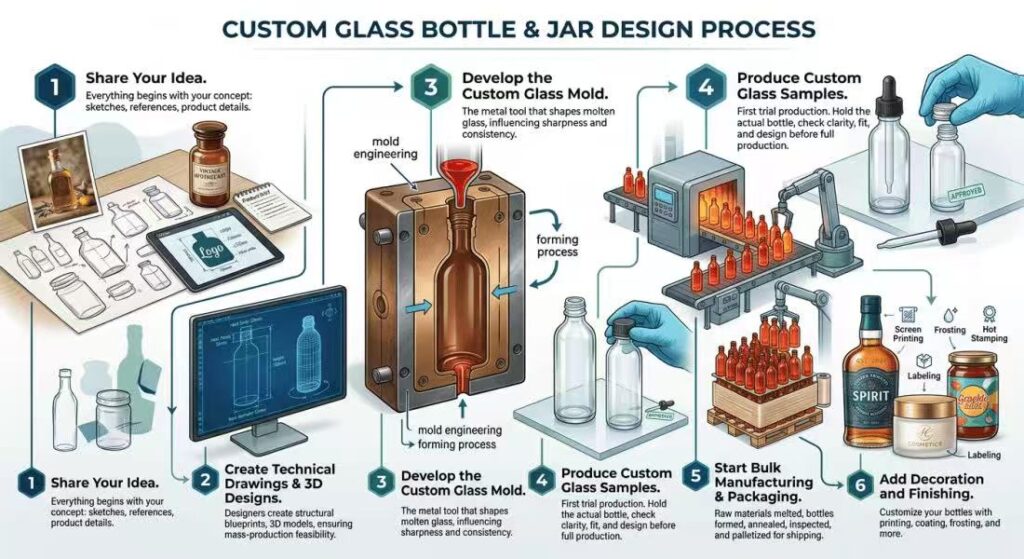
If you have never done this before, the process can feel like a mystery. Let us break it down clearly so you know exactly what happens from your first email to the finished pallet leaving the factory. This is basically how to make custom glass bottles in the real world.
1. Share your custom bottle or jar idea
Everything begins with your idea. You do not need a finished design file. What helps most is any of the following:
rough sketches
reference photos
physical samples
desired dimensions
your logo file
overall packaging concept
product details (what goes inside, target market, price point)
The more context you give, the easier it is for us to guide you in the right direction.
2. Create technical drawings and 3D designs
Our bottle designers turn your idea into technical drawings and 3D models. This stage covers:
structural design
exact bottle dimensions
neck finish details
glass weight
filling line position
bottom design and stability
mold feasibility review
Sometimes a shape looks stunning in a sketch but is not practical to mass-produce. This is where we flag those issues early, before you spend money on a mold.
3. Develop the custom glass mold
The custom glass bottle mold is the heart of the whole project. It is the metal tool that shapes molten glass into your bottle. Mold quality directly affects how sharp your embossing looks, how consistent every bottle is, and how long the mold lasts.
At this step we handle:
mold engineering
mold cost quotation
mold trial and testing
adjustments based on first results
A well-made mold can produce hundreds of thousands of bottles, so it pays to get it right.
4. Produce custom glass samples
Before mass production, we make trial samples. You hold the actual bottle, check it against your expectations, and decide if anything needs to change. Things to look at include:
appearance and glass clarity
exact size and weight
neck finish and sealing
how your cap or dropper fits
how it looks with your intended label or decoration
Nothing moves forward until you are happy with the sample.
5. Start bulk manufacturing and packaging
Once samples are approved, mass production begins. In simple terms:
raw materials are melted at very high temperatures
molten glass is formed into bottles using your mold
bottles pass through an annealing oven to release internal stress
every bottle is inspected for defects
approved bottles are packed, palletized, and prepared for shipping
For custom glass bottles wholesale orders shipped internationally, packaging strength matters just as much as the bottles themselves. Poor packing can ruin a good order during ocean transit.
6. Add decoration and finishing
If your project needs decoration, this is where it happens. Common options include: screen printing, frosting, spraying and color coating, hot stamping, decal application, labeling, acid etching, embossing (done during forming).
Many custom printed glass bottles combine two or three decoration methods — for example, a frosted body with a hot-stamped gold logo.
Key Factors to Consider Before Designing a Custom Glass Bottle or Jar
Before jumping in, take a step back and think through the following. These are the questions we walk every new customer through at the start.
Product type and filling requirements
What goes inside matters. Alcohol, water, oil, cream, wax, honey, and jam all have different filling and sealing requirements. So your product type affects glass color, neck finish, and even wall thickness.
Bottle strength and transportation safety
If bottles will travel far, they need to survive the journey. Wall distribution, base design, and glass weight all affect how well a bottle handles shipping.
MOQ and production volume
Every custom project has a minimum order quantity. It depends on bottle size, weight, and decoration. Larger runs bring down the per-unit price.
Lead time for mold, sampling, and bulk production
A realistic timeline includes design, mold making, sampling, and mass production. Rushing usually creates problems that are more expensive to fix later.
Compatibility with caps, closures, and dispensers
If you already have a cap or pump supplier, share their specifications early. Matching the neck finish to those specs from the start avoids fitting issues later.
Branding and shelf appeal
Think about where your product will actually be sold. A bottle that photographs beautifully might look completely different under harsh supermarket lighting. Good glass bottle design takes both scenarios into account.
Why Brands Choose Custom Glass Bottles and Jars
You might be wondering whether all this effort is really worth it. From what we see every day, yes — for the right kind of brand, it is.
Build a unique brand identity
When you customize glass bottle shapes and details, competitors cannot copy your packaging. The bottle becomes part of what makes your brand recognizable.
Improve product recognition on the shelf
People often recognize a brand from its silhouette long before they read the label. That is the power of a strong custom bottle design.
Increase perceived value and premium positioning
Weight, curves, embossing, and finish all influence how expensive a product feels. The same liquid inside a heavy embossed bottle simply feels more premium than in a lightweight generic one.
Create packaging that matches product function
A water bottle designer thinks about grip and drinking comfort. A perfume designer thinks about how the bottle sits on a vanity. A candle bottle needs to handle heat and look good even after the wax is gone. Function should always support form.
Support long-term brand differentiation
A strong custom bottle can stay with a brand for many years. It becomes part of the identity rather than something that gets replaced with the next trend.
Enhance customer experience and brand storytelling
The moment a customer picks up your bottle, they are already forming an opinion. Well-thought-out glass bottles creation turns that first touch into part of your brand story.
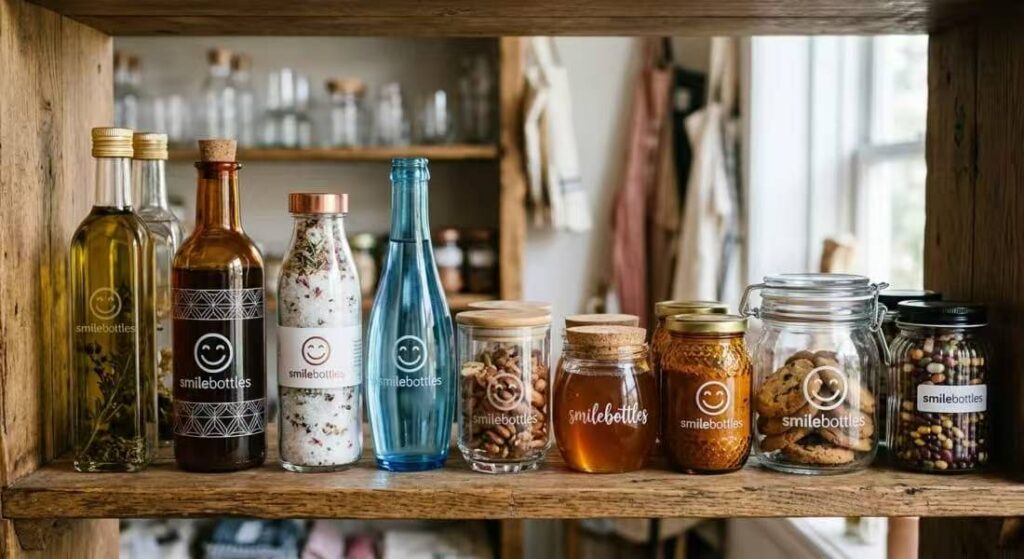
Industries That Commonly Use Custom Glass Packaging
Almost every product category benefits from customization in some way. Here are the ones we see most often.
Spirits and liquor bottles
Custom liquor bottles, custom gin bottles, custom vodka bottles, and custom rum bottles are some of the most detailed projects in the industry. Spirits brands invest heavily in bottle shape and embossing because the bottle stays on the bar long after the label has been read.
Wine and beverage bottles
Wine follows tradition, but there is still room for distinct shapes, unique punts, and custom color glass. Custom beverage bottles for juice, kombucha, cold brew, and sparkling drinks have become more creative every year.
Perfume and fragrance bottles
Custom perfume bottles and custom fragrance bottles are usually smaller, but the level of detail is very high. Weight, clarity, and matching caps play a huge role in how the product feels.
Cosmetic and skincare containers
Serums, oils, and toners often come in custom dropper bottles, while creams and lotions use jars or pump bottles. Frosted glass and matte coatings are especially popular in this space.
Food jars and sauce bottles
Custom food jars, custom honey jars, and custom jam jars need to balance visual appeal with practical use. The mouth needs to be wide enough for spoons, and the shape has to stack well on shelves and in shipping cases.
Candle jars and home fragrance containers
Custom candle jars are one of the fastest-growing categories. Customers often reuse them, so the design has to hold up long after the candle is finished. Personalized glass jars with textured surfaces or unique colors are very popular right now.
Pharmaceutical and health product packaging
Custom essential oil bottles and supplement bottles often use amber or cobalt glass to protect their contents from light and oxidation.
Garden and outdoor products
For brands producing a custom product bottle for garden products — such as plant food, insect sprays, or outdoor cleaners — the priorities shift toward durability and compatibility with trigger sprayers. Producing custom product bottles garden products at scale requires bottles that handle temperature and rough handling well.
Custom Glass Bottles vs Stock Glass Bottles: Which Is Better?
This is one of the most common questions buyers ask before starting a project. There is no single right answer — it depends on where your brand is right now.
Advantages of stock bottles and jars
lower upfront cost
no mold fee
short lead time
lower MOQ
good for testing a new product before committing
Advantages of custom glass packaging
exclusive shape that competitors cannot copy
full control over dimensions and decoration
stronger shelf presence
clearer brand identity
often better long-term unit cost at high volumes
When to choose stock packaging
If you are launching your first product, testing a new market, or working with a tight budget, stock bottles make sense. You can always switch to custom once your product has proven itself.
When to invest in a fully customized design
Once you have consistent sales and a clear brand direction, moving to custom glass bottle design is usually the next logical step. It also makes sense if your product requires a shape or function that stock bottles simply cannot deliver.
Why Choose Smilebottles as Your Custom Glass Bottle Manufacturer
We would rather share the facts than write a sales pitch, so here is what we actually do.
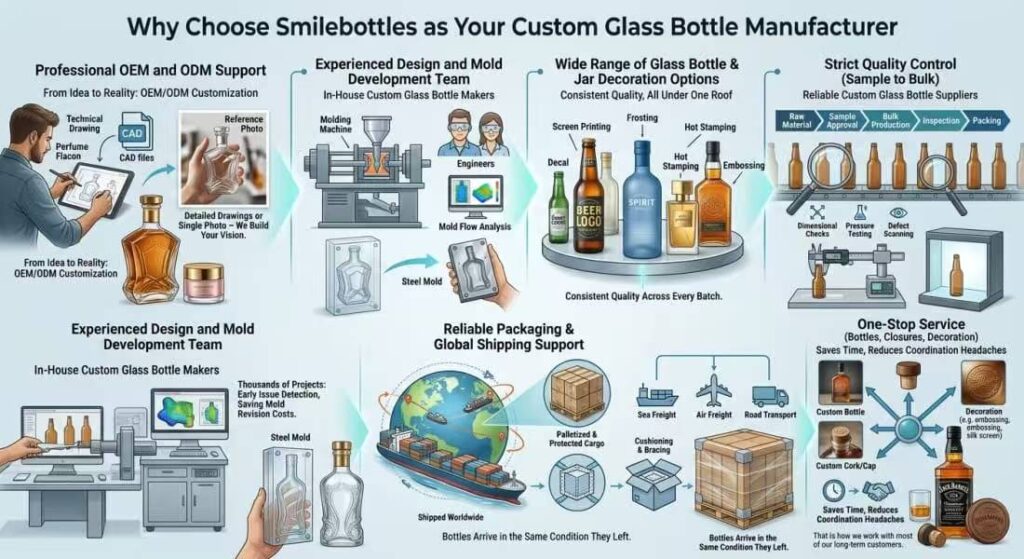
Professional OEM and ODM customization support
As a custom glass bottle manufacturer and custom glass jar manufacturer, Smilebottles handles both OEM and ODM work. Some customers arrive with detailed technical drawings, others come with a single reference photo. Either way, we work with you until the idea becomes a real product.
Experienced design and mold development team
Our in-house custom glass bottle makers and engineers have worked on thousands of projects — from small perfume flacons to heavy spirit bottles. That experience helps us spot production issues early, which saves you money on mold revisions later.
Wide range of glass bottle and jar decoration options
Screen printing, frosting, spraying, hot stamping, decal, embossing, and acid etching are all done in-house. Keeping decoration under the same roof helps quality stay consistent across every batch.
Strict quality control from sample to bulk production
Every batch goes through inspection before packing. Reliable custom glass bottle suppliers understand that a single defective bottle can shut down a filling line, so quality checks happen at every stage.
Reliable packaging and global shipping support
We ship worldwide, and we know how glass needs to be packed for long-distance ocean transport. The goal is simple — your bottles should arrive in the same condition they left our factory.
One-stop service for glass bottles, jars, closures, and decoration
Sourcing bottles, matching caps or droppers, and decoration from one supplier saves time and reduces coordination headaches. That is how we work with most of our long-term customers.
FAQ: Frequently Asked Questions About Custom Glass Bottle and Jar Design
Q1:What is the minimum order quantity for custom glass bottles and jars?
A1:MOQ depends on bottle size and complexity. For most custom projects, it starts from around 10,000 pieces, though it can vary. We can give you a clear answer once we know your design.
Q2:How long does custom mold development take?
A2:Mold development usually takes 25 to 40 days depending on complexity. Detailed embossing or unusual shapes may take a bit longer.
Q3:How much does a custom glass bottle mold cost?
A3:Mold cost depends on bottle size, shape complexity, and how many cavities the mold has. Simple bottles cost less; heavy spirit bottles with detailed embossing cost more. You always get a clear quote before committing.
Q4:Can you make a custom bottle from a sketch or sample?
A4:Yes. Many customers start with only a hand-drawn sketch or a sample bottle they want to improve. If you want to design a bottle from scratch, our team can guide you through every step.
Q5:Can I add my logo on the bottle or jar?
A5:Absolutely. Logos can be embossed into the glass, screen printed, hot stamped, or applied through decals. Each method looks a little different, and we can help you pick the right one for your product.
Q6:What decoration options are available for custom glass packaging?
A6:Screen printing, frosting, spraying, hot stamping, decal, acid etching, and embossing are the most common. Many bottles combine two methods — for example, a frosted finish with a printed logo.
Q7:Can custom glass bottles be made in different colors?
A7:Yes. Amber, green, blue, and black are the most common colored glass options. Special colors are possible but usually require larger order volumes.
Conclusion
Custom packaging is about more than looking different. It is about creating a container that feels right in the customer’s hand and tells the right story on the shelf. Whether you are working on custom glass water bottles, a limited edition spirit release, a new skincare range, or a small-batch candle line, the bottle is often the very first thing your customer touches. Getting it right is worth the effort. If you have any requirements, please contact Smilebottles.


