



Table of Contents
ToggleAuthor: SmileBottles Editorial Team
Estimated Reading Time: About 15 Minute
If you run a dairy brand, distribute dairy products, or you’re sourcing packaging for a new beverage line, this shift matters. The move back to glass milk bottles isn’t just nostalgia. It’s driven by real changes in how people shop, what they trust, and how they want brands to behave. This article walks you through why it’s happening, what to look for when you buy, and how to make the right decision for your product line.
A Quick Look Back: How Glass Milk Bottles Got Here
To understand why glass is returning, it helps to know why it left in the first place.
The early days of milk delivery
For most of the 20th century, traditional milk bottles made of glass were part of daily life. The milkman showed up before sunrise, dropped off fresh bottles on the doorstep, and picked up the empties from the day before. That closed-loop system worked because glass was durable, easy to clean, and could be refilled many times. Those vintage milk bottles — often with embossed dairy names and simple foil caps — are still remembered fondly by older generations, and they’ve become collector’s items in some places.
Why plastic took over
Starting in the 1960s and 70s, plastic jugs and paper cartons pushed glass out. They were lighter, cheaper to ship, and didn’t break. Supermarkets grew, home delivery faded, and the whole system moved toward single-use packaging. For decades, that was the norm.
What’s driving the return
Now the pendulum is swinging back. Shoppers care more about waste. Dairies want to stand out on crowded shelves. And the whole conversation around sustainable dairy packaging has moved from a niche topic to a real business concern. That’s why glass bottles for milk are showing up again, both in specialty markets and in mainstream retail.
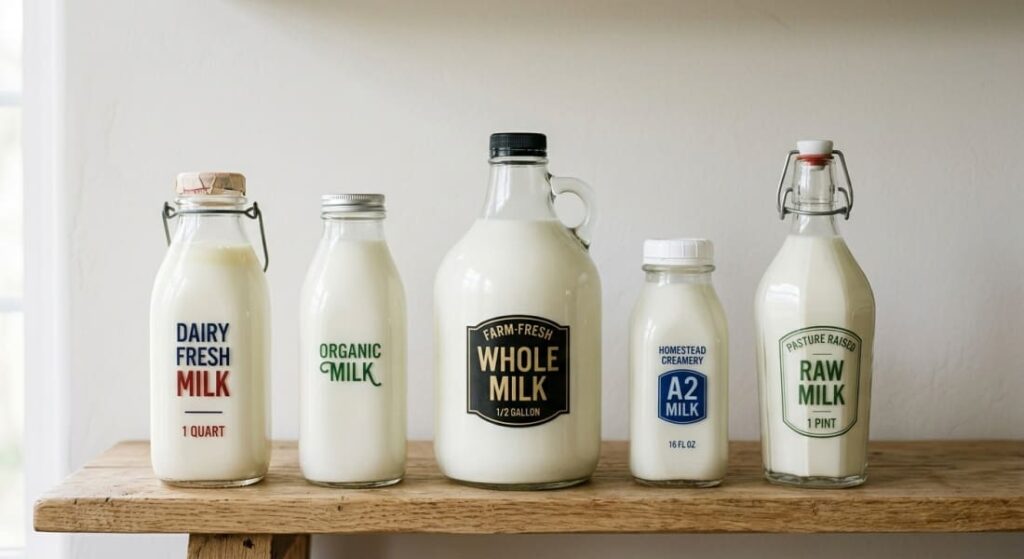
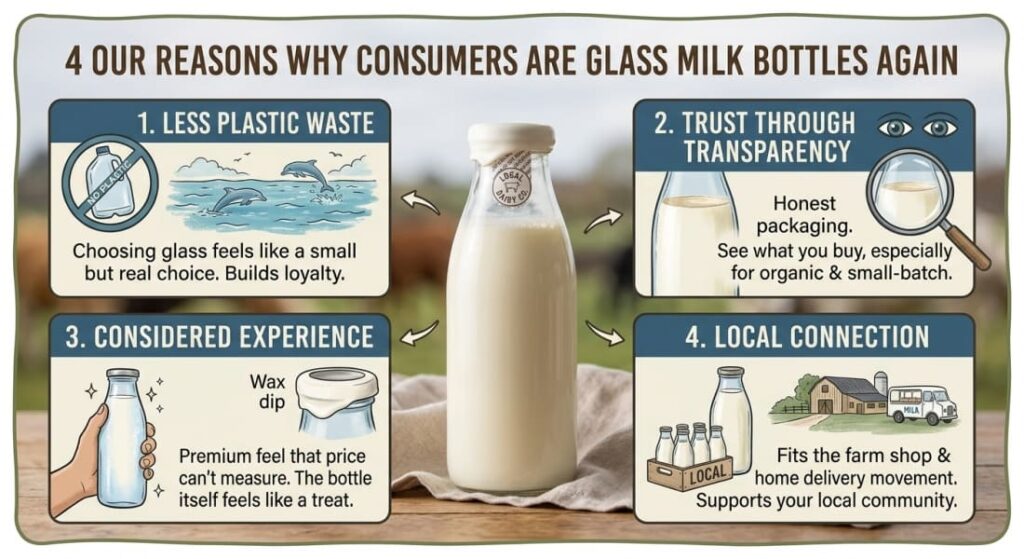
Why Consumers Are Choosing Glass Milk Bottles Again
If you’re deciding what to put your product in, you need to understand what your buyers actually care about. And their priorities have shifted.
They want less plastic in their lives
Plastic waste is no longer a background issue. People see the news, they see the ocean footage, and they think about it when they shop. When someone picks up milk in a clear glass bottle instead of a plastic jug, they feel like they’re making a small but real choice. That feeling matters. It builds loyalty in a way that price alone can’t.
They trust what they can see
There’s something honest about clear glass milk bottles. You can see the milk. You can see the cream line on non-homogenized products. Nothing is hidden. For a shopper who’s paying more for organic, grass-fed, or small-batch dairy, seeing the product through the glass is part of the value.
They like the feel of it
This one is harder to measure, but it’s real. A cold glass bottle in your hand feels different from a plastic jug. It feels considered. It feels like the brand took time. That’s why so many premium dairies use glass milk bottles with caps designed to look intentional — a foil seal, a printed cap, a wax dip on limited editions. The packaging becomes part of the experience.
They’re returning to local
Farm shops, CSAs, and home delivery services are all growing. Farm milk bottles in glass fit naturally with that whole movement. When you’re buying milk from a farm ten miles away, drinking it out of a glass bottle just makes sense.
Does Milk Last Longer in Glass?
This is a question you’ll hear from buyers all the time, so it’s worth addressing plainly. Does milk last longer in glass? The honest answer is: glass itself doesn’t magically extend shelf life, but it does help in a few practical ways.
Glass is non-porous and inert. It doesn’t absorb flavors, and it doesn’t leach anything into the milk. That means the milk tastes like milk — nothing else. Many people who switch from plastic notice a cleaner taste right away, and that’s part of why.
Glass also handles cold temperatures very well. It holds a chill longer than plastic, which helps during the trip from store to home fridge.
What matters just as much, though, is the seal, the cap, and the cold chain. A glass milk bottle with lid designed for a proper airtight fit, kept refrigerated the whole way, will keep milk at its best. Glass supports quality, but the whole system has to work together.
So when someone asks you what glass milk is or what makes it different, the simple answer is: it’s the same milk, packaged in a material that doesn’t interfere with taste and holds temperature well.
Sustainability Is a Real Driver Behind the Comeback
You can’t talk about dairy packaging trends right now without talking about sustainability. It’s not a side conversation anymore — it’s a core part of purchasing decisions, both for consumers and for wholesale buyers.
Reusable, not just recyclable
Recycling is good. Reuse is better. Reusable glass milk bottles can be washed and refilled dozens of times before they need to be recycled. That’s a completely different footprint than single-use plastic, which is used once and then, in most cases, ends up in a landfill even if it was technically recyclable.
Fitting into circular systems
Refillable milk bottles work especially well for local and regional dairies. You bottle the milk, sell it with a small deposit, and the customer brings the bottle back. Clean, sanitize, refill. That’s a circular system, and it’s exactly what eco friendly milk packaging is supposed to look like in practice.
The honest tradeoff
Glass is heavier than plastic. That’s just physics. It costs more to ship, and shipping fuel matters too. But if the bottles are being reused many times, especially in a local distribution loop, the math usually works out in glass’s favor. The tradeoff is real, but it’s manageable — and for many dairy brands, worth it.
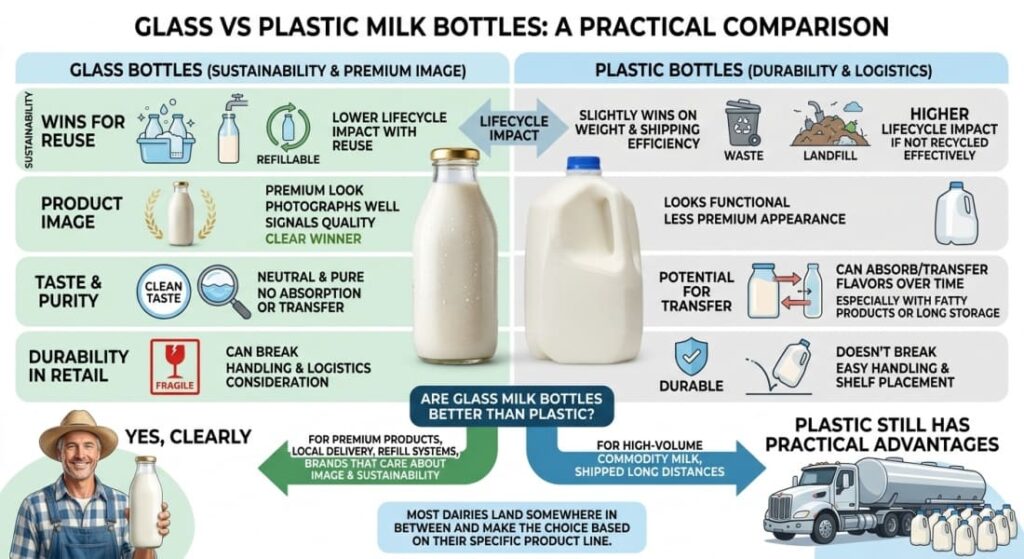
Glass vs Plastic Milk Bottles: A Practical Comparison
If you’re weighing options, here’s the glass vs plastic milk bottles comparison broken down the way a buyer actually thinks about it.
Sustainability: Glass wins for reuse. Plastic wins slightly on weight and shipping efficiency, but loses on lifecycle impact when reuse is factored in.
Product image: Glass wins clearly. It looks premium, it photographs well, and it signals quality. Plastic looks functional.
Taste and purity: Glass is neutral. It doesn’t absorb or transfer anything. Plastic can, over time, especially with fatty products or long storage.
Durability in retail: Plastic doesn’t break. Glass can. That’s a real consideration for how you handle logistics and shelf placement.
So, are glass milk bottles better than plastic? For premium products, local delivery, refill systems, and brands that care about image and sustainability — yes, clearly. For high-volume commodity milk shipped long distances, plastic still has practical advantages. Most dairies land somewhere in between and make the choice based on their specific product line.
The Comeback of Refillable and Returnable Systems
Returnable milk bottles are one of the most interesting parts of this whole shift. They aren’t just for nostalgia — they’re a working business model.
How the system works
Customers pay a small deposit on the bottle. When they finish the milk, they return the bottle — either to the store, to a delivery driver, or to a drop-off point. The bottles get washed, inspected, and refilled. Then they go back out.
Why it works for local dairies
If you’re running a small or mid-sized dairy, this model creates something valuable: repeat customer contact. Every bottle return is a touchpoint. Every refill is a reason for the customer to come back. That’s the kind of loyalty that plastic packaging just doesn’t create.
What to think about
Not every product fits refillable systems. You need the logistics, the wash capacity, and enough local density of customers to make it work. But if those pieces are in place, reusable milk bottles can genuinely change your relationship with your customers.
Glass Milk Bottles Aren’t Just for Regular Milk Anymore
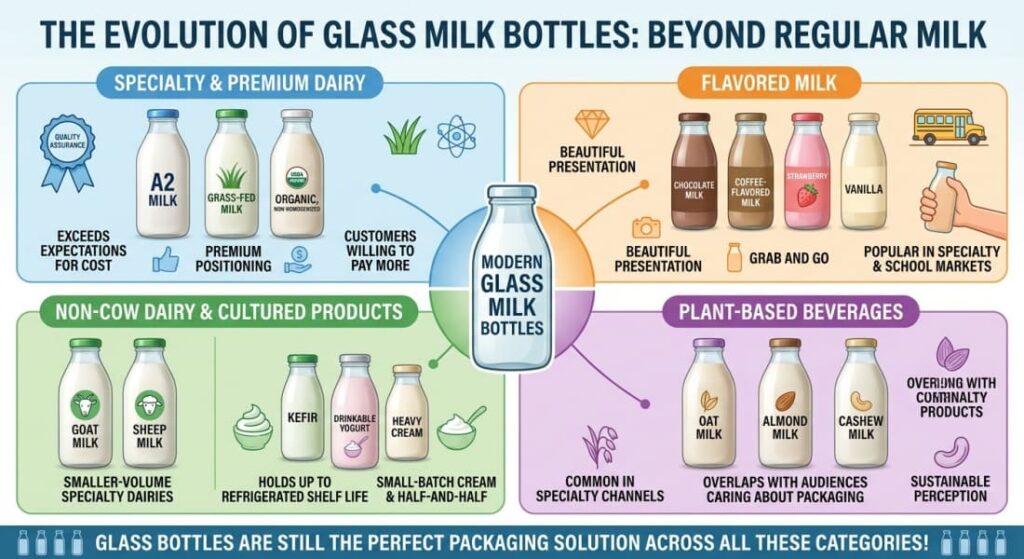
One of the more interesting shifts in dairy glass bottles is what people are putting in them. It’s not just whole milk anymore.
Specialty and premium dairy
A2 milk, grass-fed milk, organic, non-homogenized — all of these premium categories lean heavily on glass. When someone is paying twice as much for a specialty milk, they expect the packaging to reflect that. Glass delivers on that expectation.
Flavored milk
Glass chocolate milk has become a real category, especially in specialty and school-adjacent markets. Coffee-flavored milk, strawberry, vanilla — these all present beautifully in glass, and the bottle format is easy to grab and go.
Goat, sheep, and non-cow dairy
Smaller-volume specialty dairies often go straight to glass because it matches their premium positioning.
Cream, kefir, and cultured products
Glass bottles for cream are common for small-batch heavy cream, half-and-half, and drinkable yogurts. Kefir and drinkable yogurt work well in glass because the packaging holds up to the refrigerated shelf life these products need.
Plant-based beverages
Oat milk, almond milk, cashew milk — plant-based drinks in glass have become common in specialty channels. The audience overlaps heavily with people who care about packaging.
Milk on glass, whether traditional dairy or something more modern, works across all of these categories.
Why Glass Bottles Work So Well for Premium Positioning
If you’re building a brand — and you are, whether you think of it that way or not — packaging is part of the product. Premium milk packaging in glass does several things for you at once.
It signals quality instantly
Shoppers make judgments in a second or two. A glass bottle on the shelf communicates “premium” without needing a single word. That’s real value.
It gives you design options
Custom glass milk bottles can be shaped, embossed, and decorated in ways that plastic really can’t match. Whether you want a classic milkman-style bottle, a modern squared-shoulder look, or something with your logo embossed right into the glass, branded glass milk bottles give you room to build a distinctive shelf presence.
It photographs well
For a dairy brand today, half of your marketing lives on Instagram, TikTok, and other social platforms. Glass looks good in photos. That matters more than it used to.
It supports storytelling
If your brand story involves tradition, farm heritage, small-batch production, or environmental values, glass supports every one of those stories in a way that plastic can’t.
Key Features to Think About in Bottle Design
A few practical points worth thinking through before you place an order:
Capacity— match the bottle to how your customers actually drink the product
Neck finish and cap fit— this affects sealing, shelf life, and reuse
Wall thickness— thicker walls last longer in refill systems
Label area— flat panels make labeling much easier and cheaper
Stackability— matters for storage and shipping efficiency
Base design— a stable base reduces tipping and breakage
These small details add up. A well-designed bottle costs about the same as a poorly-designed one but performs much better through its whole life.
How to Choose the Right Glass Milk Bottle Manufacturer
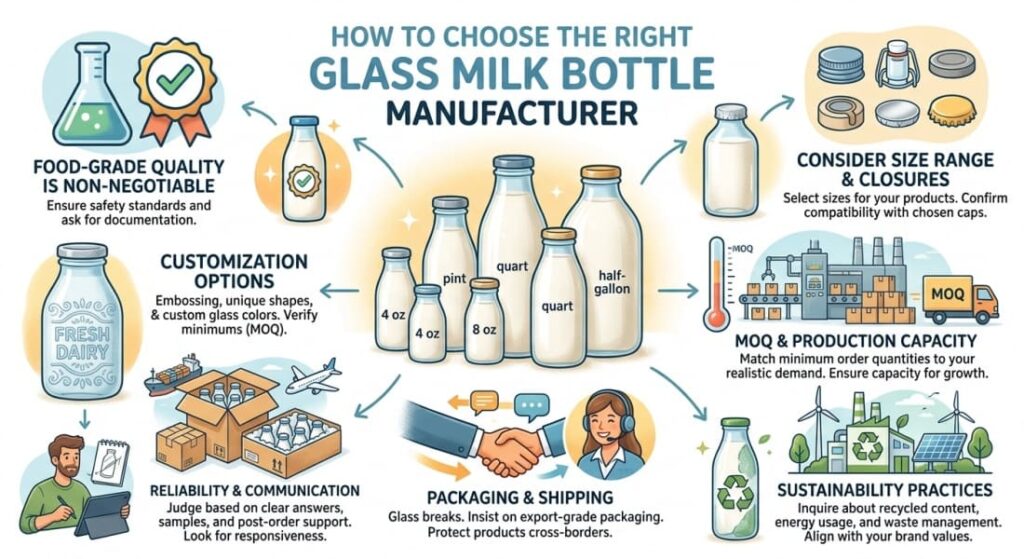
Once you’ve decided glass is the right move, the next question is who to buy from. Choosing a glass milk bottle manufacturer is a decision that affects your product for years. Here’s what to actually pay attention to.
Food-grade quality is non-negotiable
Any milk bottle manufacturer worth working with will produce food grade glass milk bottles that meet the safety standards in your market. Ask for documentation. If they can’t provide it clearly, that’s a warning sign.
Sizes and closures
Think about what sizes match your product line. Common sizes run from small 4-8 oz portions up through half-gallon and larger. Make sure the neck finish works with the caps you want to use — screw caps, swing tops, foil seals, or crown caps. This is where a lot of buyers get stuck if they don’t plan ahead.
Customization
If you want your logo embossed, a specific bottle shape, or a particular color of glass, ask what the manufacturer can actually do and what the minimums are. Some suppliers offer real customization; others only offer standard shapes with printed labels.
MOQ and production capacity
Wholesale glass milk bottles and bulk glass milk bottles come with minimum order requirements. Make sure the MOQ matches your realistic demand. Ordering too much ties up cash; ordering too little may not be possible with some suppliers.
Reliability and communication
This is the part that’s hard to judge until you’ve placed a few orders. But look for signs: do they answer questions clearly? Do they send samples? Do they explain their process? A supplier who communicates well before the order usually communicates well after.
Packaging and shipping
Glass breaks. How your bottles are packed for shipping matters a lot. Ask about their export packaging, especially if you’re importing across borders.
Sustainability practices
If sustainability is part of your brand message, ask how the manufacturer handles it on their end. Recycled content, energy use, and waste practices are all fair questions to ask.
FAQ Frequently Asked Questions About Glass Milk Bottles
Q1:Are glass milk bottles better than plastic?
A1:For premium products, reusable systems, and brand-focused dairies, yes. Glass is inert, reusable, recyclable, and visually stronger. Plastic still has advantages in weight and cost, so the best choice depends on your product, distribution, and brand goals.
Q2:Can glass milk bottles really be reused?
A2:Yes. When designed properly, they can be washed and refilled dozens of times. That’s the whole point of a returnable or refillable system, and it’s how most local milk delivery services operate.
Q3:What sizes are available?
A3:Most manufacturers offer sizes from about 4 oz up through 64 oz (half gallon), with standard options at 8 oz, 12 oz, 16 oz, 32 oz, and larger. Custom sizes are usually possible at higher volumes.
Q4:Do glass bottles work for flavored or plant-based drinks?
A4:Absolutely. Chocolate milk, coffee milk, oat milk, and other beverages all work well in glass. The material is neutral, so it doesn’t affect flavor.
Q5:Is glass really more sustainable than plastic?
A5:When bottles are reused multiple times, yes — clearly. When used only once and thrown away, the sustainability advantage shrinks. Reuse is where glass really pays off.
Q6:Is glass milk sold at HEB or other major retailers?
A6:You’ll find glass milk HEB and other retailers stock glass-bottled milk in specialty and organic sections. Availability varies by region, but glass options are becoming more common at mainstream grocers, not just specialty stores.
Q7:What should I look for when picking a supplier?
A7:Look for food-grade certification, reliable communication, appropriate MOQs, real customization capability, and solid export packaging. A supplier who can answer specific technical questions clearly is usually the right one.
Conclusion
If glass is where you’re headed, take the time to pick the right partner. A good milk bottle manufacturer will help you think through sizes, closures, custom design, and logistics — not just sell you what’s on the shelf. That kind of partnership pays off for years.
The advantages of glass milk bottles come down to something simple: they respect the product, respect the customer, and respect the environment. And when you get all three right, you’re not just selling milk. You’re building something people want to come back to.


