
Table of Contents
ToggleAuthor: SmileBottles Editorial Team
Estimated Reading Time: About 15 Minute
If you’ve ever finished a jar of pickles and thought about reusing it, you already know the problem. You wash it once, twice, maybe even three times, and the smell is still there. That sharp mix of vinegar, garlic, and dill just doesn’t want to leave. And if you’re running a food business, packing your own pickled products, or sourcing jars in bulk, this issue becomes even bigger than a home kitchen annoyance.
This guide is written for people who actually need answers, not filler. Whether you’re a home cook trying to reuse a few jars, or a buyer sourcing bulk pickle jars for your brand, you’ll find practical steps here that work. You’ll also learn why glass is still the top choice for pickled foods, and what to look for when you’re ready to buy new jars for your own production line.
Quick Answer: How Do You Get Pickle Smell Out of a Jar?
Here’s the short version for those of you who just want the fix:
Wash the jar with hot water and dish soap, then soak it overnight in a mix of warm water and baking soda. Rinse well, and if the smell is still hanging around, follow up with a diluted vinegar rinse or a squeeze of lemon juice. Dry the jar completely in sunlight if possible, and don’t forget to clean the lid separately — that’s where most of the odor actually hides.
If you need the full breakdown, keep reading. We’ll walk through each method, why it works, and when to use it.
Why Do Pickle Jars Hold Onto Odor?
Before you can fix the problem, it helps to understand where the smell is really coming from. A lot of people blame the glass, but that’s usually not the issue.
Pickles are packed with strong-smelling ingredients — vinegar, salt, garlic, dill, mustard seed, and sometimes chili or turmeric. These aromatic compounds are stubborn. They cling to anything porous or slightly rough. And when a jar sits sealed for months, those smells get concentrated inside.
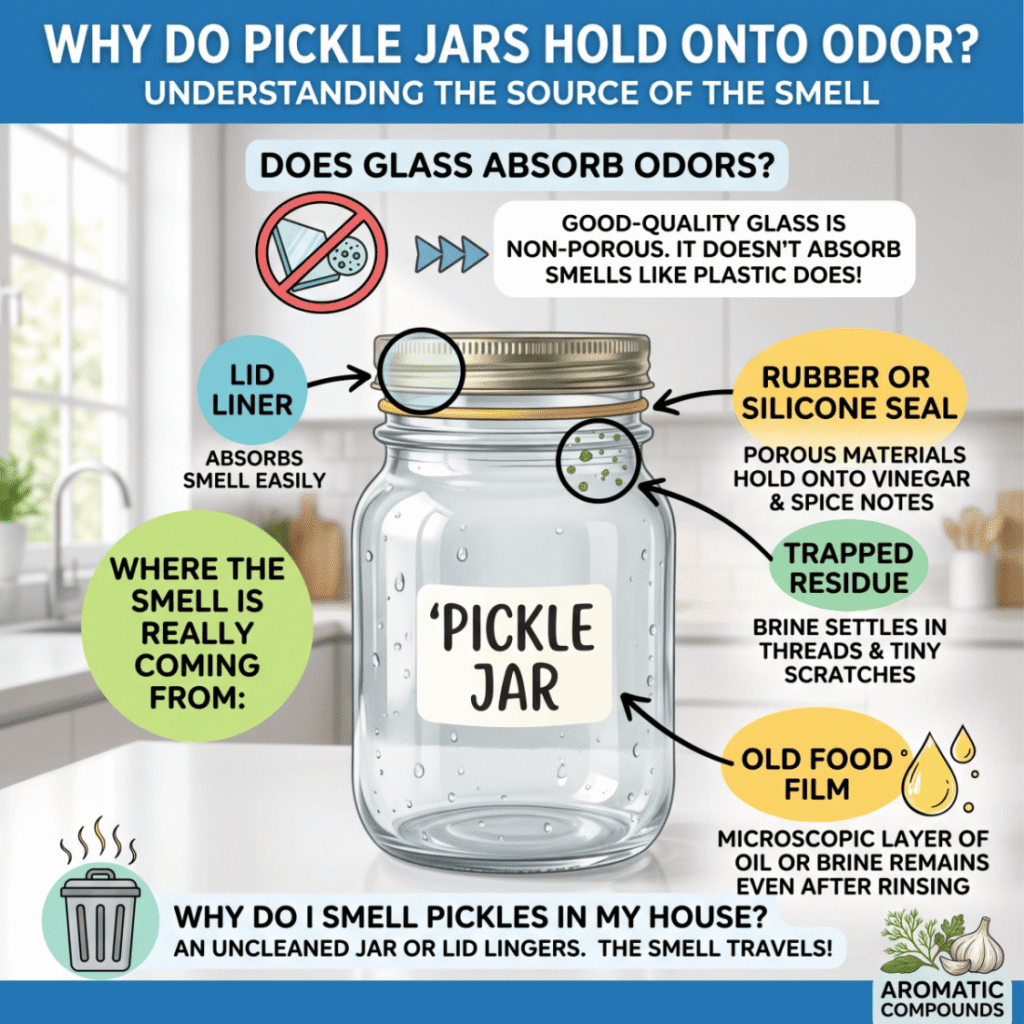
But here’s the thing: pure glass is non-porous. It doesn’t actually absorb odors the way plastic does. So if you’re wondering how to get smell out of glass jars, the first thing to check isn’t the glass at all — it’s the lid, the seal, and any tiny bits of residue you might have missed.
Where the smell is really coming from
Most of the lingering pickle odor comes from:
The lid liner — most metal lids have a thin plastic or coated liner that absorbs smell easily.
The rubber or silicone seal — these materials are porous and hold onto vinegar and spice notes.
Trapped residue — brine can settle in the threads at the top of the jar or in tiny scratches you can’t see.
Old food film — even after rinsing, a microscopic layer of oil or brine may remain.
If you’ve ever asked yourself why do I smell pickles in my house even after taking out the trash, the answer is often a jar or lid sitting somewhere in the kitchen that wasn’t fully cleaned. Pickle smell travels, and it lingers.
Does glass itself absorb pickle smell?
Not really. Good-quality glass is smooth and sealed at the surface level. It doesn’t soak up flavors or oils. That’s exactly why glass jars for pickles are the standard choice for food producers around the world. The problem almost always traces back to the closure or leftover residue — not the glass itself.
The Fastest Ways to Remove Pickle Smell from Glass Jars
Now let’s get to the part you actually came here for. If you’re figuring out how to get pickle smell out of jar containers, here are the methods that actually work, ranked roughly by how strong the smell is.
1. Start with hot water and dish soap
This is the baseline. Fill the jar with hot (not boiling) water, add a few drops of dish soap, and let it sit for 10 to 15 minutes. Use a bottle brush to reach the bottom corners and the threads at the top of the jar.
Don’t skip the threads. That’s where brine likes to hide.
2. Soak with baking soda
Baking soda is one of the most reliable ways to neutralize odors, not just cover them up. Fill the jar with warm water, add two or three tablespoons of baking soda, stir it in, and let it sit for at least four hours — overnight is even better.
After soaking, rinse well and smell the jar. In most cases, this alone solves the problem. If you’re looking up how to get the smell out of a pickle jar and want the single most effective home method, this is it.
3. Try a white vinegar rinse
This one sounds strange because vinegar is one of the reasons the jar smells in the first place. But diluted white vinegar actually helps break down mineral deposits and neutralize some of the harder-to-remove residues. The vinegar smell itself fades quickly once the jar dries.
Mix one part vinegar with three parts water, swirl it around inside the jar for a minute or two, then rinse thoroughly.
4. Use lemon juice or citrus water
If you want something more natural, lemon juice works well for mild smells. Squeeze half a lemon into the jar, add warm water, and let it sit for an hour or two. Lemon leaves a fresh scent and helps cut through any oily residue.
5. Let the jar dry in sunlight
Sunlight is underrated. After washing, place the jar upside down on a rack outside for a few hours. UV light helps break down odor molecules and kills any remaining bacteria. Just make sure the jar is completely dry before you store it or reuse it.
6. Use activated charcoal or coffee grounds
For stubborn cases, put a small amount of activated charcoal or dry coffee grounds inside the clean, dry jar and seal it for a day or two. Both are excellent odor absorbers. This trick also works for stinky pickles jars that have been sitting unwashed for a while.
Tip: Always clean the lid separately. This is the step most people skip, and it’s the reason so many jars still smell after washing. We’ll cover this next.
How to Get Pickle Smell Out of Jar Lids
Here’s a truth that most cleaning guides miss: even when the glass is spotless, the lid can still ruin everything. If you’re wondering how to get pickle smell out of jar lids, this section is for you.
Metal lids usually have a plastic-coated liner on the inside. That liner is designed to protect the food from the metal, but it also absorbs smells like a sponge. Rubber or silicone seals do the same thing.
What actually works for lids
Soak them in hot water with baking soda for at least a few hours.
Scrub the underside and the threads with an old toothbrush.
Rinse thoroughly and dry in the sun if possible.
If the smell won’t come out, replace the lid. Sometimes it’s just faster and cheaper.
If you’re running a food packaging operation, this is where lid quality really matters. Cheap liners retain smell and can even transfer flavors between batches. That’s one reason experienced buyers focus so much on closure quality when they source wholesale pickle jars.
What Not to Do When Cleaning Pickle Jars
A few warnings before you go too far with the cleaning process:
Don’t use boiling water on a cold jar. Thermal shock can crack the glass, even if it’s tempered.
Don’t use harsh solvents like acetone or paint thinner. These leave residue that isn’t food-safe.
Don’t put lids in the dishwasher on high heat if the liner is plastic — it can warp.
Don’t reuse a jar if the lid is rusted, cracked, or has a damaged seal.
Don’t assume the glass is the problem. Ninety percent of the time, it’s the lid.
Following these basic rules keeps your jars usable and safe, especially if you plan to store food in them again.
How to Sterilize Pickle Jars for Reuse
Cleaning is one thing. Sterilizing is another. If you’re planning to fill jars with your own pickles or preserves, you need to go a step further. Here’s how to sterilize pickle jars properly:
Wash the jars thoroughly with hot soapy water and rinse well.
Place them upright on a rack in a large pot.
Fill the pot with water until the jars are fully submerged.
Bring the water to a boil and let the jars boil for at least 10 minutes.
Carefully remove them with tongs and place them upside down on a clean towel to dry.
For lids, follow the manufacturer’s instructions. Some can be boiled, others should only be dipped briefly in hot water — check the specs before you assume.
If you’re doing this at commercial scale, sterilization usually happens with steam tunnels, dry heat ovens, or automated washing lines. But for home use and small batches, the boiling method is safe and effective.
Why Glass Is Still the Best Material for Pickled Foods
You’ve probably noticed that almost every commercial pickle brand uses glass. There’s a good reason for that.
Glass doesn’t react with acidic foods. Pickle brine is high in vinegar, and vinegar corrodes or leaches into many other materials — including certain metals and plastics. Glass just sits there, doing its job, without changing the flavor or safety of what’s inside.
Beyond that, glass:
Doesn’t absorb odors or flavors, so your product tastes the way it should.
Handles temperature changes well during pasteurization and cold storage.
Looks premium on a shelf, which matters more than most people realize.
Is fully recyclable, which appeals to modern consumers.
Lets customers see the product, which builds trust.
If you compare glass to plastic, the difference becomes obvious fast. Plastic containers can retain smells, stain from turmeric or paprika, and sometimes leach chemicals into acidic liquids over time. That’s why glass jars for food packaging remain the industry standard for pickles, sauces, jams, and specialty foods.
For anyone building a brand around quality, glass is almost always the right call.
Can You Reuse Pickle Jars Safely?
The short answer: yes, in most cases. The longer answer depends on what you’re using them for.
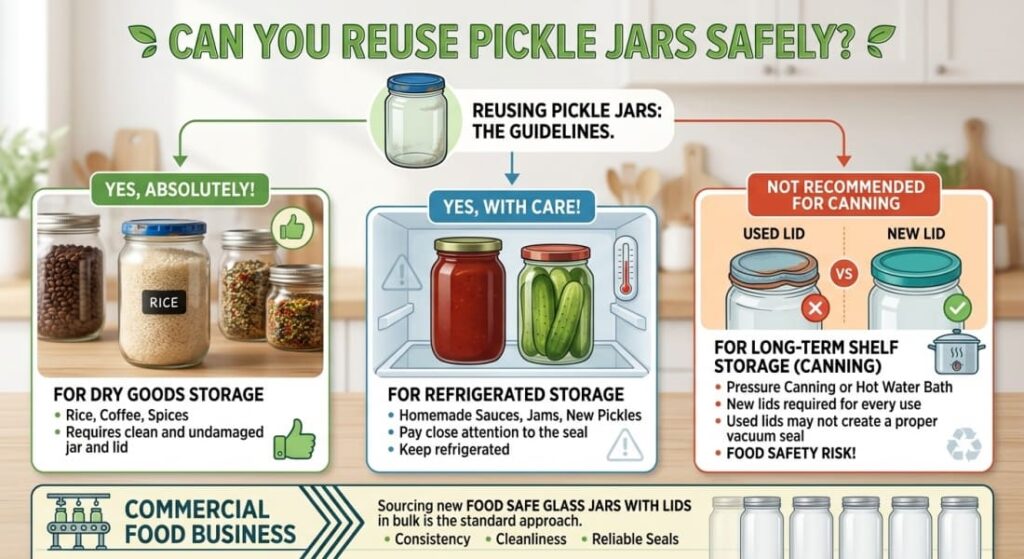
If you’re asking can you reuse pickle jars for storing dry goods like rice, coffee, or spices, absolutely — as long as the jar and lid are clean and undamaged. For refrigerated storage of homemade sauces, jams, or new batches of pickles, reuse is also fine, but pay close attention to the seal.
Where things get more complicated is with canning. If you’re pressure canning or hot water bath canning for long-term shelf storage, most food safety experts recommend using new lids every time. The seal on a used lid may not create a proper vacuum, and that’s a food safety risk you don’t want to take.
For any commercial food business, reusing jars usually isn’t practical. You need consistency, cleanliness, and reliable seals — which is why sourcing new food safe glass jars with lids in bulk is the standard approach.
Can You Reuse Pickle Jars Safely?
Why Glass Is Still the Best Material for Pickled Foods
You’ve probably noticed that almost every commercial pickle brand uses glass. There’s a good reason for that.
Glass doesn’t react with acidic foods. Pickle brine is high in vinegar, and vinegar corrodes or leaches into many other materials — including certain metals and plastics. Glass just sits there, doing its job, without changing the flavor or safety of what’s inside.
Beyond that, glass:
Doesn’t absorb odors or flavors, so your product tastes the way it should.
Handles temperature changes well during pasteurization and cold storage.
Looks premium on a shelf, which matters more than most people realize.
Is fully recyclable, which appeals to modern consumers.
Lets customers see the product, which builds trust.
If you compare glass to plastic, the difference becomes obvious fast. Plastic containers can retain smells, stain from turmeric or paprika, and sometimes leach chemicals into acidic liquids over time. That’s why glass jars for food packaging remain the industry standard for pickles, sauces, jams, and specialty foods.
For anyone building a brand around quality, glass is almost always the right call.
How Manufacturers and Bulk Buyers Handle Odor at Scale
Consumer cleaning tips are one thing. Industrial cleaning is a completely different world.
In a commercial food packaging facility, jars are cleaned and sterilized in a controlled sequence:
High-temperature washing with food-grade detergents.
Multiple rinse cycles using filtered or purified water.
Steam or dry heat sterilization to eliminate microbes.
Air knife drying or tunnel drying to prevent water spots.
Automated inspection for residue, cracks, and sealing surface defects.
New jars from a reputable manufacturer arrive clean and ready to use, but most food producers still run them through a rinsing or sterilization step before filling. This is standard practice and part of what keeps commercial pickled products safe and consistent.
If you’re sourcing jars for your own line, the cleanliness of the jars when they arrive matters. Good suppliers pack jars in sealed shrink wrap or dust-proof cartons so they stay clean during shipping. Poor suppliers cut corners here, and it shows up as extra work for your team.
How to Choose the Right Glass Pickle Jars for Your Business
If you’re at the point where you’re ready to buy jars — not just clean old ones — here’s what actually matters when you make that decision.
Look at the glass quality
Not all glass is the same. Cheaper jars often have visible bubbles, uneven walls, or weak spots. Quality jars have consistent thickness, clean edges, and a smooth finish. This affects both durability and how your product looks on the shelf.
Check the mouth size
Wide-mouth jars are much easier to fill, clean, and reuse. If your product has larger pieces — whole pickles, whole peppers, chunks of vegetables — wide mouth is almost always the better choice. Narrow-mouth jars work better for liquids and thinner sauces.
Pay attention to the closure
The lid is at least as important as the jar itself. Look for:
Food-grade liners that don’t retain odors.
Reliable sealing performance under vacuum.
Compatibility with your filling and capping equipment.
Options for tamper-evident buttons if you’re selling retail.
Think about capacity and shape
Standard sizes are easier to source and cheaper to replace. But if you want your brand to stand out, a custom shape can be worth the investment. Just make sure the shape works with standard case packing and your production line.
Consider your supplier
This is where a lot of businesses get burned. A cheap price on paper doesn’t help you if the jars arrive cracked, inconsistent, or late. Look for a supplier who can show you samples, share quality control data, and support you through customization if needed.
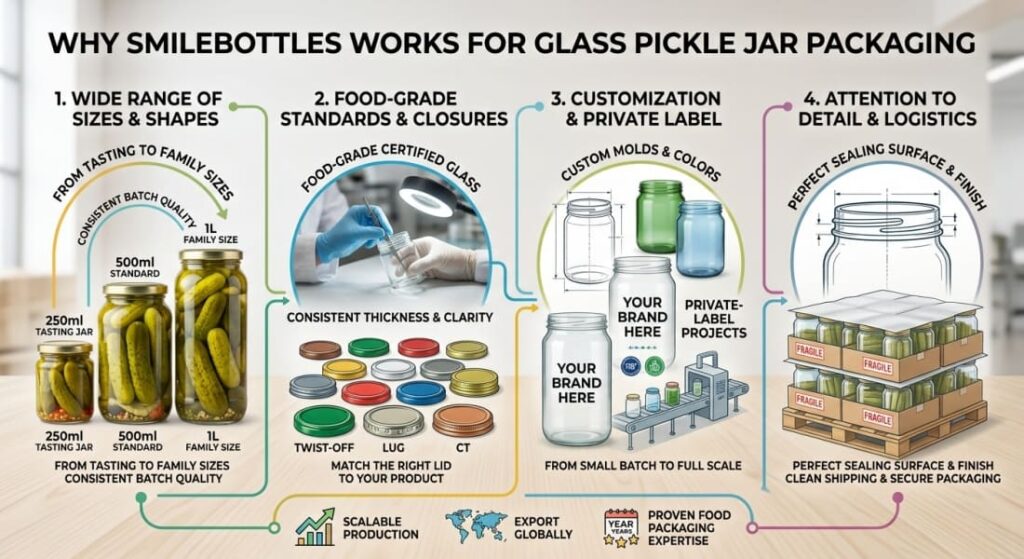
Why Smilebottles Works for Glass Pickle Jar Packaging
At Smilebottles, we’ve spent years making glass jars for food producers around the world, and pickle jars are one of our main product lines. If you’re sourcing wholesale pickle jars for your brand, here’s what we bring to the table.
We produce jars in a wide range of sizes and shapes — from small tasting jars to family-size formats. Our glass is made to food-grade standards, with consistent thickness and clarity across every batch. We also work with a range of closure options, so you can match the right lid to your product and your equipment.
For businesses that need something specific, we handle custom molds, custom colors, and private-label projects. Whether you need a few thousand jars for a small batch launch or containers for full-scale production, we can scale with you.
We focus on getting the details right — the sealing surface, the finish, the packaging that keeps jars clean during shipping. Those details are what separate a jar that works from a jar that causes problems on your line.
FAQ: Frequently Asked Questions About Pickle Jars and Odor Removal
Q1:Can pickle smell be removed completely from a glass jar?
A1:Yes, in almost every case. Glass itself doesn’t hold onto smell, so once you clean the jar thoroughly and address the lid separately, the odor should be gone. If it’s not, the lid is usually the reason.
Q2:Why does my jar still smell like pickles after washing?
A2:The smell is likely trapped in the lid liner, the rubber or silicone seal, or in tiny bits of residue caught in the threads. Wash the lid separately with baking soda, and scrub the threads with a small brush.
Q3:Does baking soda really remove pickle odor?
A3:Yes. Baking soda neutralizes odors chemically rather than just covering them up. It’s one of the most reliable methods for how to remove odor from glass jars at home.
Q4:Why is glass better than plastic for pickle storage?
A4:Glass doesn’t react with vinegar or acidic brines, doesn’t absorb smells, and doesn’t stain. Plastic can leach chemicals over time in acidic conditions and holds onto colors and flavors from previous contents.
Q5:What type of jar is best for commercial pickle production?
A5:Food-grade glass jars with reliable airtight lids. Wide-mouth designs are easier to fill and label. Consistency across the batch is critical, which is why sourcing from a dependable manufacturer matters more than saving a few cents per jar.
Conclusion
Pickle smell in a jar isn’t a mystery once you know what’s actually causing it. The glass isn’t the problem — it’s the lid, the seal, and the residue that gets left behind. With hot water, baking soda, a little vinegar, and some patience, you can get almost any jar back to neutral.
For anyone running a food business, the same principles apply, just at a bigger scale. Clean jars, quality closures, and a supplier who takes the details seriously will save you a lot of headaches. Whether you’re rescuing an old jar at home or sourcing thousands of new ones for your next production run, the fundamentals are the same: good materials, proper cleaning, and attention to the parts that most people ignore.
If you’re ready to move past the home kitchen and start sourcing jars for your own brand, focus on the things that actually matter — glass quality, lid performance, and a supplier who’s easy to work with. That’s what turns a good product into a great one on the shelf.
 English