
Table of Contents
ToggleAuthor: SmileBottles Editorial Team
Estimated Reading Time: About 15 Minute
If you have ever walked down a grocery aisle and noticed how many premium food products come packed in glass, you already have a clue about why so many food brands and everyday buyers keep coming back to this material. Glass simply behaves better around food. It stays clean, it doesn’t fight with the flavors inside, and it holds up over time.
Whether you run a small specialty food business, manage packaging decisions for a larger brand, or you are stocking a home pantry that you actually care about, the container you choose matters more than most people admit. This guide walks you through why glass jars for food storage are worth the attention they get, what to look for when you buy, and how to match the right jar to the right product.
Let’s get into it.
A Quick Answer Before You Read Further
If you are short on time, here is the short version you can take with you:
Glass jars are one of the best jars for food storage because they are non-reactive, easy to clean, recyclable, and good at protecting freshness. They work well for sauces, honey, pickles, spices, dry pantry goods, and premium retail packaging. When paired with proper lids, they keep food fresher for longer and hold up through years of reuse.
Now let’s break down why that is, and what you should look for as a buyer.
Why Glass Jars Are a Safe Choice for Food Storage
Food safety is where the conversation should always start. You can have the prettiest packaging in the world, but if the material reacts with your product, nothing else matters.
Glass Doesn’t Fight With Your Food
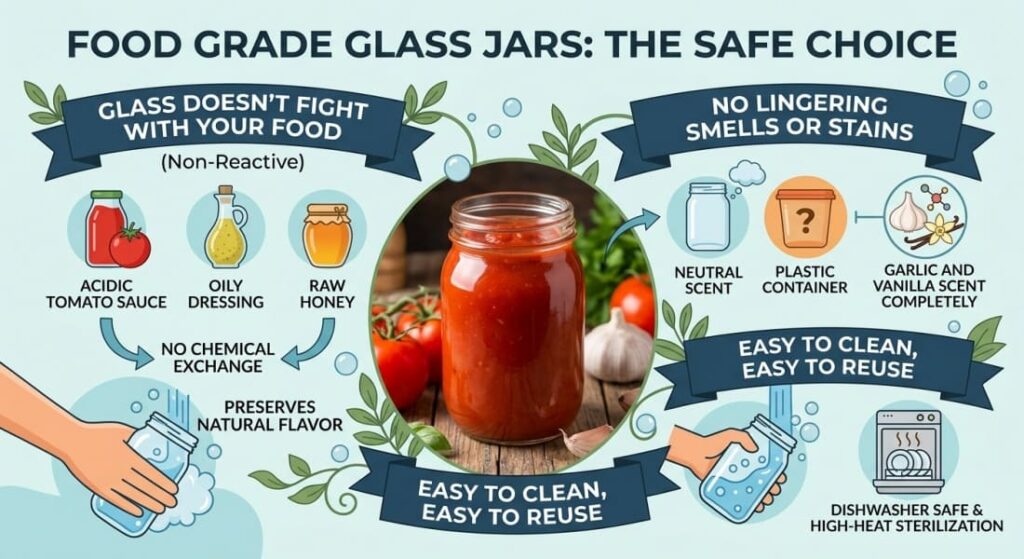
Glass is what people in the packaging industry call a non-reactive material. That means it doesn’t exchange chemicals with whatever you put inside. Acidic tomato sauce, oily dressings, alkaline preserves, fermented vegetables — glass handles all of them the same way. It just holds them.
That is why food grade glass jars are the default choice for products where purity matters. If you are packing something like raw honey, cold-pressed sauces, or fermented pickles, you don’t want the container quietly influencing the taste over the months it sits on a shelf.
This is also the reason non reactive food storage containers made from glass are recommended for long-term storage. You can put a strongly acidic hot sauce in a glass jar today, come back a year later, and the flavor profile will still be what you intended.
No Lingering Smells or Stains
If you have ever stored curry or tomato sauce in a plastic container, you already know the frustration. The smell settles in. The orange tint stays. No amount of washing brings it back to neutral.
Glass doesn’t do that. The surface is non-porous, which means nothing seeps into it. You can store garlic paste in a jar this month and use the same jar for vanilla sugar next month, and neither will know the other existed. For anyone dealing with strong-smelling ingredients, this alone is a good enough reason to switch.
Easy to Clean, Easy to Reuse
Because glass has that smooth, sealed surface, it cleans up quickly with warm soapy water. It also handles high heat, so you can sanitize it properly, whether that means running it through a dishwasher at home or through commercial sterilization at a production line.
For a food business, that consistency matters. You want packaging that meets hygiene standards without adding steps to your process.
How Glass Jars Help Keep Food Fresh Longer
Preservation is the second reason people reach for glass, and honestly, it might be the biggest reason for anyone selling premium food.
The Role of a Good Seal
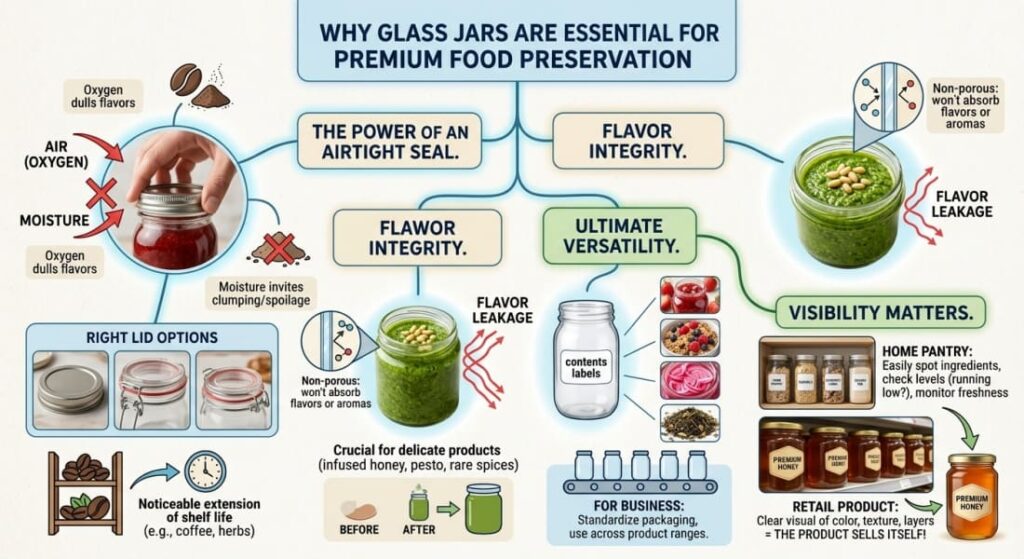
A jar is only as good as its closure. Airtight glass jars with lids create a real barrier against air and moisture, which are the two things that quietly ruin your product. Oxygen dulls flavors. Moisture invites clumping in dry goods and encourages spoilage in wet ones.
When you pair a well-made jar with the right lid — whether that’s a metal twist cap, a lug cap, a swing-top, or a rubber-sealed clamp lid — you get a small controlled environment inside. That is why glass jars with lids for food storage are what serious food producers use for everything from coffee beans to hot sauce.
If you are storing coffee, tea, herbs, or spices, the difference in shelf life between an airtight glass jar and a loose container is genuinely noticeable. You can taste it.
Flavor Stays Where It Belongs
Because glass doesn’t absorb anything, the taste and aroma of what you packed stay inside the jar and stay true to the original. This matters most for products where flavor is the whole point.
Think about a small batch of infused honey, a hand-made pesto, or a spice blend built around a single rare ingredient. If any of that flavor leaks into the container material, you have lost the thing that made the product worth buying. Glass protects that.
It Works for Wet, Dry, and Everything in Between
One of the underrated things about glass is how flexible it is across food categories. The same shape of jar can hold jam, granola, pickled onions, or loose-leaf tea. You are not locked into a single use case.
For food businesses, this flexibility is a real cost saver. You can standardize your packaging line around a few jar shapes and use them across your whole product range.
You Can See What’s Inside
This sounds small, but it matters more than people expect. Clear glass lets your customer see the color, the texture, the way the ingredients are layered. For a home pantry, it means you can spot at a glance whether you are running low on rice or whether that jar of chili flakes has been sitting there too long.
For retail products, visibility is part of the sale. A rich amber honey looks like exactly what it is when you can see it. That’s a big reason glass honey jars dominate that category — the product sells itself through the glass.
The Environmental Side of Glass Jars
You have probably noticed how much more your customers care about packaging waste than they used to. This is not going away, and glass is genuinely well-positioned here.
Recyclable, Over and Over Again
A common question that comes up is: are glass jars recyclable? The honest answer is yes, and more than that — glass can be recycled repeatedly without losing quality. A jar you drop in a recycling bin can come back as another jar, with no downgrade in performance. Not many packaging materials can claim that.
Reusable in Real Life
Beyond formal recycling, glass jars have a second life almost automatically. Customers keep them. They use them for leftovers, spice refills, homemade dressings, small storage. If you have ever seen someone’s kitchen with a shelf of mismatched jars, you have seen this in action.
For a food brand, this means your packaging keeps working after the product is gone. Your logo, your label, your jar shape — all of it stays in someone’s kitchen. That is a kind of brand exposure that plastic simply doesn’t offer.
Aligns With Where Buyers Are Heading
If you are choosing glass packaging for food products, you are also choosing to align with a bigger shift in consumer preference. Sustainable materials are no longer a nice bonus — they are increasingly what buyers look for first. Retailers know this too. Glass makes it easier to tell that story honestly.
Where Glass Jars Actually Get Used
The strength of glass shows up in the range of products it handles well. Here is where you will see it working hardest.
Home Kitchens and Pantry Storage
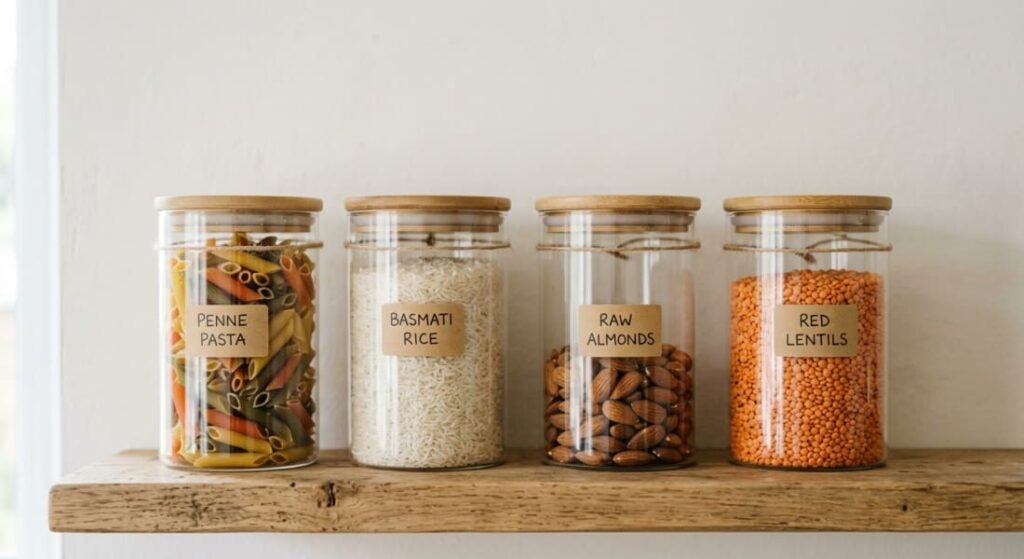
For anyone serious about keeping a clean, organized pantry, glass jars for pantry storage are the standard. You can line up flour, sugar, oats, dried beans, pasta, coffee, and tea in matching jars, and you get both organization and freshness. Because these jars seal properly, glass jars for dry food storage protect against humidity, pests, and the slow flavor loss that ruins so many pantry ingredients.
Home cooks who bake regularly know this well. Baking ingredients need to stay dry and true to their original quality, and glass handles that job without any drama.
Small Batch and Specialty Food Producers
For anyone making sauces, jams, preserves, or fermented foods, food storage glass jars are the working tool of the trade. Glass sauce jars for cooking sauces and hot sauces, glass pickle jars for cured vegetables, honey jars for raw honey producers — the category is wide.
Food packaging glass jars are also common for cookies, candies, and dry mixes sold as premium retail products. You will see them anywhere the packaging itself is part of the product story.
Cafés, Delis, and Restaurants
Commercial kitchens use glass jars for everything from housemade syrups to bulk spice storage. A glass food jars setup behind a bar or on a deli counter tells the customer that ingredients are being treated with care.
Gift and Premium Product Lines
There is a reason gift-worthy food products almost always come in glass. It feels considered. It feels durable. It suggests that whoever made the product cared about the details, which is exactly the message a premium brand wants to send.
Are Glass Jars Worth the Cost?
This is the honest question every buyer eventually asks. Yes, glass usually costs more upfront than lightweight alternatives. But look at what you get in return.
It Pays Back in Reuse
At the household level, a good jar can be used for years. For food businesses running refill or return programs, glass is one of the few materials that actually holds up through repeated cycles.
Less Product Loss
Better preservation means less spoilage. If you are producing anything with a real shelf life challenge — say, artisan condiments or infused oils — the cost of the jar is small compared to the cost of losing product before it reaches the customer.
Perceived Value Goes Up
A product in glass reads as higher quality than the same product in plastic. That is a real market reality, and it shows up in what customers are willing to pay. If you sell premium food, glass is not a cost — it is part of the value.
Long-Term Return for a Food Business
For businesses buying wholesale glass food jars, the math often works out better than people expect once you factor in shelf presence, brand equity, and customer perception. Plastic might win a single-transaction cost comparison. Glass wins over the life of a product line.
Glass Jars vs Plastic Containers: A Fair Comparison
You are probably weighing this comparison right now, so let’s look at it honestly instead of pretending one is always right.
On Safety
Glass is inert and stable across temperatures and food types. Plastic varies — some plastics are food-safe, some are not, and even the good ones behave differently under heat or with acidic foods. If food safety is your top priority, glass has fewer variables to worry about.
On Taste
If you care about flavor integrity, glass wins clearly. Plastic can pick up and give off subtle notes. Glass doesn’t.
On Sustainability
Both can be recycled in theory. In practice, glass recycles more cleanly and more often. Reusability also favors glass — plastic containers wear out faster, warp under heat, and stain over time.
On Practicality
Plastic is lighter and harder to break. That is a real advantage for shipping bulky goods or for products aimed at kids or outdoor use. Glass is heavier and can break if dropped on a hard surface. That is the trade-off.
So Which One Should You Choose?
For most food storage decisions — especially where quality, freshness, and brand perception matter — glass is the stronger choice. When you are looking for the best glass containers for food storage, you are usually looking for something that will do the job well over time, not just once. Plastic still has its place in specific logistics scenarios, but for the actual storing of food, glass tends to be the answer that holds up.
What to Look for When You Buy Glass Jars
If you are sourcing jars for a business, or even just picking better ones for your own kitchen, a few things matter more than others.
Glass Quality and Thickness
Not all glass is equal. Well-made jars have consistent wall thickness, no visible seam flaws, and a proper heat treatment that gives them everyday durability. Cheap glass can look fine and then crack under normal use.
The Lid System
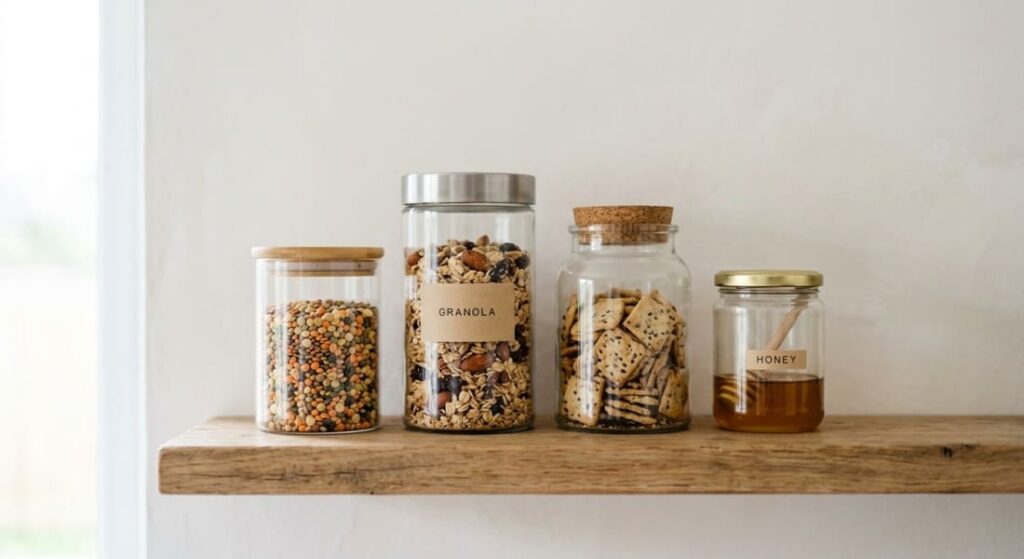
This is where most jars quietly succeed or fail. A good seal is what turns a glass container into an actual airtight storage solution. Look at the lid material, the gasket if there is one, and how the closure interacts with the jar rim. Lug caps, twist-off metal caps, and clamp lids each have their strengths depending on what you are storing.
Shape and Size
Different foods want different jars. Wide-mouth jars work better for chunky products, thick sauces, and anything you scoop. Narrow-neck jars pour more cleanly and are better for liquids like honey, syrup, or oils. Straight-sided jars are easier to label and stack. Hexagonal jars look premium on shelves. Match the shape to your product, not the other way around.
Compatibility With Your Filling Process
For food producers, this is easy to overlook but expensive to get wrong. The jar needs to work with your filling line, capping equipment, and labeling machine. If you are ordering wholesale, always confirm dimensions and tolerances before committing to a large run.
Customization Options
If you are a brand, look at what can be customized — jar shape, embossing, printed labels, colored glass, custom closures. These are the details that turn a generic jar into your jar.
glass jars for food
Why Smilebottles is Good Choice For The Food Jars?
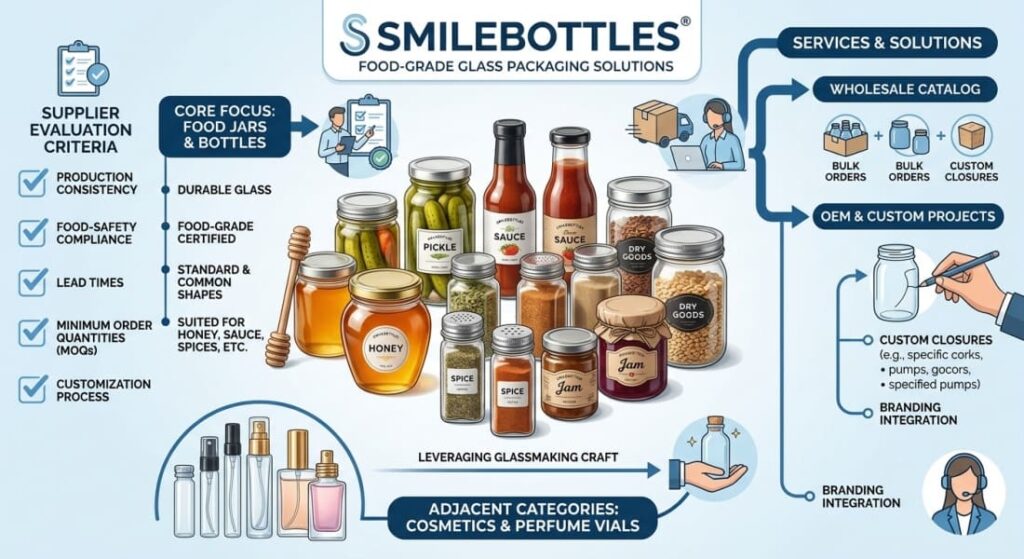
Smilebottles produces glass jars and bottles for food brands, wholesalers, and packaging buyers. The focus is straightforward: durable, food-grade glass jars built for real-world use, with options for customization when a brand needs its packaging to stand apart.
The product range covers common shapes and sizes used across food categories — jars suited for honey, jam, sauce, pickles, spices, dry goods, and specialty products. If you are looking at wholesale glass food jars for a growing product line, or you need custom shapes and closures for a new launch, Smilebottles works across both standard catalogs and OEM projects.
You may also notice Smilebottles produces bottles for adjacent categories — for example, a vial of perfume or cosmetic packaging — because the underlying craft of quality glass making translates well across industries. But food packaging remains at the center of what the brand does, and food-grade standards are treated as non-negotiable.
If you are evaluating suppliers, the things worth asking about are consistency of production, food-safety compliance, lead times, minimum order quantities, and how customization requests are handled. Any serious glass jar manufacturer should be able to answer these clearly.
FAQ: Frequently Asked Questions About Glass Jars
Q1:Are glass jars actually safe for storing food?
A1:Yes. Glass is non-reactive and non-porous, which makes it one of the safer materials for storing food long-term. It doesn’t leach anything into the food, doesn’t absorb odors, and can be cleaned thoroughly between uses.
Q2:Are glass jars really better than plastic for food?
A2:For most food storage situations, yes. Glass keeps flavors intact, doesn’t stain, and holds up over years of reuse. Plastic has its uses, but for storing food you care about, glass is the stronger choice.
Q3:What kinds of food work best in glass jars?
A3:Almost anything. Sauces, jams, honey, pickles, spices, dry goods like flour and grains, coffee, tea, candies, nuts, cookies, and premium gift products all work well. The main thing to match is the jar shape and closure to the type of food.
Q4:Do glass jars actually keep food fresh longer?
A4:When they have a proper airtight lid, yes. The seal is doing most of the work — glass just provides a stable, non-reactive environment inside. Together they slow down spoilage, oxidation, and moisture damage.
Q5:Can glass jars be recycled?
A5:Yes, and repeatedly. Glass can go through the recycling process again and again without losing quality. This is one of the reasons glass has such a strong environmental profile compared to most other packaging materials.
Q6:Are heavy glass jars worth the extra shipping cost?
A6:For premium food products, usually yes. The perceived value, the shelf life benefits, and the reusability of glass often outweigh the extra shipping weight. For very low-cost bulk products where shipping economics dominate, lighter options might make more sense.
Conclusion
Choosing the right container for your food is one of those decisions that seems small until you look at it closely. The material shapes the flavor, the freshness, the shelf appeal, and how your product is remembered.
Glass keeps doing its job quietly. It stays clean. It protects what’s inside. It recycles cleanly and reuses easily. And for the food businesses that care about how their product feels in a customer’s hand, it carries a kind of quality that plastic still hasn’t managed to match.
If you are planning your next packaging run, or you are just upgrading how you store food at home, glass is worth the second look. And if you want a manufacturer that treats food-grade glass as the standard rather than the exception, Smilebottles is a straightforward place to start the conversation.
 English