Table of Contents
ToggleAuthor: SmileBottles Editorial Team
Estimated Reading Time: About 16 Minute
Why Bulk Glass Lotion Bottles Matter for Wholesalers
Packaging decides more than how your product looks. It decides whether the lotion stays stable for its full shelf life, whether the pump works on the hundredth press, and whether the box arrives at your warehouse full of intact bottles or broken glass. When you buy in bulk, a small problem gets multiplied by thousands of units.
That’s one reason glass lotion bottles have stayed popular with skincare brands, private label companies, and packaging wholesalers. Glass protects the formula, feels good in the hand, and fits the way many shoppers now think about premium and eco-friendly products.
The hard part is the sourcing. When you search for empty glass lotion bottles, you’ll find factories, trading companies, marketplace sellers, and local distributors, and many of them use the same photos and the same promises. Prices for wholesale glass lotion bottles can look very close on paper, then turn out very different once you add pumps, printing, packaging, and freight.
This guide walks you through the main places to buy glass lotion bottles in bulk, how those channels compare, and what to check before you place an order. You’ll also find a buyer checklist and answers to common questions near the end.
What Are Empty Glass Lotion Bottles?
Empty glass lotion bottles are unfilled glass containers designed for liquid and semi-liquid personal care products. Most are sold as a set: the glass bottle itself, plus a pump or cap. Some sets also include a collar (the ring that sits on the neck) and an overcap that protects the pump.
Most cosmetic bottles are made from soda-lime glass. It’s strong enough for daily use, safe for skincare products, and easy to color, frost, or print on.
You’ll see these bottles used for:
Body lotion and hand lotion
Facial lotion and emulsion
Toner, essence, and light serum
Light creams that still flow through a pump
Liquid hand wash, shampoo, and conditioner
For wholesalers and brands, the main appeal of cosmetic glass lotion bottles is flexibility. One 100ml bottle can work as a lotion bottle with a pump, then as a toner bottle with a screw cap or a fine mist sprayer. That means you can cover several product lines with fewer bottle styles, which makes stock planning simpler.

Why Choose Glass Lotion Bottles Instead of Plastic?
Plastic costs less and weighs less, so it’s a fair question. Here’s where glass earns its place.
It Keeps Your Formula Stable
Glass is inert. It doesn’t react with most cosmetic ingredients, and it doesn’t absorb oils, fragrance, or active ingredients the way some plastics can. If your lotion contains essential oils, vitamin C, retinol, or plant extracts, glass helps keep the formula closer to how it left the lab.
It Raises Perceived Value
Pick up a glass bottle and a plastic bottle of the same size, and you’ll feel the difference right away. Glass has weight, and customers link that weight with quality. If your products sit in the mid-range or premium price band, glass packaging helps the price feel justified.
It Supports a Clear Sustainability Story
Glass can be recycled again and again without losing quality, and many glass factories already use recycled glass (cullet) in production. That’s why glass often forms the base of sustainable cosmetic packaging programs. If you want your sustainability claims to hold up, choose clear, amber, or green glass, avoid heavy coatings where possible, and pick pumps that customers can remove easily before recycling.
When Glass Makes the Most Sense
Glass cosmetic packaging is a strong fit for natural and organic skincare, premium facial care, gift sets, spa and salon products, and any formula that’s sensitive to packaging materials. Plastic may still be the better pick for travel kits, children’s products, or shower and gym use, where dropped bottles are common. Plenty of brands use glass for their hero products and plastic for travel sizes.
Common Types of Glass Lotion Bottles Available in Bulk
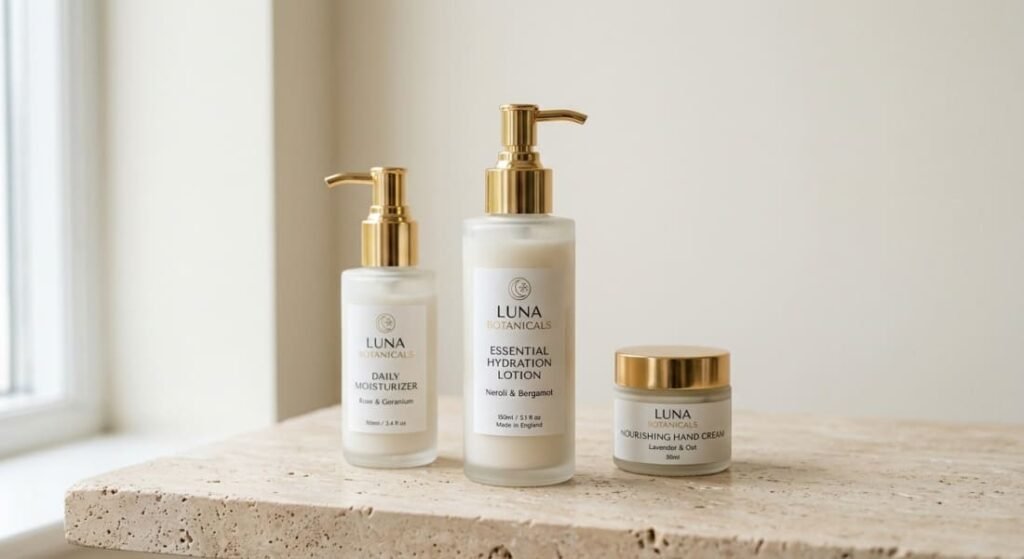
Knowing the main styles helps you describe what you want and compare quotes on equal terms.
Bottle Shapes
Boston round bottles have a rounded shoulder and a classic look. They’re easy to fill on most lines and easy to find in stock, which keeps prices down.
Cylinder bottles have straight walls and a clean, modern profile. They’re a favorite with minimalist brands because labels wrap neatly around them.
Square and rectangular bottles stand out on a shelf and give you flat faces for printing. They use slightly more glass and can need more care in packing.
Flat shoulder bottles have a sharp, tailored outline that often appears in premium and clinical skincare.
Custom-shaped bottles come from a private mold. They give you a look no competitor can copy, but they cost more upfront.
Glass Colors and Finishes
Color affects both the look of your product and how well the formula is protected.
Clear (flint) glass lets customers see the product’s color and texture. It works best for stable formulas that aren’t sensitive to light.
Amber glass lotion bottles filter out a large share of UV light. That makes amber a good match for natural oils, botanical extracts, and formulas with vitamins or other light-sensitive actives. Amber also suggests an apothecary or natural feel.
Frosted glass lotion bottles have a soft, matte surface made by acid etching or a frosted spray coating. They feel smooth and look quietly high-end. Frosting can be applied to clear or colored glass.
Black glass lotion bottles give strong light protection and a bold, modern look. You’ll often see them in men’s grooming, luxury lines, and night-care products.
Green glass lotion bottles point toward plants, herbs, and nature. They pair well with organic and herbal brands, and green glass also gives some protection from light.
Blue glass lotion bottles, from deep cobalt to soft sky blue, suggest freshness, water, and calm. They suit hydrating lotions, marine-ingredient products, and spa-style ranges. Cobalt blue is also one of the oldest colors in apothecary packaging, so it can give a heritage feel.
Sprayed or painted bottles let you match almost any brand color, including gradients and two-tone effects. Keep in mind that heavy coatings can make recycling harder in some regions.
Bottles by Use Case
Many suppliers sort their range by use, such as facial care, body care, hand care, or hair care. If you’re planning a full product line, ask for bottles from the same series so the sizes, shoulders, and neck finishes match and the line looks consistent.
Standard Sizes and Capacity Options for Wholesale Orders
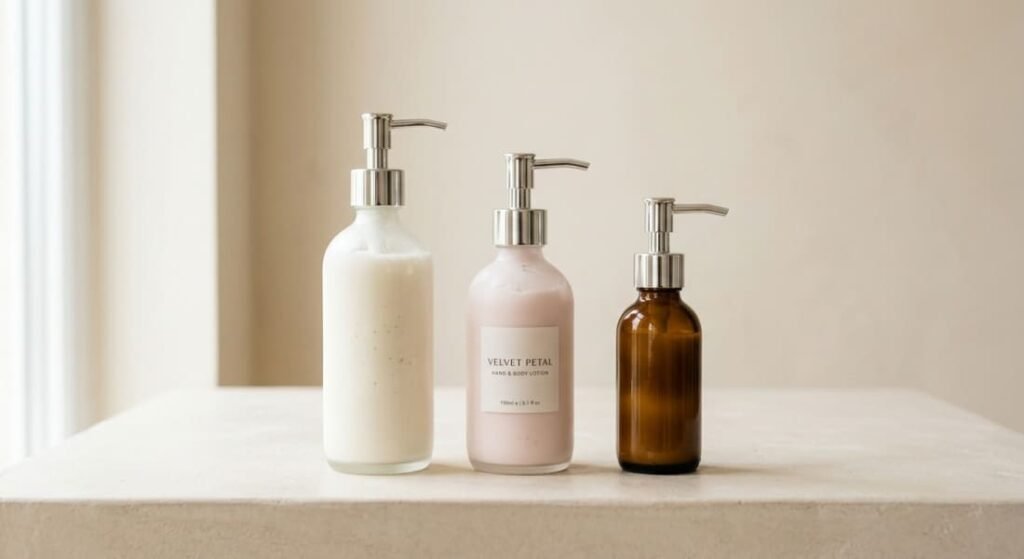
Stock sizes are faster and cheaper to source than custom capacities, so most buyers start here.
|
Capacity |
Common Uses |
|
30ml |
Samples, travel sizes, facial serums and emulsions |
|
50ml |
Facial lotions, eye products, trial kits |
|
80ml – 100ml |
Facial lotions, toners, small body care items |
|
120ml – 150ml |
Body lotion, hand lotion, toner |
|
200ml – 250ml |
Full-size body lotion, hair care, hand wash |
To pick the right size, think about how long one bottle should last your customer, what price you want to hit, and what’s normal in your category. A facial lotion usually lasts one to three months in 50–100ml. A body lotion in 50ml will feel like a sample, while 200–250ml feels like a full-size product.
Travel sizes deserve a separate thought. Many airlines limit carry-on liquids to 100ml per container, so if you’re making a travel version, 100ml or less is the safe choice. If you sell into several countries, check local preferences too. Some markets favor smaller sizes and refills, while others expect larger family-size bottles.
Also remember that a bottle’s “brim-full” capacity is larger than its fill volume. A bottle sold as 100ml may hold around 105–110ml to the brim, leaving headspace for the pump’s dip tube. Ask your supplier for both numbers.
Pump, Cap, and Closure Options for Glass Lotion Bottles
A beautiful bottle with a pump that leaks or sticks will hurt your reviews fast. The closure deserves as much attention as the glass.
Common Closure Types
Lotion pumps are the most common choice for glass lotion bottles with pump. They usually dispense around 0.5ml to 2ml per press and handle medium-thick lotions well.
Treatment pumps release a smaller, more controlled dose, often 0.1ml to 0.25ml. They suit serums, essences, and facial emulsions where a little product goes a long way.
Screw caps are simple and dependable for toners, oils, and thin liquids.
Overcaps sit over the pump to protect it in shipping and keep it clean on the shelf. Clear overcaps keep the pump visible, while solid ones give a neater look.
Bamboo and wood-look caps fit natural and eco-friendly brands.
Electroplated pumps and collars in gold, silver, or rose gold add a premium finish to luxury lines.
Neck Finish and Compatibility
Every bottle has a neck finish written as two numbers, such as 18/415, 20/410, or 24/410. The first number is the outside diameter of the neck in millimeters. The second describes the thread style and height. Your pump or cap must match both numbers. A 20/410 pump will not seal properly on a 20/415 neck, even though the diameter is the same.
Before you order glass lotion pump bottles in volume, confirm three things with your supplier:
The exact neck finish for each bottle size
The dip tube length, cut to reach close to the bottom without bending
The pump output, matched to your formula’s thickness
Then test full sample sets with your real formula. Fill a few bottles, press each pump 30 to 50 times, lay some on their sides for a couple of days, and check for leaks, dripping, or a weak spring. If you ship direct to consumers, ask about lock-down or clip-lock pumps, which stop the pump from pressing in transit.

Where Can You Find Empty Glass Lotion Bottles in Bulk?
There are five main sourcing channels. Each one suits a different kind of buyer.
Buy from Direct Glass Bottle Manufacturers
When you work with a glass lotion bottle manufacturer, you’re dealing with the company that melts, forms, and finishes the glass. This usually gives you the lowest unit price, the most control over quality, and the widest range of custom options.
A direct glass packaging manufacturer can also give you realistic advice about glass weight, color matching, wall thickness, and decoration, because their team works on the production lines every day. If you plan to reorder regularly or want a bottle design of your own, this is usually your best route.
The trade-offs are higher minimums for custom work and, if the factory is overseas, more responsibility on your side for shipping and import.
Source Through Packaging Trading Companies
Trading companies buy from several factories and sell to you through one contact person. That’s handy when you need many different items, such as bottles, jars, droppers, and boxes, in smaller amounts.
The downside is distance from production. If a batch has a problem, the trader has to go back to the factory, which slows things down. You’ll also pay a margin on top of the factory price.
Search on B2B Wholesale Marketplaces
Platforms such as Alibaba, Made-in-China, and Global Sources make it quick to find a glass cosmetic bottle supplier and compare many listings at once.
The challenge is sorting real manufacturers from traders, and reliable suppliers from weak ones. Check the company’s business license, ask for a factory video call, look at how long they’ve been trading, and always order samples. Many experienced buyers use marketplaces to build a shortlist, then move the conversation off-platform once they trust a supplier.
Visit Trade Shows and Packaging Exhibitions
Shows such as Cosmoprof Worldwide Bologna, Cosmoprof Asia in Hong Kong, Luxe Pack, PCD Paris, and MakeUp in let you meet suppliers in person. You can hold the bottles, test pumps, check frosting and printing up close, and compare a dozen companies in a day.
They cost time and travel money, but they’re very useful when you’re launching a new line or looking for a long-term partner.
Work with Regional Packaging Distributors
Local distributors keep stock in or near your country. You can order small quantities and get them in days, not weeks. That’s ideal for quick restocks and small brands testing the market.
You’ll pay more per unit, and you’re limited to what the distributor carries, with little or no customization.
Which Sourcing Channel Is Best for Wholesalers?
The right choice depends on your volume, how much customization you need, and how much time you can spend managing suppliers.
|
Sourcing Channel |
Price Level |
Typical MOQ |
Customization |
Quality Control |
Lead Time |
Best For |
|
Direct manufacturer |
Lowest |
Medium to high |
Full |
Direct, consistent |
Medium |
Larger orders, private label, repeat supply |
|
Trading company |
Medium |
Low to medium |
Limited |
Indirect |
Medium |
Mixed orders, smaller brands |
|
B2B marketplace |
Varies |
Varies |
Varies |
Depends on seller |
Varies |
Finding and comparing suppliers |
|
Trade show |
Varies |
Varies |
Often full |
Easy to check in person |
Varies |
Building long-term partnerships |
|
Regional distributor |
Highest |
Low |
Very limited |
Ready-made stock |
Short |
Urgent restocks, small batches |
If you’re buying cosmetic glass bottles wholesale for several product lines, or you expect your volume to grow, a direct manufacturer usually gives you the best mix of price, quality, and flexibility. Many buyers combine channels: a factory for core products, and a local distributor as backup when stock runs low.
Key Factors to Consider Before Buying Glass Lotion Bottles in Bulk
Price matters, but the factors below usually decide whether a bulk order goes smoothly.
Bottle Quality and Material Standards
Check the glass thickness and how evenly it’s spread around the bottle. Thin spots, especially near the base and shoulder, are where cracks start. Look for bubbles, stones (small unmelted particles), and seams that feel sharp. The neck should be round and smooth so pumps seal properly.
Ask the supplier what tolerances they work to for height, outside diameter, weight, and capacity. A good factory will give you numbers, not just “high quality.”
Product Design and Branding Potential
Think about how the bottle will sit next to your other products and on a retail shelf. Is there enough flat or gently curved space for your label or print? Does the color match your brand? Will the bottle still look good after decoration? A shape that’s easy to decorate saves you money and headaches later.
MOQ and Order Flexibility
Stock bottles often start at a few thousand pieces. Custom colors, printing, and private molds usually need much larger orders, sometimes tens of thousands. Pumps and caps may also have their own minimums. Make sure the total fits your sales forecast so you don’t tie up cash in stock that sits in a warehouse for a year.
Unit Price and Total Landed Cost
The unit price on a quote is only the starting point. To see the real cost, add:
Mold fees for custom shapes
Decoration such as printing, frosting, or spraying
Pumps, caps, collars, and overcaps
Inner and outer packaging
Freight to your port or warehouse
Import duties, taxes, and customs fees
A quote that looks cheaper can end up costing more once these are included. Always compare suppliers on landed cost per unit.
Supplier Production Capacity
Ask how many pieces the supplier can make each month and how they handle busy seasons. If your sales double, can they keep up? A partner who can grow with you is worth more than one who’s cheap today but can’t fill your order next year.
Lead Time and Delivery Reliability
Get timelines for each stage: samples, production, decoration, inspection, and shipping. As a rough guide, stock items might ship in one to two weeks, decorated bottles in three to five weeks, and custom molds can add another month or more. If your supplier is in China, plan around Chinese New Year, when many factories close for two to four weeks.
Packaging Safety for Export Orders
Glass needs protection. Ask how bottles will be packed: cardboard dividers, honeycomb inserts, foam, shrink-wrapped trays, or pallets. Ask whether they’ve done drop tests on their cartons. Good export packaging can bring breakage close to zero, while poor packing can cost you several percent of every shipment.
different sizes of glass lotion bottles
How to Evaluate a Glass Lotion Bottle Supplier
Taking time to vet suppliers properly is one of the cheapest ways to reduce risk.
Check Business Credentials and Certifications
Confirm that the company is legally registered and has real export history. An experienced glass bottle exporter knows how to prepare commercial invoices, packing lists, and certificates of origin, and understands what different markets require. Ask about quality systems such as ISO 9001, and whether they can provide material safety or migration test reports if your market needs them.
Request Samples Before Mass Orders
Samples show you what you’ll actually receive. Check weight, finish, color, and how the closure fits. Then fill them with your real formula and leave them for a week. Check for leaks, pump problems, color changes, or any reaction with the product. Keep one approved sample as your reference for future batches.
Review Customization Capability
If you want your logo printed or a custom color, ask which decoration work the supplier does in-house and which they send out. In-house decoration usually means better control and faster turnaround. Common methods include silk screen printing, hot stamping, frosting, spraying, labeling, and custom molds.
Assess Quality Control Procedures
Ask how the supplier checks incoming materials, inspects during production, and tests finished bottles. Good factories check for cracks, bubbles, size variation, and closure fit, and they run leak tests on full sets. They should also inspect cartons before shipping and welcome third-party inspection if you want it.
Evaluate Communication and Service
Pay attention to how quickly and clearly the supplier responds. Do they answer technical questions directly, or avoid them? Do they point out problems before you find them? Are their documents accurate? How a supplier communicates during the quote stage is usually how they’ll communicate when something goes wrong.
Compare Multiple Quotes Carefully
Ask at least three suppliers to quote the exact same specifications: bottle, pump, decoration, packaging, and shipping terms. Comparing a bare bottle price from one company against a full set price from another won’t tell you anything useful.
Customization Options for Wholesale Glass Lotion Bottles
Stock bottles get you to market quickly, but some level of customization helps your products stand apart. Thoughtful custom skincare packaging gives shoppers something to remember.
Bottle Decoration Methods
Silk screen printing gives sharp, durable logos and text. It works well for one to three colors.
Hot stamping adds metallic gold, silver, or colored foil, often used for logos and borders.
Frosting creates a soft matte surface across the whole bottle or in selected areas.
Color spraying lets you match brand colors, including gradients and semi-transparent effects.
Electroplating gives a mirror-like metallic coating for luxury looks.
Labeling is flexible and low-cost, especially useful for small batches or when product details change often.
Custom Shapes and Mold Development
A private mold gives you a bottle no one else can sell. It also means mold fees, longer development time, and higher minimums. Custom molds usually make sense once your sales are steady and you’re confident in the design. If you’re still testing a product, start with a stock shape and use color and printing to make it yours.
Custom Pumps, Caps, and Accessories
You can match pump and cap colors to your bottle, choose materials like bamboo, wood, or aluminum, and pick finishes such as matte, gloss, or metallic. These small details shape how finished the whole product feels.
Brand Identity and Retail Presentation
Your packaging should match where your brand sits in the market. Luxury lines often use heavy glass, frosted finishes, and gold accents. Natural brands lean toward amber or green glass with bamboo caps. Clinical skincare usually goes for clean white or clear bottles with simple black or gray printing. Minimalist brands often pick straight cylinders with a single-color logo.
Common Challenges When Sourcing Empty Glass Lotion Bottles in Bulk
Even experienced buyers run into trouble. These are the most common problems and how to avoid them.
Inconsistent quality between batches. Agree on a written quality standard and keep an approved sample on both sides for comparison.
Delayed production or shipping. Get timelines in writing, order early, and plan around holidays and peak seasons.
Pumps that don’t fit the bottle. Confirm neck finish and dip tube length, and test full sample sets with your formula before mass production.
Breakage in transit. Agree on packing methods in advance and ask for photos of packed cartons before goods leave the factory.
Hidden costs. Request an itemized quote covering molds, decoration, accessories, packaging, and shipping terms.
Slow communication through middlemen. Where possible, deal directly with the factory, or choose a trader known for fast replies.
Inventory pressure from high MOQs. Start with stock bottles and simple decoration, and move to custom molds only once demand is clear.
Why Many Buyers Choose Smilebottles for Wholesale Glass Lotion Bottles
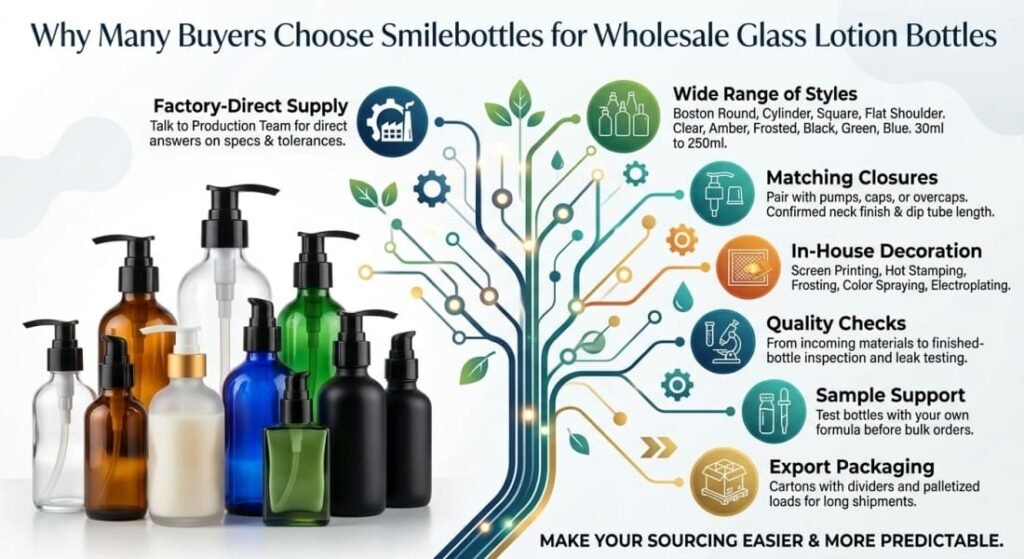
Smilebottles is a glass bottle manufacturer working with skincare brands, private label companies, wholesalers, and importers. If you’re comparing suppliers, here’s what working with us involves:
Factory-direct supply. You talk with the team that runs production, so questions about glass weight, color, or tolerances get direct answers.
A wide range of styles. Boston round, cylinder, square, and flat shoulder bottles in clear, amber, frosted, black, green, and blue glass, from 30ml to 250ml.
Matching closures. Our team helps you pair each bottle with the right pump, cap, or overcap and confirms neck finish and dip tube length before production.
In-house decoration. Screen printing, hot stamping, frosting, color spraying, and electroplating.
Quality checks at each stage. From incoming materials to finished-bottle inspection and leak testing on full sets.
Sample support. You can test bottles with your own formula before placing a bulk order.
Export packaging experience. Cartons with dividers and palletized loads designed for long sea and air shipments.
Whether you need glass pump bottles wholesale for an existing line or empty lotion bottles wholesale for a new launch, we can help you work out the right specifications, quantities, and timelines. As a skincare packaging supplier, our aim is simple: make your sourcing easier and more predictable.
FAQ: Frequently Asked Questions About Empty Glass Lotion Bottles in Bulk
Q1:What is the typical MOQ for wholesale glass lotion bottles?
A1:For undecorated stock bottles, MOQs often start in the low thousands. Custom colors and printing usually need more, and private molds need the most. Check the MOQ for pumps and caps too, since they can be separate.
Q2:Can you customize the logo, color, and pump style?
A2:Yes. Most manufacturers offer screen printing, hot stamping, frosting, color spraying, and labeling. Pumps and caps can be made in matching colors or finishes such as matte, gloss, or metallic.
Q3:Are glass lotion bottles suitable for all skincare formulas?
A3:They suit most lotions, emulsions, serums, toners, and oils because glass doesn’t react with ingredients. Very thick creams usually work better in a wide-mouth jar. For light-sensitive formulas, amber, green, black, or cobalt blue glass offers extra protection.
Q4:How do you know if a pump fits the bottle correctly?
A4:Match the neck finish exactly, for example 20/410 to 20/410, and confirm the dip tube length. Then test full sets with your formula for sealing, even dispensing, and leaks.
Q5:Are amber or frosted bottles better for skincare products?
A5:They serve different goals. Amber protects light-sensitive formulas from UV light. Frosted glass is chosen mainly for its soft, premium look. If you want both, frosted amber bottles are widely available.
Q6:Is it better to buy from a manufacturer or a trading company?
A6:For larger orders, custom branding, and stable repeat supply, a manufacturer is usually the better choice. A trading company can make sense for small, mixed orders across many packaging types.
Q7:What should you check before importing glass lotion bottles?
A7:Check import duties in your country, any material or labeling rules, your shipping terms, and whether you need test reports. Make sure your supplier provides accurate invoices and packing lists to avoid customs delays.
Conclusion
You have several ways to source glass lotion bottles in bulk: direct manufacturers, trading companies, B2B marketplaces, trade shows, and regional distributors. Each has a place, and many buyers use more than one.
What matters most is looking past the unit price. Check bottle quality, closure fit, lead times, export packaging, communication, and total landed cost. Ask for samples, test them with your real formula, and compare quotes built on the same specifications.
Taking those steps up front means fewer surprises later, and packaging that protects your products and supports your brand as you grow. If you’re planning your next order and want a second opinion on bottle style, color, or closure, the Smilebottles team is happy to talk it through with you.