
Table of Contents
ToggleAuthor: SmileBottles Editorial Team
Estimated Reading Time: About 15 Minute
As a commercial buyer, whether you are an importer, wholesaler, food brand, or private label developer, you need more than just a basic overview of capacities. You require a strategic understanding of how to source bulk mason jars effectively. This comprehensive guide will walk you through everything from the technical anatomy of packaging to a detailed mason jar size chart, helping you make commercial purchasing decisions that benefit your bottom line. We will explore how to partner with a trusted mason jar manufacturer like Smilebottles to streamline your supply chain and bring premium products to the market.
Understanding Mason Jar Anatomy: Key Components That Matter in Bulk Buying
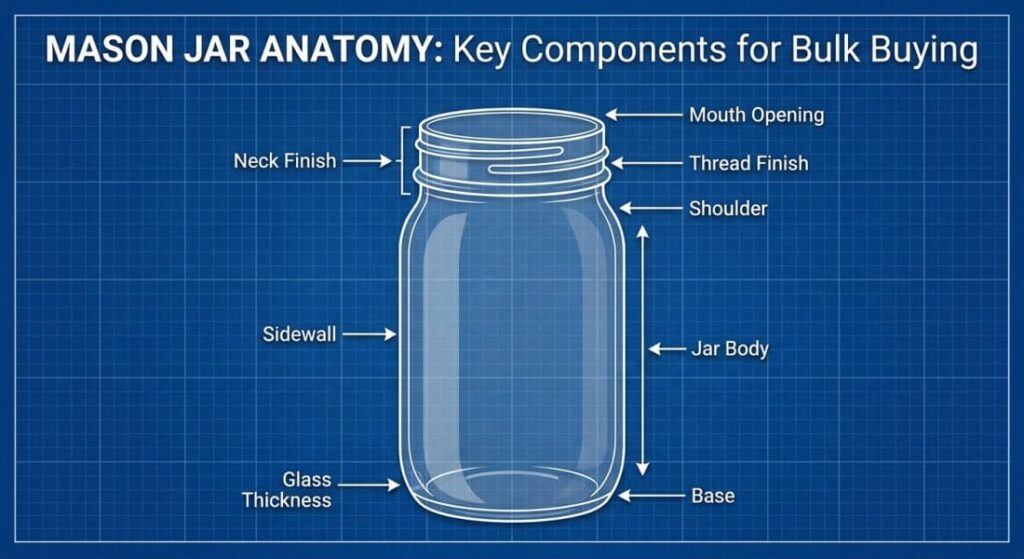
Before determining what specific volume you need, it is essential to understand the structural parts of a mason jar. When ordering on a commercial scale, the physical geometry of your packaging affects automated filling, capping, labeling, and palletizing.
The Jar Body
The main body is the most visible aspect of your packaging. The shape and structure influence how your label sits. A smooth, straight-sided body offers an excellent canvas for wraparound labels, whereas traditional square or heavily textured bodies provide a vintage aesthetic. Understanding the exact mason jar dimensions of the body ensures your chosen labels will apply smoothly without wrinkling on the production line.
Neck Finish and Mouth Opening
The neck finish dictates the type of closure you can use, while the mouth opening dictates how easily a product can be filled or dispensed. You will generally choose between a regular mouth mason jar and a wide mouth mason jar. The opening size directly impacts your filling velocity and whether a consumer can easily scoop out the contents. Understanding mason jar mouth sizes is critical for compatibility with your existing dispensing equipment.
Thread Finish and Lid Compatibility
In mass production, dimensional consistency and thread finish are non-negotiable. Whether you use standard two-piece lids, continuous thread metal screw bands, or one-piece plastisol-lined closures, the threads must maintain strict tolerances. Securing the correct mason jar lid sizes prevents leakage during transit and ensures shelf longevity.
Base, Shoulder, and Sidewall Design
The base provides stability, the shoulder transitions the body to the neck, and the sidewall dictates stacking strength. During shipping, jars must endure vibration and pressure. Jars designed with reinforced bases and uniform sidewalls perform much better on automated lines and within a stacked mason jar pallet.
Glass Weight and Thickness
Not all glass is poured equally. A heavy-bottomed premium jar conveys luxury and durability but will add to your shipping weight. A well-designed, evenly distributed standard glass weight balances sturdiness with freight efficiency. As a leading glass packaging supplier, Smilebottles ensures rigorous annealing processes so that every jar resists thermal shock and mechanical breakage.
Standard Mason Jar Sizes for Commercial and Wholesale Applications
When planning your packaging inventory, knowing what sizes do mason jars come in allows you to align your product tiering strategy. From tiny sample jars to large bulk storage containers, standardizing your product line around common mason jar sizes ensures you can always source lids and boxes reliably.
Common Mason Jar Sizes in the Market
Many buyers start their sourcing journey by asking, how big is a mason jar, or they search to find the average size of a mason jar. In reality, there is no single “average” because the use cases vary so wildly. The market relies heavily on a standardized range. The most typical capacities you will encounter include 4 oz mason jars, 8 oz mason jars, 12 oz mason jars, 16 oz mason jars, 24 oz mason jars, 32 oz mason jars, and 64 oz mason jars.
For international trade, communication is often based on milliliters. Understanding mason jar sizes in ml alongside mason jar sizes in ounces bridges the gap in global logistics. Whether your target market demands imperial or metric measurements, ensuring accurate jar sizes prevents costly miscommunications with foreign distributors.
Mason Jar Size Chart for B2B Buyers
To help you visualize your options and choose the correct glass mason jar sizes for your operation, refer to this detailed reference table. If you are ever wondering how many ml are in a mason jar or if you are looking for a reliable mason jar size guide, keep this data close at hand:
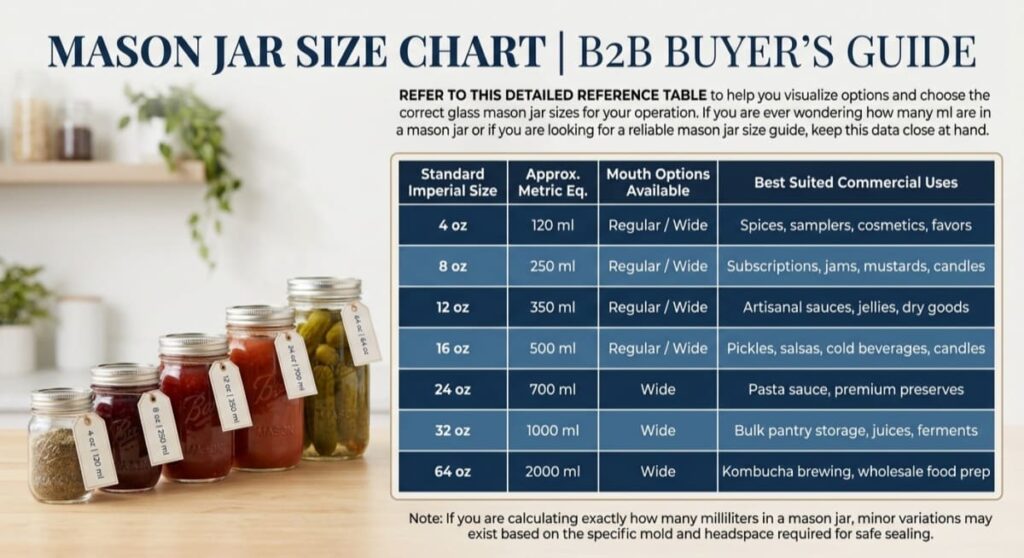
Note: If you are calculating exactly how many milliliters in a mason jar, minor variations may exist based on the specific mold and headspace required for safe sealing.
mason jar sizes chart
Regional and Market Preferences
Depending on your distribution network, you may notice different demands for different sizes of mason jars. In the US market, standardized ounce measurements dominate. Buyers heavily utilize standard canning jar sizes for retail familiarity. On the other hand, European and Asian markets often focus heavily on precise ml measurements. When you buy mason jars in bulk, working with a supplier that understands dual-unit specifications is vital for export compliance.
Occasionally, buyers entering rushed search queries may look for mason jar sizes online—while a simple typo, the intent remains the same: pinpointing accurate capacities to finalize packaging blueprints.
Regular Mouth vs. Wide Mouth Mason Jars: Which Is Better for Different Products?
After deciding on capacity, your next major decision involves the opening. The debate of wide mouth vs regular mouth mason jars is not merely about aesthetics; it comes down to functional product delivery.
What is a Regular Mouth Mason Jar?
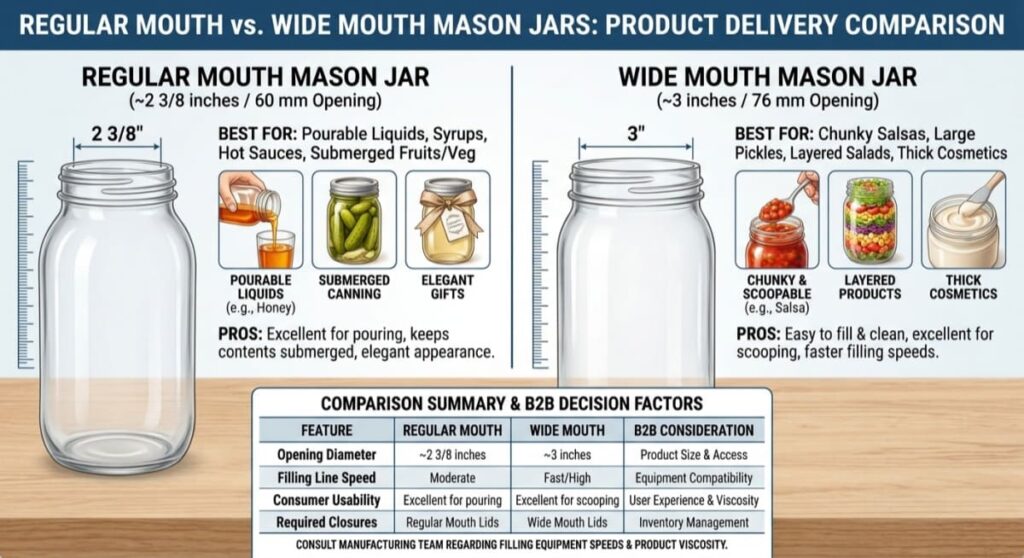
A regular mouth jar features an opening with an inner diameter of approximately 2 3/8 inches (60 mm). The shoulders of the jar curve inward gracefully to meet this narrower neck.
Pros: Outstanding for pourable liquids, syrups, and thin sauces. The narrower neck helps keep fruits and vegetables submerged below the liquid line during traditional canning.
Best for: Beverages, hot sauces, honey, and elegant gift presentations.
What is a Wide Mouth Mason Jar?
A wide mouth jar features a larger opening, generally about 3 inches (76 mm) inner diameter. If you want to know the exact size of wide mouth mason jar packaging, look for containers where the mouth is almost as wide as the body itself.
Pros: Extremely easy to fill, easy to clean, and excellent for consumer usability when a spoon or scoop is needed.
Best for: Chunky salsas, large pickles, layered salads, and thick cosmetics.
Comparison Table: Regular vs. Wide Mouth
|
Feature |
Regular Mouth |
Wide Mouth |
|
Opening Diameter |
~2 3/8 inches |
~3 inches |
|
Filling Line Speed |
Moderate |
Fast/High |
|
Consumer Usability |
Excellent for pouring |
Excellent for scooping |
|
Required Closures |
regular mouth mason jar lids |
wide mouth mason jar lids |
How B2B Buyers Should Decide
When comparing regular vs wide mouth jars for commercial runs, evaluate your product’s viscosity and the user experience. Will your customer be pouring the product (like iced coffee) or scooping it (like a thick face scrub)? Furthermore, consult your manufacturing team regarding the filling equipment. Wide mouth designs generally tolerate higher filling speeds for chunky goods without causing splash-back on the machinery.
How to Select the Right Mason Jar Size for Your Product and Market
Deciding what size is a mason jar that perfectly complements your brand requires a strategic analysis of your product category, your end consumer, and your retail environment.
Match Jar Size to Product Category
If you are wondering, how much does a mason jar hold in practical terms for retail? It boils down to category norms.
Trial and Sampler Sizes: The 4 oz to 8 oz range is perfect for multi-pack gift sets or luxury cosmetics.
Standard Retail Food Sizes: The 12 oz to 16 oz mason jars represent the sweet spot for grocery store shelves.
Bulk and Family Sizes: The 32 oz and 64 oz models are excellent for club stores or wholesale restaurant supply lines.
Consider Filling Volume and Headspace
The stated mason jar volume (the nominal capacity) is different from its total overflow capacity. You must account for headspace—the empty space left between the top of the product and the bottom of the lid. Headspace is essential for expanding frozen goods, vacuum sealing hot-fill products, and preventing leaks. When checking 16 oz mason jar dimensions, for instance, understand that the physical jar may actually hold 17 oz to the absolute brim, affording you the necessary headspace to hit a 16 oz legal claim cleanly.
Evaluate Logistics and Cost Efficiency
If you ask yourself, what are the different sizes of mason jars going to cost in freight? The larger the jar, the heavier the shipment, but the lower your individual packaging unit count. A comprehensive mason jar size comparison should include freight analysis. Using appropriately sized jars minimizes wasted space inside shipping cartons, maximizing the number of units you can fit onto a single pallet.
When analyzing a scenario like 16 oz vs 32 oz mason jars, remember that while a 32 oz jar holds double the product, it does not double your shipping footprint or lid costs, potentially offering a better margin for bulk goods.
Best Mason Jar Sizes by Industry and End Use
Different industries rely on various sizes of mason jars depending on consumer consumption habits and product preservation needs. Let’s look at exactly how to apply specific configurations to your niche.
Mason Jars for Jam and Honey
For natural preserves, fruit jellies, and artisan honey, shelf life and perceived value are key. Consumers typically use these products in small quantities.
Recommended:4 oz, 8 oz, and 12 oz.
Mason jars for honeyoften utilize regular mouths to facilitate a clean pour, though wide mouths are gaining popularity for thick, raw honey meant to be spooned.
Mason Jars for Pickles, Sauces, and Salsa
Pickled goods and Mexican-style dips require space for large chunks (like cucumber spears or diced tomatoes).
Recommended:16 oz, 24 oz, and 32 oz.
Mason jars for salsaabsolutely demand wide mouth configurations. Evaluating exact 16 oz mason jar measurements ensures your salsa fits neatly into standard supermarket snacking aisles alongside tortilla chips.
Mason Jars for Candles
The home fragrance industry has embraced glass packaging for its premium feel and heat resistance.
Recommended:4 oz, 8 oz, and 16 oz.
When sourcing containers for wax pouring, the wide mouth is highly preferred, as it ensures an even scent throw and makes the wick easy to light.
Mason Jars for Gifts and Event Packaging
Corporate events, wedding favors, and holiday gift sets thrive on miniature sizing that feels bespoke and personalized.
Recommended:4 oz and 8 oz.
Mason Jars for Storage and Bulk Pantry Goods
Zero-waste shops, dried goods manufacturers, and home storage brands require maximum capacity.
Recommended:32 oz and 64 oz.
These dominant sizes cater perfectly to the aesthetic organization market.
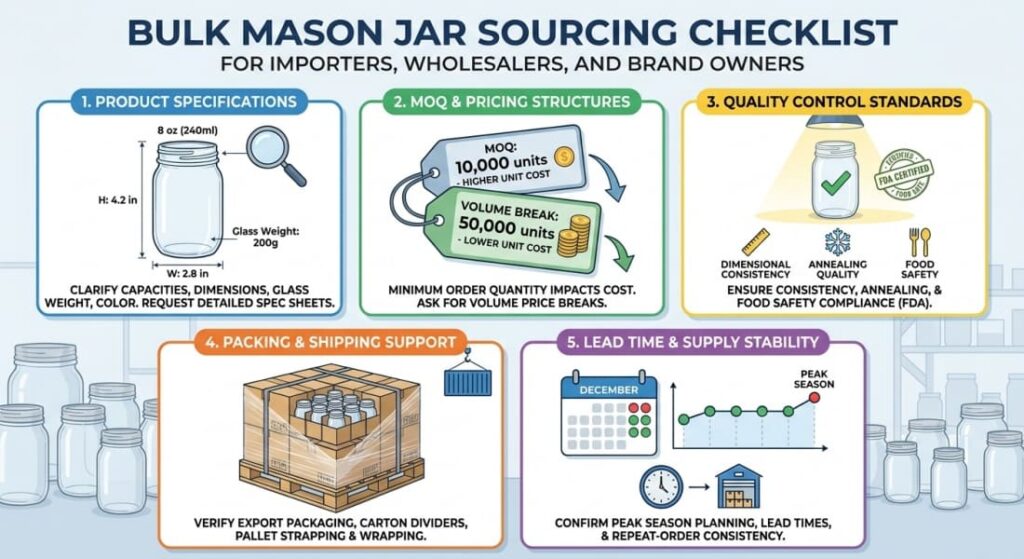
Bulk Mason Jar Sourcing Checklist for Importers, Wholesalers, and Brand Owners
Purchasing packaging at volume introduces new complexities. When stepping away from retail purchases and looking to source wholesale mason jars, you are entering the realm of B2B negotiations. Use this checklist when speaking with a mason jars supplier.
1. Confirm Strict Product Specifications
Ensure you have absolute clarity on capacities, dimensions, glass weight, and color. If you are ordering based on an exact mason jar volume, ask your supplier for detailed specification sheets. Do not assume all 16 oz jars share the same external footprint.
2. Review MOQ and Pricing Structures
When evaluating bulk glass mason jars, the Minimum Order Quantity (MOQ) significantly impacts your unit cost. Ask about volume price breaks. Moving from 10,000 units to 50,000 units might dramatically slash your per-unit cost.
3. Check Quality Control Standards
A reliable supplier must maintain strict dimensional consistency, exceptional annealing (cooling) quality to prevent stress fractures, and food-contact safety compliance. If you are sourcing wholesale glass mason jars for consumables, FDA or equivalent food safety certifications are mandatory.
4. Evaluate Packing and Shipping Support
How will the product survive transit? Request details on export packaging. Are the cartons fortified with sturdy dividers? Will the goods arrive on a strapped and shrink-wrapped pallet? Optimizing your container load ensures you aren’t paying to ship empty air.
5. Verify Lead Time and Supply Stability
Can your supplier fulfill a sudden spike in demand during the holiday boom? Ask about their peak season planning and repeat-order consistency so your brand never faces a packaging bottleneck.
Custom Mason Jar Options for Private Label and Brand Differentiation
Off-the-shelf sizes are convenient, but unique branding is what sells. To stand out on crowded supermarket shelves or digital storefronts, consider investing in personalized aesthetics when you order custom mason jars bulk.
Custom Logo Embossing
Embossed mason jars convey heritage and premium quality. By creating a custom mold, your brand’s logo can be permanently raised into the glass body. This tactile feature makes your jar memorable without relying solely on a paper label.
Printed Decoration and Labeling
If you desire vibrant graphics, printed mason jars offer direct silk-screen printing, decals, or color frosting. This is highly popular for limited-edition seasonal releases, beverage tumblers, and high-end cosmetics.
Comprehensive Sets and Packaging
Look for suppliers that offer custom glass jars with lids. Customizing the lid color (e.g., matte black, brushed gold, or copper) instantly changes the product’s character. Furthermore, combining standard jars with customized retail gift boxes from the same factory simplifies your procurement. As a fast-growing brand, ordering personalized mason jars bulk gives you the creative freedom to dominate your niche.
Developing Exclusive Molds
If you want a proprietary shape that no other brand can use, ask your manufacturing partner about developing an exclusive, custom mason jars mold that serves as the distinctive signature for your product line.
Why Smilebottles Is a Reliable Mason Jar Manufacturing Partner
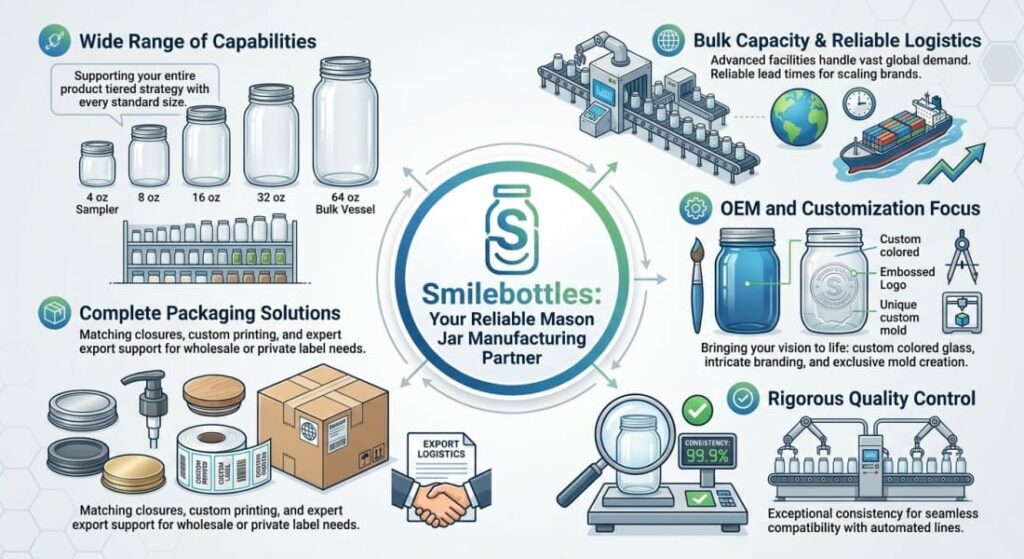
While finding a manufacturer is easy, finding a genuine partner who understands commercial growth is rare. Smilebottles is a seasoned manufacturer with a proven track record. By choosing Smilebottles, you are partnering with an expert who understands not only standard mason jar sizes but the logistics behind B2B operations.
Wide Range of Capabilities: We offer every standard size from 4 oz samplers to 64 oz bulk vessels, ensuring we can support your entire product tiered strategy.
Bulk Capacity: Our advanced production facilities easily handle vast global demand, providing reliable lead times for brands scaling up and requiring dependable stock.
OEM and Customization Focus: We specialize in bringing your vision to life, from custom colored glass to intricate branding and exclusive mold creation.
Rigorous Quality Control: We guarantee exceptional consistency, ensuring seamless compatibility with high-speed automated filling and capping lines.
Complete Packaging Solutions: As a comprehensive manufacturer, we don’t just supply glass; we provide matching closures, custom printing, and expert export logistics support tailored to your unique wholesale or private label needs.
FAQ: Frequently Asked Questions About Mason Jar Sizes and Bulk Orders
When businesses plan their supply chains, specific technical questions frequently arise. Here are concise answers to common inquiries to aid your purchasing research.
Q1. What sizes do mason jars typically come in?
A1:Standard volumes include 4, 8, 12, 16, 24, 32, and 64 ounces (roughly scaling from 120 ml up to 2000 ml). These cover everything from small spices to large bulk fermentation or storage needs.
Q2. How many ml in a mason jar in standard sizes?
A2:If you want to know how many ml in mason jar containers, a 4 oz jar holds about 120 ml, an 8 oz is 250 ml, a 16 oz is 500 ml, and a 32 oz jar holds around 1000 ml. Depending on the exact mold, minor variations occur.
Q3. What is the difference between a regular and a wide-mouth?
A3:Regular mouth jars have a ~2.38-inch opening, ideal for pourable liquids. Wide mouth jars have a ~3-inch opening, making it much easier to scoop thick contents like salsa, use as a drinking glass, or fill on automatic packaging lines.
Q4. How big are mason jars physically?
A4:Physical dimensions vary by volume. For instance, a classic 16 oz regular mouth jar frequently measures about 5.3 inches tall with a 3.2-inch diameter. Always request technical drawings before finalizing label dimensions.
Q5. Which jar size is best for candles?
A5:The 4 oz, 8 oz, and 16 oz wide-mouth jars are universally favored by candle makers because the wider opening optimizes the fragrance throw and allows easy access for lighting wicks.
Q6. Are these jars safe for hot-fill processes?
A6:Yes. When manufactured with high-quality, properly annealed glass (like the standard maintained by Smilebottles), these jars easily withstand the temperature fluctuations of typical hot-fill food processing and canning.
Q7. Can we order custom embossing on bulk jars?
A7:Absolutely. Ordering in bulk allows businesses to amortize the one-time mold fee quickly, making distinctive, embossed logos highly cost-effective for private label brands.
Q8. Do bulk orders automatically include lids?
A8:Not always. In wholesale, jars and closures are often quoted separately to allow buyers to select specific lid colors, materials, and liner types (such as plastisol for vacuum sealing). Ensure your quote specifies a complete set if needed.
Q9. How big is a standard mason jar?
A9:If there were a “standard,” the 16-ounce (pint) jar is the most universally recognized size on supermarket grocery shelves worldwide, perfectly balancing volume and hand-held convenience.
Q10. What metrics should I check before ordering a pallet?
A10:Always verify the overflow capacity versus the nominal volume, confirm the neck finish (e.g., 70-450 vs. 70G), check food-contact safety certificates, and determine exact carton dimensions for optimized pallet loading and freight efficiency.
Conclusion
Selecting the correct mason jar is an integral business strategy, not just a packaging afterthought. Making informed decisions regarding capacities, mouth diameters, and glass quality directly dictates product safety, supply chain costs, user satisfaction, and retail shelf appeal. By familiarizing yourself with standard volumes, anticipating logistics requirements, and acknowledging when to leverage custom branding, you set your product line up for long-term commercial success. Navigating these details can be complex, but you do not need to do it alone.
Partner with an experienced manufacturer that understands the realities of large-scale wholesale and custom production. Contact Smilebottles today for personalized size recommendations, material samples, or a comprehensive bulk quotation tailored to elevate your brand’s next big launch.