
Índice
AlternarAutor: Equipo editorial de SmileBottles
Tiempo estimado de lectura: Aproximadamente 16 minutos
Walk into any grocery store or cosmetics aisle today and you’ll notice the packaging debate is very much alive. Brands are switching materials. Customers are asking questions. And if you’re sourcing packaging for your business, you’ve probably found yourself wondering whether glass vs plastic really makes a meaningful difference when it comes to sustainability.
When you’re evaluating Envases de vidrio vs. envases de plástico, the right choice depends on your product type, your supply chain, your customers’ expectations, and the recycling infrastructure available where your products land. This guide breaks it down so you can make a more confident call.
Quick Answer: Is Glass or Plastic Better for the Environment?
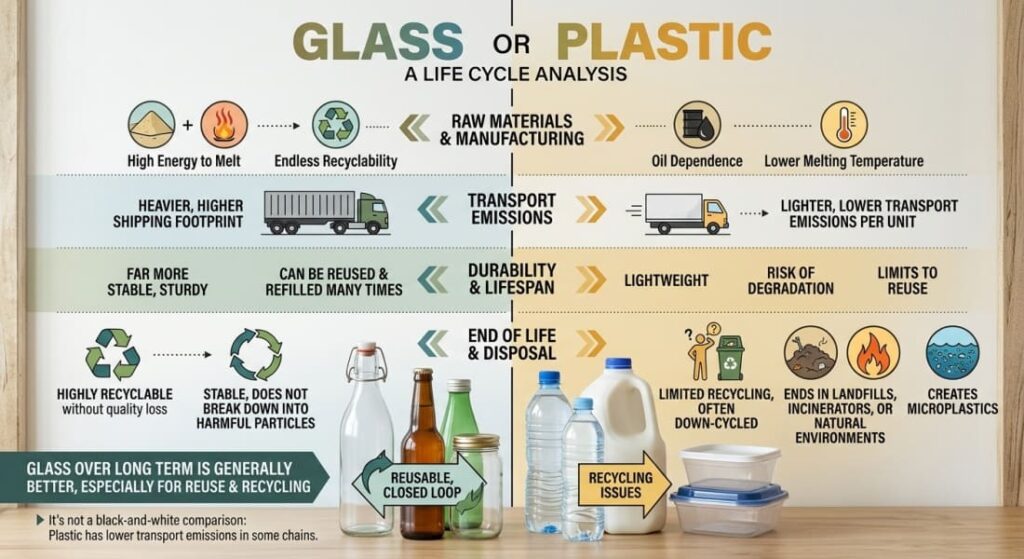
If you need a fast take on is glass or plastic better for the environment, here it is: glass generally performs better over the long term — especially when it’s reused, refilled, or recycled in a closed-loop system.
That said, plastic versus glass isn’t a clean black-and-white comparison. Plastic is lighter, which means lower transport emissions per unit in some supply chains. Glass is heavier but far more stable as a material — it doesn’t break down into harmful particles, and it can be recycled without quality loss in many systems.
Where plastic consistently loses out is at the end of its life. Much of the plastic produced today ends up in landfills, incinerators, or natural environments. Glass, when managed properly, carries none of that same risk.
What Makes Packaging Environmentally Friendly?
Before going into the specifics, it helps to agree on what “environmentally friendly” actually means for packaging. The term covers a lot of ground.
When you’re evaluating environmentally friendly bottle packaging, you’re really looking at several factors at once:
Raw materials — where does the material come from? Is it a finite fossil fuel resource or a naturally abundant mineral?
Manufacturing energy — how much energy does production require?
Transport weight — does the weight add meaningfully to shipping emissions?
Reusability — can the packaging be refilled and used again?
Reciclabilidad — can it be recycled, and is that infrastructure actually available in your market?
End-of-life pollution — what happens when the packaging is discarded? Does it persist in the environment?
No single material scores perfectly on all of these. But when you look at the full picture, glass and plastic have very different profiles.
Glass vs Plastic at a Glance
Here’s a side-by-side comparison before we go deeper.
Factor | Glass | Plastic |
Raw materials | Sand, soda ash, limestone (abundant) | Fossil fuels (finite) |
Reciclabilidad | High — closed-loop recycling possible | Varies widely by resin type |
Reuse potential | Excellent | Limited in most formats |
Food/contact safety | Chemically inert, no leaching | Potential chemical migration |
Transport weight | Pesado | Lightweight |
Breakage risk | Más alto | Menor |
Premium appearance | Strong | Less so |
Pollution persistence | Low | High — microplastics, marine waste |
Closed-loop potential | Strong | Weak in most systems |
This quick overview already shows why so many brands lean toward embalajes de vidrio sostenibles as their default. But let’s look at what the real story looks like for each material.
How Sustainable Is Glass Packaging?
Is glass environmentally friendly? For most use cases — especially food, beverage, and cosmetics — yes, though with a few honest caveats.
Glass is made from naturally abundant raw materials: primarily sand, soda ash, and limestone. None of these come from fossil fuel extraction, which gives glass a head start over petroleum-based plastics before manufacturing even begins.
Is glass sustainable? It genuinely is, particularly when you factor in recyclability. Is glass recyclable? Yes — and not just technically. Glass can be recycled repeatedly without losing quality. When processed into cullet (crushed recycled glass), it reduces the energy needed to produce new glass, which lowers the overall manufacturing carbon footprint.
Is glass a sustainable material? By most lifecycle assessments, yes. Unlike plastic, which degrades with each recycling pass and often gets downcycled into lower-grade products, glass retains its quality through the recycling process. That’s a real difference when you’re thinking long term.
From a product safety standpoint, glass is chemically inert — it doesn’t interact with the product inside. That makes it especially valuable for food packaging, beverages, cosmetics, and pharmaceuticals, where material compatibility matters.
A few trade-offs worth naming: glass production is energy-intensive, and the heavier weight can increase shipping emissions over long distances. Breakage is also a real concern in some supply chains. These factors don’t cancel out glass’s environmental advantages, but they’re worth planning for in your packaging strategy.
Where Plastic Falls Short Environmentally
Why is plastic bad for the environment? There are several reasons, and they tend to compound.
Most plastics start as petrochemicals — derivatives of fossil fuel extraction. That means every piece of plastic packaging carries an embedded carbon cost just from sourcing the raw material, before a single bottle is formed.
Then there’s the recycling problem. Is plastic recyclable? Technically yes, but the reality is more complicated. Recycling rates for plastic are significantly lower than for glass in most markets. Many plastic formats — especially mixed-material or colored packaging — can’t be processed through standard collection systems at all.
Even when plastic does get recycled, it often produces a lower-grade output. That means downcycling rather than genuine closed-loop recovery. A plastic bottle may end up as a park bench, but it won’t become another food-grade bottle.
The environmental impact of plastic packaging extends beyond manufacturing and recycling too. Plastic that escapes collection systems can persist in landfills for hundreds of years. It also breaks down into microplastics — tiny particles that end up in waterways, soil, and increasingly in food and human tissue.
You may have come across the topic of more microplastics in glass than plastic — this is a nuanced point. Some studies have detected microplastic contamination in products stored in glass, but this is generally attributed to environmental contamination from the surrounding air and handling rather than the glass itself. Glass doesn’t shed microplastic particles; the contamination comes from outside.
The disadvantages of plastic packaging are significant when you’re building a brand with a genuine environmental position. Consumers are increasingly aware of these issues, and their expectations are shifting.
Are There Situations Where Plastic Still Makes Sense?
Fairness matters here. Plastic or glass — there are cases where plastic is genuinely the more practical option.
Is plastic more durable than glass? In terms of impact resistance, yes. Plastic is far less likely to shatter during shipping or in retail environments where breakage carries real costs. For high-volume products shipped over long distances, the weight difference also translates to lower freight emissions per unit.
If you’re operating in a region where glass collection and recycling infrastructure is limited — or where a glass return system doesn’t exist — the actual end-of-life performance of glass may not be as strong as it looks on paper. In those cases, a recyclable, mono-material plastic format might deliver better real-world outcomes than glass that ends up in general waste.
That said, these scenarios are becoming less common as infrastructure improves and glass return schemes expand. For most plastic bottle or glass bottle which is better decisions, brands with strong sustainability goals tend to land on glass — especially when reuse or refill models are part of the strategy.
Glass vs Plastic Recycling: What You Should Know
Recycling is often treated as the straightforward answer to packaging waste, but the details matter a lot.
For glass, the recycling story is relatively strong. Recyclable glass packaging can be processed back into new glass with very little quality degradation. Closed-loop glass recycling exists and works well. The main requirement is keeping glass in a separate clean stream — contamination with food waste or other materials reduces the viability of cullet.
For plastic, the picture is messier. Different resin types need to be sorted separately. Contamination is a persistent problem. Colored plastics often can’t be recycled back into the same color. Labels, pumps, and closures that aren’t removed can compromise entire batches.
The practical takeaway: if you’re choosing packaging with recycling in mind, glass generally offers more reliable end-of-life outcomes — particularly in markets with established glass collection.
Why Refillable Glass Supports a Circular Packaging Model
Single-use packaging is increasingly out of step with where the market is heading. Refillable glass bottles are one of the clearest examples of circular packaging that actually works in practice.
When glass is refilled and reused — rather than recycled and remanufactured — the environmental math gets even better. You skip the energy-intensive remanufacturing step entirely. Each refill cycle extends the value of the original packaging while reducing the need for new production.
This model works well across a range of categories: beverages, condiments, personal care, candles, home fragrance, and more. If your product could work with a refill or return model, eco friendly glass bottles and jars are worth considering seriously. The main requirements are reliable reverse logistics, effective cleaning, and packaging designed to survive multiple use cycles.
frascos de vidrio
Glass vs Plastic for Food, Beverage, and Cosmetic Packaging
Glass packaging for food products has been a standard for a long time, and for good reason. Glass doesn’t interact with the food it contains. It doesn’t absorb flavors or odors. It performs well with high-acid, high-fat, and high-temperature contents that would stress or degrade many plastic alternatives.
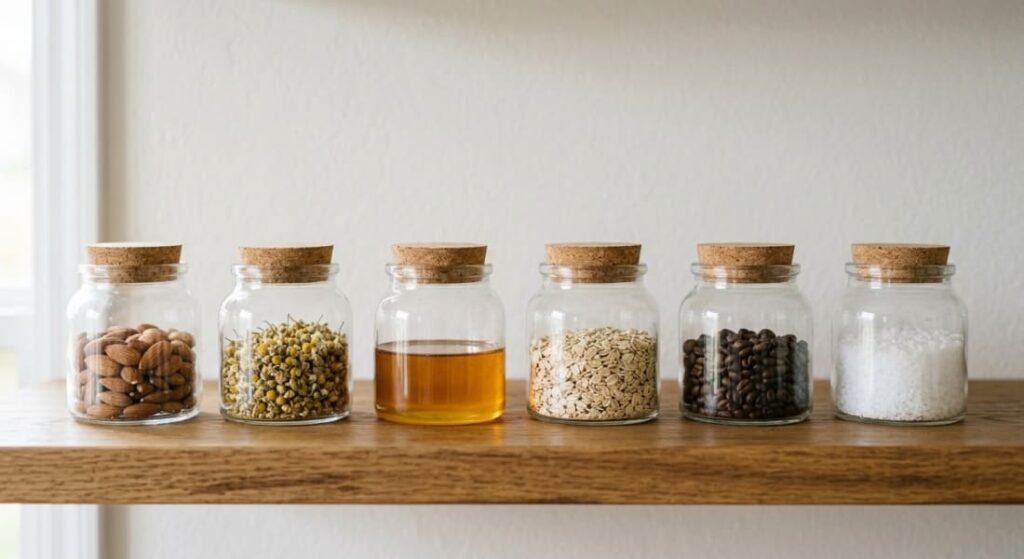
Glass jars for food packaging — from sauces and pickles to honey and spreads — are a reliable format that consumers associate with quality and product integrity. If you’re looking for a glass jar supplier to develop your own format, these categories tend to offer consistent demand and strong shelf appeal.
For beverages, glass vs plastic bottles remains a live debate, but premium segments have largely moved to glass. The perception of quality is real: consumers consistently rate products in glass higher, and glass genuinely preserves carbonation, aroma, and flavor better than most plastic alternatives. A good glass bottle supplier or fabricante de botellas de vidrio can help you navigate bottle shapes, fill volumes, closures, and decoration options for your specific product.
For beauty and personal care, cosmetic glass packaging and glass packaging for cosmetics offer something plastic often can’t — a premium feel and a strong brand signal at shelf. Sustainable cosmetic packaging is one of the fastest-growing areas in the industry right now, driven by both consumer demand and increasing regulatory pressure on single-use plastics. Luxury glass packaging for serums, perfumes, face oils, and candles continues to outperform plastic counterparts in market positioning across most premium categories.
The Advantages of Glass Packaging — And Why It Matters for Your Brand
When you’re weighing up materials, the advantages of glass packaging go beyond just sustainability. The benefits of glass bottles include:
Product safety and purity — no chemical migration, no flavor transfer
Preservation — glass keeps contents stable over longer periods
Premium positioning — the tactile and visual quality of glass signals value
Consumer trust — buyers associate glass with cleaner, better-quality products
Versatility — suitable for food, beverage, cosmetics, pharmaceuticals, candles, and home products
Reciclabilidad — a genuine closed-loop material when collection systems are in place
These factors together explain why glass bottles are better than plastic for brands that care about both product quality and environmental responsibility.
How to Choose the Right Eco-Friendly Packaging for Your Product
If you’re working through the glass versus plastic decision for your own product, here’s a practical way to think about it.
Choose eco friendly glass packaging when:
Your product is food, beverage, cosmetic, or pharmaceutical
You want chemical inertness and product safety as a given
Your customers value premium presentation
Your supply chain can manage the weight
Local recycling infrastructure supports glass
You’re exploring or planning a refill model
Consider plastic when:
Your product is being shipped over very long distances and weight is the dominant carbon factor
Breakage risk in your supply chain is genuinely high and costly
Glass collection and recycling systems are not available in your target market
You’re using a specific closed-loop return system for a durable plastic format
Is glass cheaper than plastic? In most cases, no — glass has a higher unit cost and heavier shipping weight. But when you factor in premium positioning, brand credibility, and long-term recyclability, many businesses find that environmentally friendly glass delivers better value overall than the unit price suggests.
Why More Brands Are Choosing Glass Packaging
Sustainable packaging trends are pointing clearly in one direction: away from single-use plastic and toward materials that can be genuinely recovered and reused. Glass is well-positioned for this shift.
Beyond sustainability, glass also delivers on product quality and shelf appeal. Premium glass bottles and jars signal a level of quality that plastic rarely matches. For brands in food, beverage, beauty, and wellness, the move to glass is often driven as much by brand strategy as environmental goals — and the two reinforce each other in a way that’s hard to ignore.
Why is glass better than plastic from a sustainability standpoint comes back to the full lifecycle: recyclable without quality loss, made from natural materials, no microplastic shedding, and well-suited for refill systems. When you weigh those factors together against the alternatives, the case for eco friendly glass packaging holds up.
Is glass better than plastic for the environment? For most commercial packaging applications, yes — especially when the alternatives involve fossil-fuel-derived plastics with limited end-of-life options.
Why Smilebottles Is a Reliable Partner for Glass Bottles and Jars
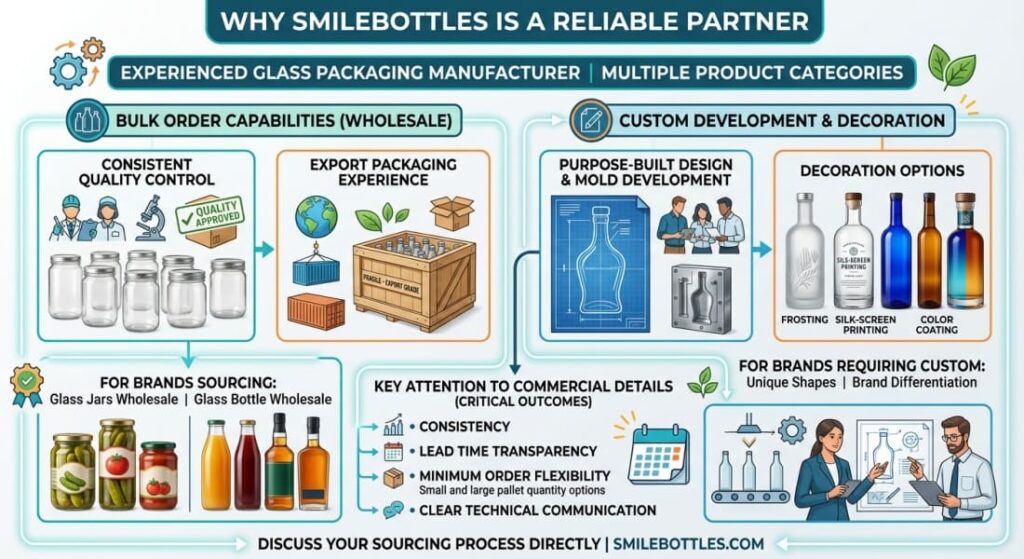
As a glass packaging manufacturer with experience across multiple product categories, Smilebottles works with brands in food, beverage, cosmetics, and household products. Whether you need standard formats or purpose-built custom development, the team understands the specifications that matter for real commercial use.
If you’re sourcing glass jars wholesale or glass bottle wholesale, Smilebottles offers bulk order capabilities with consistent quality control and export packaging experience. For brands that need something custom-designed, mold development and decoration options — including frosting, silk-screen printing, and color coating — are available as part of the process.
Working with a custom glass bottle manufacturer means paying attention to the details that actually affect your packaging outcomes: consistency, lead time transparency, minimum order flexibility, and clear communication on technical specifications. These are worth discussing directly during your sourcing process.
Preguntas frecuentes: Frequently Asked Questions About Eco-Friendly Glass Packaging
P1:Is glass always more environmentally friendly than plastic?
A1:Not in every single case, but in most packaging scenarios — food, beverage, cosmetics, pharmaceuticals — glass performs better across the full lifecycle. The main exception is logistics-heavy situations where transport weight is the dominant carbon variable.
Pregunta 2:Can glass be recycled endlessly?
A2:In principle, yes. Glass can be recycled into new glass repeatedly without losing material quality. In practice, effectiveness depends on clean, separate collection streams and accessible cullet processing.
Pregunta 3:What is the carbon footprint glass vs plastic comparison?
A3:The carbon footprint glass vs plastic comparison is nuanced. Glass production is energy-intensive, which can produce a higher manufacturing footprint per unit in some analyses. But plastic’s end-of-life impact — particularly when it isn’t recycled — often tilts the lifetime comparison back toward glass. Context and geography matter a lot.
Pregunta 4:Is glass safer for food and cosmetics?
A4:Yes. Glass is chemically inert and doesn’t leach compounds into the product it holds. This is one of the clearest practical advantages over plastic for food and personal care packaging.
Pregunta 5:Are glass jars more sustainable than plastic jars?
A5:When comparing glass vs plastic jars across the full lifecycle, glass generally wins on recyclability, reuse potential, and material safety. The main trade-off is unit cost and shipping weight.
Pregunta 6:When should a brand choose plastic instead of glass?
A6:When shipping distance is very long and weight is a dominant factor, when breakage risk is significant, or when local glass recycling infrastructure is genuinely limited. Outside those scenarios, glass is usually the better long-term choice.
P7:What industries benefit most from glass packaging?
A7:Food and condiments, beverages (especially premium), cosmetics and skincare, candles and home fragrance, pharmaceuticals, and specialty wellness products.
Conclusión
Is glass better than plastic? Across recyclability, chemical safety, reuse potential, and microplastic-free material performance, glass holds up well. That doesn’t mean plastic has no role — but if you’re sourcing packaging and want to align with current sustainable packaging trends, minimize environmental impact, and give your customers something they’ll trust, glass is the right call in most situations.
If you’re looking for a manufacturer who can support your packaging development from spec to finished product, Smilebottles is set up to help — whether you need a standard format or something built from scratch for your brand.Ready to discuss bottle formats, jar specifications, or custom packaging development? Reach out to Smilebottles directly to get started.
 Spanish (Chile)
  English
  Russian
  Spanish (Colombia)
  Spanish (Ecuador)
  Swedish
  Arabic
  French
  Portuguese