
Índice
AlternarAutor: Equipo editorial de SmileBottles
Tiempo estimado de lectura: Aproximadamente 15 minutos
If you’ve ever held a jar of honey up to the light or twisted open a jam jar from your pantry, you’ve probably noticed how solid and clear the glass feels in your hand. But have you ever stopped to think about what actually goes into making that jar? For buyers who source packaging in bulk, understanding how are glass jars made isn’t just a curiosity — it helps you choose the right supplier, spot quality issues before they cost you money, and make smarter decisions for your brand.
At Smilebottles, we’ve spent years producing glass jars for food, cosmetic, and specialty brands around the world. In this guide, we’ll walk you through the full glass jar manufacturing process, from raw sand to finished packaging, so you know exactly what you’re buying and what to look for.
What Are Glass Jars Made Of?
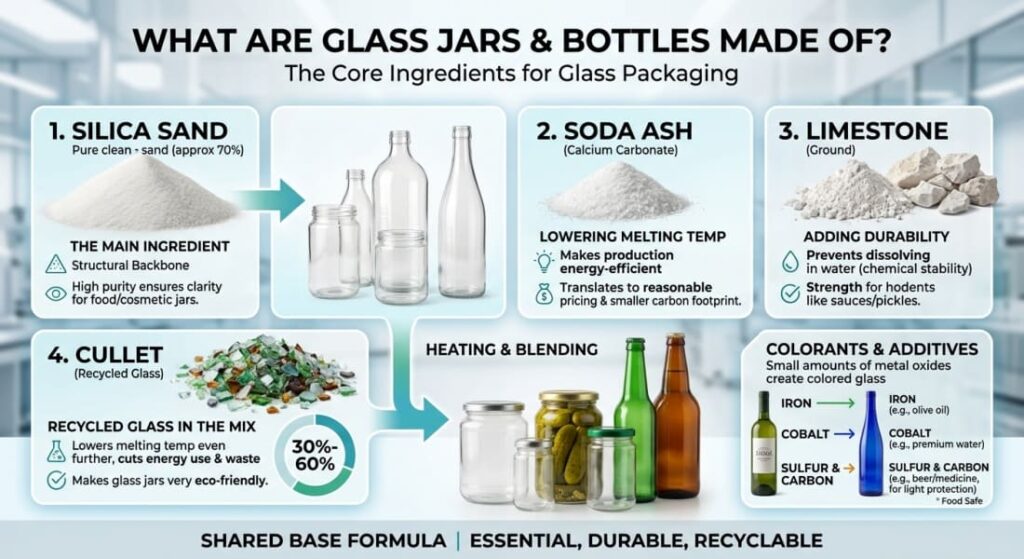
Before we get into the machinery and heat, let’s talk about the recipe. What are glass jars made of is a question we hear often from buyers who are new to sourcing glass packaging. The answer is simpler than most people expect — glass is essentially a blend of four main ingredients, plus a few optional additives depending on the color or performance you need.
This is also the short answer to what are glass bottles made of, since bottles and jars share nearly the same base formula.
Silica Sand: The Main Ingredient
Silica sand makes up about 70% of the glass mixture. It’s the structural backbone of every jar you’ll ever buy. The purity of the sand matters a lot — cleaner sand produces clearer glass, which is why food and cosmetic buyers usually want jars made from high-grade silica. If you see cloudiness or a slight tint in a supposedly “clear” jar, low-quality sand is often the reason.
Soda Ash: Lowering the Melting Temperature
Pure silica melts at around 1,700°C, which would burn through way too much energy. Soda ash brings that temperature down, making production more efficient. For you as a buyer, this translates into more reasonable pricing and a smaller carbon footprint per jar.
Limestone: Adding Durability
Without limestone, glass would slowly dissolve in water — not something you want in a jar meant to hold pickles or sauce. Limestone gives the finished jar its chemical stability and everyday strength.
Cullet: Recycled Glass in the Mix
Cullet in glass manufacturing is one of the most important ingredients for modern production. Cullet is simply crushed recycled glass, and adding it to the batch lowers the melting temperature even further, cuts energy use, and reduces waste. Most reputable manufacturers today include a significant percentage of cullet — sometimes 30% to 60% — which is a big reason recyclable glass jars are considered one of the most eco-friendly packaging options available.
Colorants and Additives
If you need amber jars for light-sensitive products, green jars for a natural look, or blue for a premium feel, small amounts of metal oxides are added. Iron gives green, cobalt gives blue, and sulfur with carbon creates amber. These additives don’t affect food safety when done properly.
How Raw Materials Are Batched and Prepared
Once the raw materials arrive at the factory, they don’t just get tossed into a furnace. There’s a careful measuring and mixing stage called batching, and it’s more important than most buyers realize.
Each ingredient is weighed to precise ratios. If the proportions drift even slightly, you can end up with jars that are weaker, cloudier, or dimensionally inconsistent from one production run to the next. When you’re ordering 50,000 jars for a product launch, that kind of inconsistency causes real problems on your filling line.
After mixing, the batch travels on conveyors or through automated feeders into the furnace, where the real transformation begins.
How the Glass Melting Process Creates Molten Glass
The glass melting process is the heart of the entire operation. This is where a dry, sandy mixture turns into a glowing river of liquid glass.
Furnace Temperatures
Industrial glass furnaces run between 1,400°C and 1,600°C. At that heat, the batch slowly melts down over many hours, sometimes more than a full day, depending on the furnace design. Modern furnaces are built to run continuously — often for years at a time without shutting down — because reheating one from cold is enormously expensive.
Refining the Glass
As the glass melts, tiny bubbles form. If those bubbles stay trapped, they become visible defects in your finished jars. Refining is the stage where the molten glass sits at high temperature long enough for bubbles to rise out. This is why good manufacturers don’t rush the melting step.
Conditioning for Forming
Before the glass can be shaped, it needs to cool slightly to the right viscosity — thick enough to hold shape, thin enough to flow into molds. This stage happens in a section called the forehearth, where temperature is fine-tuned with almost surgical precision.
How Molten Glass Is Cut Into Gobs
Once the glass is at the right temperature, it flows out of the forehearth and gets cut into portions called gobs. Think of a gob as a glowing orange droplet, roughly the size and shape of the jar it’s about to become.
Gob weight and temperature are controlled to the gram and the degree. If a gob is too heavy, your jars end up thick and expensive. Too light, and the walls become fragile. This is one of the quiet details that separates a good glass packaging supplier from an average one.
How Glass Jars Are Shaped in Molds
Now for the part most people picture when they think of glassmaking — the forming stage. There are two main methods used in the glass container manufacturing process, and the choice affects the final quality of your jars.
Blow and Blow Process
The blow and blow process is the older of the two methods. Compressed air pushes the gob into a rough shape called a parison, and then a second blast of air blows the parison into its final form inside a second mold. This method works best for narrow-neck containers like bottles and some glass pitcher designs where the opening is smaller than the body.
Press and Blow Process
The press and blow process uses a metal plunger to press the gob into the initial shape, and then compressed air finishes the forming in the final mold. Because the plunger gives more control over the glass, this method produces jars with more uniform wall thickness — which matters when you want lightweight jars that don’t sacrifice strength.
Blow and Blow vs Press and Blow
So which is better? Comparing blow and blow vs press and blow really comes down to what you’re making.
Blow and blow suits narrow-neck bottles and traditional jar shapes
Press and blow works better for wide-mouth jars, food grade glass jars, and lightweight glass packaging where wall consistency is critical
Press and blow generally allows you to use less glass per jar without losing strength, which reduces shipping cost and material use
If you’re sourcing wide-mouth jars for jam, honey, candles, or cosmetics, press and blow is usually the better fit. This is also how most modern frascos de vidrio para el empaque de alimentos are made today.
How Annealing Strengthens Glass Jars
Right after forming, your jar looks finished — but it isn’t. Freshly molded glass is full of internal stress from rapid cooling on the outside while the inside is still hot. If you skipped annealing, jars would crack the moment they hit a filling line or a warm dishwasher.
Inside the Annealing Lehr
The lehr is basically a long, temperature-controlled tunnel. Jars enter at around 500–600°C and slowly cool over 30 minutes to an hour. Each cooling zone is carefully calibrated so the glass relaxes evenly.
Why This Matters for You
A properly annealed jar can survive hot filling, cold storage, transport bumps, and consumer handling without breaking. Poorly annealed jars — the kind you sometimes get from bargain suppliers — fail unpredictably, and one broken jar on a retail shelf can damage your brand reputation more than any savings are worth.
What Surface Treatments and Finishing Steps Are Used?
Once the jars leave the lehr, they go through finishing steps that most buyers never see but definitely benefit from.
Hot-End Coating
Applied while the jar is still hot, this thin coating helps the glass resist scratches during handling and transport. It also gives the jar a smoother surface for later coatings.
Cold-End Coating
Added after annealing, this coating reduces friction between jars so they slide smoothly on filling and labeling lines. If you’ve ever had jars get stuck or scratch each other during production, cold-end coating quality was likely the issue.
Decoration Options
This is where your brand identity comes in. Common options include:
Frosting for a soft, matte finish
Screen printing for logos and text
Embossing for a raised, premium look
Custom colors and coatings
Neck finish adjustments for specific lid types
Un buen custom glass jar manufacturer can guide you through which combinations work for your product and budget.
How Quality Control Ensures Safe and Consistent Glass Jars
Quality control isn’t a single step — it runs through the entire process. When you’re evaluating suppliers, this is one of the most important areas to ask about.
Hot-End Inspection
While jars are still hot, cameras and sensors check for shape, wall thickness, and obvious defects. Jars that fail here get pulled and recycled back into cullet.
Cold-End Inspection
After annealing, every jar goes through more detailed checks — dimensional accuracy, cracks, sealing surface quality, and finish precision. Automated systems can catch defects a human eye would miss.
Common Glass Container Defects to Watch For
If you’ve ever received a batch of jars with problems, you might have encountered these common glass container defects:
Stones — small unmelted particles trapped in the glass
Blisters — bubbles that didn’t rise out during refining
Checks — hairline cracks near the finish or shoulder
Uneven wall thickness — leads to weak spots
Warped finish — causes sealing problems with lids
Reputable manufacturers reject jars with these issues before they ever ship. This is worth asking about when comparing quotes — a lower price often means less rigorous inspection.
Where Are Glass Jars Used? Key Industries and Applications
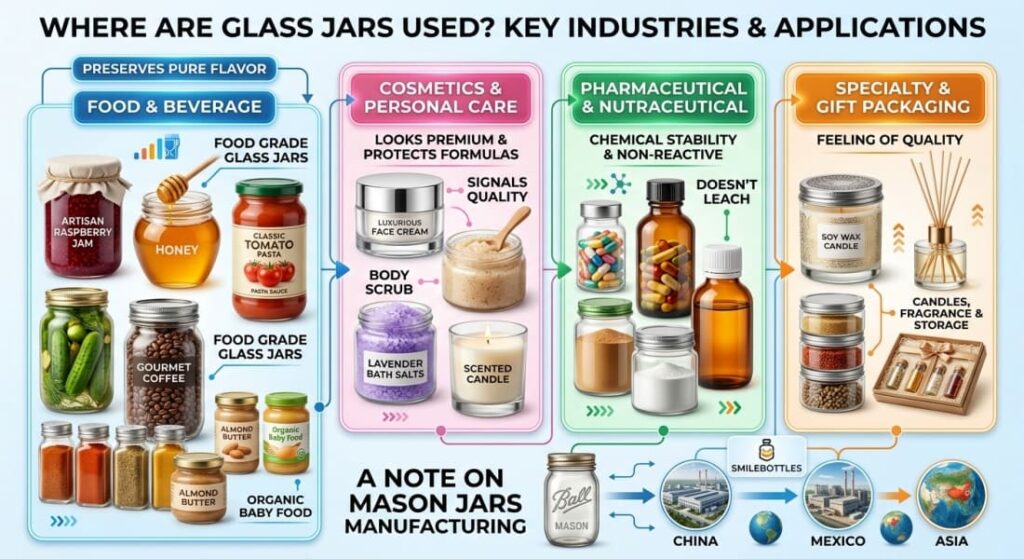
Glass jars end up in almost every consumer category, but a few industries rely on them more than others.
Food and Beverage
Jam, honey, sauces, pickles, coffee, spices, nut butters, baby food — the list is long. Glass keeps flavors pure because it doesn’t absorb or release chemicals. This is why so many premium food brands specifically choose food grade glass jars over plastic alternatives.
Cosmetics and Personal Care
Creams, masks, scrubs, bath salts, and candles all benefit from glass. It looks premium on the shelf, protects sensitive formulas, and signals quality to your customers.
Pharmaceutical and Nutraceutical
For products where chemical stability matters most, glass is often the only acceptable option. It doesn’t react with contents, doesn’t leach, and holds up under a wide range of storage conditions.
Specialty and Gift Packaging
For candles, home fragrance, storage products, and gift sets, glass adds a feeling of quality that plastic simply can’t match.
A quick note on where are mason jars manufactured — while the classic American mason jar has historical roots in the U.S., most mason-style jars today are produced in China, Mexico, and various parts of Asia. Smilebottles produces mason-style jars along with many other jar designs for buyers around the world.
Why Glass Jars Remain a Sustainable Packaging Choice
Sustainability isn’t a marketing angle anymore — it’s a real buying criterion. If your customers care about the environment, your packaging choices matter.
100% Recyclability
Glass can be recycled endlessly without losing quality. A jar you use today could become part of another jar next year, and another one after that. That’s a real advantage over most plastics, which degrade with each recycling cycle.
Lower Energy Use With Cullet
The more cullet a manufacturer uses, the less energy the furnace needs. Every 10% increase in cullet content typically reduces energy use by around 2–3%. This is one of the reasons embalajes de vidrio sostenibles has become a serious focus for major food and beverage brands.
Refill and Reuse Trends
More brands are moving toward refillable models — think of shampoo bars, refillable cleaning products, and bulk food stores. Glass fits these models naturally because it’s durable and doesn’t retain smells or residues.
Why Brands Choose Glass for Premium Positioning
If you want your product to feel high-end, glass helps you get there. Eco friendly glass jars carry a sense of care and quality that plastic packaging rarely matches, and consumers are willing to pay more for products that feel this way.
different glass jars
Future Trends in Glass Jar Manufacturing Technology
The industry isn’t standing still. A few changes are worth knowing about as you plan your future packaging needs.
Smarter Inspection Systems
AI-powered vision systems are getting better at spotting microscopic defects. This means higher quality jars reaching your line and fewer surprises during filling.
Lightweighting
Modern press and blow technology can now produce jars up to 30% lighter than older designs without sacrificing strength. Lighter jars mean lower shipping costs and a smaller carbon footprint per unit.
Cleaner Furnaces
Newer furnace designs use more electricity and less natural gas, and some are experimenting with hydrogen. If carbon reporting matters to your brand, ask suppliers about their furnace technology.
More Flexibility for Small Batches
Historically, custom jars required huge minimum orders. That’s slowly changing as manufacturers adopt more flexible mold systems. If you’re a smaller brand, custom options are more accessible now than they were even five years ago.
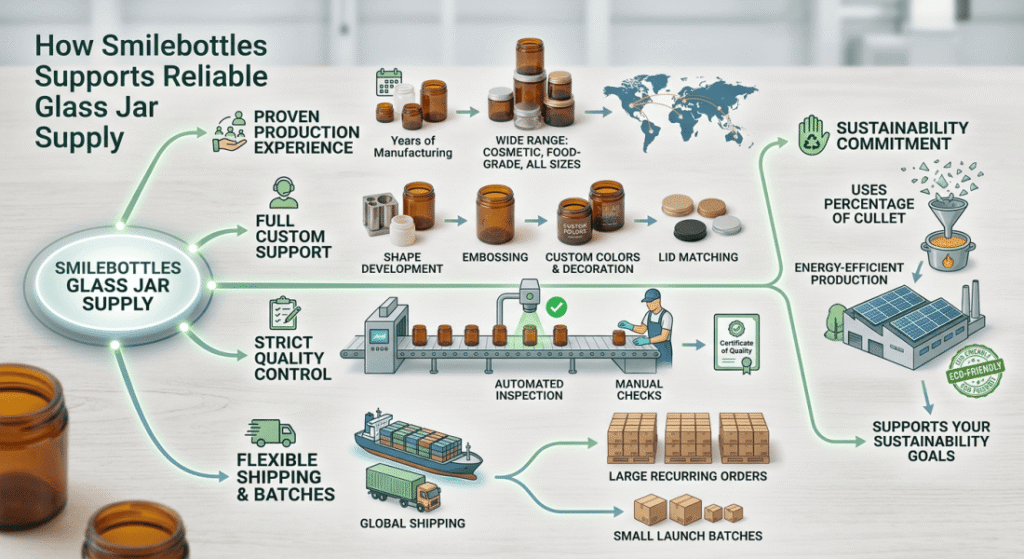
How Smilebottles Supports Reliable Glass Jar Supply
If you’re comparing manufacturers, here’s what we bring to the table without any sales spin.
We’ve been producing glass jars for years across a wide range of shapes, sizes, and finishes. Our production covers everything from small cosmetic jars to larger food-grade containers, and we work with brands of all sizes.
For custom projects, we support shape development, embossing, custom colors, decoration, and lid matching. Our quality control combines automated inspection with manual checks so that what leaves our factory matches what you agreed to buy.
We ship to buyers around the world and can support both large recurring orders and smaller launch batches. And because we use a meaningful percentage of cullet and continue investing in energy-efficient production, we can support your sustainability goals too.
Preguntas frecuentes: Frequently Asked Questions About How Glass Jars Are Made
P1:Are glass jars really made from sand?
A1:Yes. Silica sand is the main ingredient, making up around 70% of the mixture. It’s combined with soda ash, limestone, and recycled glass before melting.
Pregunta 2:What temperature is used to make glass jars?
A2:Furnaces typically operate between 1,400°C and 1,600°C. The exact temperature depends on the batch composition and the furnace design.
Pregunta 3:What’s the difference between blow and blow and press and blow?
A3:Blow and blow uses air pressure for both stages of forming and works well for narrow-neck containers. Press and blow uses a plunger for the first stage, giving better wall thickness control, which is ideal for wide-mouth jars and lighter designs.
Pregunta 4:Why is annealing important?
A4:Annealing removes internal stress from the glass. Without it, jars would crack easily during filling, transport, or normal use. It’s what makes the difference between a jar that survives your supply chain and one that fails.
Pregunta 5:Are glass jars environmentally friendly?
A5:Yes, especially compared to most plastic alternatives. Glass is 100% recyclable, can be reused many times, and modern production uses substantial amounts of recycled cullet to reduce energy consumption.
Pregunta 6:How long does it take to make a glass jar?
A6:The forming itself takes just seconds per jar, but the full process — including melting, annealing, inspection, and packaging — takes several hours from raw material to finished product.
Conclusión
Understanding how glass jars are made puts you in a stronger position as a buyer. You’ll know what questions to ask, what defects to look for, and which manufacturing methods suit your product. From raw silica sand to a finished, inspected jar on your filling line, every step affects the quality and cost of what you’re buying.
If you’re planning your next packaging project and want to talk through options, sample jars, or custom designs, Smilebottles is here to help. Whether you need standard food jars, custom cosmetic containers, or something completely unique, we’d be glad to walk you through what’s possible.
 Spanish (Chile)
  English
  Russian
  Spanish (Colombia)
  Spanish (Ecuador)
  Swedish
  Thai
Thai  Turkish
  Ukrainian