
Índice
AlternarAutor: Equipo editorial de SmileBottles
Tiempo estimado de lectura: Aproximadamente 16 minutos
If you’ve ever stood in front of a shelf of wine trying to work out how many bottles to buy for a dinner, you already know the question: how many glasses in a bottle? The short answer is that a standard 750 ml wine bottle gives you about five glasses, a 750 ml bottle of spirits gives you about 17 shots, and a 750 ml bottle of champagne fills about six flutes.
The real answer depends on how much you pour, which glass you use, and what is in the bottle. Once you understand that, you can plan events more accurately, price drinks properly, and choose the right bottle sizes if you’re building a beverage brand.
This guide walks you through the numbers step by step. You’ll find bottle capacities, standard pour sizes, glass sizes, event planning formulas, and a few things to think about if you’re sourcing bottles for your own products.
Quick Answer: How Many Glasses Does Each Bottle Size Serve?
If you just need the numbers, start here. The figures below use the most common US pour sizes: 5 oz (150 ml) for wine, 1.5 oz (44 ml) for spirits, and 4 oz (120 ml) for champagne.
|
Bottle Type |
Bottle Size |
Pour Size |
Approximate Servings |
|
Wine (split) |
187 ml |
5 oz / 150 ml |
1 glass |
|
Wine (half bottle) |
375 ml |
5 oz / 150 ml |
2.5 glasses |
|
Wine (standard) |
750 ml |
5 oz / 150 ml |
5 glasses |
|
Wine (liter) |
1 L |
5 oz / 150 ml |
6–7 glasses |
|
Wine (magnum) |
1.5 L |
5 oz / 150 ml |
10 glasses |
|
Liquor (pint) |
375 ml |
1.5 oz / 44 ml |
8 shots |
|
Liquor (fifth) |
750 ml |
1.5 oz / 44 ml |
17 shots |
|
Liquor (liter) |
1 L |
1.5 oz / 44 ml |
22 shots |
|
Liquor (handle) |
1.75 L |
1.5 oz / 44 ml |
39 shots |
|
Champagne (standard) |
750 ml |
4 oz / 120 ml |
6 flutes |
|
Champagne (magnum) |
1.5 L |
4 oz / 120 ml |
12 flutes |
You can save this table as a quick bottle size chart for planning. One thing stands out: the answer to how many glasses in a 750ml bottle changes a lot depending on the drink. That same 750 ml can be five glasses of wine, six flutes of champagne, or 17 shots of vodka. So if you’re asking how many drinks in a 750ml bottle, you first need to know what kind of drink you’re serving.
The Simple Formula Behind Every Number
You can work out any serving count yourself with one formula:
Number of servings = Bottle volume ÷ Pour size
For example, if you want to know how many glasses of wine is 750 ml at a 150 ml pour, divide 750 by 150. You get 5. If you pour 125 ml, you get 6. That’s all there is to it. The formula works for any bottle, from a small sample vial to a large-format bottle.

How Many ML Are in a Bottle of Wine?
Before you can count glasses, you need to know what you’re starting with. So how many ml are in a bottle of wine? A standard bottle holds 750 ml. This size is used by wineries all over the world, and it has been the industry norm for decades.
If you’ve ever searched how many milliliters in a bottle of wine or how many milliliters is a bottle of wine, the answer is the same: 750 ml is the standard. When people ask how many ml is a wine bottle, they almost always mean this size, though other formats exist (more on those below).
The fill volume is always printed on the label, so you can check the ml in bottle before you buy. In most markets, wine sold in other sizes still follows a set of approved volumes, such as 187 ml, 375 ml, 500 ml, 1 L, and 1.5 L.
Converting Wine Bottle Volume to Ounces and Cups
If you work in US units, these conversions will help:
How many ounces in a 750ml bottle? About 25.4 fluid ounces.
1 liter is about 33.8 fluid ounces.
1.5 liters is about 50.7 fluid ounces.
You might also wonder about cups in a wine bottle. A standard bottle holds about 3.2 US cups. That figure comes in handy when you’re cooking. If a sauce recipe calls for 1 cup of wine, you’ll use roughly a third of the bottle. Knowing the cups in wine bottle measurement also helps if you’re making sangria or mulled wine in big batches.
A Quick Note on Different Phrasings
People search this question in many ways. You might type how many milliliters in a wine bottle, how many ml in a wine bottle, or the shorter how many ml in wine bottle. Others search mls in wine bottle, how many mls in wine bottle, or how many milliliters are in a bottle of wine. Some even type ml in bottle wine into the search bar. Whatever wording you use, the standard answer is 750 ml.
That consistency matters if you sell wine. The ml in a bottle of wine sets your cost per serving, so knowing the ml in a wine bottle you use helps you price each glass properly.
How Many ML Is a Glass of Wine?
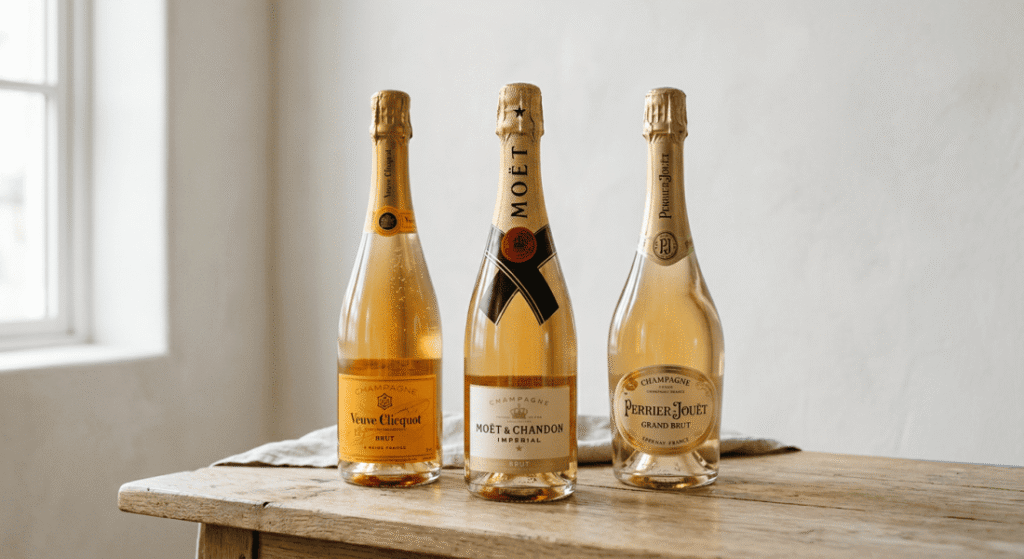
This is where things get a little less fixed. So, how many ml is a glass of wine? In the United States, a standard glass is 5 oz, which is about 150 ml. That’s the figure most restaurants, health guidelines, and event planners use.
So if you’ve been asking how many ml in a glass of wine, 150 ml is a safe starting point. The same goes if you’re working out how many millilitres in a glass of wine using British spelling, or how many milliliters in a glass of wine using the American one.
The Standard Wine Pour in the US
A standard wine pour in the US is 5 oz (about 148 ml, usually rounded to 150 ml). This pour has a practical basis. At around 12% alcohol, 5 oz of wine contains roughly the same amount of alcohol as 1.5 oz of 40% spirits or 12 oz of regular beer. That’s why it’s used as the “standard drink” measurement.
If someone asks you how many ml is in a glass of wine at a typical American restaurant, 150 ml is the answer. The same goes for how many mils in a standard glass of wine and how many ml is standard glass of wine. You’ll often see the glass of wine ml figure listed as 150 on menus and in drink guides.
Pour Sizes in the UK and Europe
Outside the US, the numbers shift. In the UK, bars often offer three sizes:
|
Pour Name |
Glass of Wine in ML |
Glasses per 750 ml Bottle |
|
Small |
125 ml |
6 |
|
Standard (medium) |
175 ml |
about 4.3 |
|
Large |
250 ml |
3 |
That means the glass of wine milliliters you get in London may be quite different from what you get in New York. A large UK pour puts 250 ml in glass, which is one-third of the whole bottle. If you’re writing a menu or planning stock for a venue, it’s important to list the glass of wine in ml so customers know exactly what they’re paying for.
Tasting Pours and Restaurant Pours
Not every pour is a full glass. Wineries and tasting rooms often use 60 to 90 ml (2 to 3 oz) per sample. That lets guests try several wines without drinking too much. On the other hand, some restaurants pour 6 oz (about 180 ml) to make a glass look more generous.
So when you ask how many ml in glass of wine, think about the setting. A tasting room, a casual bar, and a fine dining restaurant may all give you a different ml glass of wine.
Converting 1 Glass to ML
If you need to convert 1 glass to ml for a recipe or a planning sheet, use these defaults:
1 glass of wine = 150 ml (US) or 175 ml (UK)
1 flute of champagne = 120 ml
1 shot of spirits = 44 ml (US)
It’s worth keeping in mind that asking how many ml in a glass only makes sense once you know the drink. A glass of water, a glass of wine, and a glass of beer all hold very different amounts. When people search how many mils is a glass of wine, how many mls is a glass of wine, or mls in glass of wine, they’re almost always looking for that 150 ml figure. The ml in glass of wine you serve at home can be anything you like, but 150 ml is the benchmark. That ml in a glass of wine figure is also a useful habit if you’re keeping an eye on how much you drink.
Wine Glass Size vs Pour Size: Why They Are Not the Same
One of the most common mix-ups is thinking a full wine glass equals one serving. It doesn’t. Your wine glass size and your pour size are two different things.
How Big Are Wine Glasses?
How big are wine glasses, really? Most modern glasses hold far more than a standard pour. Here are some typical capacities:
|
Glass Type |
Typical Wine Glass Volume |
Common Pour |
|
White wine glass |
240–350 ml (8–12 oz) |
150 ml |
|
Red wine glass |
350–450 ml (12–15 oz) |
150 ml |
|
Bordeaux glass |
550–650 ml (18–22 oz) |
150–180 ml |
|
Champagne flute |
180–250 ml (6–8 oz) |
120 ml |
|
Dessert wine glass |
120–180 ml (4–6 oz) |
60–90 ml |
The average size of a wine glass today is about 350 ml (12 oz). So if you’re asking wine glass how many ml, the honest answer is “it depends on the glass,” but most land somewhere between 250 and 450 ml.
Why Glasses Are Bigger Than the Pour
The extra space has a purpose. A large bowl lets the wine breathe and gives you room to swirl, which releases aroma. That’s why a standard pour fills only about a third of a red wine glass. When someone asks how many ml wine glass holds versus how much should go in it, the gap can be two or three times.
El wine glass volume also affects how much people drink. Studies on serving behavior have found that people tend to pour more into larger glasses without noticing. If you run a bar or plan an event, choosing a smaller glass can help you control pours and costs.
Dimensions of Wine Glass Types
If you’re buying glassware or designing packaging, the dimensions of wine glass shapes are useful to know. A typical red wine glass stands about 20–23 cm (8–9 inches) tall, with a bowl about 9–10 cm (3.5–4 inches) across at its widest point. White wine glasses are usually a little shorter and narrower. Flutes are tall and slim, often 22–25 cm (9–10 inches) high, which helps keep bubbles longer.
For a practical measurement of wine glass pours, fill to the widest part of the bowl. That usually lands close to 150 ml in a standard red glass. If you want accuracy, use a jigger or a marked pour line. Many bars use a simple measure of wine glass pours, such as a small line etched on the glass, to keep every serving the same.
How Many Glasses of Wine in a Bottle? A Size-by-Size Breakdown
Now that you know the pour and the bottle volume, let’s answer the main question for each size. How many glasses of wine in a bottle? For a standard 750 ml bottle, it’s five 150 ml glasses.
The Standard 750 ml Bottle
How many glasses in a wine bottle of the standard size? Five, at a 5 oz pour. That is the most common answer you’ll see, and it’s the one most event planners use. So how many glasses in a 750ml wine bottle is easy to remember: five.
But pour size changes the count. How many 6 oz glasses in a bottle of wine? Divide 25.4 oz by 6, and you get just over four. So if your restaurant pours 6 oz, plan on four servings per bottle with a little left over. Anyone asking how many 6 oz glasses of wine in a bottle should expect four, not five. This small difference adds up fast when you’re ordering for a large venue.
In short, how many servings in a wine bottle depends on your pour:
4 oz (120 ml) pour: about 6 glasses
5 oz (150 ml) pour: 5 glasses
6 oz (180 ml) pour: about 4 glasses
250 ml pour: 3 glasses
The 187 ml Split (Piccolo)
The smallest common wine bottle is 187 ml. How many oz in 187 ml? About 6.3 fluid ounces. How big is 187 ml in real terms? It’s a quarter of a standard bottle, or one generous glass. You’ll often see these small bottles on airlines, in hotel minibars, and in gift sets. They’re also popular for sparkling wine at events because each guest gets a fresh, sealed bottle.
The 375 ml Half Bottle
How many glasses in a half bottle of wine? About two and a half glasses at a 5 oz pour. If you’re wondering half a bottle of wine is how many glasses in practice, think of it as two good glasses for a couple sharing dinner. Half bottles are common for dessert wines and for restaurants that want to offer something between a glass and a full bottle.
The 500 ml Bottle
Some wines, especially sweet and specialty styles, come in 500 ml bottles. 500 ml of wine is how many glasses? About three and a third at 150 ml, so plan on three full glasses.
The 1 Liter Bottle
How many glasses of wine are in a liter? About six and a half to seven at a 150 ml pour. Liter bottles are popular for everyday table wine in Europe and offer good value for casual gatherings.
The 1.5 Liter Magnum
The magnum causes more confusion than any other size, so here’s the full picture.
How many bottles of wine in 1.5 liters? Exactly two standard bottles. So if you’re asking how many bottles of wine is 1.5 liters or how many bottles of wine in 1.5 l, the answer is two 750 ml bottles.
That makes the glass count simple. How many glasses of wine in a 1.5 liter bottle? Ten glasses at 150 ml. Whether you search how many glasses of wine in 1.5 liters, how many glasses of wine in 1.5 l, or how many glasses of wine in a 1.5 l bottle, the answer stays at ten. People who type 1.5 liter bottle of wine how many glasses or how many glasses of wine in a bottle 1.5 liter into Google are after the same number. Shorter versions like how many glasses of wine in 1.5 l bottle and 1.5 l of wine is how many glasses come back to ten too.
The 1.5 L bottle has a name: the magnum. So how many glasses in a magnum of wine? Ten standard glasses. How many glasses of wine are in a magnum if you pour 6 oz? About eight. And how many glasses of wine in a magnum for a tasting at 3 oz? Around 16.
Many wine lovers believe wine ages more slowly and gracefully in magnums, because there’s less air in the neck relative to the volume of wine. Magnums also look impressive on a table, which is why they’re a favorite for celebrations. So if someone asks you how many glasses in a magnum, you can confidently say ten.
Large-Format Bottles
How many glasses of wine are in the bigger bottles? Here’s a guide to the larger wine bottle sizes you may come across:
|
Bottle Name |
Volume |
Equal to Standard Bottles |
150 ml Glasses |
|
Split / Piccolo |
187.5 ml |
1/4 |
about 1 |
|
Half / Demi |
375 ml |
1/2 |
2.5 |
|
Standard |
750 ml |
1 |
5 |
|
Magnum |
1.5 L |
2 |
10 |
|
Jeroboam |
3 L |
4 |
20 |
|
Rehoboam |
4.5 L |
6 |
30 |
|
Methuselah |
6 L |
8 |
40 |
|
Salmanazar |
9 L |
12 |
60 |
|
Balthazar |
12 L |
16 |
80 |
|
Nebuchadnezzar |
15 L |
20 |
100 |
Keep in mind that naming can vary by region. In Bordeaux, for example, a Jeroboam may refer to a 4.5 L or 5 L bottle, and a 6 L bottle is often called an Imperial. If exact volume matters, always check the label.
How Many Shots in a Liquor Bottle?
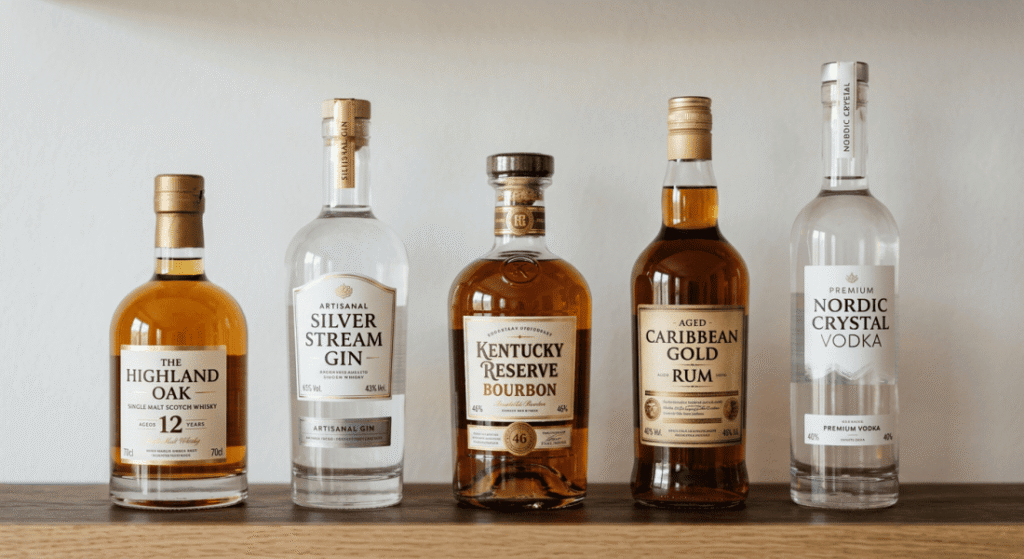
Spirits work the same way as wine, but with a much smaller pour. How many shots in a bottle? It depends on the bottle size and the standard liquor pour.
What Is a Standard Liquor Pour?
In the US, a standard shot is 1.5 oz, or about 44 ml. In the UK, a single measure is usually 25 ml or 35 ml, depending on the venue. Cocktails often use 1.5 to 2 oz of base spirit, and a “double” is typically 3 oz.
Common Liquor Bottle Sizes
Here are the most common liquor bottle sizes and how many 1.5 oz shots each one gives you:
|
Bottle Name |
Volume |
Ounces |
1.5 oz Shots |
|
Miniature |
50 ml |
1.7 oz |
1 |
|
Half pint |
200 ml |
6.8 oz |
4 |
|
Pint |
375 ml |
12.7 oz |
8 |
|
Fifth |
750 ml |
25.4 oz |
about 17 |
|
Liter |
1 L |
33.8 oz |
about 22 |
|
Handle |
1.75 L |
59.2 oz |
about 39 |
How many shots in a 750ml bottle? About 17 standard shots. The bottle is often called a “fifth” because it’s close to one-fifth of a US gallon.
How many shots in a liter bottle? About 22. Liter bottles are common in bars and duty-free shops.
How many shots in a handle? About 39. The 1.75 L handle gets its name from the built-in grip on the bottle, and it’s a popular size for parties and high-volume bars.
How Many Cocktails Can You Make?
How many drinks in a bottle of liquor also depends on your recipe. If each cocktail uses 1.5 oz, a 750 ml bottle makes about 17 drinks. If you use 2 oz per drink, you’ll get about 12. For a party, it’s smart to count the base spirit in each recipe and plan from there.
How Many Glasses in a Champagne Bottle?
Sparkling wine is usually served in smaller pours than still wine, so you get more servings per bottle.
Champagne Pour Size
A typical champagne pour size is 4 oz (about 120 ml). Flutes are narrow and tall, so a 4 oz pour fills them nicely while leaving room for the bubbles. For a toast, many hosts pour less, around 2 to 3 oz.
So how many glasses in a champagne bottle? About six at a 4 oz pour. And how many flutes in a bottle of champagne for a toast with smaller pours? Around eight.
Champagne Bottle Sizes
Most champagne bottle sizes follow the same names as wine, with a few extra small formats:
|
Bottle Name |
Volume |
4 oz Flutes |
|
Piccolo / Split |
187.5 ml |
1–2 |
|
Demi |
375 ml |
3 |
|
Standard |
750 ml |
6 |
|
Magnum |
1.5 L |
12 |
|
Jeroboam |
3 L |
25 |
|
Rehoboam |
4.5 L |
37 |
|
Methuselah |
6 L |
50 |
How Much Champagne for a Toast?
If you’re wondering how much champagne for a toast, plan on one standard bottle for every eight guests, assuming a 3 oz toast pour. For 100 guests, that’s about 13 bottles. If you expect people to keep drinking champagne after the toast, double that number.
How to Estimate Bottles for Parties, Weddings, and Events
Here’s where all of this becomes practical. The question of how many servings in a bottle turns into “how many bottles do I need?”
A Simple Event Formula
Use this formula as your starting point:
Bottles needed = (Number of guests × Drinks per guest) ÷ Servings per bottle
A common rule is one drink per guest per hour.
How Many Bottles of Wine for a Party?
How many bottles of wine for a party? For a three-to-four-hour evening where wine is the main drink, plan on about one bottle for every two guests. Here’s a quick guide:
|
Guests |
Bottles of Wine (3–4 hour party) |
|
10 |
5–6 |
|
25 |
12–15 |
|
50 |
25–30 |
|
100 |
50–60 |
How Much Wine for a Wedding?
How much wine for a wedding depends on the length of the reception and what else you’re serving. Here’s an example. You have 100 guests and a five-hour reception. At one drink per guest per hour, that’s 500 drinks. If half of those drinks are wine, you need 250 glasses. At five glasses per bottle, that’s 50 bottles.
Many planners split wine by color, such as 60% red and 40% white, but you should adjust based on your menu, the season, and your guests’ habits. It’s always better to have a few extra bottles than to run out. Unopened bottles can often be returned, depending on your supplier.
Why Bottle Size Matters for Beverage Brands and Hospitality Businesses
If you run a winery, distillery, bar, or beverage brand, these numbers go beyond party planning. Bottle size affects your costs, your pricing, and how customers see your product.
Inventory and Cost Control
When you know exactly how many servings come from each bottle, you can calculate your pour cost. If a 750 ml bottle costs you $20 and you pour five glasses, each glass costs $4. Without this math, it’s easy to underprice drinks or lose money to over-pouring.
Choosing Sizes for Your Sales Channels
Different channels suit different bottle sizes:
Retail shelves: 750 ml is the norm for wine and spirits.
Bars and restaurants: 1 L and 1.75 L bottles lower the cost per pour.
Hotels and airlines: 50 ml, 187 ml, and 200 ml formats work well for single servings.
Gifting and celebrations: Magnums and large formats stand out.
Sampling and trial packs: Small bottles let customers try your product at a low cost.
Brand Image and Customer Experience
The bottle is often the first thing a customer sees. Shape, weight, color, and finish all send a message about your product. A heavy, tall wine bottle suggests a premium product. A slim, clear spirits bottle can look modern and clean. Smaller sizes make it easier for new customers to try your product without much risk.
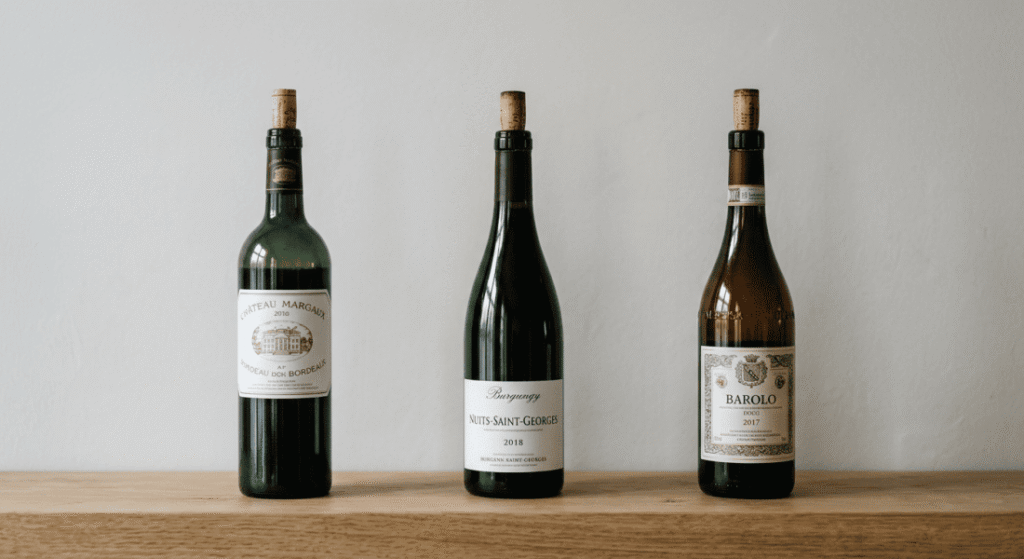
wine glass bottles
Choosing the Right Glass Bottle Supplier
If you’re developing a beverage line, the bottle you choose plays a big part in your product’s success. Here are a few things to think about before you place an order.
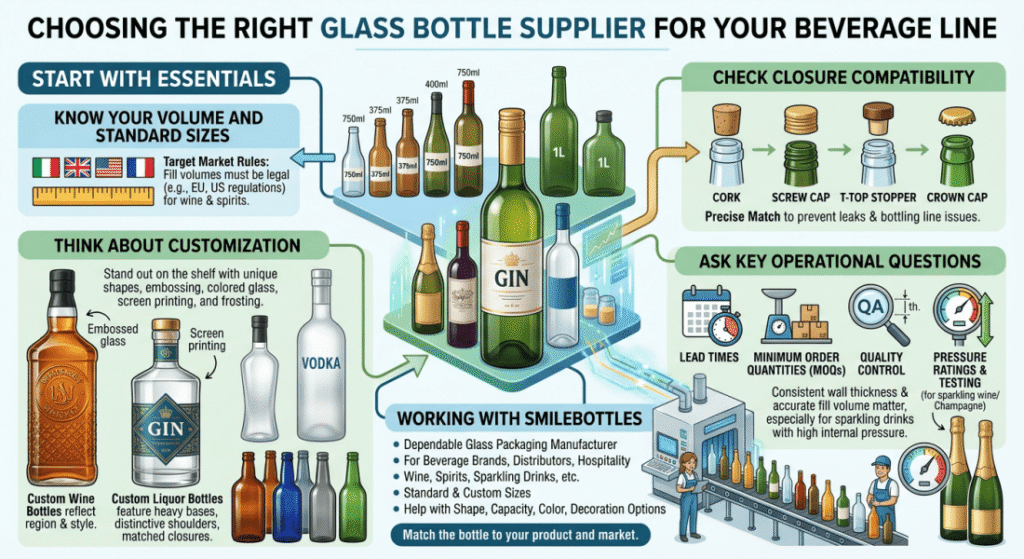
Know Your Volume and Standard Sizes
Start with your target market’s rules. Many countries only allow certain fill volumes for wine and spirits. Make sure the bottle size you pick is legal where you plan to sell.
Think About Customization
Custom glass bottles can help your product stand out on a crowded shelf. Common options include unique shapes, embossed logos, colored glass, screen printing, and frosting. If you make wine, custom wine bottles can reflect your region, style, or story. For distilleries, custom liquor bottles often feature heavy bases, distinctive shoulders, and closures that match the brand.
Check Closure Compatibility
Your bottle neck needs to match your closure, whether it’s a cork, screw cap, T-top stopper, or crown cap. Mismatches can cause leaks or slow down your bottling line.
Ask About MOQs, Lead Times, and Quality Control
When you’re comparing wholesale glass bottles, ask suppliers about minimum order quantities, production lead times, and how they check quality. Consistent wall thickness and accurate fill volume matter, especially for sparkling wine, which needs bottles that can handle high internal pressure. If you’re sourcing champagne bottles wholesale, ask about pressure ratings and testing.
Working With Smilebottles
At Smilebottles, we work with beverage brands, distributors, and hospitality businesses that need dependable glass packaging. As a fabricante de botellas de vidrio, we produce bottles for wine, spirits, sparkling drinks, and other beverages, in both standard and custom sizes. If you’re looking for a beverage bottle manufacturer that can help with shape, capacity, color, and decoration options, our team is happy to talk through your project and help you match the bottle to your product and market.
Preguntas frecuentes: Preguntas frecuentes Acerca de How Many Glasses Does Each Bottle Size Serve?
P1:How many glasses are in a bottle of wine?
A1:How many glasses are in a bottle of standard wine? About five, based on a 750 ml bottle and a 150 ml pour.
Pregunta 2:How many glasses of wine are in a 1.5 liter bottle?
A2:Ten glasses at a 150 ml pour. A 1.5 L bottle is a magnum and holds the same amount as two standard bottles.
Pregunta 3:How many ml is a standard wine glass?
A3:A standard serving is 150 ml in the US. As for how many ml in a standard wine glass in terms of total capacity, most glasses hold 350 to 450 ml, but you should only fill them about a third of the way.
Pregunta 4:How many shots are in a 750 ml bottle?
A4:About 17 shots at 1.5 oz each.
Pregunta 5:How many flutes of champagne come from one bottle?
A5:About six flutes at 4 oz, or around eight smaller toast pours.
Pregunta 6:How many glasses of wine are in a liter?
A6:About six and a half to seven glasses at 150 ml.
P7:Does glass size change the number of servings?
A7:Not directly. The number of servings depends on how much you pour, not how big the glass is. A larger glass can lead to bigger pours, though, so you may get fewer servings in practice.
Conclusión
These numbers help you buy the right amount for a party or wedding, price drinks fairly in a bar, and choose bottle sizes that suit your sales channels if you run a beverage brand. If you’re planning a new product line and need help choosing the right bottle, feel free to contact Smilebottles. We’re glad to help you find a bottle size and style that fits your product.