
Índice
AlternarAutor: Equipo editorial de SmileBottles
Tiempo estimado de lectura: Aproximadamente 16 minutos
If you’re planning a new sparkling wine line or switching suppliers, bottle weight probably isn’t the first thing on your list. Most buyers start with shape, color, and price. But weight affects almost every later decision: how much you pay to ship, how many bottles fit on a pallet, how the bottle handles pressure, and how your customers feel when they pick it up.
So, how much does a bottle of champagne weigh? The short answer is that it depends on whether you mean the empty glass or the finished, filled product, and on the size and design of the bottle. This guide walks you through the numbers, explains why champagne bottles weigh more than ordinary wine bottles, and helps you work out which weight makes sense for your product and budget.
The Short Answer: Typical Champagne Bottle Weights
Here are the figures most buyers need:
Empty 750ml champagne bottle: usually about 835g to 1,000g. Some lightweight sparkling wine bottles come in under 800g, and some premium designs go well over 1kg.
Full 750ml bottle of champagne: roughly 1.6kg to 1.8kg (about 3.5 to 4 lb). That includes the wine, cork, wire cage, foil, and label.
Magnum (1.5L): the empty bottle is often around 1.7kg to 1.9kg, and a full magnum can be close to 3.5kg.
Keep in mind that these are general ranges. The actual champagne bottle weight you get will depend on the mold, the glass distribution, and the specification you agree on with your supplier. Two 750ml bottles that look almost the same can still be 100g or more apart.

Why Are Champagne Bottles So Heavy?
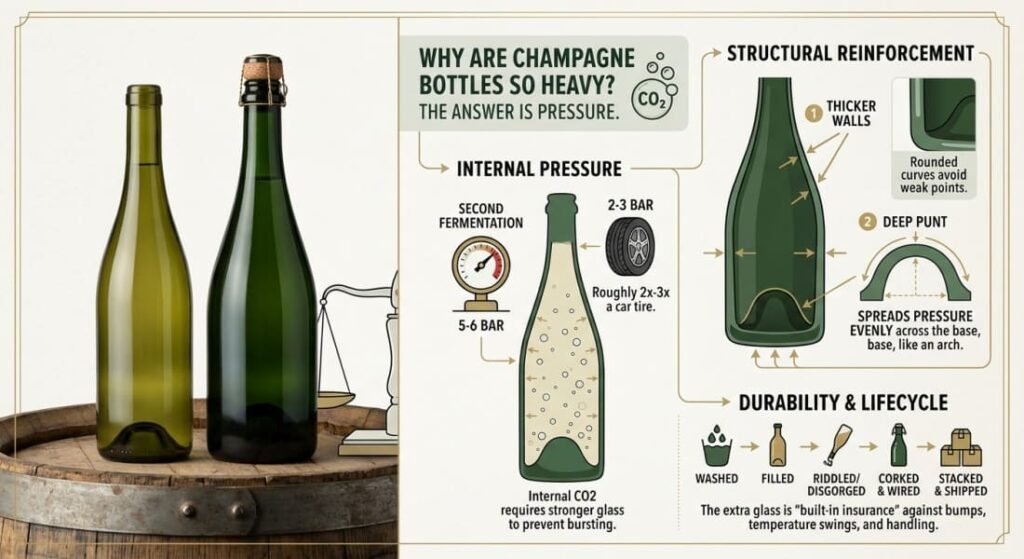
A lot of buyers ask the same thing: why are champagne bottles so heavy compared with the still wine bottles they already use? The answer is pressure.
Internal Pressure Requires Stronger Glass
Champagne and other traditional-method sparkling wines go through a second fermentation inside the bottle. That process produces carbon dioxide, and the gas stays trapped in the wine. A finished bottle of champagne usually holds around 5 to 6 bar of pressure. That’s roughly two to three times the pressure in a car tire.
A standard still wine bottle simply isn’t built for that. Under that kind of force, thin glass can crack or burst, and that’s a real safety risk for workers on the bottling line, warehouse staff, and the people opening the bottle at home. To handle it, champagne bottles use thicker glass, and thicker glass means more weight. Good sparkling wine bottles are designed to withstand far more pressure than they’ll ever hold in normal use, which gives you a safety margin during transport, temperature changes, and handling.
Thicker Walls and a Deeper Punt Add Strength
Pressure doesn’t push evenly on every part of a bottle. The base and shoulder take a lot of stress, so manufacturers put extra glass in those areas. You’ll also notice that most champagne bottles have a deep punt, which is the indent in the bottom. The punt helps spread the pressure more evenly across the base, much like an arch spreads weight in a bridge.
The rounded shoulders and smooth, gradual curves on a classic champagne bottle aren’t just for looks either. Sharp angles create weak points, so sparkling wine bottles tend to avoid them.
The Bottle Needs to Survive More Than Just Filling
Your bottles go through a lot before they reach a shelf. They’re washed, filled, riddled (if you use the traditional method), disgorged, corked, wired, packed, stacked, and shipped, sometimes across oceans. Each step brings bumps, temperature swings, and stacking loads. The extra glass helps the bottle survive all of that without failing. When you look at it this way, the weight isn’t wasted material. It’s built-in insurance.
Empty vs. Full: Understanding the Difference
When you search for the weight of a champagne bottle, you’ll find numbers that seem to disagree. That’s usually because some sources mean the empty glass and others mean the finished, filled bottle. As a buyer, you need both figures, but you’ll use them for different things.
Empty Champagne Bottle Weight
The empty champagne bottle weight is the number that matters most when you’re talking to glass suppliers. It affects the unit price of the bottle (more glass usually costs more), how much empty glass you can fit in a truck or container, and how the bottle performs under pressure.
For a 750ml champagne bottle, you’ll commonly see weights around 835g, 900g, and 1,000g or more. The 835g figure is worth knowing. Several years ago, the Champagne region moved toward a lighter standard bottle to cut carbon emissions, and many producers adopted it without any loss in safety. That shows there’s room to reduce weight when the bottle design is done well. Lighter sparkling wine bottles used for some Prosecco or Cava-style products can be lower still, depending on the pressure they need to hold.
How Much Does a Full Bottle of Champagne Weigh?
Now for the other side: how much does a full bottle of champagne weigh? Take a 900g empty bottle and add:
About 750g of wine (sparkling wine weighs close to the same as water)
Around 10g for the cork
A few grams for the wire cage (muselet) and metal cap
A few grams for the foil capsule and labels
That brings you to roughly 1.65kg to 1.7kg. A heavier premium bottle can push the total above 1.8kg. In pounds, most full 750ml bottles land somewhere around 3.5 to 4 lb.
Why the Difference Matters for You
The empty weight shapes your glass cost and inbound freight. The full weight shapes everything that happens after filling: case weight, pallet weight, outbound shipping cost, and even how much your distributors pay to move your product. A case of 12 full bottles typically weighs somewhere between 19kg and 22kg once you include the carton and dividers. If you’re shipping thousands of cases, a difference of 100g per bottle quickly adds up to tons of extra weight.
Champagne Bottle Weight by Size and Format
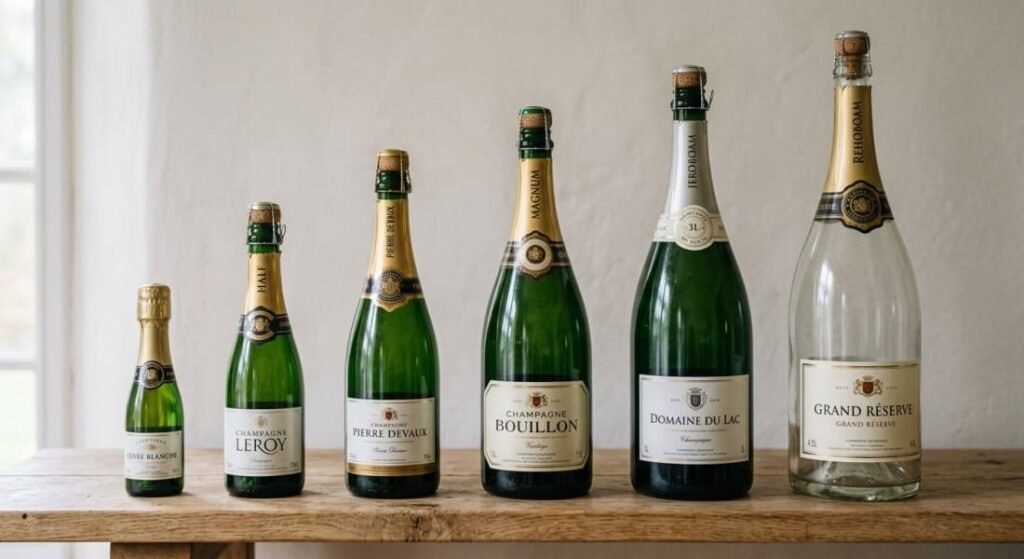
Champagne comes in many sizes, from single-serve minis to huge formats used mainly for celebrations and display. Here’s a general guide to what you can expect. Treat these as approximate figures, since actual weights vary by design and manufacturer.
|
Bottle Size |
Common Name |
Approx. Empty Weight |
Approx. Full Weight |
Typical Use |
|
187.5ml / 200ml |
Piccolo / Split |
300g–400g |
500g–600g |
Single servings, airlines, events, gift sets |
|
375ml |
Half Bottle |
500g–650g |
900g–1,050g |
Restaurants, smaller retail packs |
|
750ml |
Standard |
835g–1,000g+ |
1.6kg–1.8kg |
Main retail and on-trade format |
|
1.5L |
Magnum |
1.7kg–1.9kg |
3.2kg–3.5kg |
Premium releases, aging, celebrations |
|
3L |
Jeroboam |
3.5kg–4.5kg |
6.5kg–7.5kg |
Special events, display, luxury gifting |
187ml Champagne Bottles
Small bottles have a higher glass-to-wine ratio, so they feel heavier for their size. They still have to hold the same pressure as a full-size bottle. If you’re targeting airlines, hotels, or event packs, weight per serving is worth checking because it affects shipping cost per drink.
375ml Champagne Bottles
Half bottles are popular with restaurants and buyers who don’t want to open a full bottle. They’re lighter to ship, but the cost per milliliter of glass is higher than a 750ml.
750ml Standard Champagne Bottles
This is the format most of your volume will probably go into. The standard champagne bottle weight varies more than many buyers expect. You’ll find lightweight, standard, and heavy versions of what looks like the same basic shape. This is where your choice of specification has the biggest impact on cost.
Magnum Champagne Bottles
Many winemakers say champagne ages better in magnums because of the ratio of wine to air in the neck. Magnums use much thicker glass and need careful packaging. They’re also heavy enough that case sizes are usually smaller, often 3 or 6 bottles.
Larger Formats
Jeroboams and bigger bottles are mostly made in small runs. They’re heavy, harder to fill on standard lines, and usually need custom packaging. If you plan to offer these, talk to your supplier early about lead times and minimum orders.
What Factors Affect Champagne Bottle Weight?
If you’re comparing quotes from different suppliers, you’ll see different weights for bottles that seem similar. Here’s what’s behind those differences.
Bottle Size and Capacity
This one is obvious, but it’s worth stating. More wine means a bigger bottle, more glass, and more weight. The relationship isn’t perfectly linear, though. A magnum doesn’t always weigh exactly twice what a 750ml bottle does, because wall thickness and base design change with size.
Glass Thickness and Pressure Rating
The pressure your wine will hold is a major factor. A traditional-method champagne at 6 bar needs a stronger bottle than a lightly sparkling wine at 2.5 bar. If your product is low-pressure, you may be able to use a lighter bottle. Just make sure you confirm the pressure rating with your supplier before you make that call.
Shape and Base Design
A deep punt adds glass. A thick, heavy base adds even more. Some premium bottles are designed with extra-heavy bottoms because they feel solid in the hand. Slimmer or more unusual shapes may need extra glass in certain spots to stay strong.
Glass Distribution
This is less visible but very important. Two bottles can have the same total weight, but one may have the glass spread evenly while the other has thin spots. Even distribution is what actually makes a bottle strong. A well-made lighter bottle can perform better than a poorly made heavier one.
Decoration and Surface Treatment
Embossing, debossing, and raised logos add a small amount of glass. Coatings, frosting, and printing add very little weight but can affect handling and scratch resistance. If you’re ordering custom champagne bottles with heavy embossing, expect the weight to change slightly from the standard version.
Custom Molds and Design Requirements
When you create a unique bottle, the mold design determines how the glass flows and where it ends up. A good custom champagne bottle manufacturer will help you balance your design ideas with what the glass actually needs to stay safe under pressure. Sometimes a small change to the shoulder or base can save a noticeable amount of weight.
Does a Heavier Champagne Bottle Mean Better Quality?
Not necessarily. This is one of the most common assumptions in the wine packaging world, and it’s worth thinking through carefully.
Why Heavy Bottles Feel Premium
People link weight with value. When your customer picks up a heavy bottle, it feels expensive and well made. That’s why many luxury brands still choose heavy glass, and it’s a fair choice if your brand depends on that first impression on the shelf or at the table.
Why Weight Alone Doesn’t Tell You Much
From a technical point of view, bottle quality comes down to things like:
Even glass distribution
Consistent dimensions, especially at the neck and finish
Proper annealing (how the glass is cooled to remove stress)
Passing pressure and impact tests
A smooth, defect-free surface
A heavy bottle with uneven walls or stress in the glass can fail sooner than a lighter bottle that was made with tight quality control. So when you compare bottles, ask about test results and quality checks, not just weight.
Match the Weight to Your Brand
Think about who buys your product and what they expect. A prestige cuvée sold in fine dining restaurants is a very different product from a sparkling wine sold in high volume through supermarkets. One may benefit from a heavy, impressive bottle. The other may benefit more from savings on glass and freight.
How Champagne Bottle Weight Affects Bulk Buying and Shipping Costs
If you’re buying bulk champagne bottles, weight stops being a small detail and becomes a real line item in your budget.
Freight and Container Costs
Freight is usually priced by weight, volume, or both. Shipping containers and trucks have weight limits. With heavy glass, you may hit the weight limit before you fill the space, which means you pay to ship partly empty containers. Over a year of orders, the difference between an 835g bottle and a 1kg bottle can be significant, both for the empty glass coming to you and the full bottles going out.
Pallet Weight and Warehouse Handling
Heavier bottles mean heavier pallets. That affects how high you can stack, what equipment you need, and how your warehouse team handles the load. Some distributors and retailers also have limits on case weight for staff safety. It’s worth checking those limits before you lock in a heavy bottle.
Breakage and Protective Packaging
Heavier glass is often more resistant to impact, but it also hits harder when something goes wrong. A dropped case of heavy bottles can do more damage to surrounding cases. Your packaging, including dividers, cartons, and pallet wrap, needs to suit the weight of the bottle. Plan the bottle and the packaging together rather than separately.
Sustainability and Carbon Footprint
Glass production uses a lot of energy, and moving heavy glass burns more fuel. Cutting bottle weight is one of the simplest ways a winery can reduce its carbon footprint. More retailers and importers are asking about packaging emissions, and in some markets, lighter bottles are becoming part of buying requirements. If sustainability matters to your customers, a lighter bottle gives you something real to talk about.
glass champagne bottles
How to Choose the Right Champagne Bottle Weight for Your Product
There’s no single right answer. The best choice depends on your brand, your market, and how your product moves through the supply chain. Here’s how to think about it.
If You Run a Premium or Luxury Brand
A heavier bottle can support your price point and give a strong sense of quality. Still, you don’t have to go to the extreme. A well-designed bottle around 900g to 1kg with good finishing, a clean shape, and quality decoration can feel just as premium as a much heavier one. Put your budget into details your customer will actually notice.
If You Sell in High Volume
For everyday sparkling wines, the savings from a lighter bottle add up quickly. A lighter standard bottle, as long as it’s properly rated for your wine’s pressure, can cut both glass and freight costs. Ask your supplier for lightweight options that still meet your pressure needs.
If You Export Your Wine
Long-distance shipping makes weight even more important. You need a bottle that’s strong enough for long transit times, temperature changes, and multiple handling points, but not so heavy that freight eats your margin. Many exporters land on a mid-range weight with strong packaging as the best balance.
If Sustainability Is Part of Your Brand Story
Choose the lightest bottle that safely handles your wine’s pressure. Ask about recycled glass content too. Lighter bottles combined with recycled content give you a stronger and more honest sustainability message.
Don’t Forget Your Filling Line
Whatever weight you choose, the bottle must work with your equipment. Check the neck finish (cork finish or crown finish), height, diameter, and base shape with your bottling team before ordering. A bottle that’s slightly off in size can cause jams, slow your line, or affect the seal.
Common Misunderstandings About Champagne Bottle Weight
“Heavier Always Means Better”
As covered above, strength comes from good design and good manufacturing, not just more glass. A properly made lighter bottle can be just as safe.
“All 750ml Champagne Bottles Weigh the Same”
They don’t. Weights for 750ml sparkling bottles can range from under 800g to well over 1.1kg. Always ask for the exact weight and tolerance in writing when you request a quote.
“Bottle Weight Only Affects Appearance”
Weight affects your glass cost, shipping cost, storage, line performance, safety, and environmental impact. It’s a business decision as much as a design decision.
“I Can Change the Weight Later Without Problems”
Switching bottle weight can affect your labels, cartons, filling line settings, and even how your product looks on the shelf. It’s easier and cheaper to get the specification right from the start.
How to Evaluate a Champagne Bottle Manufacturer
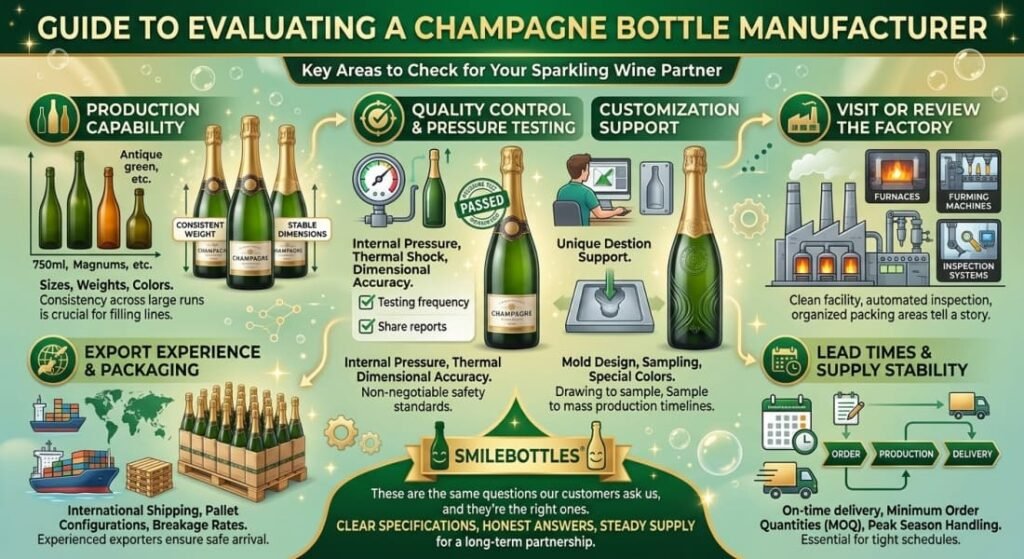
Once you know what you need, the next step is finding the right partner. Whether you’re looking for wholesale champagne bottles in standard designs or a fully custom bottle, these are the areas to check.
Look at Production Capability
Ask whether the champagne bottle manufacturer you’re considering can produce the sizes, weights, and colors you need, and whether they can keep the weight consistent across large runs. Consistency matters a lot. If one batch comes in heavier or lighter than the last, it can affect your costs and your filling line.
Ask About Quality Control and Pressure Testing
For sparkling wine, this is non-negotiable. Ask how the bottles are tested for internal pressure, thermal shock, and dimensional accuracy. Ask how often they test and whether they can share reports. A reliable champagne bottle supplier won’t hesitate to answer these questions in detail.
Check Customization Support
If you want a unique shape, embossed logo, special color, or decoration, check whether the supplier can handle mold design and sampling. Ask how long it takes to go from drawing to sample, and from sample to mass production. Good suppliers will also tell you honestly when a design idea won’t work under pressure.
Visit or Review the Factory
If you can, visit the champagne bottle factory or ask for a video tour. You’ll learn a lot from seeing how the furnaces, forming machines, inspection systems, and packing areas are run. A clean, organized facility with automated inspection is usually a good sign.
Review Export Experience and Packaging
If the bottles are shipping internationally, ask how they’re packed, what pallet configurations are available, and what the typical breakage rate is on arrival. Experienced exporters will have clear answers and proven packing methods.
Confirm Lead Times and Supply Stability
Sparkling wine production runs on tight schedules. Make sure your supplier can deliver on time, especially for repeat orders. Ask about minimum order quantities, typical lead times, and how they handle peak season demand.
At Smilebottles, these are the same questions our customers ask us, and they’re the right ones to ask any supplier. Clear specifications, honest answers about weight and pressure, and steady supply are what make a long-term partnership work.
Preguntas frecuentes: Frequently Asked Questions About Champagne Bottle Weight
P1:How much does an empty champagne bottle weigh?
A1:A standard empty 750ml champagne bottle usually weighs between about 835g and 1,000g. Lightweight sparkling wine bottles can be lower, and premium designs can be higher.
Pregunta 2:How much does a full 750ml champagne bottle weigh?
A2:A full 750ml bottle of champagne typically weighs around 1.6kg to 1.8kg (about 3.5 to 4 lb), including the wine, cork, cage, foil, and label.
Pregunta 3:Why is a champagne bottle heavier than a regular wine bottle?
A3:Champagne holds about 5 to 6 bar of internal pressure from carbon dioxide. The bottle needs thicker glass and a stronger base to hold that pressure safely. Still wine bottles don’t face that pressure, so they’re often 400g to 600g.
Pregunta 4:Does a heavier champagne bottle mean better quality?
A4:Not always. Bottle quality depends on even glass distribution, proper cooling, consistent dimensions, and pressure testing. Weight mostly affects how premium the bottle feels and how much it costs to ship.
Pregunta 5:Do all champagne bottles weigh the same?
A5:No. Weight changes with size, shape, base design, decoration, and manufacturer. Even two 750ml bottles of similar appearance can differ by 100g or more.
Pregunta 6:How much does a magnum of champagne weigh?
A6:An empty magnum usually weighs around 1.7kg to 1.9kg. Full, it’s typically about 3.2kg to 3.5kg.
Conclusión
The right choice comes down to a few questions. What pressure does your wine hold? How do you want your brand to be seen? Where are your bottles going, and how far? How much does freight cost you today? What does your filling line need?
Once you have those answers, you can work with your supplier to find a bottle that’s strong enough, looks right, and doesn’t cost more than it should. Ask for clear specs, request samples, and test them on your own line before you place a large order. Taking a little extra time at this stage can save you a lot of money and trouble later.