Índice
AlternarAutor: Equipo editorial de SmileBottles
Tiempo estimado de lectura: Aproximadamente 16 minutos
If you sell sauces, honey, juice, oils, or pickles, your packaging matters a lot. The jar or bottle protects the food, and it also shapes how customers see your brand. A good container can help a product sell. A poor one can lead to leaks, spoilage, and returns.
Glass has been used to pack food for well over a century, and it is still one of the most trusted materials on the market. In this guide, you will learn why frascos de vidrio para el empaque de alimentos y glass bottles for food packaging remain popular with food brands. You will also learn how to pick the right shape, size, color, and closure for your product, what to check before you place an order, and which mistakes cost buyers the most money.
Why Glass Works So Well for Food Packaging
Before you compare suppliers or catalogs, it helps to understand what glass actually does for your product. The benefits are practical, not just visual.
Glass Keeps Flavor and Freshness Locked In
Glass is non-porous and almost completely inert. It does not absorb odors, and it does not pass flavors into the food. A tomato sauce stays tasting like tomato sauce, even after months on a shelf. This matters most for products with strong or delicate flavors, such as cold brew coffee, infused oils, vinegar, and fruit preserves.
Glass also acts as a strong barrier against oxygen and moisture. When it is paired with a good seal, it helps slow down the quality loss that shortens shelf life. That is one reason so many food packaging glass containers are used for products that need to last a long time after filling.
Glass Is a Safe Food Contact Material
Food grade glass jars and food grade glass bottles are made mostly from sand, soda ash, and limestone. This type of glass, called soda-lime glass, is the standard for food and beverage packaging around the world. It does not contain the plasticizers that some buyers worry about with certain plastics, and it does not soften or change shape with normal use.
Keep in mind that the glass is only one part of the package. The lid, the liner inside the lid, and any coating or print on the outside also need to be safe for their intended use. We will come back to this later.
Glass Helps Your Product Look Premium
Put two jars of jam side by side, one in plastic and one in glass, and most shoppers will expect the glass one to be higher quality. Clear glass lets customers see the real color and texture of the food. That is a big advantage for products like chunky salsa, layered pickles, golden honey, or bright fruit juice. Here the product itself does part of the selling.
Glass Is Recyclable and Reusable
More buyers now look for sustainable food packaging glass because their customers and retail partners ask for it. Glass can be recycled again and again without losing quality, which makes it one of the most practical forms of recyclable glass food packaging. Many consumers also keep and reuse jars at home for storage, which gives your brand a little extra life after the product is gone.
If your brand message includes natural, organic, or low-waste values, eco friendly glass food packaging supports that message in a way customers can see and feel.

Start With Your Product, Not the Container
A lot of buyers start by browsing bottle shapes. That is a natural instinct, but it often leads to problems later. If you have ever wondered how to choose food packaging containers that actually work on your filling line and in your customers’ kitchens, the answer begins with the food itself.
Ask These Questions First
Take a few minutes to answer the following before you look at any catalog:
Is your product liquid, thick, chunky, dry, or powdered?
Will it be hot filled, cold filled, or pasteurized after sealing?
Is it sensitive to light?
Will customers pour it, scoop it, shake it, or spoon it out?
Is it carbonated or likely to build pressure?
Will you sell it in retail stores, online, or both?
Do you need tamper evidence?
How long is your target shelf life?
Your answers narrow your options very quickly. A thick honey that tends to crystallize needs a different container than a thin vinaigrette. A carbonated kombucha needs a bottle rated for pressure, which a standard sauce bottle is not.
Match the Package to How the Food Is Used
Think about the moment a customer opens your product at home. If they need a spoon, a narrow bottle will frustrate them. If they only need a few drops, a wide jar will lead to spills and waste. Good packaging feels easy to use, and that ease brings repeat purchases.

Types of Glass Containers for Food
There are many types of glass containers for food, but most products fall into a few main groups. Here is how they usually line up.
Glass Jars for Spreads, Preserves, and Pickles
Jars are the go-to choice for thick, spoonable, or chunky foods. Glass jars for jam are often short and wide, with a lug cap that seals well after hot filling. Glass jars for honey come in many shapes, including round, square, and the classic hexagon jar that many honey brands use to stand out on the shelf.
If you are looking for the best packaging for jam and honey, a wide opening is usually more important than a fancy shape. Honey can crystallize over time, and customers will want to get a spoon all the way to the bottom.
Glass jars for pickles need to be sturdy and usually larger, since pickles, olives, and preserved vegetables are often sold in family sizes. They also need a strong seal, because the brine is acidic and the product is usually heat processed.
Glass Sauce Bottles
Sauce glass bottles cover a wide range, from small woozy bottles for hot sauce to tall bottles for barbecue sauce and salad dressing. Glass bottles for sauce are often fitted with orifice reducers or drip-control inserts so customers can pour neatly. Thicker sauces need a wider neck, while thin hot sauces work best in a narrow bottle that controls the flow.
Beverage Bottles
Beverage glass bottles are used for juice, water, cold brew, plant milks, kombucha, and sparkling drinks. Glass bottles for juice are commonly made in 250ml to 500ml sizes and sealed with metal twist caps or plastic screw caps. If your drink is carbonated, make sure the bottle is designed to hold pressure. Not every beverage bottle is.
Oil and Vinegar Bottles
Oil and vinegar glass bottles are usually tall and slim, which makes pouring easy and saves shelf space. Glass bottles for oil are often made in darker glass because light speeds up oxidation, which makes oil go rancid faster. Many olive oil brands use dark green or amber glass for this reason.
Glass bottles for vinegar can be clear or tinted. Since vinegar is acidic, the closure and liner should be able to resist acid over time without breaking down or affecting taste.
Spice Jars and Small Bottles
Glass spice jars are usually small, between 50ml and 200ml, and often come with shaker tops, sifter inserts, or grinder caps. Spice glass bottles with narrow profiles fit neatly in kitchen racks and gift sets. Since spices lose aroma when exposed to air, a tight seal makes a real difference in how long they stay fresh.
Jar or Bottle: Which One Fits Your Product?
This is one of the first real decisions you will make, and getting it right saves time on everything else.
How to Choose Glass Jars for Food Packaging
If you are working out how to choose glass jars for food packaging, start with texture. Jars are best for products that are thick, chunky, layered, or meant to be scooped. They are also easier to fill when the product contains solid pieces that could clog a narrow neck.
Wide mouth glass jars for food are especially useful for nut butter, salsa, pickles, and honey. They make filling easier on your line and make the product easier to use at home. If you also want your jar to be reused, a wide mouth adds value, since customers find it more practical for storage.
You may notice that many of the best glass jars for food storage at home share the same traits as good commercial jars: a wide opening, a thick base, a lid that seals evenly, and a simple shape that is easy to clean.
How to Choose Glass Bottles for Food Packaging
When you are deciding how to choose glass bottles for food packaging, think about flow and control. Bottles suit liquids that customers pour in measured amounts, such as oil, vinegar, syrup, dressing, and drinks.
The neck size should match the thickness of your product. A thin liquid in a wide neck can splash. A thick sauce in a narrow neck will be hard to fill and even harder for customers to get out. The best glass bottles for food products balance a clean pour with efficient filling.
Choose the Right Shape and Capacity
Once you know whether you need a jar or a bottle, the next step is to choose size and shape. These choices affect your costs, your filling line, and how your product looks on the shelf.
Common Glass Container Sizes for Food Packaging
Here is a general look at common glass container sizes for food packaging:
|
Size Range |
Common Uses |
|
30ml – 100ml |
Samples, extracts, hot sauce, premium oils, gift sets |
|
100ml – 250ml |
Spices, jam, small sauces, specialty honey |
|
250ml – 500ml |
Juice, dressing, cold brew, standard sauces, oil |
|
500ml – 1000ml |
Pickles, family-size honey, sauces, olive oil |
|
Over 1000ml |
Food service, bulk pickles, catering products |
Do not forget headspace. This is the empty space between the food and the lid. It allows for expansion during heating and helps create a vacuum seal. If you pick a jar that is too large for your fill weight, the product looks underfilled and customers may feel short-changed. If the jar is too small, you will struggle to fill it cleanly at line speed.
Choose a Shape That Works in Practice
Round containers are the most common because they run smoothly on most filling and labeling lines. Square containers save shelf and carton space and give a modern look. Hexagon jars are popular for honey and gifts. Tall bottles suit oils and drinks, while short wide jars suit spreads and chunky foods.
Unusual shapes can help your brand stand out, but they often cost more to pack and ship, and they may need special change parts on your filling line. Many growing brands start with a standard shape and build their identity through the label.
Select the Right Glass Color
Glass color affects both product protection and brand image.
Clear Glass
Clear glass jars for food packaging are the most popular choice because they let customers see exactly what they are buying. They work very well for colorful products like jam, pickles, sauces, dried fruit, and juice. If your product looks good, clear glass lets it speak for itself.
Amber and Other Tinted Glass
Amber glass bottles for food block a large share of UV light. This helps protect light-sensitive products such as some oils, extracts, syrups, and specialty beverages. Green glass also offers some protection and is a traditional choice for olive oil.
Frosted or Coated Glass
Some premium brands use frosted or spray-coated glass for gift sets, seasonal editions, or high-end sauces. If you go this route, check that the coating is suitable for your filling process and will not peel or fade during washing, heating, or cold storage.

Pay Close Attention to the Finish and Closure
Many packaging failures have nothing to do with the glass itself. They happen at the neck. The “finish” is the top part of the container where the lid attaches, and it must match the closure exactly.
Common Closure Types
Most food packaging jars with lids use one of a few closure systems:
Lug caps (twist-off lids): The most common choice for jam, sauces, and pickles. They work well with hot fill and vacuum sealing.
Continuous thread (CT) caps: Simple screw caps used for many dry foods, spices, and cold-filled products.
Metal caps with a vacuum button: The button pops up if the seal is broken, which gives customers a clear sign of freshness.
ROPP and pilfer-proof caps: Often used on oil and spirit-style bottles.
Crown caps: Common for carbonated drinks.
Corks and stoppers: Used for some specialty vinegars, syrups, and gift products.
Pourers, drip-stop inserts, shakers, and grinders: Added for better control and convenience.
Glass jars with metal lids for food remain the standard for heat-processed products, because metal lugs with plastisol liners form a dependable vacuum seal. For dry goods, airtight glass jars for food packaging with a good liner keep moisture out and help coffee, tea, and spices hold their aroma.
Match the Closure to the Product
When you source glass food jars with lids, check the finish size (for example 63mm, 70mm, or 82mm lug) and make sure the lids you buy are made for that exact finish. Even a small mismatch can lead to leaks or failed seals.
The same goes for glass bottles with caps for food packaging. A juice bottle, an oil bottle, and a hot sauce bottle each need a different closure, even if the bottles look similar.
If your product is sold in retail stores, consider tamper evident caps for glass bottles. These include breakaway bands, shrink sleeves, and vacuum buttons. They reassure customers that nobody has opened the product before them, and some retailers require them.
It also makes life easier when one supplier provides both the container and the matching closure. That way you avoid the common problem of lids from one factory not quite fitting jars from another.
Confirm Food Safety and Processing Requirements
This is the step you should never rush. A beautiful jar that fails safety checks or cracks during processing is worse than no jar at all.
Food Contact Compliance
Ask your supplier for documents showing that the glass, the closure, and the liner meet food contact rules in your target market. In the United States, this usually means FDA requirements. In the European Union, buyers usually look for compliance with Regulation (EC) No 1935/2004 and related rules. Other regions, such as the Middle East or Australia, may have their own documentation needs.
You should also ask about heavy metal limits, especially if the container has color, print, or decoration on it. Reliable suppliers can provide test reports on request.
Hot Fill and Thermal Shock
Many sauces, jams, and juices are filled at high temperatures to help with food safety and shelf life. Hot fill glass bottles and hot fill glass jars are designed to handle this, but no glass likes sudden temperature changes. If a cold jar is filled with very hot product, or a hot jar is sprayed with cold water too fast, it can crack. This is called thermal shock.
As a general rule, the temperature difference between the glass and what touches it should be kept small and changed gradually. Preheating jars before filling is a common and effective practice. When you choose glass bottles for hot fill food, share your exact filling temperature with your supplier so they can confirm the container is suitable.
Pasteurization and Sterilization
If your product is pasteurized or retorted after sealing, you need glass jars for pasteurization that can handle repeated heating and cooling, along with closures that keep their seal under those conditions. Tell your supplier:
Your filling temperature
Your pasteurization or sterilization temperature and time
Your cooling method
Your storage conditions after packing
One more note: if you use high pressure processing (HPP) for cold-pressed juice, glass is generally not suitable. HPP uses very high water pressure, and rigid glass cannot flex the way plastic does. Knowing this early can save you a costly mistake.
Plan for Labeling and Decoration
Your container needs to work for marketing as well as production.
Make Sure the Surface Is Label-Friendly
If you use pressure-sensitive labels, you need a smooth, flat or gently curved labeling panel. Highly curved or textured surfaces often cause wrinkles, bubbles, or crooked labels. Before you commit to a shape, test a few sample labels on actual containers.
Opciones de decoración
Beyond paper or film labels, glass can be screen printed, hot stamped, frosted, spray coated, or embossed with your logo during molding. Embossing and custom shapes require a mold, which adds upfront cost but creates a container nobody else has. For most new brands, a standard container with a strong label is the most cost-effective place to start.
Think About Shipping, Storage, and Breakage
Glass is heavier than plastic and can break, so logistics should be part of your decision from day one.
Choose Shapes That Travel Well
Tall, thin, or unusually shaped bottles are more likely to break in transit, especially in e-commerce shipments where parcels are handled many times. Straight-sided and square containers pack more tightly into cartons and pallets, which lowers freight cost per unit.
Check How Your Supplier Packs the Goods
Ask your supplier how the empty containers will be packed. Common methods include cartons with dividers, layer pads on pallets, and shrink-wrapped pallets. For export orders, strong outer packing matters almost as much as the glass itself. A low unit price means little if a significant share of the order arrives broken.
Balance Price, MOQ, and Lead Time
The right packaging is not always the cheapest one. It is the one that fits your budget, your order size, and your launch schedule.
Look at the Total Cost
When you compare quotes for wholesale glass jars for food or wholesale glass bottles for food, look beyond the unit price. Add up:
Closure cost
Mold cost if you need a custom shape
Decoration cost
Freight and import duties
Expected breakage rate
Lead time and its effect on your launch
A slightly more expensive jar that fits standard lids and arrives intact can easily be the cheaper option overall.
Buying in Bulk
If you are planning steady production, ordering bulk glass food containers usually lowers your unit cost and secures stock for the season. When sourcing bulk glass jars for food packaging or bulk glass bottles for food packaging, check that the supplier can keep color, weight, and dimensions consistent from batch to batch. Small variations in neck size can cause problems on automatic capping lines.
Stock vs Custom Packaging
Stock containers are already in production, which means lower MOQs, shorter lead times, and no mold fees. They are often the smart choice for a new product launch.
Custom glass jars for food packaging and custom glass bottles for food packaging make sense when:
Your sales volume is large enough to justify mold costs
You want a shape that strengthens brand recognition
You need a container your competitors cannot copy
You are building a premium or gift product line
A common path is to launch with stock packaging, test the market, and then move to a custom design once demand is proven.
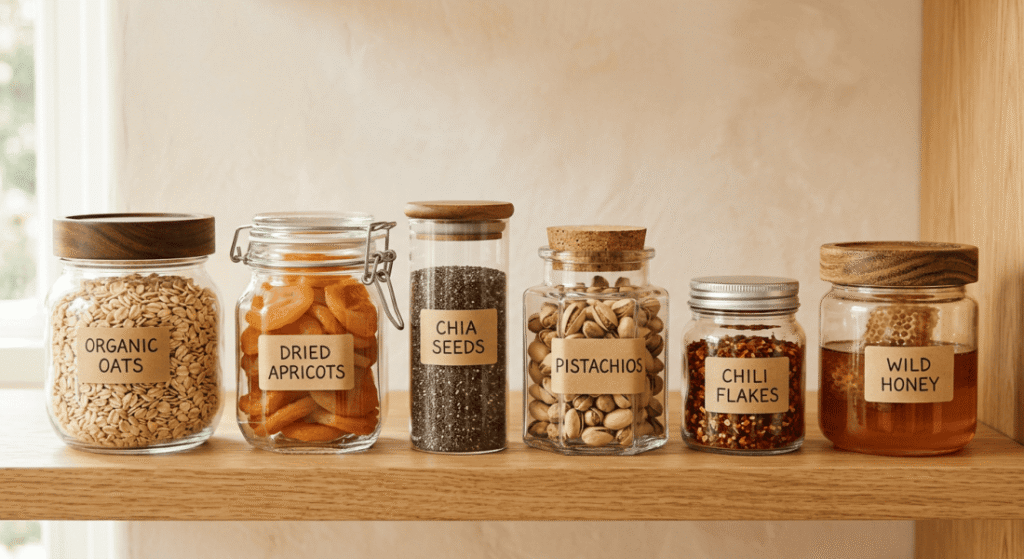
glass jars with food
Common Mistakes to Avoid
Many buyers learn these lessons the hard way. You do not have to.
Choosing the Container Before Testing the Closure
Always order samples of the jar and lid together, then fill, seal, and test them under real conditions. Do not assume a lid will fit just because the size number matches.
Ignoring Your Filling Process
A jar that looks great but is not suitable for hot fill or pasteurization can crack on your line. Share your process details with your supplier from the start.
Picking the Wrong Opening Size
A narrow neck on a chunky product slows filling and frustrates customers. A wide mouth on a thin liquid causes spills.
Overlooking Light Sensitivity
Putting a light-sensitive oil in clear glass may look attractive, but the product may lose quality faster on a bright store shelf.
Underestimating Shipping Risks
A fragile shape with weak outer packing can lead to high breakage, unhappy customers, and lost profit.
Working With an Experienced Glass Manufacturer
Choosing the right partner can make the whole process smoother. A reliable glass food packaging manufacturer does more than sell containers. It can help you match closures, check processing suitability, and plan for steady supply as your brand grows.
En Smilebottles, we work with food brands, distributors, and co-packers who need jars and bottles for sauces, honey, beverages, oils, spices, and preserved foods. As a food packaging glass bottle manufacturer and food packaging glass jar manufacturer, we offer stock items for fast launches, matching closures, decoration services, and custom molds for brands that want their own shape. Our goal is to provide glass packaging solutions for food brands that fit real production needs, not just catalog pictures.
Whichever supplier you choose, look for consistent quality, clear communication, and a willingness to send samples and documents before you commit.

Preguntas frecuentes: Preguntas frecuentes About Glass Jars
P1:Are glass jars safe for food packaging?
A1:Yes. Food grade soda-lime glass is inert and does not leach chemicals into food under normal conditions. It is one of the most widely used food contact materials in the world. Just make sure the lid, liner, and any outer decoration also meet food contact requirements for your market.
Pregunta 2:What is the best glass packaging for food?
A2:There is no single answer, because it depends on your product. Wide-mouth jars with lug lids suit jam, honey, sauces, and pickles. Narrow-neck bottles suit oil, vinegar, juice, and dressing. Small jars with shaker tops suit spices. The best choice is the one that fits your product texture, filling process, shelf life goals, and how customers will use it.
Pregunta 3:Are glass bottles better than plastic for food?
A3:Glass has clear advantages in flavor protection, oxygen barrier, recyclability, and premium appeal. It does not absorb odors or stains. Plastic is lighter and less likely to break, which can lower shipping costs. For premium, natural, and long-shelf-life products, many brands find glass the better fit. For products where weight and impact resistance matter most, plastic may still make sense.
Pregunta 4:Which glass jar is best for honey?
A4:A wide-mouth jar with a secure lug or screw lid usually works best. The wide opening helps customers scoop out honey easily, even after it crystallizes. Hexagon and round jars are both popular. Clear glass is the most common choice because the color of the honey is part of its appeal.
Pregunta 5:What type of bottle is best for sauce?
A5:It depends on how thick the sauce is. Thin hot sauces work well in narrow woozy bottles with orifice reducers. Medium sauces like barbecue sauce and dressing suit round or square bottles with a moderate neck. Thick or chunky sauces, such as salsa or pasta sauce, are usually better in wide-mouth jars.
Pregunta 6:Can glass jars and bottles be hot filled?
A6:Many can, but you need to confirm it with your supplier. Share your exact filling and processing temperatures, preheat containers before filling, and cool them gradually to avoid thermal shock.
Conclusión
Glass remains one of the most reliable choices for food packaging because it protects flavor, supports food safety, looks premium, and fits the growing demand for sustainable packaging. Choosing the right container still takes careful thought.
Start with your product. Decide whether a jar or bottle fits best, then choose the size, shape, color, and closure that suit your filling process and your customers. Confirm food safety and processing requirements, plan for labeling and shipping, and look at the total cost rather than just the unit price.
When you work through these steps one at a time, glass packaging for food becomes much more than a container. It protects your product, earns customer trust, and helps your brand grow over time.