
Índice
AlternarAutor: Equipo editorial de SmileBottles
Tiempo estimado de lectura: Aproximadamente 15 minutos
Why Medicine Bottles Are Amber: The Short Answer
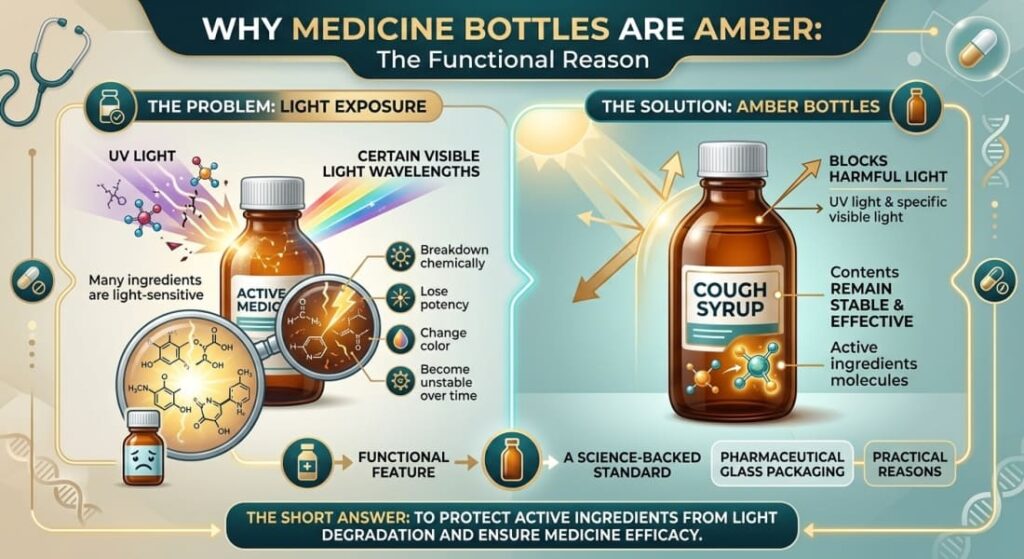
If you’ve ever picked up a bottle of cough syrup, vitamins, or liquid prescription medicine and noticed that deep brownish-orange glass, you’ve probably wondered why. The answer is straightforward: amber medicine bottles are made to block harmful light — specifically UV light and certain wavelengths of visible light — from reaching the contents inside.
That protection matters more than it might seem at first. Many pharmaceutical and health products are sensitive to light. When certain active ingredients absorb light energy, they can break down chemically, lose potency, change color, or become unstable over time. The color in amber glass medicine bottles isn’t a branding choice or a manufacturing tradition. It’s a functional feature.
This is why drugs stored in amber coloured bottles are so common in pharmacies, hospital dispensaries, and health retailers worldwide. It’s a well-established standard in pharmaceutical glass packaging, and it exists for practical, science-backed reasons.
Why Light Exposure Can Damage Pharmaceuticals
To understand why bottle color matters, it helps to understand what actually happens when certain medicines meet light.
What Is Photodegradation?
Photodegradation — sometimes called photolysis — occurs when light energy triggers a chemical reaction inside a substance. In pharmaceutical products, this means the active ingredient can slowly break down after exposure to UV or visible light.
The change isn’t always visible right away. By the time a product looks discolored or cloudy, degradation may have been happening for weeks. This is exactly why why does some liquid medicines kept in dark coloured bottles is such a practical question for anyone working in product development or pharmaceutical sourcing — it’s about preserving what the product actually does, not just how it looks.
Which Types of Light Are Most Harmful?
UV light is the primary concern. Ultraviolet wavelengths carry high energy and can break molecular bonds in sensitive compounds. But it isn’t just sunlight you need to worry about. Fluorescent and LED lighting in warehouses, retail spaces, and clinical environments can also contribute to light-related degradation over time, particularly for products stored uncovered or displayed openly.
Blue light and shorter visible wavelengths can also affect some formulations. This is part of what makes amber glass UV protection valuable — it works across a broader band of the spectrum, not just the ultraviolet range.
How Light Affects Product Quality
For a light-sensitive product that degrades before it reaches the end user, several problems can follow:
Active ingredient potency drops, meaning the product no longer works as intended
Color or odor changes signal chemical breakdown
Shelf life shortens, increasing the risk of out-of-specification product
In some cases, degradation by-products can form
For a brand, those outcomes translate into returns, complaints, or regulatory scrutiny. For the consumer, it means a product that simply underperforms.
Which Products Are Most at Risk?
Not everything requires amber packaging. But if you’re working with any of the following categories, light protection deserves serious consideration:
Syrups and oral liquid solutions
Essential oils and herbal tinctures
Eye drops and ophthalmic formulations
Botanical extracts and herbal products
Certain tablet and capsule formulations
Lab reagents and nutraceuticals
For these categories, why are some medicines stored in dark bottles comes down to protecting active compounds from the kind of ordinary light exposure that happens daily during shipping, storage, and retail display.
How Amber Glass Protects Medicine from Light
Now let’s look at what amber glass actually does, and why it works.
What Makes Amber Glass Different from Clear Glass?
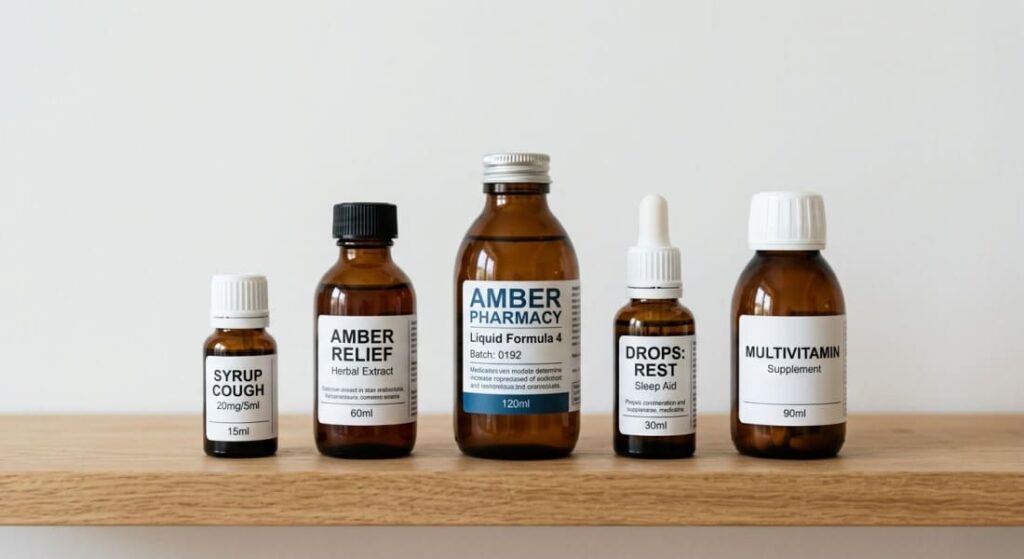
Amber glass gets its color from iron, sulfur, and carbon compounds introduced during manufacturing. These elements absorb light across the UV spectrum and into the lower end of visible wavelengths — roughly 290 to 450 nanometers — which is precisely where many pharmaceutical and nutraceutical ingredients are most sensitive.
When people ask about amber vial meaning in a packaging context, the answer is that amber is a color chosen specifically for its light-filtering properties. It’s not cosmetic, and it’s not simply an industry habit.
How Effective Is the Protection?
Amber glass UV protection is well established in the pharmaceutical industry. Standard amber glass blocks a substantial portion of UV and blue-visible light, making it practical for a wide range of photosensitive products. The benefits of amber glass bottles extend across product categories — from liquid medicines to tinctures to nutraceutical supplements — wherever light exposure poses a real risk to product quality.
Clear glass, by comparison, offers almost no meaningful UV filtration. If you package a light-sensitive formulation in clear glass, you’re relying entirely on secondary packaging — outer cartons, foil barriers, or opaque labels — to do the protective work. That approach is less reliable, especially once secondary packaging is removed during use or left off during retail display.
Amber Glass vs. Clear Glass: A Practical Look
Here’s how the two options compare for pharmaceutical and health product applications:
|
Factor |
Amber Glass |
Clear Glass |
|
UV protection |
Significant |
Minimal |
|
Blue light filtering |
Partial |
None |
|
Product visibility |
Limitado |
Full |
|
Suitability for light-sensitive products |
Recommended |
Not recommended |
|
Consumer recognition |
Widely associated with medicine |
More neutral |
For most medicine bottle packaging involving photosensitive products, amber remains the standard choice. Clear glass works when product visibility matters and light sensitivity is genuinely not a risk factor.
Why Brown and Amber Bottles Mean the Same Thing
You’ll often hear why are medicine bottles brown rather than amber — and the answer is that both terms describe the same glass. The color appears brown or deep orange-brown depending on the glass thickness and lighting conditions. In packaging and pharmaceutical industry usage, “amber” is the standard terminology. In everyday conversation, “brown” is common. Either way, both refer to the same light-filtering glass that protects amber medicine products across pharmaceutical and health categories.
Does Every Medicine Need Amber Packaging?
No — and it’s worth being clear on this. The right container depends on the specific formulation, its stability profile, and stability testing results. Many products, including certain vitamin tablets, water-based solutions in opaque outer packaging, and formulations with demonstrated light stability, don’t require amber glass.
The decision should come from your product’s own data and the regulatory requirements applicable to your market. But for products that are sensitive, amber bottle medicine packaging remains one of the most accessible and cost-effective protective solutions.
Why Glass Remains the Preferred Material for Pharmaceutical Packaging
The amber color is one part of the equation. The fact that it’s glass is the other.
Glass Is Chemically Inert
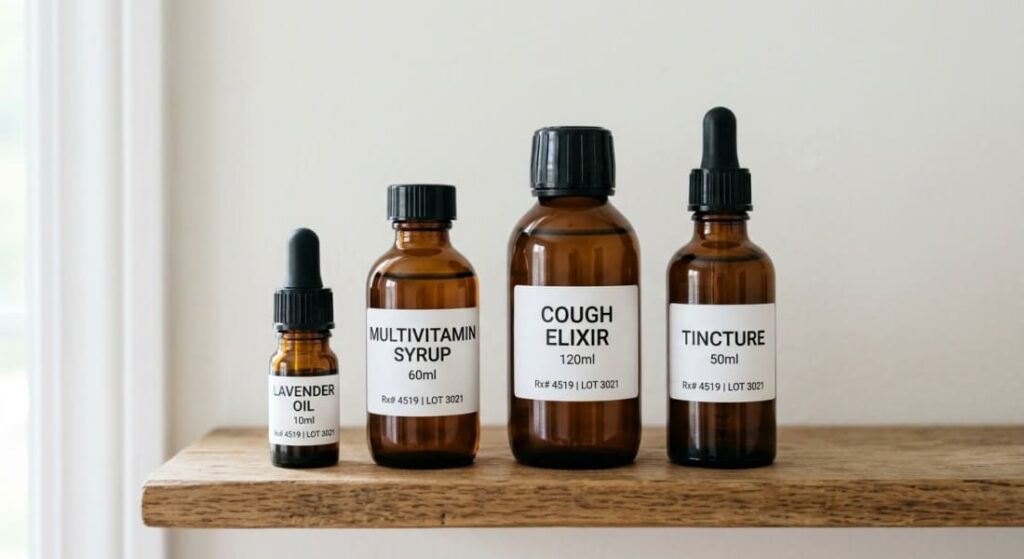
One of the most important properties of pharmaceutical-grade glass is that it doesn’t react with its contents. It doesn’t leach chemicals, absorb active ingredients, or release compounds that could compromise the formulation. For products that need to stay precisely as formulated through their entire shelf life, that inertness is critical.
Plastic packaging — even pharmaceutical-grade plastic — can interact with certain ingredients over time. Some compounds can adsorb to plastic surfaces, reducing their effective concentration. Others may be affected by plasticizers or by oxygen permeation through the container wall. For sensitive liquid formulations, glass is generally the safer choice.
Barrier Performance
Pharmaceutical glass bottles provide an excellent barrier against moisture, oxygen, and volatile compounds. This is especially relevant for liquid products that require a long shelf life or stable storage conditions. Glass maintains its barrier properties over time regardless of temperature variation, which matters for products moving through different storage environments before they reach the end user.
Appearance and Brand Perception
There’s a practical commercial reason why health and pharmaceutical brands choose glass medicine bottles over plastic. Consumers associate glass with quality, purity, and seriousness — particularly in a healthcare context. For brands selling premium herbal extracts, high-potency vitamins, or professional healthcare products, plastic packaging can quietly undercut the message the product is trying to communicate.
Sustainability Considerations
Glass is infinitely recyclable without any loss of quality. For brands with sustainability goals — or customers who factor packaging waste into purchasing decisions — medicine bottles glass aligns better with circular economy objectives than single-use plastic formats.
Amber Glass vs. Amber Plastic
Amber plastic bottles provide some degree of light protection and are appropriate for certain applications. But when you compare them directly to brown glass medicine bottles for pharmaceutical use, glass typically holds the advantage on light filtration quality, chemical inertness, barrier performance, and perceived product value.
How to Choose the Right Medicine Bottle for Your Product
If you’re sourcing packaging for a pharmaceutical, nutraceutical, or health product, here are the key questions to work through before committing to a specific bottle type.
Step 1: Understand Your Product’s Light Sensitivity
Has your formulation undergone stability testing? Do you know how it responds to UV or visible light over time? If you’re not sure, that’s the first thing to establish. Work with your formulator or follow your regulatory authority’s photostability testing guidance.
If your product contains essential oils, plant-based actives, certain vitamins, or liquid APIs known to be photosensitive, amber glass should be on your shortlist from the beginning.
Step 2: Choose the Right Glass Color
For most light-sensitive liquids, amber glass medicine bottles are the standard choice. For products where appearance matters and light isn’t a concern — certain clear liquid supplements or formulations in opaque outer packaging — clear glass may be appropriate.
Step 3: Match Bottle Size and Closure to the Application
The bottle isn’t only about the glass. You also need to think through:
Volume: Small dropper vials for concentrated formulations, larger Boston round or square bottles for syrups
Closure type: Dropper assemblies, spray pumps, child-resistant caps, and tamper-evident closures — the right option depends on the product type and dosing method
Acabado del cuello: The neck finish must pair precisely with your chosen closure to ensure a reliable seal
Getting closure compatibility wrong creates leakage, dosing problems, and potential compliance issues.
Step 4: Evaluate Quality and Compliance Requirements
Para pharmaceutical glass packaging, consistency matters throughout the supply chain. Dimensional accuracy, glass composition, absence of inclusions, and cleanliness all affect whether your filling line runs smoothly and whether your finished product meets regulatory specification.
When you talk to a potential medicine bottle supplier, ask about compliance with ISO, USP, or EP glass standards, quality control processes, and batch-to-batch consistency documentation.
Step 5: Think About Supply Chain Reliability
Packaging shortages stop production. When you’re evaluating a pharmaceutical bottle manufacturer or pharmaceutical packaging manufacturer, the unit price is one factor — but so is lead time, minimum order quantity, inventory availability during high-demand periods, and the supplier’s track record for hitting commitments. A supplier who performs well at 10,000 units needs to be equally reliable when you scale to 100,000.
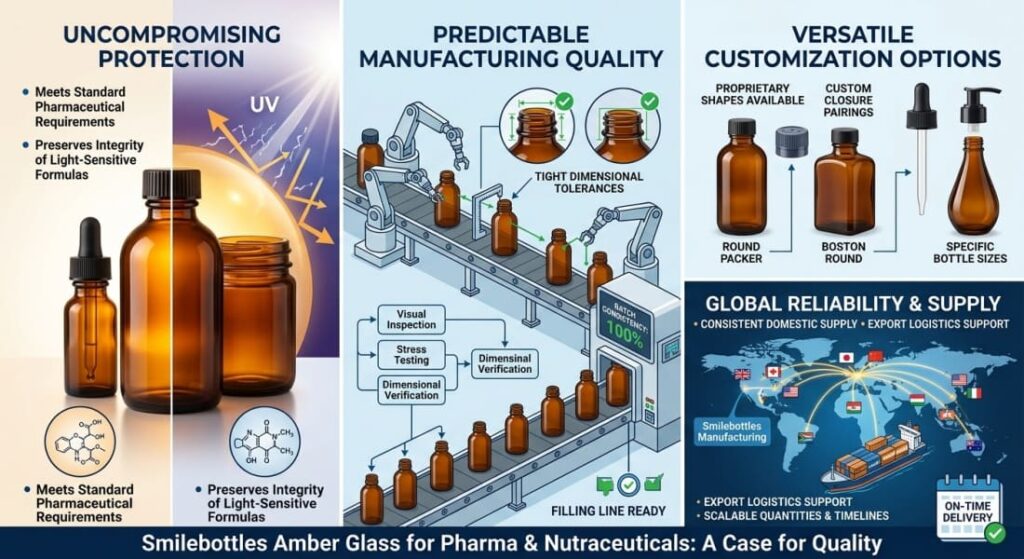
Why Pharmaceutical Brands Choose Amber Glass Bottles from Smilebottles
Smilebottles is a glass bottle manufacturer with experience in pharmaceutical and nutraceutical packaging. As a pharmaceutical bottle manufacturer working with brands across different markets and stages of growth, Smilebottles is built around the supply chain needs that matter most: consistent quality, reliable lead times, and packaging that actually does its job.
Designed for Protection and Presentation
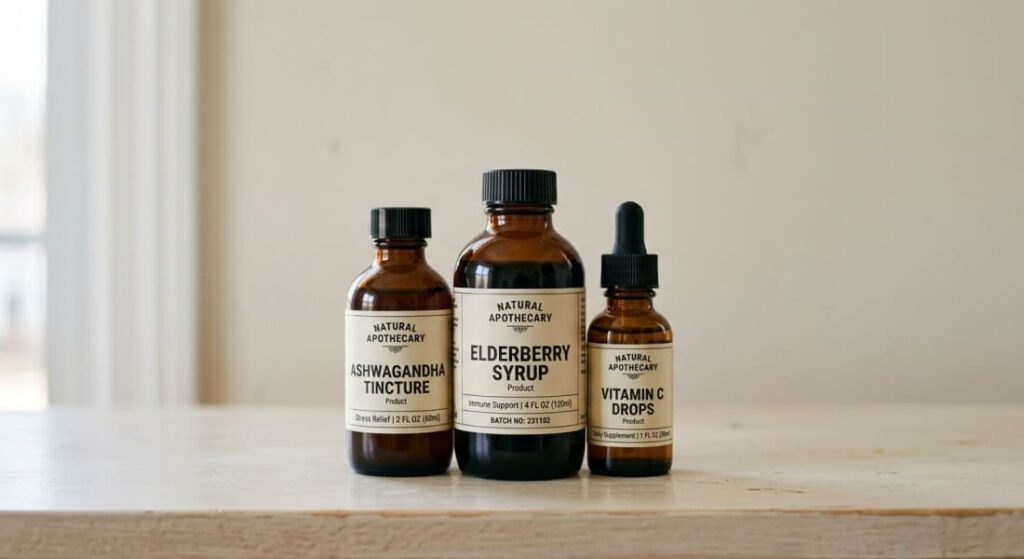
Smilebottles’ amber glass medicine bottles are made for products that need reliable light protection. The glass meets standard pharmaceutical quality requirements, and the range covers common sizes and formats used across pharmaceutical, nutraceutical, and health product categories — from small dropper vials to larger formats for syrups and oral solutions.
Manufacturing Quality You Can Plan Around
Tight dimensional tolerances and documented quality control processes mean your filling line runs predictably and your product stays within specification.
Opciones de personalización
For brands that need a specific bottle size, a proprietary shape, or custom closure pairing, Smilebottles offers customization support. Colored capsule bottles amber options are available alongside standard formats, giving you flexibility in both light protection and commercial presentation.
Global Supply Support
Smilebottles works with brands and manufacturers across multiple international markets. Whether you need consistent domestic supply or export logistics support, the team can work with you on quantities and timelines.
Preguntas frecuentes: Frequently Asked Questions About Amber Medicine Bottles
P1:Why are medicine bottles amber instead of clear?
A1:Amber glass medicine bottles block a significant portion of UV and short-wave visible light that can degrade photosensitive pharmaceutical and nutraceutical products. The color is functional — it helps maintain potency, stability, and shelf life for products that would otherwise be vulnerable to light exposure.
Pregunta 2:Do amber bottles actually block UV light?
A2:Yes. Standard amber glass UV protection covers a meaningful portion of the UV spectrum as well as some blue-visible wavelengths, making it one of the most practical solutions for light-sensitive pharmaceutical glass packaging.
Pregunta 3:Are amber and brown medicine bottles the same?
A3:In most cases, yes. Brown glass medicine bottles and amber glass bottles are the same product. “Amber” is the standard industry term; “brown” is the everyday description of the same color.
Pregunta 4:Does all medicine need amber bottles?
A4:No. Packaging decisions depend on the product formulation, stability testing data, and applicable regulations. Not every product is light-sensitive, and not every light-sensitive product needs glass. The correct choice follows from the product’s own stability profile.
Pregunta 5:Why is glass preferred over plastic for medicine bottles?
A5:Medicine bottles glass construction is chemically inert, provides a stronger barrier against moisture and gas, doesn’t interact with pharmaceutical ingredients, and is perceived as higher quality by consumers. For light-sensitive products, amber glass typically outperforms amber plastic in protection and long-term stability.
Pregunta 6:What types of products are commonly stored in amber glass?
A6:Common applications include syrups and oral solutions, essential oils, herbal tinctures, eye drops, botanical extracts, liquid vitamins, lab reagents, and nutraceuticals — essentially any product containing compounds sensitive to UV or visible light.
P7:What should I look for when choosing a pharmaceutical glass bottle supplier?
A7:Look for a pharmaceutical packaging manufacturer who can demonstrate consistent product quality, provide standards compliance documentation, offer reliable lead times, and scale with your order volume from initial production runs through full-scale manufacturing.
Conclusión
Understanding why amber medicine products are packaged the way they are — and what the science behind that decision looks like — gives you a stronger foundation for making sourcing decisions that hold up across your product’s lifecycle.
Whether you’re launching a new pharmaceutical product, sourcing packaging for a nutraceutical line, or looking to stabilize your supply chain around a dependable medicine bottle supplier, the fundamentals stay the same: choose materials that protect the product, verify the quality, and work with a pharmaceutical bottle manufacturer who understands what’s at stake.
If you’re evaluating amber glass medicine bottles for your next product, Smilebottles is ready to help. Reach out to discuss your specifications, request samples, or talk through your packaging requirements with the team.
 Spanish (Colombia)
  English
  Russian
  Spanish (Chile)
  Spanish (Ecuador)
  Swedish
  Arabic
  French
  Portuguese