
Índice
AlternarAutor: Equipo editorial de SmileBottles
Tiempo estimado de lectura: Aproximadamente 15 minutos
For wine brands, large format wine bottles are much more than a visual statement — they’re a strategic packaging choice that can affect how your wine ages, how your brand is perceived, and how your product performs across different sales channels.
This guide is for wineries, brand managers, importers, distributors, and packaging buyers who are seriously considering large glass wine bottles for their next project. You’ll find a breakdown of standard sizes, the real benefits of going bigger, technical factors worth understanding, and practical guidance on sourcing and working with manufacturers. Whether you’re planning a limited-edition release, building out a gifting line, or looking to stand out in the premium market, understanding the full picture on large format will help you make better decisions from the start.
What Are Large Format Wine Bottles?
Definition
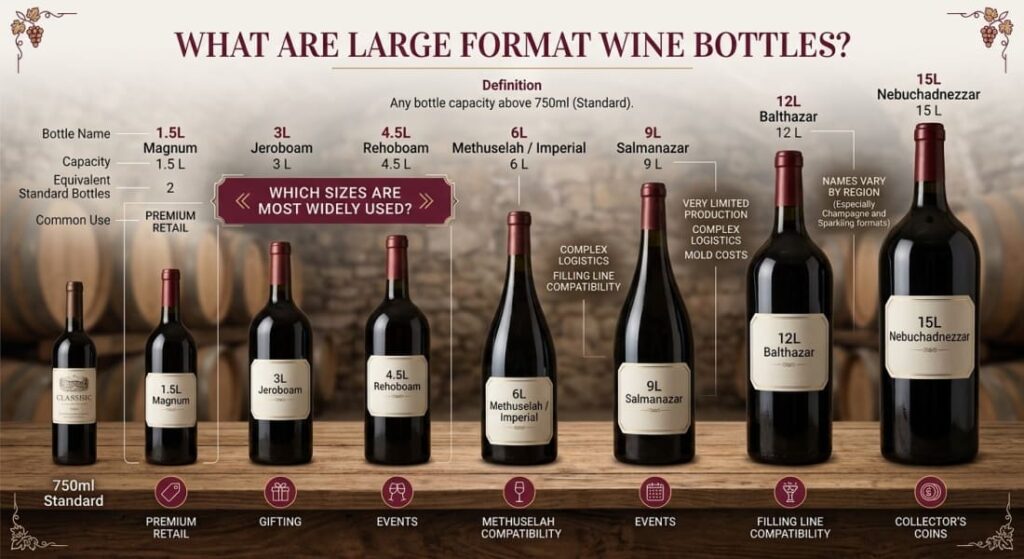
Simply put, a large format wine bottle is any bottle with a capacity above the standard 750 ml. The 750 ml became the industry standard largely for practical and historical reasons, but the wine world has long used larger formats for special releases, aging, and prestige presentations.
When buyers and wineries talk about large format, they’re usually referring to bottles ranging from 1.5 liters up to 15 liters or beyond. These bottles carry different names depending on their size and the wine region they’re associated with, and understanding those names is useful whether you’re purchasing for your own brand or advising clients.
Common Large Wine Bottle Sizes and Names
The wine bottle size chart below covers the most recognized large format sizes in use commercially:
Bottle Name | Capacity | Equivalent Standard Bottles | Common Use |
Standard | 750 ml | 1 | Everyday retail and restaurant |
Magnum | 1.5 L | 2 | Premium retail, gifting, events |
Jeroboam | 3 L | 4 | Special releases, hospitality |
Rehoboam | 4.5 L | 6 | Champagne, limited editions |
Methuselah / Imperial | 6 L | 8 | Events, display, collectors |
Salmanazar | 9 L | 12 | High-profile events, very limited |
Balthazar | 12 L | 16 | Show-piece and collector use |
Nebuchadnezzar | 15 L | 20 | Rare, luxury display |
Naming conventions can vary by region and bottle style — especially with Champagne and sparkling formats. Not every winery uses every size, and not every manufacturer produces every size at commercial scale, so it’s worth confirming availability early in your planning.
Which Sizes Are Most Widely Used?
In practical terms, the most commercially active wine bottle sizes for large format production are the 1.5L wine bottle (Magnum), the 3L wine bottle (Jeroboam), and the 6L wine bottle (Methuselah or Imperial). These three cover the widest range of applications — from retail shelf display to gifting to hospitality and event use — and they’re the formats most manufacturers can produce consistently at volume.
If you’re new to large format and trying to decide where to start, these three sizes are the safest entry points. Anything above 6 L tends to move into very limited production territory, where mold costs, logistics challenges, and filling line compatibility all become more complex.
Why Large Format Bottles Appeal to Premium Wine Brands
Luxury Shelf Presence and Brand Image
A large bottle physically occupies more space and naturally draws the eye. On a retail shelf crowded with standard 750 ml options, a magnum wine bottle or a Jeroboam sits in a different visual category entirely. That differentiation matters, especially for brands operating in the premium or ultra-premium segment where shelf impact is a real competitive factor.
Beyond size alone, large format bottles communicate celebration, quality, and ceremony. When a customer picks up a large bottle, the implicit message is that it’s meant for a special occasion — and that framing supports premium pricing.
Better Storytelling and Limited-Edition Appeal
Large format bottles are a natural fit for winery storytelling. Anniversary releases, reserve labels, vineyard-specific expressions, and collector editions all benefit from the added gravitas that comes with a bigger format. Many brands use the larger canvas — both the physical space and the presentation — to tell a story that a standard bottle simply can’t carry.
If you’re developing a limited-edition line or a flagship product, a large format gives you more room to work with on label design and decoration, and it signals to buyers immediately that this isn’t a typical retail bottle.
Gifting, Events, and Collector Value
There’s a reason most fine dining rooms keep a few large format bottles on display, and why giant bottles of wine are a fixture at charity auctions and high-profile events. They’re memorable, shareable, and naturally suited to celebration. From corporate gifting to weddings to hospitality activations, large bottles fill a role that standard 750 ml bottles can’t.
For collectors, larger formats are also desirable for their rarity and the aging potential they may offer.
Potential Aging Advantages
This is one of the most discussed reasons for choosing large format. The basic reasoning: larger bottles contain more wine relative to the amount of oxygen that gets through the closure, which means the wine may develop more slowly and gracefully over time. For fine wines designed for long cellaring, this can be a genuine advantage.
That said, the science isn’t completely settled, and the effect varies by wine type, closure, and storage conditions. It’s accurate to say large format “may” or “can” support more gradual aging — not that it always does. But it’s a real factor that resonates with serious wine buyers and adds credibility to a premium positioning.
Higher Perceived Value and Pricing Opportunities
Large format bottles typically command a price premium well above the pro-rated equivalent of two or four standard bottles. That pricing structure creates margin opportunity, particularly when the bottle itself is well-designed. For brands building a premium wine packaging strategy, large format is a lever worth considering seriously.

Common Applications for Large Format Wine Bottles
Large format bottles show up across a wide range of commercial contexts. Knowing where your product is going helps you make better decisions about specification and design.
Reserve and limited-edition wines are a natural fit. Wineries launching a small-batch flagship often choose large format for the shelf impact and the story it tells at point of sale.
Hospitality and fine dining rely on large bottles for tableside service and bar display. A well-chosen bottle on a table or behind a bar becomes part of the dining experience, not just a beverage container.
Corporate gifting and events are another strong use case. Companies regularly use large format bottles as high-end gifts or event centerpieces, often with custom labels or branding applied.
Private-label and promotional projects sometimes use large format for certain SKUs to differentiate a range. An importer or distributor building a private-label line can use a Magnum or Jeroboam to anchor the premium tier of their portfolio.
Collectors specifically seek out large format bottles for cellaring, and some formats carry genuine secondary market value for sought-after producers.
Technical Specifications That Matter in Large Glass Wine Bottle Production
When you’re sourcing large format bottles, the technical details matter more than they do with standard sizes. Here’s what to pay close attention to.
Glass Weight and Wall Thickness
Larger bottles need to be structurally sound, which generally means thicker walls and heavier glass overall. There’s a balance to strike, though. A heavier bottle looks and feels more premium and resists breakage during transport — but it also adds freight cost, especially for international shipments. When you’re working with a manufacturer, ask specifically about their standard wall thickness for each large format size and how they manage consistency across a production run.
Bottle Dimensions and Neck Finish
Dimensional accuracy is critical for large format because these bottles often need to work with specialized filling lines, corking equipment, and labeling systems that may not have the same flexibility as standard machinery. Height, body diameter, and neck finish all need to be confirmed against your existing setup before you commit to a mold or a bottle spec. Getting this wrong at the sample stage is manageable; getting it wrong after committing to a full production run is expensive.
Glass Color and Light Protection
The most common color choices for wine bottles are flint (clear), antique green, dead leaf green, and amber. Color affects both aesthetics and function. Green and amber glass filters some UV light, which can help protect the wine — though for bottles stored in the dark, this matters less than for bottles displayed in bright retail environments.
Color is also a significant brand decision. Antique green and dead leaf green give a traditional, premium appearance, while flint suits contemporary label designs and certain modern brand aesthetics.
Closure Compatibility
Large format bottles most commonly use natural corks, which require the right neck finish for a proper seal. Before finalizing your spec, confirm that your chosen bottle’s neck finish is compatible with your preferred closure and that your corking equipment can actually handle the larger format. It sounds basic, but this is a detail that can cause real disruption if it’s left until late in the process.
Decoration and Customization Options
For custom wine bottles, the most common decoration techniques for large format glass include embossing, debossing, screen printing, frosting, spray coating, and hot stamping. Embossing and debossing require mold modifications, which adds upfront cost but creates a highly distinctive bottle that’s hard to replicate. Screen printing and spray coating can typically be applied without mold changes and at smaller minimums, making them practical for shorter runs or brands testing a format before committing to a full custom mold.
Manufacturing Challenges of Large Format Wine Bottles
Large format glass isn’t simply a scaled-up version of a standard bottle. The manufacturing process has specific challenges that are worth understanding when you’re evaluating potential suppliers.
Structural Strength at Larger Capacities
Maintaining even wall thickness and structural integrity becomes harder as bottles get bigger. Poor annealing or uneven glass distribution can result in bottles that crack or break under normal handling stress — often not at the factory but somewhere in your supply chain, which is far more disruptive.
Mold Precision
Large format molds are more complex and more expensive than standard bottle molds. Small variations in mold design can produce bottles that don’t fill, close, or label correctly on automated lines. A manufacturer with real experience in large format will have worked through these issues and can provide bottles that meet tight dimensional tolerances.
Annealing and Thermal Stress
After forming, glass bottles go through an annealing process to relieve internal stress. For larger bottles, this requires more careful control. Done incorrectly, you end up with bottles that have hidden stress points and fail later — during filling, shipping, or even in the consumer’s hands.
Breakage Prevention and Export Packaging
Large bottles are heavy and require appropriate inner packaging — custom inserts, dividers, or foam protection — to survive transport, especially for export. This is something to discuss with your manufacturer well before the first order ships, not as an afterthought. Ask what packaging they use, what breakage rates they typically see in transit to your target market, and whether they have any data to back that up.

How to Choose the Right Large Format Wine Bottle for Your Brand
Match Bottle Size to Your Product Strategy
Start with what the bottle is for. A 1.5L wine bottle works well for broader retail distribution and premium gifting. A 3L wine bottle suits hospitality, events, and collector-focused releases. A 6L wine bottle is more of a show piece — excellent for events, bar display, and very limited runs, but less practical for regular retail. Knowing the end use helps you choose the right size rather than defaulting to whatever’s most familiar.
Select the Right Shape and Design
The main bottle shapes used in wine are Bordeaux (high shoulders, good for strong label graphics) and Burgundy (sloping shoulders, more elegant profile). If you’re developing something unique, custom mold development is an option, though it adds lead time and upfront tooling cost. For most brands, working with an existing mold and adding decoration is a more practical starting point.
Balance Premium Look with Logistics Reality
A very heavy, thick-walled bottle looks impressive, but it increases freight costs and can complicate palletization for international shipments. Think about where your bottles are shipping, how many fit on a pallet at your target weight, and what the freight cost per unit looks like at your expected order volumes. Sometimes a slightly lighter bottle that still looks premium is the smarter commercial decision.
Confirm Technical Compatibility Before Ordering
Before placing an order, confirm that the neck finish is compatible with your closure, that the body dimensions work on your filling line, that the labeling area fits your artwork, and that the packaging is appropriate for your shipping method. These details seem minor until one of them causes a delay or a rejection at the filling stage.
How to Choose a Reliable Large Wine Bottle Manufacturer
What Capabilities to Look For
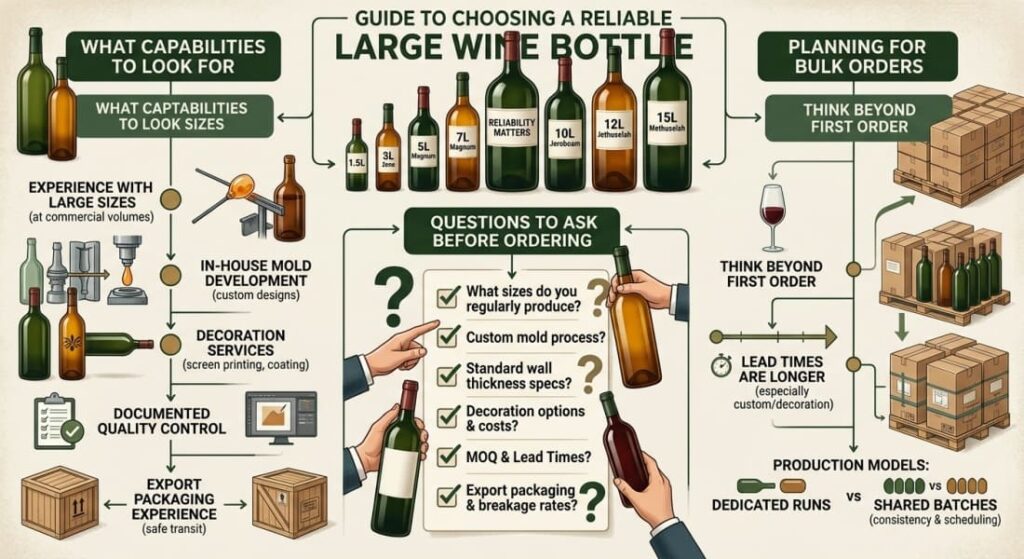
Not every glass bottle manufacturer has meaningful experience with large format production. When evaluating potential suppliers, look specifically for experience producing the sizes you need at commercial volumes, in-house mold development capability, decoration services if you need them, documented quality control processes, and export packaging experience relevant to your target market.
Questions to Ask Before Ordering
When you speak with a glass wine bottle supplier, these are the questions that reveal whether they actually know what they’re doing:
What large format sizes do you regularly produce at commercial volumes?
Can you support custom mold development, and what does that process look like?
What are your standard wall thickness and glass weight specs per size?
What decoration options do you offer, and what are the tooling and setup costs?
What are your MOQ and standard lead times for large format production?
How do you package large format bottles for export, and what breakage rates do you see?
A supplier who can answer these with actual specifics — not vague reassurances — is one that has real experience.
Planning for Bulk Orders
If you’re ordering bulk wine bottles for an ongoing product line, think beyond the first order. Lead times for large format production tend to run longer than for standard bottles, especially when custom molds or decoration are involved. Ask whether the manufacturer does dedicated production runs or batches within a shared run — both models work, but they have different implications for consistency and scheduling.
Preguntas frecuentes: Frequently Asked Questions About Large Format Wine Bottles
P1:What is considered a large format wine bottle?
A1:Any wine bottle with a capacity above the standard 750 ml. In practice, the term usually refers to bottles from 1.5 L upward.
Pregunta 2:What are the most popular large wine bottle sizes?
A2:The Magnum (1.5 L), Jeroboam (3 L), and Methuselah (6 L) are the most commercially active. The Magnum is by far the most widely available and the easiest to source consistently.
Pregunta 3:Why do wines in larger bottles sometimes age differently?
A3:The theory is that a larger bottle contains more wine relative to oxygen exposure at the closure, which can slow the aging process. This is a real factor, but the degree varies by wine type, closure, and storage conditions — so it’s more accurate to say large format “may” support slower aging rather than that it always does.
Pregunta 4:Are large format glass wine bottles suitable for bulk orders?
A4:Yes. Most manufacturers that specialize in large format production are set up for bulk supply. MOQs are typically higher than for standard bottles, and lead times are longer — especially for custom sizes or decorated bottles.
Pregunta 5:Can large wine bottles be customized with embossing or printing?
A5:Yes. Embossing, debossing, screen printing, frosting, and spray coating are all available depending on the manufacturer. Embossing requires mold modification, which carries an upfront cost, but produces a highly distinctive result that can’t be easily replicated with a standard bottle.
Pregunta 6:Are large glass wine bottles more difficult to ship?
A6:They do require more robust inner packaging, heavier cartons, and careful palletization. An experienced manufacturer will have standard export packaging solutions and will be able to share transit breakage data for your target shipping routes.
P7:What is the best large bottle size for premium wine brands?
A7:It depends on the application. For retail and gifting, the Magnum is the most versatile. For hospitality and events, the 3 L or 6 L creates more impact. For display and collector positioning, 6 L and above is the most dramatic choice.
Conclusión
Large format wine bottles aren’t right for every product, but when the application fits, they deliver real commercial value — in shelf presence, pricing opportunity, brand storytelling, and wine preservation potential. The key is approaching the decision with clarity: the right size for your sales channel, the right technical specifications for your production setup, and the right manufacturing partner to deliver consistent quality at volume.
For wineries and brands exploring large format wine bottles — whether that’s a Magnum for a gifting line, a Jeroboam for a hospitality program, or a custom embossed bottle for a limited collector release — Smilebottles works with wineries, importers, and private-label brands on exactly these projects. We can help you evaluate size options, confirm technical specs, and work through decoration and export packaging requirements so your order arrives the way it should.
 Spanish (Ecuador)
  English
  Russian
  Spanish (Chile)
  Spanish (Colombia)
  Swedish
  Arabic
  French
  Portuguese