
Table of Contents
ToggleAuthor: SmileBottles Editorial Team
Estimated Reading Time: About 15 Minute
If you’re sourcing packaging for tablets, capsules, or supplements, you’ve probably asked this question more than once: should you go with glass or plastic? It sounds simple. But once you start looking at shelf life, compliance, freight costs, and how your product looks on a shelf, the answer gets more complicated.
Both materials are used every day for medicine bottles around the world. Plastic pill bottles are what most people get at the pharmacy counter. Glass pill bottles are common in premium supplements, herbal products, and many pharmaceutical applications where stability matters most. Neither one wins in every situation.
This guide walks you through the real differences so you can make a decision that fits your product, your market, and your budget. Whether you run a pharmaceutical brand, a nutraceutical company, or a private label supplement line, you’ll find practical points here to help you choose the right pill bottle packaging.
Quick answer:
Choose glass when product stability, chemical inertness, premium presentation, and recyclability are your top priorities.
Choose plastic when lightweight shipping, impact resistance, and the lowest possible unit cost matter more.
For sensitive formulations, high-value supplements, and many regulated products, glass is often the safer long-term choice.
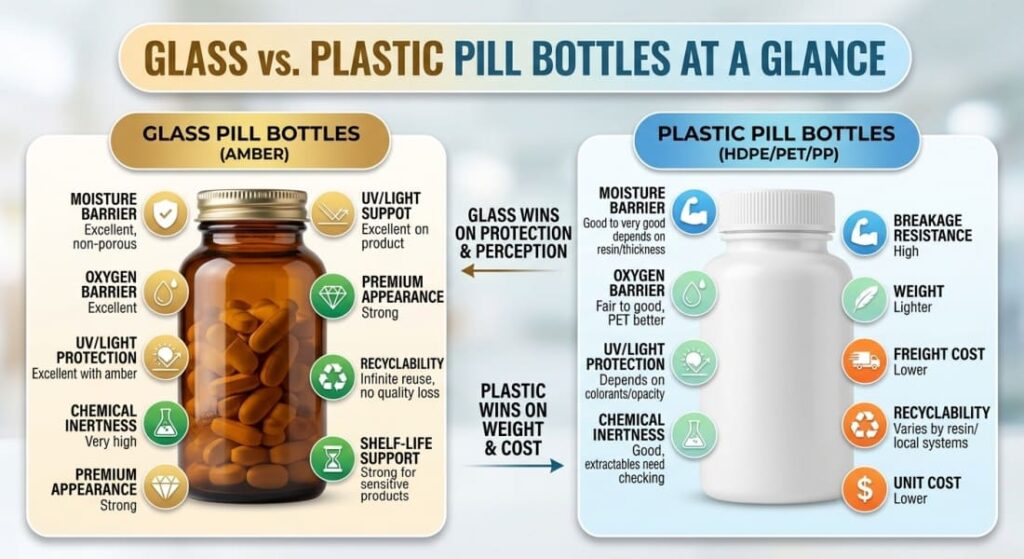
Glass vs. Plastic Pill Bottles at a Glance
Before getting into the details, here’s a side-by-side view of how the two materials usually compare. Keep in mind that plastic performance varies a lot by resin type (HDPE, PET, and PP all behave differently), so treat this as a general guide.
Factor | Glass Pill Bottles | Plastic Pill Bottles |
Moisture barrier | Excellent (non-porous) | Good to very good, depends on resin and wall thickness |
Oxygen barrier | Excellent | Fair to good (PET better than HDPE) |
UV/light protection | Excellent with amber glass | Depends on colorants and opacity |
Chemical inertness | Very high | Good, but extractables need checking |
Breakage resistance | Lower | High |
Weight | Heavier | Lighter |
Freight cost | Higher | Lower |
Recyclability | Can be recycled repeatedly without quality loss | Varies by resin and local systems |
Premium appearance | Strong | Moderate |
Unit cost | Higher | Lower |
Shelf-life support | Strong for sensitive products | Good with proper closures and desiccants |
If you only take one thing from this table, let it be this: glass tends to win on protection and perception, while plastic tends to win on weight and cost.
Barrier Protection and Shelf Life: Which Material Protects Pills Better?
Pills and capsules can break down faster than you’d expect. Moisture can make tablets crumble or capsules go soft and sticky. Oxygen can degrade active ingredients like vitamins and probiotics. Light can trigger chemical changes in sensitive compounds. Your bottle is the first line of defense against all three.
Moisture Protection
Glass is non-porous. Water vapor simply doesn’t pass through it. That makes a well-sealed capsule glass bottle a good fit for hygroscopic products, meaning products that pull moisture from the air. Gelatin capsules, effervescent tablets, and many herbal extracts fall into this group.
Plastic is different. HDPE has a fairly good moisture barrier, which is one reason it’s so common in pharmacies. But all plastics allow some level of moisture vapor transmission over time. Thicker walls and the right closure help, and adding a desiccant can close much of the gap. Still, if your product is very moisture-sensitive and you need a long shelf life, glass medicine bottles give you more margin for error.
Oxygen Protection
This is where the gap between materials gets wider. Glass is essentially impermeable to oxygen. HDPE, on the other hand, lets oxygen through more easily than many buyers realize. PET performs better than HDPE, but it still doesn’t match glass.
If you’re packaging omega-3 capsules, vitamin C, probiotics, or any formula prone to oxidation, this point deserves real attention in your stability planning.
Light Protection and Amber Glass
Some ingredients degrade when exposed to UV and short-wavelength visible light. Riboflavin, vitamin A, certain herbal actives, and a range of prescription drugs are good examples.
This is why amber glass pill bottles are so widely used. Amber glass filters out most UV light and a good share of blue light, which helps protect what’s inside. Pharmacopeia standards such as USP <660> even set limits on light transmission for light-resistant glass containers.
Plastic can offer light protection too, usually through colorants or opaque white resin. It works in many cases, but the level of protection depends on the formulation of the plastic itself. With amber medicine bottles made from glass, the protection is built into the material and stays consistent over the life of the product.
The Closure System Matters as Much as the Bottle
Here’s something that often gets overlooked: a bottle is only as good as its seal. You can have a great glass bottle and still lose moisture protection if the cap and liner don’t fit well.
When you evaluate packaging, look at the whole system:
Cap type and thread fit
Liner material (pulp, foam, PE, or foil)
Induction seals for tamper evidence and added barrier
Desiccants, if your product needs them
Secondary packaging like cartons or blister cards
Shelf life comes from the full package working together, not from the bottle material alone.

Product Safety and Regulatory Compliance: What B2B Buyers Need to Check
If you sell regulated products, packaging is not just a design choice. It’s part of your quality system. A bottle that looks fine but reacts with your formula can lead to failed stability tests, recalls, or worse.
Chemical Inertness
Glass is one of the most chemically stable packaging materials available. It doesn’t react with most formulations, and it doesn’t release additives into the product. That’s why pharmaceutical glass bottles have been trusted for so long.
Glass used in pharma is usually classified by type. Under USP <660>, Type I borosilicate glass has the highest chemical resistance and is common for injectables. Type III soda-lime glass is widely used for oral solid dosage forms like tablets and capsules, and it works well for most pill and supplement applications.
Plastic can also be safe when it’s the right grade and properly tested. The main concern is extractables and leachables, meaning substances that could migrate from the plastic into your product. For dry solids like tablets, the risk is generally lower than for liquids, but it still needs to be part of your evaluation.
What Regulations Should You Keep in Mind?
Pharmaceutical packaging compliance depends on your market and product category. A few common areas to review include:
Pharmacopeia standards such as USP <660> for glass and USP <661> for plastic materials, plus USP <671> for container performance testing
FDA guidance on container closure systems for human drugs
Child-resistant packaging rules, such as the Poison Prevention Packaging Act in the US and ISO 8317 internationally
Tamper-evident packaging requirements for many OTC products
Food contact rules for dietary supplements, depending on the region
Labeling requirements in each target market
Your regulatory team will know the exact rules that apply to your product. Your job when sourcing is to make sure the supplier can support those requirements with the right documents.
A Simple Checklist for Buyers
Before you approve a bottle, ask yourself (and your supplier) these questions:
Is the material compatible with your formulation?
Does the bottle meet relevant pharmacopeia or packaging standards?
Have the cap and liner been tested with the bottle?
Can the supplier provide material certificates and test reports?
Is the packaging suitable for the markets you sell into?
Does the supplier have consistent quality control from batch to batch?
A good pharmaceutical packaging manufacturer should be able to answer all of these without hesitation.
Key takeaway: For regulated pharmaceutical and nutraceutical products, choose your packaging based on stability data, compliance documents, and closure compatibility, not on unit price alone.
Brand Positioning and Consumer Perception: Why Packaging Material Shapes Value
Your customers judge your product before they ever open it. The bottle in their hand tells them something about quality, and they pick up on that quickly.
Glass tends to signal purity, quality, and care. It feels solid. It looks clean. For wellness brands, herbal supplements, and premium vitamins, that impression can support a higher price point and build trust.
Plastic sends a different message. It feels practical and familiar. For mass-market products, that’s not a bad thing at all. People expect a basic multivitamin to come in a plastic bottle, and many won’t think twice about it.
The question for you is simple: what do you want your customers to feel when they see your product?
A few design details also shape perception:
Color: Amber suggests protection and an apothecary feel. Clear glass highlights the product. Cobalt blue or green can help you stand out.
Shape: Round, square, or custom shapes affect how your product sits on a shelf and in a photo.
Weight: Heavier glass often feels more premium in the hand.
Decoration: Screen printing, embossing, and frosting can raise perceived value.
If you sell online, remember that product photos do a lot of the selling. Glass usually photographs very well, which can help your listings look more polished.
Sustainability: Comparing Glass and Plastic in a Circular Economy
More buyers are asking about environmental impact, and your customers are probably asking too. But sustainability isn’t as black and white as many marketing claims suggest.
The Case for Glass
Glass can be recycled again and again without losing quality. It’s made from abundant raw materials like sand, soda ash, and limestone, and recycled glass (cullet) can be melted back into new bottles. Glass is also reusable, and some brands now offer refill programs built around durable glass containers.
Because glass is inert, it also supports a “clean” product story, which matters for brands focused on natural ingredients.
The Case for Plastic
Plastic is much lighter. That means lower fuel use during shipping, which can reduce transport emissions, especially over long distances. Some plastics, like PET and HDPE, are widely recyclable, and recycled-content options (PCR plastic) are becoming more common.
The catch is that plastic recycling depends heavily on local systems, resin type, and contamination. In many regions, a large share of plastic packaging still ends up in landfill.
Looking at the Full Picture
If sustainability is a real goal for you, look at the full life cycle:
Raw material sourcing
Manufacturing energy
Transport distances and weight
Reuse potential
Recycling rates in your target markets
End-of-life impact
For many brands, glass is a strong option for eco friendly pharmaceutical packaging and sustainable supplement packaging, especially when products are sold in regions with good glass recycling. But if you ship long distances in very high volumes, plastic may have a lower carbon footprint in some scenarios. Be honest with yourself and your customers about the trade-offs.
Key takeaway: Glass is often favored for recyclability and inertness, while plastic may lower transport emissions. The more sustainable choice depends on your full supply chain.
Shipping, Durability, and Total Cost: Looking Beyond Unit Price
This is where plastic often looks like the clear winner, at least at first glance. Plastic bottles cost less per unit, weigh less, and rarely break. But unit price is only one part of your real cost.
What Drives Your Total Cost?
When you compare quotes, consider:
Unit price of the bottle and closure
Freight cost, which is heavily affected by weight and volume
Breakage rates during shipping, filling, and handling
Protective packaging, like dividers and sturdier cartons for glass
Warehouse space and pallet efficiency
Product loss from poor barrier performance
Returns and complaints from damaged or degraded products
Where Glass Costs More
Glass bottles are heavier, so freight costs go up, particularly for international shipping. They also need better protective packaging, and breakage risk means you’ll want to plan for some loss. On filling lines, glass may need adjustments to handling speed and equipment.
Where Glass Can Save You Money
A cheaper bottle isn’t always cheaper in the end. If your product degrades early because of moisture or oxygen exposure, you’ll pay for it through returns, shorter shelf life, and damage to your reputation. If your brand charges a premium, glass can also support stronger margins that more than cover the extra packaging cost.
For high-value products, the bottle is often a small share of the total product cost. Spending a little more on packaging to protect a costly formula usually makes sense.
Customization Options: Choosing the Right Bottle for Your Brand and Product
Once you’ve picked a material, you still have plenty of decisions to make. The right specifications help your product perform well on the filling line, on the shelf, and in your customer’s home.
Size and Capacity
Think about your fill count and capsule size. A bottle that’s too large leaves extra headspace, which means more air (and more oxygen and moisture) inside. A bottle that’s too small makes filling harder. Common pill bottle sizes run from about 30 ml to 500 ml, but the best size depends on your dosage count.
Neck Finish and Closures
Your neck finish needs to match your closure. Common options include: Standard screw caps, Child-resistant caps, Tamper-evident caps, Caps with induction seal liners, Caps with built-in desiccants
Always test the bottle and cap together before you scale up.
Color Choices
Amber is the most popular choice for light-sensitive products, and amber glass medicine bottles remain a standard in both pharma and supplements. Clear glass works well for products that aren’t light-sensitive and where you want customers to see what’s inside. Green, cobalt blue, and custom colors can help with brand recognition.
Decoration and Branding
You can make your bottles stand out with:
Screen printing
Embossing or debossing
Frosting or coating
Hot stamping
Pressure-sensitive labels
Private molds for unique shapes
Customization is more than looks. It also affects compliance (label space for required information), filling compatibility, and how easily customers can use the product.
When Glass Pill Bottles Are the Better Choice
Glass is often the stronger option if your product fits one or more of these situations:
Light-sensitive ingredients like certain vitamins, herbal extracts, or prescription drugs
Moisture- or oxygen-sensitive formulas such as probiotics, fish oil capsules, or effervescent tablets
Premium nutraceuticals where packaging supports a higher price point
Herbal and natural supplements where “clean” packaging fits the brand story
High-value, small-batch products where protecting the formula outweighs freight costs
Brands with strong sustainability goals in markets with good glass recycling
Long shelf-life targets where you need extra barrier protection
If you checked several of these boxes, glass is probably worth the investment.
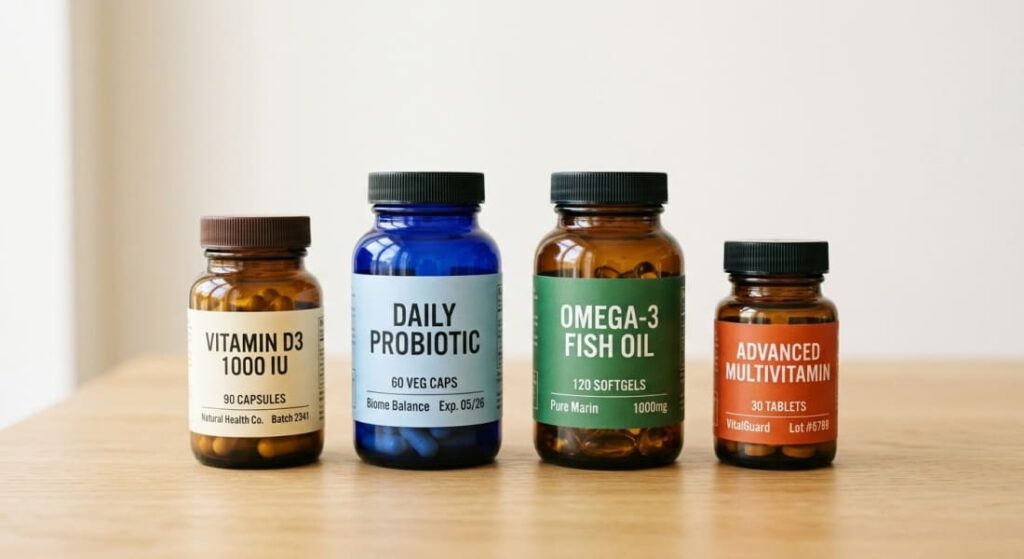
glass pill bottles
When Plastic Pill Bottles Make More Sense
To be fair, plastic is the better choice in plenty of cases:
Mass-market supplements sold at low price points
Very high-volume distribution where freight costs add up fast
Cost-sensitive product lines with tight margins
E-commerce products shipped directly to consumers with rough handling
Products with low sensitivity to moisture, oxygen, or light
Pharmacy dispensing, where lightweight and shatter-resistant bottles are the norm
Settings where breakage is a safety risk, such as hospitals, gyms, or travel products
There’s no shame in choosing plastic when it fits your product. The goal is the right package, not the fanciest one.
How to Choose Between Plastic and Glass Pill Bottles
If you’re still on the fence, work through these steps:
- Assess your formula’s sensitivity.Is it affected by moisture, oxygen, or light? Your R&D or quality team should know.
- Set your shelf-life target.Longer shelf life usually calls for stronger barrier protection.
- Review regulatory requirements.Check the rules for your product type and every market you sell in.
- Define your brand positioning.Are you premium, mid-market, or value-focused?
- Calculate total cost.Include freight, breakage, protective packaging, and potential product loss.
- Consider sustainability goals.Look at recycling systems in your key markets.
- Test before you commit.Run stability and compatibility tests with the actual bottle and closure.
Here’s a quick decision guide you can use as a starting point:
Your Priority | Usually the Better Choice |
Premium branding | Glass |
Lowest freight cost | Plastic |
Chemical inertness | Glass |
Breakage resistance | Plastic |
Light protection | Amber glass |
Oxygen barrier | Glass |
Lowest unit price | Plastic |
Recyclability story | Glass |
E-commerce durability | Plastic |
Long shelf life for sensitive products | Glass |
Choosing the Right Glass Pill Bottle Supplier
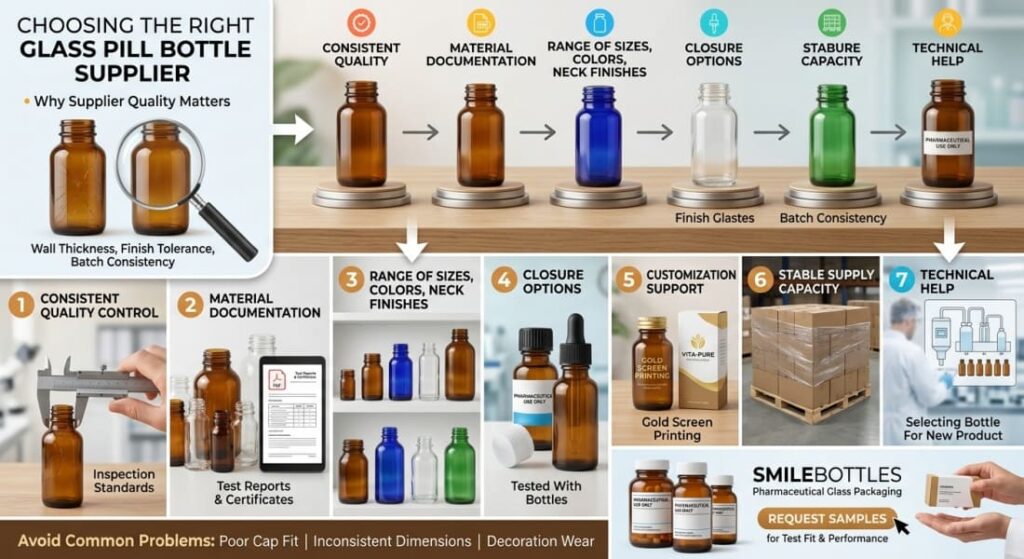
If you decide glass is right for you, your supplier matters almost as much as the material. Two glass bottles can look identical on paper and still perform differently because of wall thickness, finish tolerance, or batch consistency.
When you compare suppliers, look for a pill bottle manufacturer that can offer:
Consistent quality control with clear inspection standards
Material documentation and test reports
A range of sizes, colors, and neck finishes
Closure options that are tested with the bottles
Customization support, from decoration to private molds
Stable supply capacity for bulk orders
Technical help when you’re selecting a bottle for a new product
An experienced glass packaging manufacturer can also help you avoid common problems, like poor cap fit, inconsistent bottle dimensions that slow down filling lines, or decoration that wears off in transit.
At Smilebottles, we work with pharmaceutical and nutraceutical brands on glass medicine bottle projects, including amber glass options for light-sensitive products, custom decoration, and closure matching. If you’re comparing suppliers, it’s worth asking any pharma packaging supplier for samples so you can test fit and performance with your own product before placing a large order.
FAQ: Frequently Asked Questions About Plastic vs. Glass Pill Bottles
Q1:Are glass pill bottles better than plastic?
A1:It depends on your product. Glass is usually better for chemical inertness, barrier protection, and premium appearance. Plastic is usually better for weight, impact resistance, and lower costs. For sensitive or high-value products, glass is often the better fit.
Q2:Do pills last longer in glass bottles?
A2:They can, especially if the product is sensitive to moisture, oxygen, or light. However, shelf life also depends on the formula, the closure system, desiccants, and storage conditions. Stability testing is the only way to know for sure.
Q3:Are amber glass bottles good for vitamins and supplements?
A3:Yes. Amber glass blocks most UV light and some visible light, which helps protect light-sensitive vitamins and herbal ingredients. It’s one of the most common choices for supplements for this reason.
Q4:Why do pharmacies usually use plastic pill bottles?
A4:Plastic bottles are light, hard to break, inexpensive, and easy to handle during dispensing. For short-term use after a prescription is filled, they work well for most medications.
Q5:Is glass safer than plastic for capsules?
A5:Glass is more chemically inert, so there’s less risk of interaction with your product. That said, both materials can be safe when they’re the right grade and have been tested with your specific formula.
Q6:Which is more sustainable: glass or plastic pill bottles?
A6:It depends on recycling systems, shipping distances, and reuse options. Glass can be recycled many times without quality loss, while plastic’s lower weight can reduce transport emissions. Look at the full life cycle for your supply chain.
Q7:What is the best bottle for vitamins and supplements?
A7:The best bottle depends on how sensitive your ingredients are, what shelf life you need, how you sell, and how you want your brand to be seen. Amber glass is a strong option for many sensitive and premium products.
Conclusion
There’s no universal winner in the plastic vs. glass debate. Plastic gives you lower weight, better impact resistance, and lower costs. Glass gives you stronger barrier protection, chemical inertness, a premium look, and a good recycling story.
For pharmaceutical and nutraceutical products, the right choice comes down to how sensitive your formula is, what your market requires, how you want your brand to be seen, and what your total packaging cost looks like. When product integrity and premium positioning matter most, glass pill bottles are often the better long-term choice.
Before you make a final decision, request samples, run compatibility tests, and talk with your supplier about the full packaging system.
 French
  English
  Russian
  Spanish (Chile)
  Spanish (Colombia)
  Spanish (Ecuador)
  Swedish
  Arabic
  Portuguese