
Table of Contents
ToggleAuthor: SmileBottles Editorial Team
Estimated Reading Time: About 14Minutes
If you are launching a new skincare line or upgrading your existing brand, you already know that packaging is just as important as the product inside. When you source glass jars for cosmetics, one of the most critical decisions you will make is choosing the correct size. The right jar size does more than just hold your formula; it impacts your user experience, product positioning, shipping costs, and shelf appeal.
As a beauty brand owner or purchasing manager, you need to understand the nuances of cream jar packaging. This guide, Smilebottles will walk you through everything you need to know about glass cream jar sizes, from measurement units and standard capacities to how you can choose the perfect size for your specific product. Whether you are looking for trial sizes or bulk containers, this comprehensive breakdown will help you make an informed decision for your next project.
Introduction: Why Glass Cream Jar Size Matters in Cosmetic Packaging
When you are sourcing packaging for creams, balms, or masks, the physical size of the container plays a massive role in your product’s success. It is not just about finding a vessel to hold your formula. The dimensions and volume of your glass skincare jars directly influence several core business factors.
First, size dictates the user experience. A jar that is too small for a daily body butter will frustrate your customers, while a massive jar for a premium eye cream will seem wasteful and ruin the luxury feel. Second, the size affects your bottom line. Larger, heavier jars cost more to ship, and inefficient sizes can complicate your filling lines. Finally, consumers have built-in market expectations. When someone buys a standard day cream, they subconsciously expect a specific volume. If your packaging deviates too far from the norm, it might confuse buyers or make them question the value of your product.
By understanding the standard sizes and how to measure them, you ensure that your packaging meets both industry standards and your customers’ expectations.
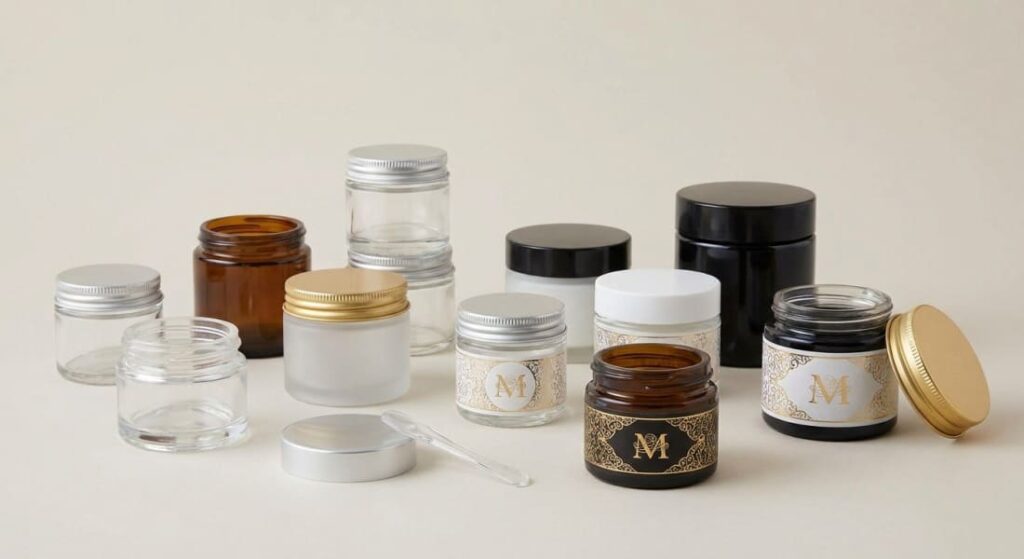
Common Units of Measurement for Glass Cream Jars
When you start talking to a skincare packaging manufacturer, you will hear a few different measurement terms. Understanding these units is essential to ensure you order exactly what you need.
Milliliters (ml)
Milliliters are the most widely used measurement in the cosmetic packaging industry worldwide. They measure volume, which tells you how much space is inside the jar. When you look at catalogs for cosmetic packaging jars, you will almost always see sizes listed in milliliters. Common examples include 5ml, 15ml, 30ml, 50ml, and 100ml.
Ounces (oz)
While milliliters are standard globally, ounces are frequently used in the US and some international markets. You will often need to convert between the two depending on where your target audience lives. Here is a quick reference for approximate conversions:
5ml ≈ 0.17 oz
10ml ≈ 0.34 oz
15ml ≈ 0.5 oz
30ml ≈ 1 oz
50ml ≈ 1.7 oz
100ml ≈ 3.4 oz
Gram vs. Milliliter: What Buyers Should Know
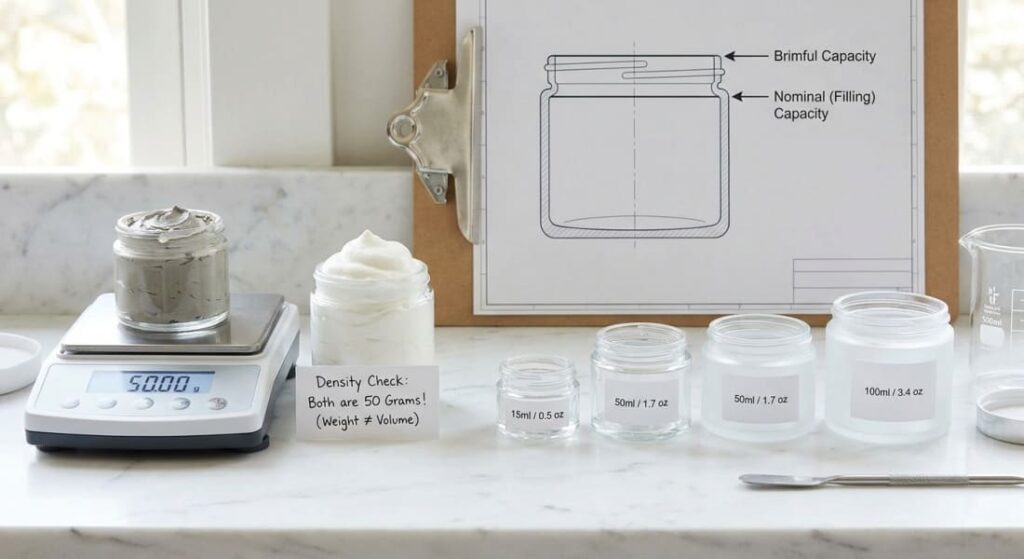
A common point of confusion for buyers is the difference between grams (weight) and milliliters (volume). Cream jars are usually categorized by volume. However, because cosmetic formulas have different densities, 50ml of a light, whipped face cream will not weigh the same as 50ml of a dense, heavy clay mask. Therefore, a 15 gram cream size might actually require a 20ml jar depending on how fluffy your formula is. Always request samples and do a real-world filling test with your specific formula rather than assuming 1 gram equals 1 milliliter.
Capacity Terms You May See
When reviewing technical specifications, you might come across terms like:
Brimful capacity: The absolute maximum volume of liquid the jar can hold if filled to the very top edge.
Nominal capacity (or Filling capacity): The practical, recommended fill volume that allows room for the inner lid and cap without spilling over.
How to Measure a Glass Cream Jar Correctly
Knowing how to properly measure a jar will save you time and money, especially when matching jars with custom caps or calculating shipping carton sizes.
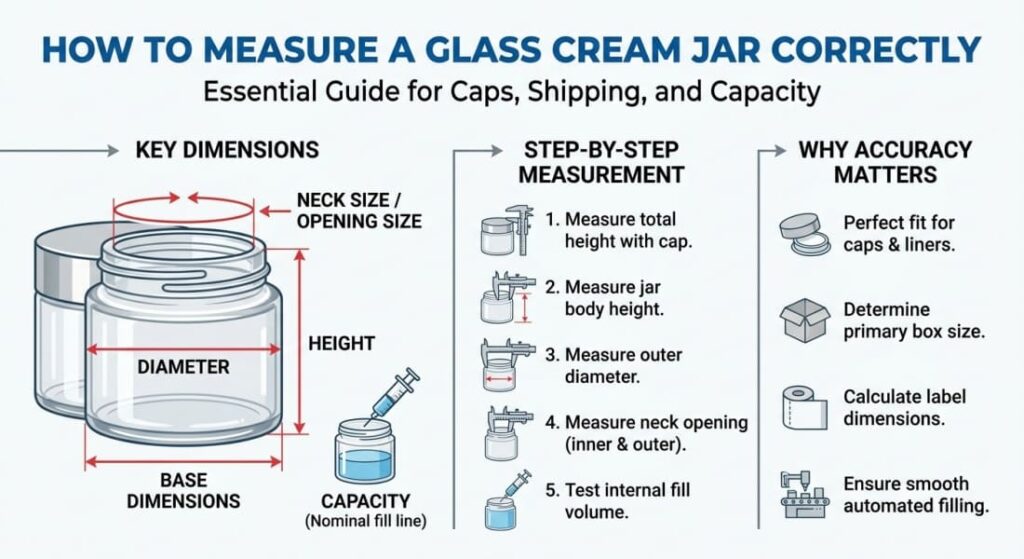
Key Dimensions of a Cream Jar
To get a complete picture of your jar, you need to measure a few distinct areas:
Diameter: The width across the bottom or the widest part of the jar body.
Height: Measured from the base to the top of the neck.
Neck Size / Opening Size: The diameter of the mouth, which dictates what size cap you need.
Base Dimensions: The footprint of the jar, important for retail shelf planning.
How Capacity Is Determined
As mentioned earlier, capacity is usually measured in ml. You should always focus on the nominal capacity to ensure your filling machines do not overflow the jars.
How to Measure Jar Dimensions Step by Step
If you have a physical sample and need to verify its specs:
Use calipers to measure the total height with the cap on.
Remove the cap and measure the jar body height.
Measure the outer diameter at the widest point of the jar.
Measure the neck opening (both the inner hole and the outer threading).
To test internal fill volume, fill the jar with water using a graduated syringe up to the nominal fill line.
Why Accurate Measurement Matters
Accurate measurements ensure that your caps, liners, and spatulas fit perfectly. They also dictate the size of your primary paper box, help you calculate the exact dimensions for label printing, and ensure your jars will run smoothly on automated filling machinery.
Standard Glass Cream Jar Sizes and Best Uses in Cosmetics
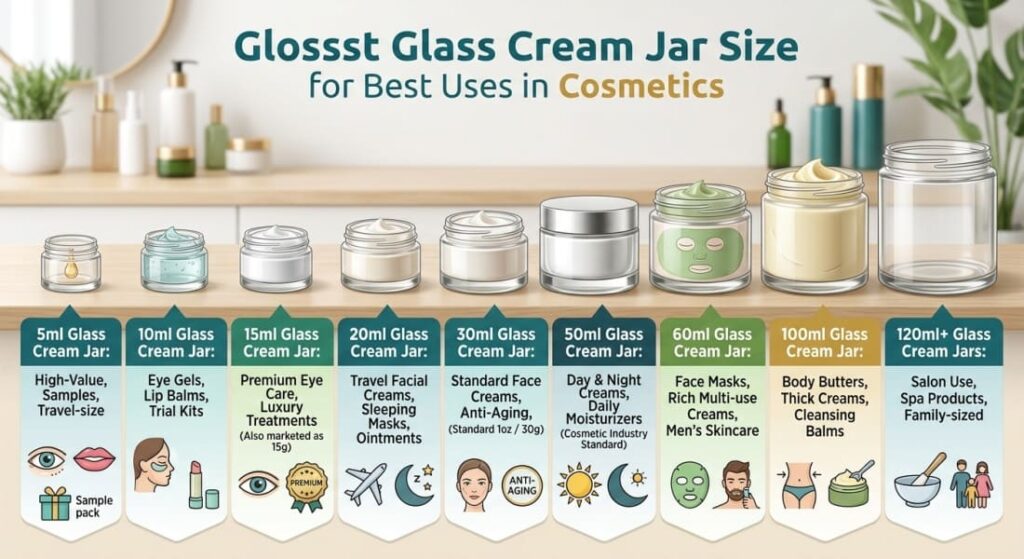
Different cosmetic products require different amounts of formula. Here is a breakdown of the standard sizes and what they are best used for.
5ml Glass Cream Jars
These tiny jars are perfect for high-value, highly concentrated products. You will commonly use them for eye creams, lip masks, sample packs, and travel-size promotional giveaways.
10ml Glass Cream Jars
Slightly larger, the 10ml size is ideal for eye gels, lip balms, concentrated spot treatments, and premium trial kits.
15ml Glass Cream Jars
This is the gold standard for premium eye care. When a consumer buys an eye cream, they generally expect this size. If your formula is slightly denser, you might market this as a 15 gram cream size. It is also great for small-batch luxury treatments.
20ml Glass Cream Jars
If you are formulating travel-size facial creams or sleeping masks, 20ml is an excellent choice. Some brands also use this size for specialized ointments, sometimes marketed as cream jars for 20 grams depending on product weight.
30ml Glass Cream Jars
The 30ml jar is incredibly versatile. It is the classic one-ounce size, perfect for standard face creams, anti-aging moisturizers, and functional skincare treatments. If you are looking for a standard 30g bottle size for dense creams, this 30ml vessel is usually the perfect match.
50ml Glass Cream Jars
The 50ml glass cream jar is arguably the most recognizable size in the beauty industry. It is the absolute standard for day creams, night creams, and daily moisturizers.
60ml Glass Cream Jars
At two ounces, the 60ml jar gives a little extra room. It is best used for face masks, rich multi-use creams, and men’s skincare products that require a slightly larger daily dose.
100ml Glass Cream Jars
When you move into body care, 100ml is where you start. This size is best for body butters, thick body creams, cleansing balms, and hair masks.
120ml and Larger Sizes
For professional salon use, spa products, or family-sized body care, you will want jars sized at 120ml, 150ml, or even 200ml.
Quick Reference Chart:
|
Jar Size |
Approx. Oz |
Common Cosmetic Use |
|
5ml |
0.17 oz |
Eye cream, samples |
|
15ml |
0.5 oz |
Eye treatment |
|
30ml |
1 oz |
Small face cream |
|
50ml |
1.7 oz |
Day/night cream |
|
100ml |
3.4 oz |
Body butter, cleansing balm |
Choosing the Right Glass Cream Jar Size for Different Cosmetic Products
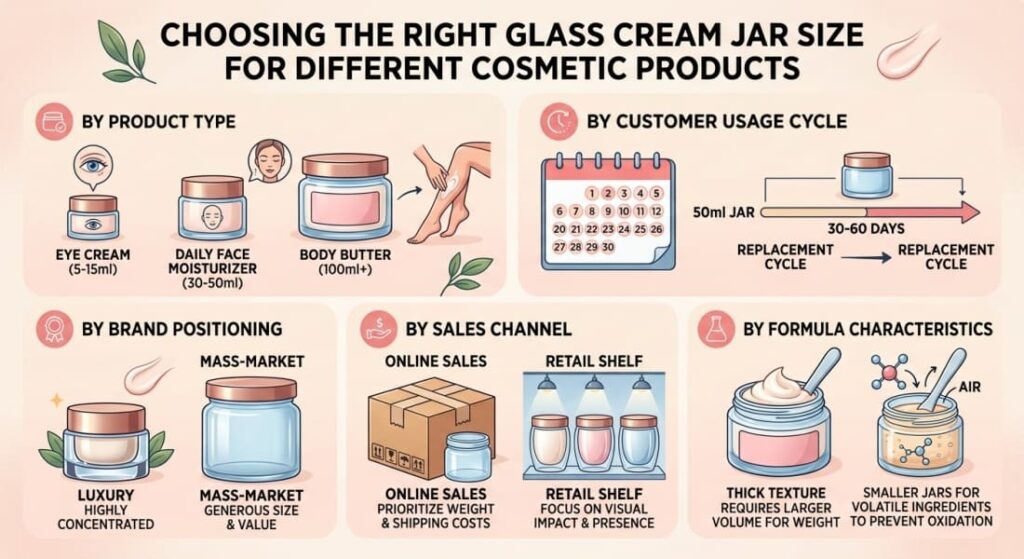
Selecting the right size is not a guessing game. You need to align the jar’s capacity with your product’s purpose, your brand identity, and your customers’ habits. When you are looking for glass jars for face cream or body lotions, consider these angles:
By Product Type
The application area dictates the size. An eye cream requires a very small amount per use, so 5ml to 15ml is plenty. A daily face moisturizer requires more, placing it in the 30ml to 50ml range. Body butter, which is applied liberally over arms and legs, needs at least a 100ml jar.
By Brand Positioning
Luxury brands often lean toward smaller jars for highly concentrated, expensive formulas, or they use thick-walled glass to make a smaller volume feel heavier and more premium. Mass-market brands, on the other hand, focus on value, offering larger standard sizes that look generous on the retail shelf.
By Customer Usage Cycle
Think about how long you want the product to last. Most skincare brands aim for a 30-to-60-day replacement cycle. A 50ml jar of day cream used every morning typically lasts about a month to a month and a half.
By Sales Channel
If you sell primarily online, weight and dimensions are crucial because they dictate your shipping costs. A massive, heavy jar might eat into your profit margins. For retail shelves, visual impact matters more, so you might choose a double-walled design that looks larger than its actual internal capacity.
By Formula Characteristics
Thick, whipped textures take up more space and might require a larger volume jar just to hold a standard weight of product. Volatile formulas with active ingredients might need smaller jars so the consumer finishes the product before it oxidizes.
Other Important Factors to Consider Besides Jar Size
While capacity is crucial, the physical design and material of your glass cosmetic jars will ultimately define your brand’s aesthetic.
Material Quality and Glass Thickness
Glass offers a premium, weighty feel that plastic simply cannot match. It provides superior chemical stability, meaning it will not react with your active ingredients. Furthermore, consumers increasingly demand eco friendly cosmetic jars, and glass is highly recyclable. Thick-bottomed jars add a sense of luxury and durability.
Jar Shape and Design
You are not limited to basic round jars. You can choose straight-sided jars for a modern, minimalist look, or opt for heavy-base luxury designs that command attention.
Closure Options
The cap is just as important as the jar. You need to select high-quality screw caps, inner lids (to prevent messy lids during shipping), and proper foam or foil liners to ensure an airtight seal. Many brands also pair their jars with custom spatulas for hygienic application.
Color Options
Clear glass is great for showing off colorful formulas, but it exposes ingredients to light. Amber glass provides excellent UV protection for sensitive formulas. Alternatively, you can choose frosted glass cosmetic jars for a soft, elegant aesthetic, or use custom color spraying to make your jars completely opaque in black, white, or your specific brand colors.
Decoration and Branding
To stand out, you need custom decoration. Look into silk screen printing, hot stamping for metallic logos, custom labeling, or electroplating. The way you decorate the jar turns a basic container into a branded masterpiece.
Compatibility with Filling and Packing
Make sure the neck opening is wide enough for your automated filling lines. Check that the cap threads smoothly to prevent leakage during transport. Always conduct compatibility testing before placing a massive bulk order.
Why 50ml Is the Most Popular Glass Cream Jar Size in Skincare
If you look at the market, the 50ml size dominates the skincare aisle. Why? Because it strikes the perfect balance. It is the established consumer standard for face creams and moisturizers. It provides a 30-to-45-day supply, which is the ideal timeframe for consumers to see results and return to buy more. Furthermore, it is a highly practical size for retail merchandising—not too small to get lost on the shelf, and not too big to take up unnecessary space.
Common Mistakes When Choosing Glass Cream Jar Sizes
Even experienced buyers make errors. Here are a few traps you should avoid:
Choosing size solely based on appearance: Do not pick a jar just because it looks cute without calculating if it actually holds the right amount of your specific formula.
Confusing grams with milliliters: As stressed earlier, always test your formula’s density.
Ignoring shipping costs: Heavy glass is premium, but oversized packaging for a tiny amount of product will skyrocket your freight costs.
Forgetting the inner lid: If your jar requires an inner disc, ensure the nominal capacity allows room for it without pushing the cream out over the edges.
Why Cosmetic Brands Choose Smilebottles for Glass Cream Jars
When you are ready to order, partnering with a reliable cosmetic packaging manufacturer makes all the difference. Smilebottles has built a reputation as a trusted cosmetic packaging factory by focusing on what beauty brands actually need.
First, we offer a massive range of standard sizes. Whether you need 5ml sample jars or 100ml body butter containers, we have molds ready to go. Second, we excel in custom packaging solutions. We do not just sell plain glass; we offer custom color spraying, silk screen printing, and bespoke cap designs to make your brand unique.
Furthermore, as a direct cosmetic glass jar manufacturer, we ensure strict quality control. You get durable glass, consistent threading, and stable supply chains. Whether you are looking for glass cream jars wholesale for a massive retail launch or need flexible OEM/ODM support for a growing private label, Smilebottles provides a seamless, one-stop service from raw glass production to final decoration and shipping.
FAQ: Frequently Asked Questions About Glass Cream Jar Sizes
Q1:What is the most common size for a glass cream jar?
A1:The 50ml jar is the industry standard and the most common size for daily face creams and moisturizers.
Q2:What size jar is best for eye cream?
A2:Eye creams are highly concentrated, so 5ml, 10ml, or 15ml jars are typically the best choices.
Q3:Is jar capacity measured in ml or grams?
A3:Jars are measured in milliliters (ml) to indicate volume. Grams measure weight, which will vary based on the specific density of your cosmetic formula.
Q4:How do I choose the right jar size for my cosmetic product?
A4:You should consider the type of product, how much a customer uses per application, your brand’s price point, and your shipping and retail requirements.
Q5:Are glass cream jars better than plastic jars?
A5:Glass jars offer a more premium, weighty feel and superior chemical stability. They are also infinitely recyclable, making them highly attractive to eco-conscious consumers.
Q6:Can I customize glass cream jars with my logo and color?
A6:Yes. A professional manufacturer can provide silk screen printing, hot stamping, frosting, and custom color spraying to match your exact brand guidelines.
Q7:What size glass jar is best for samples or travel skincare?
A7:For travel and sample kits, 5ml to 20ml jars are the most practical and cost-effective.
Conclusion
Choosing the right glass cream jar size is a foundational step in bringing your cosmetic product to market. The capacity you select impacts everything from your filling line efficiency and shipping costs to how the consumer perceives your brand’s value. By understanding the standard dimensions—from 5ml eye cream jars up to 100ml body butter containers—you can align your packaging perfectly with your formulation and market expectations.
Do not leave your packaging success to chance. You need a reliable cosmetic packaging supplier to help you navigate capacities, decorations, and shipping logistics. If you are ready to find the perfect jars for your skincare line, reach out to Smilebottles today to explore our extensive catalog of standard and custom glass cream jar solutions.