
Table of Contents
ToggleAuthor: SmileBottles Editorial Team
Estimated Reading Time: About 16 Minute
If you buy glass bottles for juice, tea, sauce, dairy drinks, or other beverage lines, the filling method matters just as much as the bottle shape. It affects food safety, shelf life, packaging cost, and even the way the bottle itself has to be designed. When you compare hot fill vs cold fill in glass bottles, you are not only picking a process. You are shaping how your product looks, tastes, and lasts on the shelf.
Glass is used everywhere in beverages because it protects flavor, looks premium, and works with different filling systems. Still, the same bottle will not fit every process. That is why understanding hot fill glass bottles and cold fill glass bottles is worth your time before you place a large order.
This guide walks you through both methods in plain language. You will see what each process really does, where each one fits best, and how to choose the right approach for your product. By the end, you should feel more confident when talking to your filling partner or your packaging supplier.
What Is Hot Filling in Glass Bottles?
What hot filling means
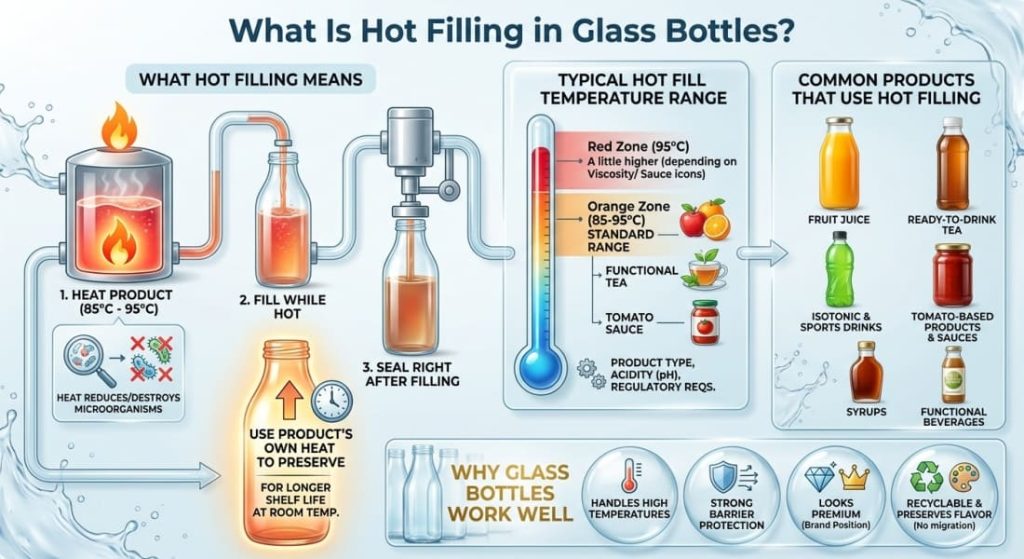
So what is hot filling? In simple terms, the product is heated to a high temperature first, then filled into clean or sterilized glass bottles while still hot. The bottle is sealed right after filling, and the heat inside helps reduce or destroy microorganisms.
The idea is straightforward: the hot fill process uses the product’s own heat to help preserve it. That is why it is common for beverages and sauces that need a longer shelf life at room temperature.
Typical hot filling temperature range
Fill temperatures usually sit around 85°C to 95°C. Some products go a little higher or lower, depending on: product type, acidity (pH), viscosity, regulatory requirements in the target market
A thin fruit juice, a thicker tomato sauce, and a functional tea will not follow the exact same setting, but they often fall inside this range.
Common products that use hot filling
You will often see hot filling in:fruit juices, ready-to-drink teas, isotonic and sports drinks, tomato-based products, sauces, syrups, some functional beverages
These are usually products that are either acidic or stable enough to handle heat without losing their identity.
Why glass bottles work well for hot filling
Glass has a few natural strengths that matter here. It can handle high temperature better than many plastics. It gives strong barrier protection, so your product stays cleaner for longer. It looks premium on the shelf, which supports brand positioning. It is recyclable. And it does not pass flavor into the product, which is important when you have spent time perfecting a recipe.
For these reasons, hot fill glass bottles remain a common choice for juice, tea, and sauce brands around the world.
What Is Cold Filling in Glass Bottles?
What cold filling means
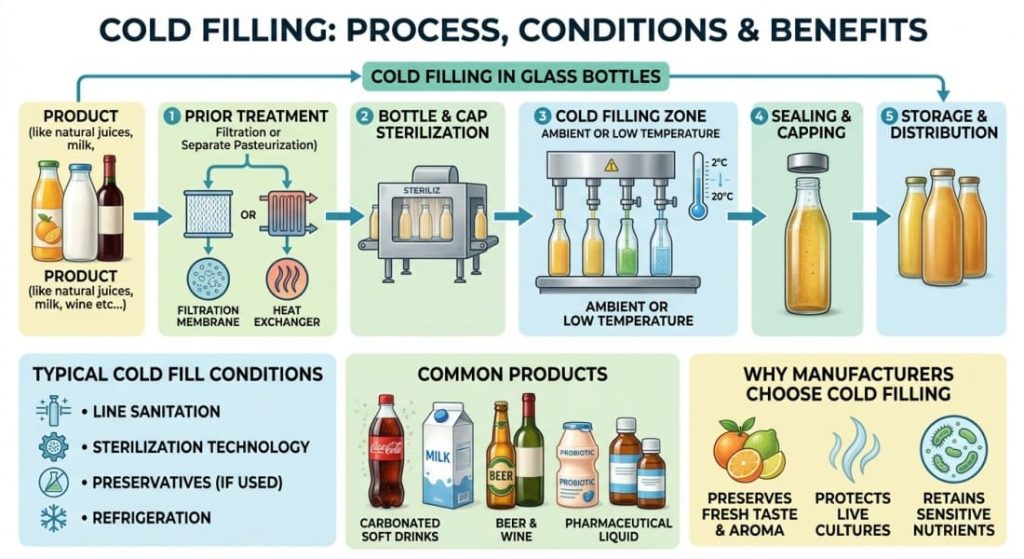
If someone asks you what is cold filling, the answer is basically the opposite. The product is filled at a low or ambient temperature. The heat step is either done separately or not needed at all.
The cold filled meaning in everyday factory language is simple: the liquid never becomes the “sterilizing agent” inside the bottle. Instead, the product and the container are cleaned and controlled through other methods, such as filtration, separate pasteurization, sterilization, refrigeration, or aseptic filling.
Typical cold filling conditions
Cold filling may happen at chilled, cool, or room temperature. There is no single number that fits every line. What matters is that the safety of the product does not depend on hot temperature during filling. Instead, it depends on:line sanitation, sterilization, preservatives (when used), refrigeration, aseptic technology
Common products that use cold filling
Typical products include: carbonated soft drinks, milk and other dairy beverages, beer, wine, spirits, probiotic drinks, some pharmaceutical and nutraceutical liquids, any product that reacts badly to heat
Anything sensitive to temperature tends to end up on a cold fill line.
Why manufacturers choose cold filling
For many drinks, taste and quality can’t survive high heat. Fresh dairy, live cultures, delicate aromas, and carbonation all suffer if you heat them too much. Cold fill beverage preservation protects those qualities by shifting the safety strategy away from heat and toward hygiene and controlled processing.
If your brand relies on fresh taste, natural aroma, or “live” ingredients, cold filling often makes more sense.
How the Hot Filling Process Works in Glass Bottles
Understanding the hot filling process step by step helps you spot where quality and packaging really matter.
Step 1: Product preparation and heating
You start by mixing your ingredients and heating the product to the target temperature. This heat step is a core part of microbial safety, so it has to hit the right temperature and hold long enough.
Step 2: Glass bottle inspection and cleaning
Before filling, bottles are checked for cracks, chips, or shape defects. They are then washed or air-rinsed, depending on the production standard. A tiny fault that is fine at room temperature can become a break point under heat, so this stage is more important than it looks.
Step 3: Filling at high temperature
Hot liquid goes into the glass bottle while the process temperature is kept stable. Sudden temperature drops can weaken the preservation effect, so the line is designed to keep heat steady.
Step 4: Capping and sealing
The bottle is sealed right after filling. Quick sealing keeps the headspace clean and helps lock in the effect of the heat. This is one reason closure compatibility matters so much for hot fill applications.
Step 5: Inversion or holding period if required
Some lines invert bottles for a short time after capping. That lets the hot product touch the cap and the headspace, which helps reduce contamination risk in that small but critical area.
Step 6: Cooling
After sealing, bottles cool gradually, usually through a cooling tunnel. Fast cooling can cause thermal shock and crack the glass. Slow, controlled cooling protects both the bottle and the product.
Key control points in hot filling
For your process, the main things to watch are: fill temperature, holding time, closure compatibility, controlled cooling, glass bottle thermal resistance
If any one of these is off, you may see broken bottles, deformed caps, or products that don’t last as long as expected.
How the Cold Filling Process Works in Glass Bottles
The cold filling process looks simple on paper, but the control demands are different.
Step 1: Product treatment and preparation
Your product may be filtered, pasteurized separately, sterilized, or processed under aseptic conditions before it reaches the filler. The point is that the safety work is done before filling, not during it.
Step 2: Bottle cleaning or sterilization
Glass bottles are cleaned, and in many cases sterilized, before filling. For sensitive products, this step can decide whether the shelf life is stable or not.
Step 3: Filling at low or ambient temperature
The product enters the bottle under hygienic or aseptic conditions. Since there is no strong heat step at this moment, everything around the fill point has to stay very clean.
Step 4: Capping and sealing
Closures need to protect the product from contamination and, for carbonated or oxygen-sensitive drinks, from gas loss. A good seal helps hold flavor, freshness, and carbonation over time.
Step 5: Optional secondary processing
Some products then go through refrigeration, tunnel pasteurization, or cold-chain storage. Others may go straight to distribution. It depends on the formula and the shelf-life plan.
Key control points in cold filling
The main control points are: hygiene level of the production line, sterilization effectiveness, closure performance, refrigeration or cold-chain requirements, oxygen and CO₂ control for sensitive beverages
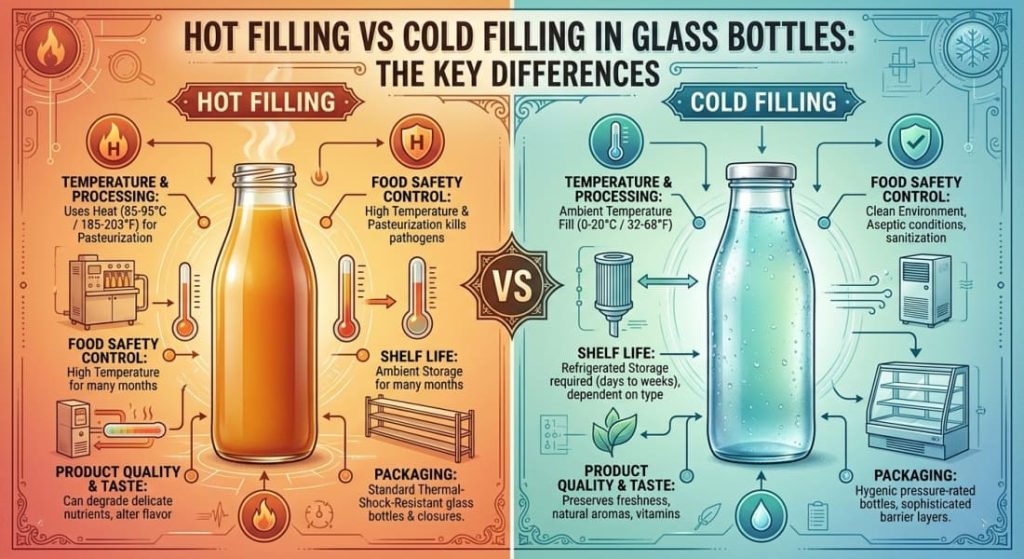
Hot Filling vs Cold Filling in Glass Bottles: The Key Differences
Both methods can produce safe, high-quality drinks. The real question is which one fits your product better
Difference in temperature and processing
The clearest gap is the fill temperature. Hot filling uses heat as a preservation tool. Cold filling relies on cleaner processing and other controls. This shapes almost every other decision after it.
Difference in food safety control
With hot filling, the heat itself does a lot of the safety work inside the bottle. With cold filling, safety comes from the environment: air quality, equipment sanitation, water quality, and closure integrity. Both can be safe, but the control focus is not the same.
Difference in shelf life
Well-designed hot-filled products can sit on ambient shelves for many months. Cold-filled products vary a lot. Some carbonated drinks and beers hold up well at room temperature, while dairy and probiotic drinks usually need refrigeration.
Difference in product quality and taste
Heat can be tough on delicate ingredients. Fresh notes, natural aromas, some vitamins, and live cultures don’t enjoy high temperatures. If you care most about a fresh, close-to-original taste, cold filling has an edge.
Difference in packaging and bottle requirements
Hot filling asks for bottles with good thermal shock resistance and closures that stay tight during cooling. Cold filling asks for bottles that meet the right hygiene, pressure, and barrier levels. Carbonated drinks in particular need bottles that can hold internal pressure without failure.
Difference in production cost and efficiency
Hot filling burns more energy for heating and cooling. Cold filling can save on heat but may cost more on sterile lines, aseptic technology, or cold-chain logistics. The “cheaper” option really depends on your existing setup and the volume you plan to run.
Pros and Cons of Hot Filling in Glass Bottles
Advantages of hot filling
Extends shelf life for suitable products
Reduces or removes the need for some preservatives
Works well for high-acid beverages and sauces
Glass handles higher temperatures better than many plastic materials
Supports ambient distribution, which simplifies logistics
If you sell juices, teas, or sauces in markets without strong cold-chain support, this is often the more practical route.
Limitations of hot filling
Not ideal for heat-sensitive ingredients
Can affect taste, color, or nutrition
Needs bottles and closures with reliable thermal performance
Cooling must be controlled to avoid breakage
Adds energy cost from both heating and cooling
Pros and Cons of Cold Filling in Glass Bottles
Advantages of cold filling
Protects carbonation and fresh flavor
Keeps heat-sensitive nutrients and aromas closer to the original recipe
Suits dairy, alcohol, kombucha, and probiotic drinks
Delivers strong product quality when combined with proper hygiene systems
Offers flexibility for premium and “fresh” positioning
Limitations of cold filling
Demands stricter sanitation across the line
Often requires refrigeration or aseptic technology
Shelf life can be shorter without extra preservation steps
Process control is more complex, especially for small teams
Cold-chain failures can hurt product quality quickly
Which Products Are Better Suited to Hot Fill or Cold Fill Glass Bottles?
Best products for hot filling:Fruit juices, Tea beverages, Sports and isotonic drinks, Jams and liquid sauces, Other high-acid products
Best products for cold filling: Carbonated soft drinks, Beer, Wine, Milk-based beverages, Kombucha, Functional drinks with heat-sensitive ingredients
Can some products use either process?
Yes. Some beverages can go either way depending on: formulation, pH, shelf-life goals, available equipment, distribution conditions, regulatory compliance
For example, a fruit tea can be hot-filled for ambient shelf life or cold-filled with aseptic support for a fresher taste. Two similar products on the same shelf may still come from two different filling lines.
How to Choose Between Hot Filling and Cold Filling for Your Glass Bottles
Choosing the right method is not only a technical call. It ties into your brand, your target market, and your logistics. Here is how to think it through.
Consider your product formulation
Ask yourself:
How acidic is your product?
How much sugar does it contain?
Does it include dairy, cream, or protein?
Is it carbonated?
Are any ingredients sensitive to heat?
A high-acid juice can usually handle hot filling. A dairy-based probiotic drink usually cannot.
Consider your shelf-life target
Do you need ambient shelf life for supermarket distribution, or is a chilled shelf life fine for your market? Are you exporting long distances? The longer and hotter the journey, the more shelf stability matters.
Consider food safety and compliance
Different markets have different rules. Check local regulations, microbial risk levels, and how much you want to rely on preservatives. Cold filling may push you toward stricter validation, while hot filling requires steady heat control.
Consider bottle and closure design
Whatever process you pick, your bottle has to match. Look at: thermal shock resistance, neck finish compatibility, cap liner suitability, internal pressure requirements
A great process with the wrong bottle will still fail. This is one of the most common issues buyers run into.
Consider production cost and line capability
Think about what you already have. Do you have heating and cooling equipment? Aseptic filling capacity? Cold-chain logistics? Adding a new capability from scratch is a big investment. Fitting the process to your current line often saves money and time.
Consider consumer positioning
If your brand is built on “clean label,” “preservative free,” or “fresh taste,” that shapes the decision too. A premium probiotic drink almost always calls for cold filling. A shelf-stable, no-preservative juice may lean toward hot filling. The process should match the story you want on the label.
Why Choose Smilebottles for Hot Fill and Cold Fill Glass Bottles?
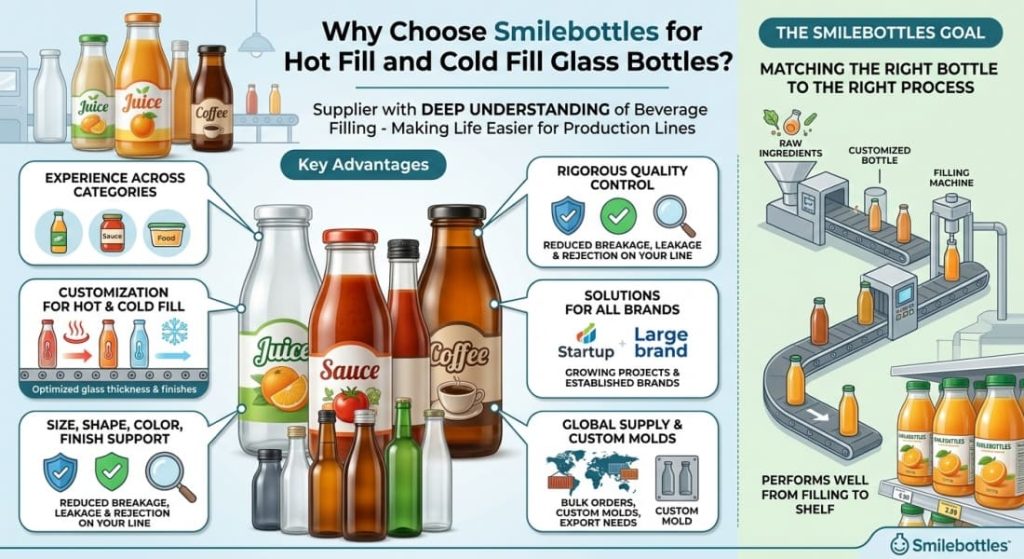
If you are sourcing bottles for either process, working with a supplier that understands beverage filling makes life easier. At Smilebottles, the focus is on practical packaging that fits real production lines, not just catalog specs.
You can expect:
glass bottle manufacturing experience across beverage, sauce, and food categories
bottle customization for different filling methods, including hot fill and cold fill
support on size, shape, color, finish, and decoration
quality control aimed at reducing breakage, leakage, and rejection on your line
solutions for both established brands and growing beverage projects
support for bulk orders, custom molds, and export needs
The goal is simple: help you match the right bottle to the right process, so your product performs well from filling to shelf.
FAQ Frequently Asked Questions About Hot Filling vs Cold Filling in Glass Bottles
Q1:Is hot filling better than cold filling?
A1:Not always. It depends on your product, shelf-life target, and the equipment you can run. For high-acid juices and sauces, hot filling is often a strong fit. For carbonated or heat-sensitive drinks, cold filling usually wins.
Q2:Can glass bottles be used for both hot filling and cold filling?
A2:Yes. But the bottle design has to match. Hot-fill bottles need thermal shock resistance. Cold-fill bottles for carbonated products need proper pressure resistance.
Q3:What temperature is used in hot filling?
A3:Most hot-fill processes run around 85°C to 95°C, depending on the product and local regulations.
Q4:Is cold filling safer for carbonated drinks?
A4:In general, yes. Carbonation is very sensitive to heat, so cold filling is normally the better choice for sparkling drinks, beer, and similar products.
Q5:Do hot-filled glass bottles need preservatives?
A5:Not always. Many hot-filled products rely mostly on heat treatment and sealing. Whether preservatives are needed depends on the formula, target shelf life, and local rules.
Q6:Which is more expensive, hot filling or cold filling?
A6:There is no single answer. Hot filling adds heating and cooling costs. Cold filling can raise costs for sterile equipment, aseptic systems, or cold-chain logistics. Your current setup usually decides which is cheaper for you.
Conclusion
Glass bottles can perform well in both, as long as the bottle design fits the process. The best choice for your brand depends on the product formula, your shelf-life target, the filling line you can access, and the packaging design you want to run with.
If you are sourcing glass bottles for hot fill or cold fill applications, Smilebottles can help you find a packaging solution that fits your product, your process, and your market—so you can focus on growing your brand instead of chasing packaging problems.
 English