
Table of Contents
ToggleAuthor: SmileBottles Editorial Team
Estimated Reading Time: About 15 Minute
You can choose a bottle in five minutes from a catalog. Choosing one that still works after filling, capping, labeling, packing, and shipping takes longer. Capacity is only the number printed on the front. The bottle also has to suit your sauce, your equipment, your sales channel, and the way a customer pours it at the table.
That is why buyers should compare hot sauce bottle sizes as complete packaging systems. The bottle, reducer, cap, label, carton, and filling process have to work together. If one part is wrong, a low bottle price will not save the project. This guide gives you a practical way to narrow the options. You will find common capacities, approximate dimensions, bottle shapes, closure considerations, and the questions worth asking before you order hot sauce bottles for production.
What is the standard hot sauce bottle size?
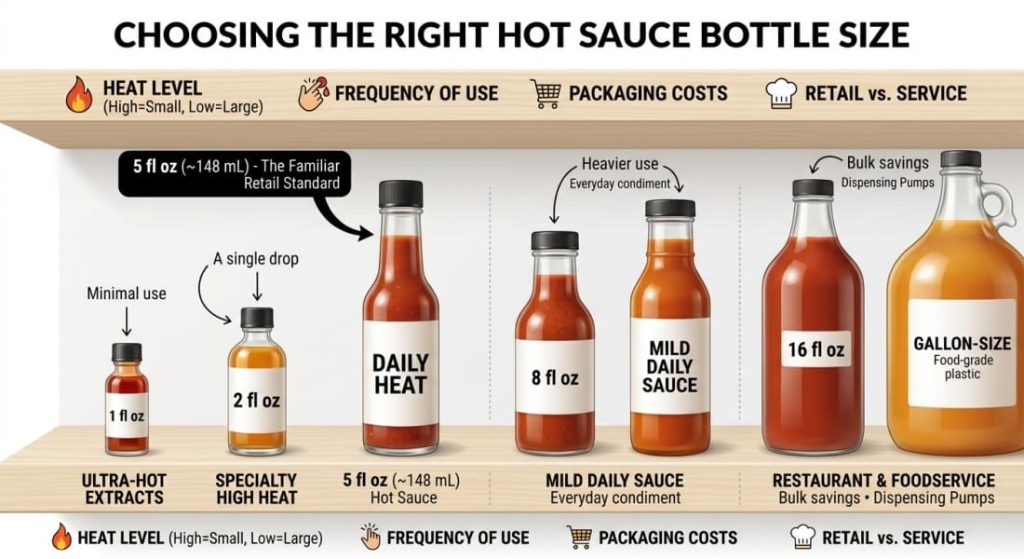
For a conventional retail sauce, 5 fl oz (about 148 mL) is the familiar answer. You have probably handled the classic tall, narrow bottle many times. It fits comfortably in one hand, looks at home on a retail shelf, and holds enough sauce for repeated use without making a specialty product feel oversized.
Still, “standard” does not mean “best for every sauce.” A very hot extract may belong in 1 or 2 oz. A mild everyday sauce may sell better in 8 or 12 oz. Restaurants may prefer 16 oz or larger. The right hot sauce bottle size depends on how much people use, how often they use it, and what they expect to pay.
Start with the bottle as a complete system
When you review glass sauce bottles, look beyond the shape. Ask for nominal capacity, brimful capacity, overall height, maximum diameter or width, glass weight, label panel, and neck finish. These figures tell you whether the bottle will fit your line and your case. A photograph cannot do that.
Nominal capacity is the quantity sold to the customer. Brimful capacity is what the bottle holds when filled to the top. Your normal fill level sits below that point because the product needs headspace. Fill temperature, cooling, and the behavior of the sauce all affect how much headspace is sensible. It is better to establish the fill point during a trial than to guess from the catalog capacity.
The neck finish is equally important. A description such as 24-490 or 28-400 identifies more than the opening diameter; it also describes the closure interface. Do not choose hot sauce bottle caps because the first number appears to match. Compare the bottle drawing and cap drawing, then test the cap, liner, reducer, and bottle together.
Hot Sauce Bottle sizes in inches: a planning chart
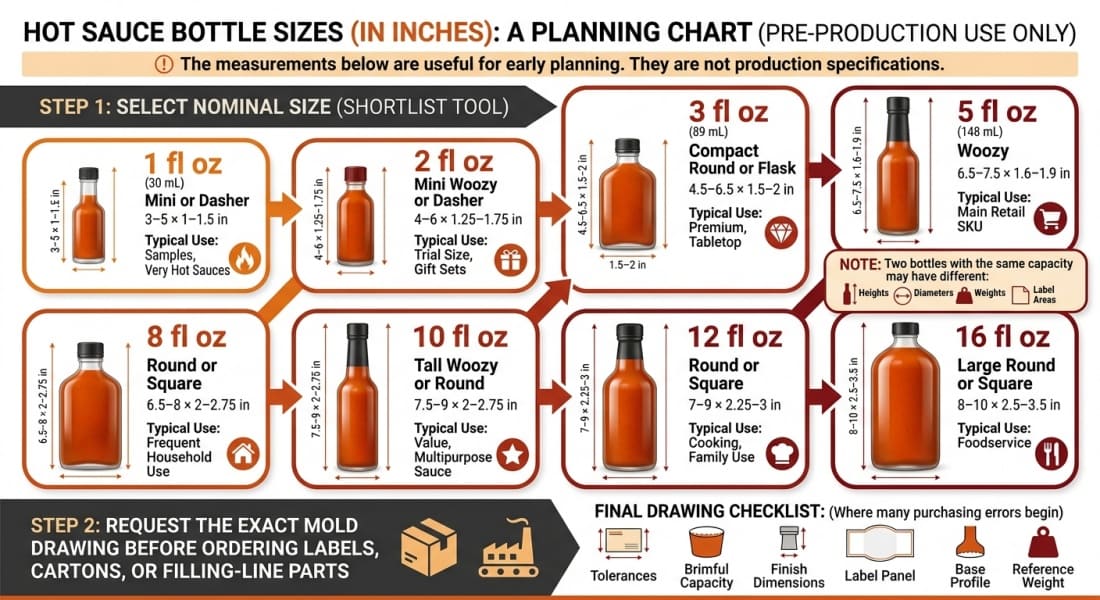
The measurements below are useful for early planning. They are not production specifications. Two bottles with the same capacity may have different heights, diameters, weights, and label areas. Before you order labels, cartons, or filling-line parts, request the drawing for the exact mold you intend to buy.
|
Nominal size |
Approx. metric volume |
Common shape |
Approximate planning dimensions (height × width/diameter) |
Typical use |
|
1 fl oz |
30 mL |
Mini or dasher |
3–5 × 1–1.5 in |
Samples and very hot sauces |
|
2 fl oz |
59 mL |
Mini woozy or dasher |
4–6 × 1.25–1.75 in |
Trial size and gift sets |
|
3 fl oz |
89 mL |
Compact round or flask |
4.5–6.5 × 1.5–2 in |
Premium or tabletop use |
|
5 fl oz |
148 mL |
Woozy |
6.5–7.5 × 1.6–1.9 in |
Main retail SKU |
|
8 fl oz |
237 mL |
Round or square |
6.5–8 × 2–2.75 in |
Frequent household use |
|
10 fl oz |
296 mL |
Tall woozy or round |
7.5–9 × 2–2.75 in |
Value or multipurpose sauce |
|
12 fl oz |
355 mL |
Round or square |
7–9 × 2.25–3 in |
Cooking and family use |
|
16 fl oz |
473 mL |
Large round or square |
8–10 × 2.5–3.5 in |
Foodservice |
Treat this hot sauce bottle size inches chart as a shortlist tool. Your final drawing should also show tolerances, brimful capacity, finish dimensions, label panel, base profile, and reference weight. Those details are where many purchasing errors begin.
Which capacity fits your product?
1 oz and 2 oz: small, but not always simple
1 oz hot sauce bottles work well for samples, event giveaways, travel formats, and sauces used by the drop. They also let you combine several flavors in one set. The disadvantage is cost per ounce. You still pay for a cap, label, filling operation, divider, and handling even though the fill is small.
2 oz hot sauce bottles feel more substantial and leave a little more room for branding. They suit paid trials, limited editions, and premium recipes. If your filler usually handles larger containers, check its accuracy at low volumes. A small dosing error becomes a large percentage of a 2 oz fill.
These sizes are often sold as mini hot sauce bottles, but “mini” is not a technical description. Confirm the actual capacity and finish. Also check whether mandatory label information will fit. You may need a carton, folded label, or neck tag rather than shrinking the type until nobody can read it.
3 oz: a useful middle ground
3 oz hot sauce bottles suit products that need more than a sample but less than a mainstream family format. They can work for premium sauces, travel retail, or tabletop service. Because shoppers are less likely to recognize 3 oz as the category norm, your label should make the serving style and value clear.
5 oz: the familiar retail choice
For many brands, 5 oz hot sauce bottles are the easiest place to begin. Customers know the size, retailers know how to shelve it, and co-packers are often familiar with the format. A 5 oz woozy bottle also gives your product an immediate hot-sauce identity.
Do not assume all 5 oz woozies are interchangeable. One mold may be taller, heavier, or finished differently from another. If you change suppliers, repeat the cap, label, line, and carton checks. “Same capacity” is not the same as “same package.”
8 oz, 10 oz, and 12 oz: more sauce, different expectations
8 oz hot sauce bottles are a natural fit for milder sauces, wing sauces, and products poured generously. They can offer better value per ounce, though the filled pack becomes heavier and wider.
10 oz hot sauce bottles make sense when the sauce doubles as a cooking ingredient. You can keep a tall silhouette or move to a wider body for better stability. Either way, check one-handed pouring.
12 oz hot sauce bottles are common candidates for marinades, chili sauces, and family-use products. At this point, the dispensing system matters more. A narrow reducer that behaves w
Woozy, dasher, square, or round?
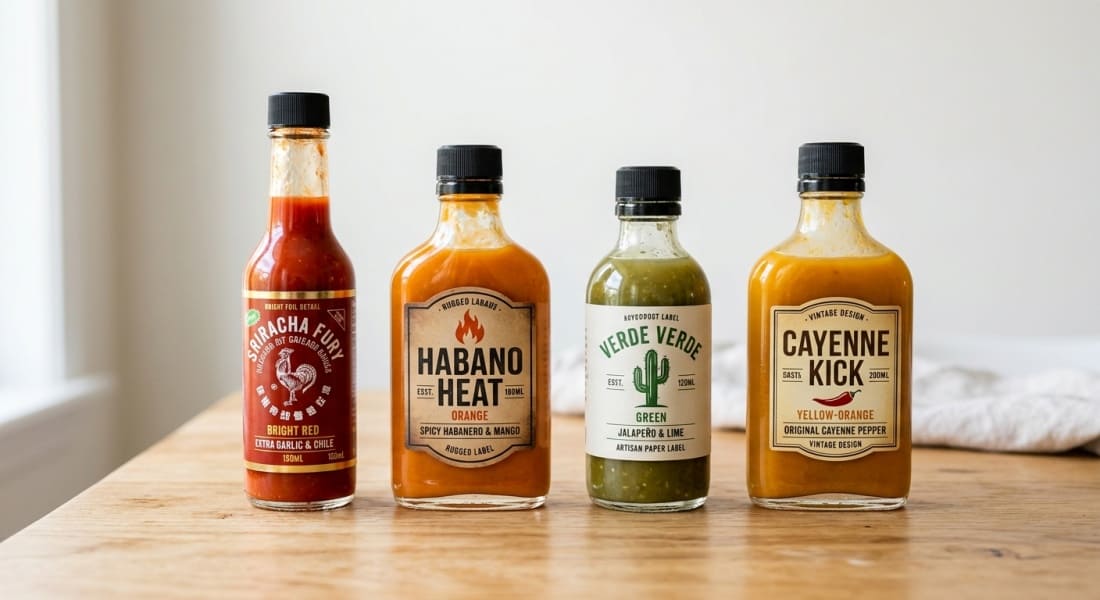
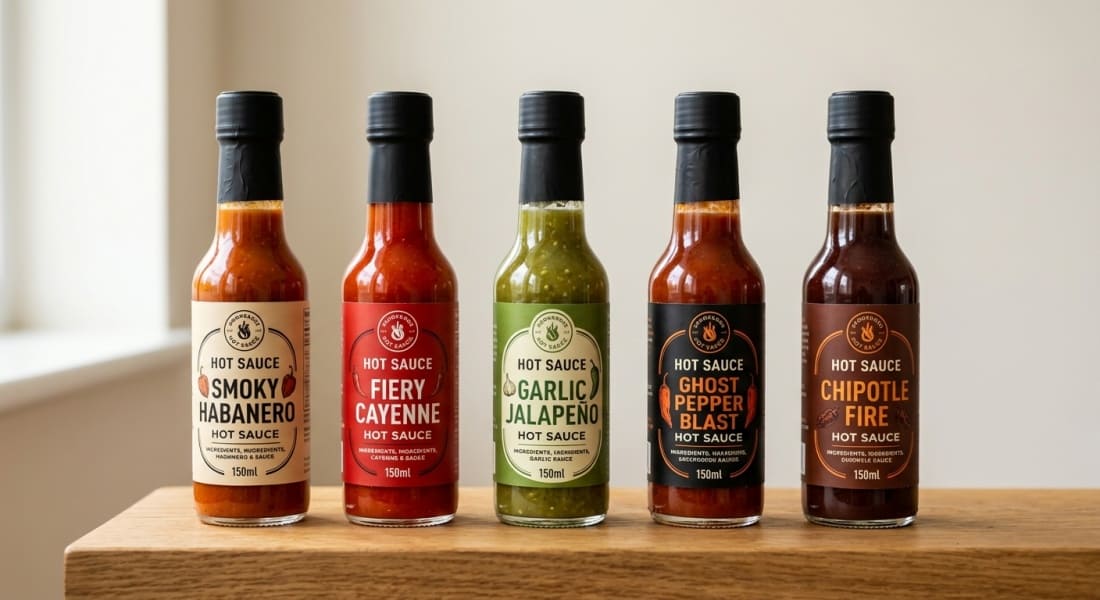
If a new buyer asks what is a woozy bottle, the simplest answer is: the tall, slender glass bottle strongly associated with traditional hot sauce. It offers familiar shelf recognition and an easy grip. Its narrow body, however, limits label width, and a very tall version can need extra care on conveyors.
Dasher bottles are designed for controlled, small doses. They are useful for concentrated sauces and tasting sets. The flow may come from an insert rather than the glass itself, so particle size and viscosity matter.
Square bottles offer flat label faces and efficient case layouts. They can give a brand a modern look, but the labeler may need to orient each bottle. Corners also change the way bottles contact dividers and neighboring containers in transit.
When you compare sauce bottle sizes, compare shape and capacity together rather than treating them as separate decisions.
Match the opening to the sauce
The same caution applies to woozy bottle caps. That phrase is convenient when browsing, but it does not tell a supplier enough. State the neck finish, cap construction, liner or sealing feature, reducer type, orifice size, application torque, and tamper-evident method.
Think about your filling line before you commit
The drawing tells you whether a bottle should fit. A line trial tells you whether it actually runs. Tall narrow bottles may tip where conveyors transfer. Square bottles may rotate before labeling. Small bottles may sit below a fill nozzle or outside the reliable dosing range of a machine.
Record the height and diameter limits of your filler, capper, labeler, coder, and case packer. Note where guide rails touch the bottle. Test more than one sample because glass dimensions have manufacturing tolerances. If possible, trial bottles from different mold cavities or production lots.
Your label deserves its own test. Shoulders, heel curves, seams, and taper reduce the usable area. Apply production-equivalent labels and leave them through temperature and humidity changes. Look for lifting edges, wrinkles, scuffing, and unreadable lot codes before you approve artwork.
Glass, product protection, and compliance
Many brands choose glass hot sauce bottles because glass feels rigid, looks premium, and lets the sauce color support the branding. It also accepts pressure-sensitive labels and several decoration methods. Those advantages are real, but the complete pack still includes a closure, liner, ink, adhesive, and perhaps a coating.
That is why you should request compliance documents for all product-contact parts, not only the bottle. The term food grade glass sauce bottles is useful in conversation, but your purchasing file should identify the relevant destination-market requirements and the documents that support compliance.
Clear glass hot sauce bottles are ideal when color is part of the sale. They also make separation, sediment, and color changes visible. If light could affect your recipe, conduct shelf-life work in the actual bottle. Colored glass, a coating, or a carton may be more suitable than clear flint glass.
Glass is widely recyclable, although local collection, color sorting, transport distance, and end markets affect the result. Keep environmental claims specific. A broad claim such as “always greener” is difficult to support and unnecessary for a useful buyer guide.
Common mistakes worth avoiding
The first mistake is ordering from appearance alone. A rendering does not show whether the bottle rocks on a conveyor or leaks after shipping. The second is releasing labels from generic hot sauce bottle dimensions. Capacity is not geometry; use the controlled mold drawing.
Another common problem is treating the cap as interchangeable. Two caps with the same nominal diameter can have different threads, liners, heights, or sealing surfaces. Test the complete system under your real process conditions.
Finally, do not skip distribution trials. Pack the filled, labeled sale unit in its intended carton and test the route it will actually travel. Parcel delivery, pallet freight, warehouse stacking, vibration, and temperature cycling create different stresses.
Stock bottles or a custom mold?
Stock empty hot sauce bottles are usually the sensible starting point for a new flavor or young brand. You can sample them faster, avoid mold development, and use an established closure family. Ask whether the item is genuinely stocked in your region and whether the mold will remain available.
The handling plan matters too. Empty glass hot sauce bottles should arrive protected from dust and damage. Agree on packaging, storage, and any cleaning or preparation before filling. Do not add a rinsing step simply because it sounds safer; make sure it suits your line and food-safety plan.
Custom hot sauce bottles become attractive when a proprietary shape, embossing, or unusual capacity adds enough value to justify tooling. You will need time for design review, molds, samples, testing, and approval. Put mold ownership, maintenance, expected life, tolerances, and change control in writing.
You can also create distinction without a new mold. Cap color, screen printing, frosting, coating, and a well-designed label can change a standard bottle considerably. Test decoration for scuffing and make sure it stays outside product-contact areas unless specifically approved.
Shipping and total cost
When you purchase bulk hot sauce bottles, ask for units per case, cases per pallet, pallet height, gross weight, and loading method. A small change in body diameter can alter case count and pallet use. For wholesale hot sauce bottles, compare quotations on the same terms.
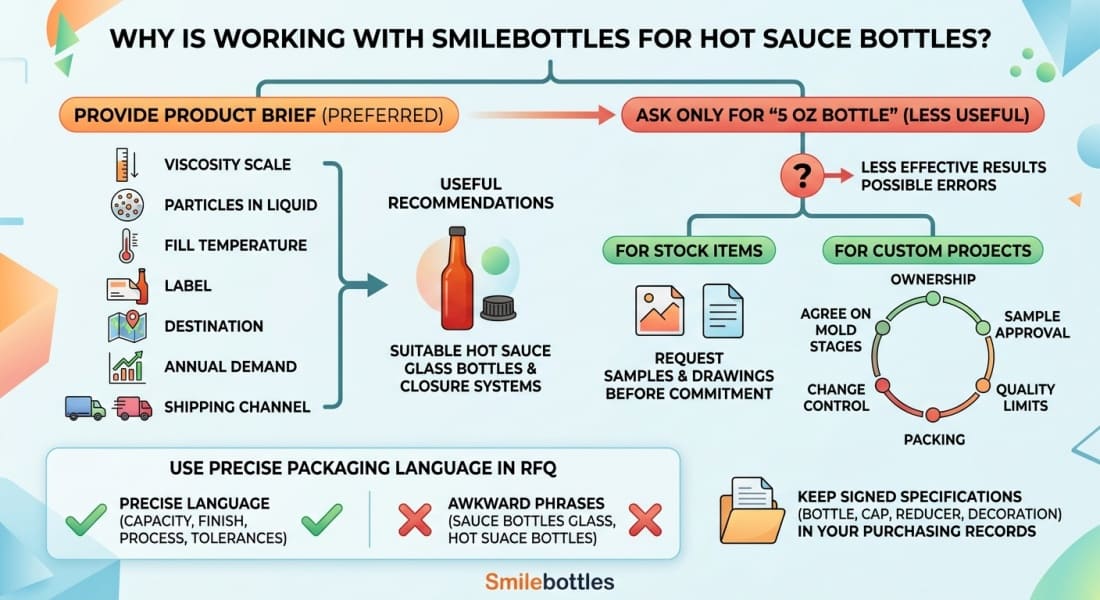
Why Is Working with Smilebottles For Hot Sauce Bottles?
You will get a more useful recommendation from Smilebottles when you share the product brief rather than asking only for “a 5 oz bottle.” Include viscosity, particles, fill temperature, label method, destination, annual demand, and shipping channel. That information makes it easier to shortlist suitable hot sauce glass bottles and closure systems.
For stock items, request samples and drawings before you commit to production. For a custom project, agree on mold stages, ownership, sample approval, quality limits, packing, and change control. Keep signed specifications for the bottle, cap, reducer, and decoration in your purchasing records.
Buyers sometimes search awkward phrases such as sauce bottles glass, and keyword reports may even contain the misspelling hot suace bottles. That may explain how someone reaches the page, but your RFQ should use precise packaging language. Capacity, finish, process, and tolerances lead to a better quotation than a search phrase does.
FAQ: Frequently Asked Questions About Hot Sauce Bottles
Q1:What size works best for samples?
A1:Hot sauce sample bottles are usually 1 or 2 oz. Choose 1 oz for a concentrated sauce or giveaway and 2 oz when you want a paid trial with more label room. Check fill accuracy and protection between bottles in a set.
Q2:Are 5 oz bottles all the same dimensions?
A2:No. A woozy, square, flask, and round bottle can hold the same volume while using different dimensions, weights, finishes, and label panels. Approve the exact mold drawing.
Q3:Can a reducer handle thick sauce?
A3:Sometimes, but you need to test it with the real recipe and its largest particles. Pour it cold and at room temperature. If customers must shake hard or strike the bottle, the opening is probably too restrictive.
Q4:What should you check before ordering?
A4:Check the drawing, capacity tolerances, finish, closure, reducer, food-contact documents, case pack, pallet, samples, lead time, and quality agreement. Then conduct a filled-line and distribution trial.
Conclusion
The 5 oz woozy remains a practical reference, but your sauce should make the final decision. Start with the dose and pouring behavior. Then check the bottle against your line, label, carton, shipping route, and price point.
Shortlist two or three glass bottle options, fill them with the actual recipe, and use the production cap and label. Test leakage, torque, pouring, shelf life, line handling, and transport before releasing a large order. That sequence takes more effort at the beginning, but it is far cheaper than correcting a package after launch.
Clear specifications also make sourcing easier. Whether you need standard stock, decoration, or a custom mold, you can compare offers fairly when every supplier is quoting the same bottle system. That is the surest way to choose hot sauce packaging that works in production and feels right in the customer’s hand.
 English