Table of Contents
ToggleAuthor: SmileBottles Editorial Team
Estimated Reading Time: About 14Minutes
When you look at a shelf fully stocked with premium spirits and fine vintages, you might ask yourself a very common question: just how do these beverages compare in terms of actual alcohol? The question of how many bottles of whiskey equal one bottle of wine is not just a matter of casual consumer curiosity. If you are a buyer, a distributor, or a brand owner making crucial packaging decisions, understanding this equivalence is vital to your business.
As a brand owner, you know that wine bottles and spirit bottles are never just containers. It is a vessel that protects your product, communicates your brand’s value, and dictates your shipping logistics. However, size does not always equal strength. While a standard whiskey bottle and a standard wine bottle might hold the exact same volume of liquid, their physical packaging, weight, and true alcohol content are vastly different.
In this comprehensive guide, we will break down everything you need to know about comparing these two popular beverages. From glass manufacturing standards and logistics to the exact mathematical breakdown of alcohol equivalence, this guide will help you make informed decisions for your brand. Whether you are stocking a warehouse or designing your next custom bottle with a reliable manufacturer like Smilebottles, understanding these core differences will set your product up for success.
Introduction: Why Compare Whiskey and Wine Bottles?
At first glance, comparing whiskey and wine might seem like comparing apples to oranges. However, the comparison is incredibly important for several key players in the beverage industry. The root of the confusion usually comes down to volume versus alcohol strength. Because both beverages are frequently sold in 750ml bottles, it is easy for an untrained eye to assume they are equivalent.
However, you must clarify for your consumers and your supply chain that bottle size does not equate to alcohol equivalence. The true determining factor is the Alcohol by Volume (ABV).
Understanding this distinction has practical use cases across the industry:
Consumers: Buyers want to know standard drink comparisons to manage their consumption responsibly.
Distributors: If you manage logistics, knowing the true alcohol yield of a pallet affects your licensing, taxation, and inventory planning.
Brands and Packaging Buyers: If you are sourcing glass, the physical differences between these bottles dictate your design, the glass weight you choose, and your ultimate shipping costs.
Whiskey vs Wine Bottles: Size, Weight, and Packaging Differences
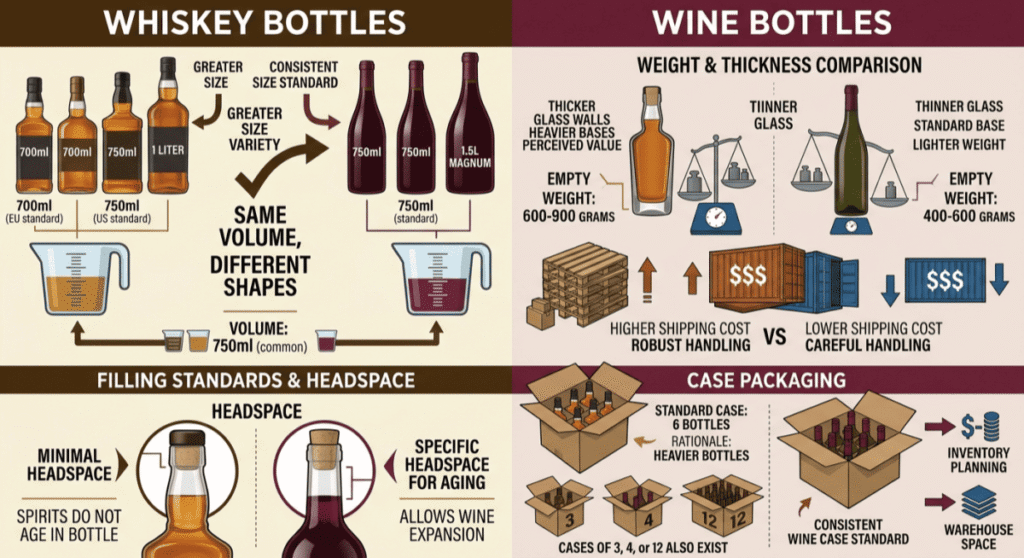
If you are purchasing glass bottles in bulk, you need to know the physical and logistical differences between these two distinct categories. They may share similar volumes, but their packaging requirements are entirely different.
Bottle Size Comparison: Are They Really the Same?
When you choose your packaging, understanding standard whiskey bottle sizes is your first step. Globally, the most common standard size for both wine and whiskey is 750ml. However, the spirits industry has a bit more variation depending on the market. While wine is almost exclusively bottled in 750ml formats (with exceptions for magnums or splits), whiskey is frequently sold in 700ml (the standard in Europe and the UK), 750ml (the US standard), and 1-liter bottles for travel retail and hospitality.
The key insight for you as a brand owner is this: you are dealing with the exact same volume of liquid in a standard 750ml bottle, but a completely different alcohol strength. This means your packaging needs to reflect the premium nature and the slower consumption rate of the spirit.
Glass Weight & Thickness: Why Whiskey Bottles Feel Heavier
When you hold a premium spirit, you immediately notice the weight. The standard 750ml whiskey bottle weight is intentionally heavier than a standard wine bottle. Why? It all comes down to consumer psychology and product positioning.
Whiskey Bottles: These bottles require a thicker base—often referred to as a “glass punt” or heavy base—to provide a premium, substantial feel in the consumer’s hand. Because whiskey is a high-value item that sits on a shelf or a home bar for months, the heavy glass reinforces the brand’s premium identity. The average 750ml whiskey bottle weight can range from 500 grams to over 800 grams for luxury editions.
Wine Bottles: Wine is generally consumed much faster, often in a single sitting. Therefore, wine bottles are typically lighter, averaging between 400 and 500 grams. Lighter glass is used to maximize transport efficiency and lower shipping costs for high-volume products.
For you as a buyer, this directly ties into your costs, shipping freight limits, and potential breakage rates. Heavier glass means higher perceived value, but it also means fewer bottles per pallet before hitting weight limits.
Filling Standards and Headspace Differences
Another critical difference you must consider during the bottling process is headspace—the empty space between the liquid and the closure.
Wine: Wine bottles usually require a slight headspace. This is essential for the wine to age properly and to allow for minimal oxygen interaction through the cork.
Whiskey: Spirits do not age once they leave the barrel. Therefore, whiskey filling requires much more precision with less variation, ensuring a uniform look on the shelf and minimizing oxidation.
Case Packaging: Wholesale and Logistics Considerations
If you are a distributor, your daily operations revolve around case sizes. When determining the number of bottles of whiskey to include, you must factor in the heavy glass and the high value of the product.
Wine Packaging: Wine is almost universally packed in 12 bottles per case. Because the glass is lighter, a 12-pack remains manageable for warehouse workers and retail staff.
Whiskey Packaging: If you are asking yourself how many whiskey bottles in a case, the answer varies. While standard value brands might pack 12 to a case, premium spirits are often packed in cases of 6. Distributors often ask us, how many bottles are in a case of whiskey compared to standard wine shipments? The reality is that a 6-bottle case is the industry standard for heavier, premium spirits to prevent box failure and reduce the physical lifting strain.
Understanding exactly how many bottles in a case of liquor helps you plan your pallet efficiency. Because a case of 6 premium whiskey bottles can sometimes weigh almost as much as a case of 12 light wine bottles, your storage and shipping strategies must be adjusted accordingly.
Standard Alcohol Content: The Real Difference Between Whiskey and Wine
To truly answer our main question, we have to look past the glass and examine the liquid inside. The structural difference in the beverages dictates everything from taxation to consumer health tracking.
Typical Wine ABV Explained
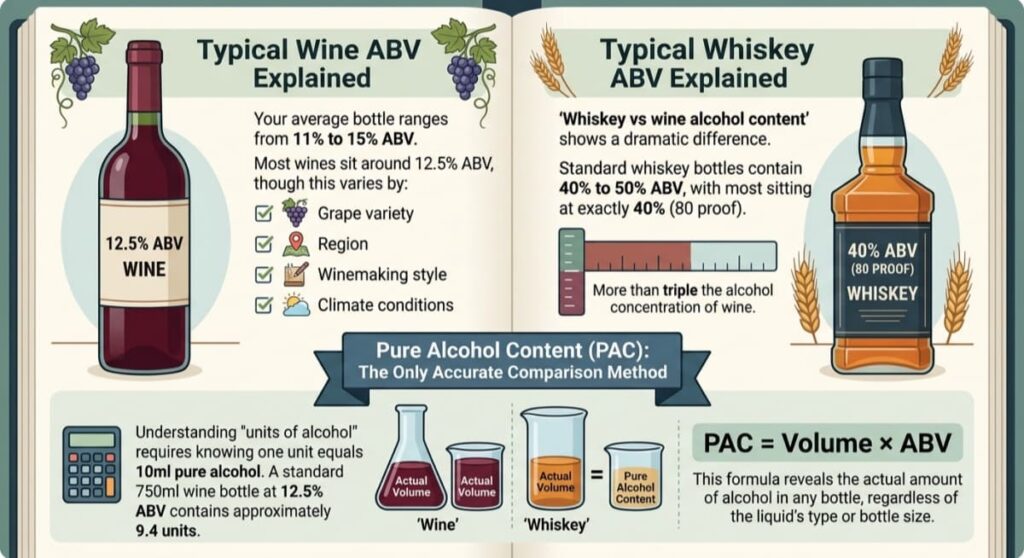
The alcohol content in a bottle of wine varies depending on the grape, the region, and the fermentation process. Generally, standard table wines sit between 11% and 15% Alcohol by Volume (ABV). For the sake of standard industry calculations, the average benchmark used globally is 12.5% ABV.
To understand the health and regulatory side, you might wonder how many units of alcohol in a bottle of wine. A standard 750ml bottle at 12.5% ABV contains roughly 9 to 9.5 units of alcohol. Furthermore, if you are a food scientist or regulatory buyer looking at nutritional labels, calculating how many grams of alcohol in bottle of wine yields about 74 grams of pure ethanol.
Typical Whiskey ABV Explained
Whiskey is a distilled spirit, meaning the alcohol is concentrated. Most standard whiskeys are bottled at 40% to 50% ABV. Some cask-strength variations can even exceed 60%. However, the global standard benchmark for whiskey is 40% ABV (80 proof).
Pure Alcohol Content (PAC): The Only Accurate Comparison Method
Understanding the alcohol content of whiskey vs. wine requires a simple yet vital formula. To compare the two beverages fairly, you must calculate the Pure Alcohol Content (PAC).
The Formula: PAC = Volume × ABV
This formula gives you the exact amount of pure ethanol inside the bottle. Whether you are determining the alcohol limits for shipping across state lines or calculating tax duties, PAC is the only accurate comparison method. It strips away the water, the flavor compounds, and the bottle size, leaving you with the core metric that matters.
How Many Bottles of Whiskey Equal One Bottle of Wine?
Now that we have established the rules of Pure Alcohol Content, let’s break down the exact mathematical answer.
Step-by-Step Calculation (Simple Explanation)
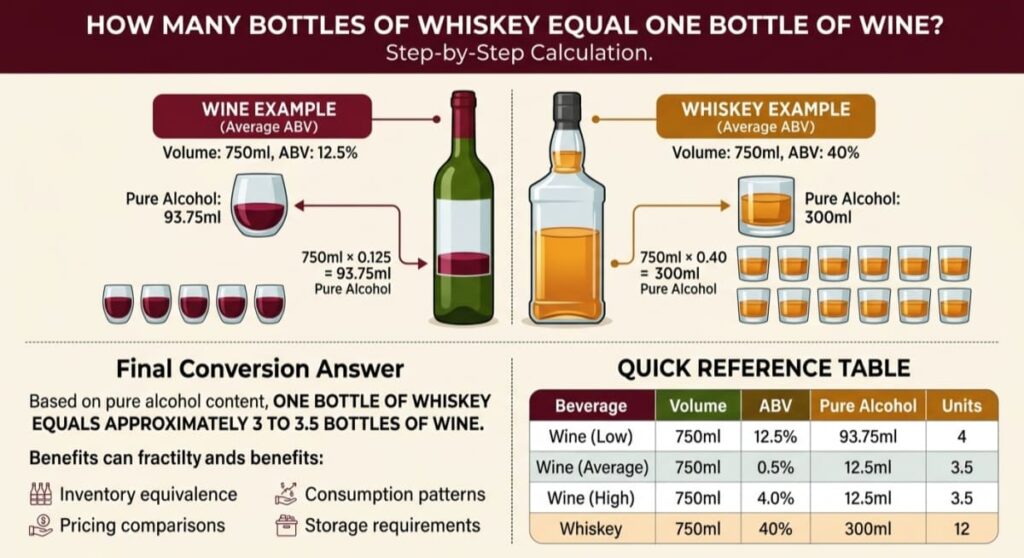
Let’s take standard 750ml bottles for both beverages and apply our PAC formula to see exactly how much alcohol in wine bottle formats compares to spirits.
Wine Calculation:
750ml × 12.5% ABV = 93.75ml of pure alcohol
Whiskey Calculation:
750ml × 40.0% ABV = 300.00ml of pure alcohol
Final Conversion Answer
By dividing the pure alcohol of whiskey (300ml) by the pure alcohol of wine (93.75ml), we get our definitive answer:
👉 1 bottle of whiskey ≈ 3.2 bottles of wine (in terms of alcohol content)
This means that to consume the exact same amount of alcohol found in a single 750ml bottle of standard 40% whiskey, a person would have to drink just over three standard bottles of wine.
Of course, this ratio fluctuates based on the specific alcohol content in a bottle of wine.
If you are dealing with a light Riesling (8% ABV), one bottle of whiskey is equal to nearly 5 bottles of wine.
If you are dealing with a heavy, high-proof Zinfandel (15% ABV), one bottle of whiskey is closer to 2.6 bottles of wine.
Consumer habits reflect this heavy concentration. While consumers enjoy sipping a fine vintage over dinner, you will rarely see anyone shooting wine like they might take a shot of whiskey. The concentration of alcohol completely changes the consumption method.
Quick Reference Table
For buyers and distributors who need to reference these figures quickly, here is a highly useful breakdown.
|
Beverage |
Standard Volume |
Average ABV |
Pure Alcohol (PAC) |
Drink Equivalence |
|
Wine |
750ml |
12.5% |
~94ml |
~5 glasses |
|
Whiskey |
750ml |
40.0% |
300ml |
~16-17 shots |
As the table shows, a common consumer question is how many drinks in a bottle of whiskey? The standard answer is about 16 to 17 standard 1.5oz pours, compared to just 5 standard 5oz glasses of wine.
Practical Implications for Buyers, Distributors, and Brands
Why does this math matter to you as a B2B buyer or a brand owner? Understanding the concentration of alcohol and the physical packaging weight completely changes your business strategy.
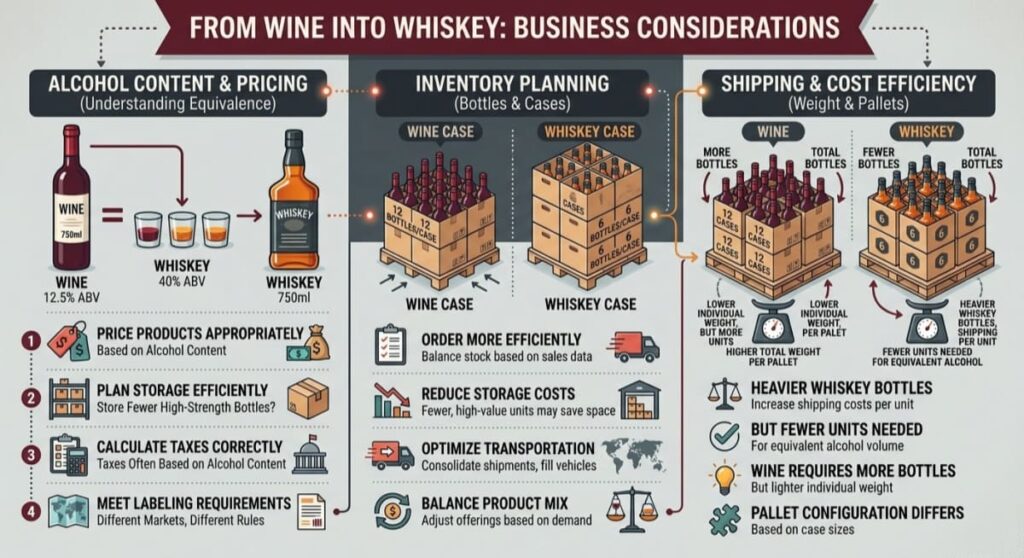
Inventory Planning: Why Alcohol Strength Matters
When you are planning inventory, you must consider the production cycle and the final yield. For example, distillers must calculate how many 750ml bottles of whiskey they can produce in a barrel. Because of the “angel’s share” (evaporation during aging), a standard 53-gallon barrel usually yields around 250 to 280 standard 750ml bottles.
Because one bottle of whiskey contains the alcohol equivalent of three bottles of wine, you are storing a much higher value and a higher tax liability in a much smaller physical footprint. Your stock levels, vault security, and pricing strategies must reflect this density of value. Interestingly, modern flavor trends have even seen distilleries finishing their spirits in wine casks, pouring a small amount of wine into whiskey barrels to age, bridging the gap between these two distinct inventory types.
Shipping and Cost Efficiency
As previously mentioned, when deciding how many bottles in a case of liquor to ship, you have to balance weight and volume.
Whiskey: You have heavier bottles, but fewer units are needed to generate high revenue. Because whiskey moves more slowly on retail shelves than wine, you ship lower volumes but at higher margins.
Wine: You are shipping lighter bottles but in much higher volumes. A standard pallet of wine holds 56 cases (672 bottles). The shipping efficiency is high, but the profit margin per bottle is generally lower than premium spirits.
Product Positioning and Consumer Perception
For brand owners, understanding these metrics helps you position your product. Whiskey is inherently viewed as a premium, strong, and highly giftable item. It commands thicker glass, intricate closures, and luxury labeling. Wine, while it has its luxury tiers, is largely positioned for casual, social, and daily consumption. Your glass packaging must instantly communicate these distinct consumer expectations.
Choosing the Right Bottle for Your Brand
Knowing the logistics, the alcohol content, and the case sizes is only half the battle. The most important decision you will make as a brand owner is selecting the actual glass that will hold your product. Your packaging is your silent ambassador on the retail shelf.
Key Factors When Selecting Glass Bottles
When you are ready to purchase glass bottles wholesale, you must evaluate several critical factors:
Weight & Thickness: As we discussed, a heavy base implies luxury. Do you want a heavy, 800-gram flint glass bottle for your premium bourbon, or a sleek, 450-gram antique green bottle for your Sauvignon Blanc?
Shape & Branding: Your bottle’s shape must align with industry expectations while standing out.
Closure Type: Will you use a natural cork, a synthetic T-cork, or a highly efficient aluminum screw cap (ROPP)? Spirits typically require tight-fitting bar top corks, while wine varies between corks and screw caps.
Customization: Can your manufacturer provide embossing, custom molds, or frosting to make your brand unique?
Whiskey vs Wine Bottle Design Considerations
The design language of these two beverages is completely different.
Whiskey Aesthetics: You should look for premium aesthetics. This means wide shoulders, thick bases, and high-clarity flint glass to show off the amber color of the spirit. Whiskey bottles are designed to look commanding on a bar cart.
Wine Aesthetics: You should stick to traditional, historically proven shapes. The Bordeaux bottle (high shoulders) and the Burgundy bottle (sloping shoulders) are industry standards that consumers immediately recognize and trust.
Why Smilebottles Is the Ideal Manufacturing Partner
Navigating these packaging decisions can be complex, but you don’t have to do it alone. As a premier glass bottle manufacturer, Smilebottles specializes in helping brand owners, distributors, and buyers find the perfect packaging solutions for both wine and spirits.
When you partner with Smilebottles, you benefit from:
Custom Glass Solutions: Whether you need a standard Bordeaux wine bottle or a heavy-base, custom-embossed whiskey decanter, we have the molds and the expertise.
Consistent Quality Control: We understand that precise filling and headspace requirements are non-negotiable for your automated bottling lines.
Bulk Production Capability: We can handle high-volume orders, ensuring your supply chain never faces a bottleneck.
Expert Consultation: We know exactly how to optimize your glass weight to reduce shipping costs without sacrificing your brand’s premium feel.
👉 If you are ready to elevate your packaging, contact Smilebottles today for custom glass bottle solutions tailored specifically to your wine or spirits brand.
FAQ Frequently Asked Questions About Hot Sauce Bottle Packaging
To ensure you have all the information you need, here are answers to some of the most common questions buyers and consumers ask about bottle equivalence.
Q1:Is one bottle of whiskey stronger than one bottle of wine?
A1:Yes, absolutely. Because of the distillation process, a standard bottle of whiskey is roughly 3 to 3.5 times stronger in total alcohol content than a standard bottle of wine.
Q2: Why are whiskey bottles heavier than wine bottles?
A2:Whiskey bottles use thicker glass, particularly at the base, to create a premium, substantial feel. Because whiskey is a high-priced item that is consumed slowly over time, the heavy glass reinforces the luxury positioning of the brand.
Q3: Are all whiskey bottles 750ml?
A3:No. While 750ml is the standard in the United States, 700ml is the legal standard in Europe and the UK. You will also frequently see 1-liter bottles used in bars, restaurants, and duty-free shops.
Q4: Does bottle size affect alcohol strength?
A4:No. The size of the bottle has absolutely no impact on the strength of the alcohol. The strength is determined entirely by the ABV (Alcohol by Volume). A 50ml miniature bottle of 40% whiskey is just as strong per drop as a 750ml bottle.
Q5: How many glasses of wine equal one glass of whiskey?
A5:When looking at standard servings, 1 standard shot of whiskey (1.5 ounces at 40% ABV) contains roughly the same amount of pure alcohol as 1 standard glass of wine (5 ounces at 12% ABV).
Conclusion
The ultimate takeaway is that beverage packaging is about alcohol content and brand positioning, not just volume. The heavy glass of a spirit bottle, the 6-pack case logistics, and the high concentration of alcohol all dictate how you price, store, and ship your product.
Whether you are launching a new craft bourbon or importing a high-volume European wine, your packaging must be flawless. Choosing the right glass manufacturer ensures that your product is safe, your logistics are optimized, and your brand looks exceptional on the shelf. Let Smilebottles be your trusted partner in navigating the complex world of glass manufacturing. Reach out to our team today to start designing a bottle that truly represents the quality of the liquid inside.
 English