
Table of Contents
ToggleAuthor: SmileBottles Editorial Team
Estimated Reading Time: About 15 Minute
If you are sourcing bottles for a whiskey brand, one of the first numbers you will end up asking about is weight. It sounds like a small detail, but it quietly controls a lot of things — your shipping costs, your shelf presence, your production line speed, and even how your product feels in a customer’s hand. So before you place a large order, it helps to actually understand what goes into that number. Here is the short version, and then we will get into the details.
Quick Answer: Average Empty and Filled Weight of a 750ml Whiskey Bottle
A 750ml whiskey bottle weight typically falls somewhere between 450g and 900g when empty. Once you fill it, add a closure, and stick a label on it, the total weight usually lands between 1.2kg and 1.7kg.
Empty bottle: 450g–900g
Filled bottle: about 1.2kg to 1.7kg
Heavy-base premium bottles can go well above this range
The exact weight depends on shape, base thickness, glass distribution, closure, and decoration
That is the quick snapshot. Now let’s break down why the range is so wide, and how you should think about it as a buyer.
What Is the Average Weight of a 750ml Whiskey Bottle?
There is no single “correct” weight for a 750ml whiskey bottle. Different brands use very different bottle designs, and glass makers engineer each mold based on what the customer is trying to achieve. Still, most bottles you will see on the market fall into a few clear categories.
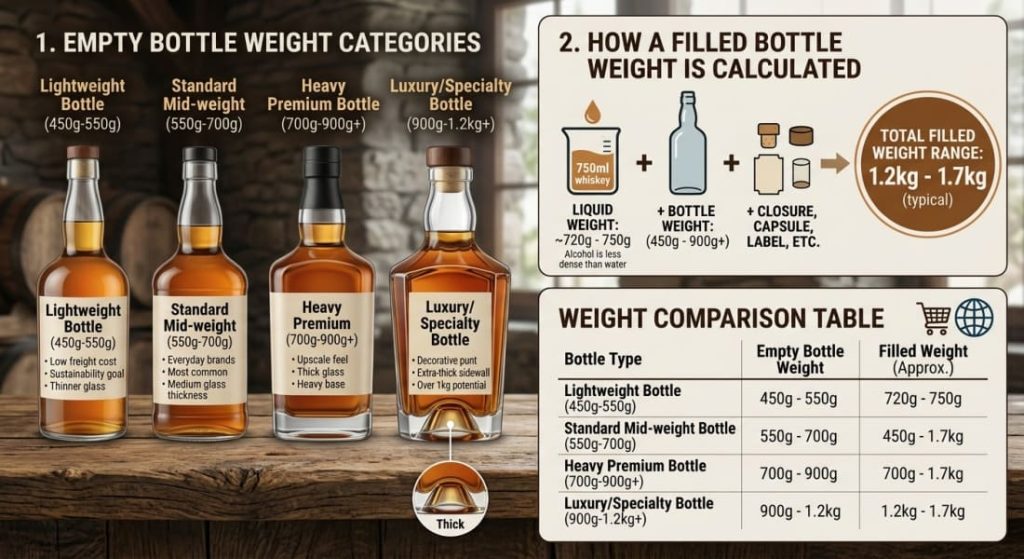
Typical Empty Bottle Weight Range
Lightweight bottles: around 450g–550g. These are used when a brand wants to lower freight cost or hit a sustainability goal.
Standard mid-weight bottles: around 550g–700g. This is the most common range for everyday whiskey brands.
Heavy premium bottles: around 700g–900g or more. These use thick glass and a heavy base to feel more upscale.
Luxury or specialty bottles: can go over 900g, sometimes reaching 1kg or higher when there is a decorative punt or extra-thick sidewall.
Typical Filled Bottle Weight Range
People often ask how much does a 750 ml bottle of liquor weigh once it is actually filled. The math is fairly simple:
750ml of whiskey weighs roughly 720g–750g. Alcohol is slightly less dense than water, so the 750 ml to kg conversion is about 0.72–0.75kg for the liquid alone.
Add the bottle itself (450g–900g).
Add the closure, capsule, label, and any tax seal.
So when someone asks how much does a 750ml bottle of whiskey weigh in total, the honest answer is: it depends, but plan for 1.2kg to 1.7kg for most designs.
Weight Comparison Table
|
Bottle Type |
Empty Bottle Weight |
Filled Weight (Approx.) |
|
Lightweight 750ml whiskey bottle |
450–550g |
1.2–1.35kg |
|
Standard 750ml whiskey bottle |
550–700g |
1.35–1.5kg |
|
Heavy-base premium bottle |
700–900g+ |
1.5–1.7kg+ |
|
Luxury / specialty bottle |
900g–1.2kg+ |
1.7kg+ |
If you are working out logistics, a table like this is the fastest way to estimate your total shipment weight before you commit to a design.
Why Can 750ml Whiskey Bottles Have Very Different Weights?
Two bottles can hold the same 750ml volume and still weigh completely different amounts. The reason comes down to how the glass is distributed, not just how much is used.
Glass Thickness
Thicker walls mean more strength and a more solid feel in the hand. Thinner walls mean lower material use and lower freight cost. Neither is automatically better — it depends on what your brand needs.
Base Thickness and Heavy-Bottom Design
This is the single biggest factor in 750ml liquor bottle weight. A heavy punt or a thick base can add 100–300g to the same bottle shape without changing capacity at all. Premium whiskey brands often use this trick because a weighty base signals quality the second a customer picks up the bottle.
Bottle Shape and Dimensions
Tall, narrow bottles distribute glass differently than short, wide ones. Square bottles usually need more glass at the corners for structural balance. Round bottles are generally the most efficient in terms of 750ml glass bottle weight per unit of strength.
Neck Finish and Closure Type
A cork finish, a bar top, a screw cap (BVS or ROPP), or a tamper-evident closure will each affect the neck design and the total weight. Cork finishes usually add more glass at the neck because the finish has to be strong enough to grip the cork over years of storage.
Decoration and Custom Features
An embossed whiskey bottle may weigh slightly more than a smooth one because the raised design needs enough glass behind it to stay sharp. Frosting, coatings, and metal medallions also add to the total shipping weight, even if the bottle body itself does not change much.
Structural and Shipping Requirements
If your bottles are shipped long distances or exported by sea, they may need extra structural strength in the shoulder and heel. Drop resistance, line compatibility, and stacking pressure all factor into how a whiskey bottle manufacturer engineers the final weight.
Why Bottle Weight Matters for Shipping Costs, Pallet Efficiency, and Container Loading
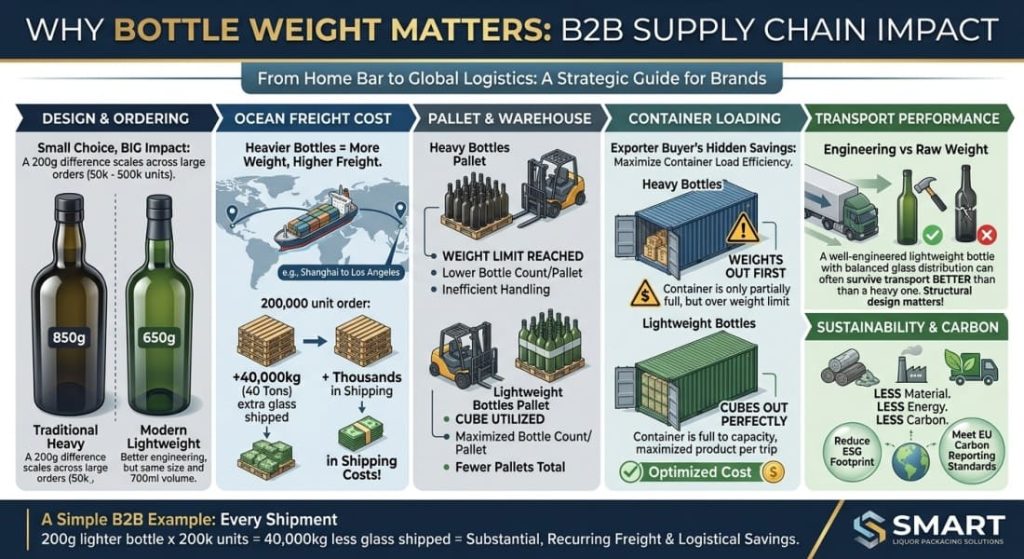
For a small home bar, bottle weight is just a number. For a brand ordering 50,000 or 500,000 units, it becomes one of the most important cost drivers in the entire packaging budget.
Freight Cost Per Unit
Heavier bottles cost more to ship. That sounds obvious, but the effect scales quickly. If your bottle is 150g heavier than a competitor’s bottle, across 100,000 units you are shipping an extra 15,000kg — that is 15 tons of glass moving across the ocean for no product benefit.
Pallet Weight and Warehouse Handling
Lighter bottles allow more efficient handling. Some warehouses have strict maximum pallet weights, which can limit how many bottles fit per pallet if the glass is too heavy. Working with a liquor bottle manufacturer who understands pallet math can save you a real amount of money over a year.
Container Loading Efficiency
Sea containers have a weight limit before you have to switch to a different container class or pay more per trip. Bottle weight decides whether a 20ft container “cubes out” or “weights out” first. For export buyers, this is usually where the biggest savings hide.
Breakage Risk and Transport Performance
Heavier is not automatically safer. A well-engineered lightweight bottle with balanced glass distribution can actually survive transport better than a poorly designed heavy one. Structural design matters more than raw weight.
Sustainability and Carbon Impact
Lightweight glass uses less raw material and burns less fuel during transport. If your brand has ESG commitments or you sell into markets like the EU where carbon reporting matters, whiskey bottle weight becomes part of your sustainability story too.
A Simple B2B Example
Say you are ordering 200,000 bottles. If you pick a design that is 200g heavier than needed, you are moving an extra 40,000kg of glass. Depending on your shipping route, that can add several thousand dollars in freight alone — every single shipment. That is why smart buyers look at bottle weight before finalizing a design, not after.
Lightweight vs. Heavy-Base Whiskey Bottles: Which Option Fits Your Brand?
This is the real decision most buyers face. Both directions can be right, depending on where your product sits in the market.
Advantages of Lightweight Bottles
Lower freight cost per unit
Less raw material used
Better fit for high-volume distribution
Stronger sustainability profile
Easier warehouse handling
Advantages of Heavy-Base Bottles
Premium look and feel
Strong shelf presence
Excellent for gifting and limited editions
Supports higher price positioning
Signals craft or luxury without a single word
Drawbacks of Each Option
Lightweight bottles, if the design is not thought through carefully, can feel cheap in the hand. Heavy-base bottles cost more to produce and ship, and they lower your container efficiency.
Best Use Cases by Brand Positioning
|
Factor |
Lightweight Bottle |
Heavy-Base Bottle |
|
Cost |
Lower |
Higher |
|
Freight efficiency |
Better |
Lower |
|
Premium appearance |
Moderate |
Strong |
|
Sustainability |
Better |
Lower |
|
Shelf presence |
Good |
Excellent |
|
Best for |
High-volume brands |
Premium / luxury brands |
If you are launching a large-volume mainstream whiskey or a private label export product, lightweight usually wins. If you are launching a premium single malt, a limited edition, or a gift-focused SKU, heavy-base is usually worth the extra cost.

Key Questions to Ask Before Ordering a 750ml Whiskey Bottle
Whether you are working with us or with any other whiskey bottle supplier, these are the questions worth confirming before you sign off on a design.
Q1:What Is the Exact Empty Bottle Weight?
A1:Ask for the target weight in grams and the tolerance (for example, 620g ± 15g). Vague answers here usually mean vague quality control later.
Q2:What Is the Total Filled and Packed Weight?
A2:Include the closure, label, capsule, carton, and dividers. This is the number your freight forwarder actually cares about.
Q3:How Many Units Fit Per Pallet or Container?
A3:Confirm the pallet configuration, the total pallet weight, and how many pallets fit into a 20ft or 40ft container. This is where wholesale whiskey bottles buyers save or lose real money.
Q4:What Strength Tests Has the Bottle Passed?
A4:Especially for export, ask about top load, impact, and thermal shock results. A bottle that has not been tested at target weight is a risk.
Q5:Does the Weight Match the Brand Positioning?
A5:Do not overpay for glass you do not need, and do not under-design a premium product. The weight should support the story, not fight it.
How to Choose the Right 750ml Whiskey Bottle Weight for Your Project
If you take one thing away from this, let it be this: there is no single standard weight for a 750ml whiskey bottle. Most empty bottles fall between 450g and 900g, and the “right” number depends on your brand, your shipping route, and your production setup.
Lightweight bottles win on cost, freight, and sustainability.
Heavy-base bottles win on shelf presence and premium feel.
Mid-weight bottles cover most of the market and usually offer the best balance.
The best choice is the bottle engineered for your product — not the heaviest, not the cheapest.
If you are sourcing custom whiskey bottles for a new launch or reviewing an existing SKU, take the time to look at weight as a real design decision. It affects your margin on every single unit you ship.
How 750ml Whiskey Bottle Weight Is Engineered: A Manufacturer’s Perspective
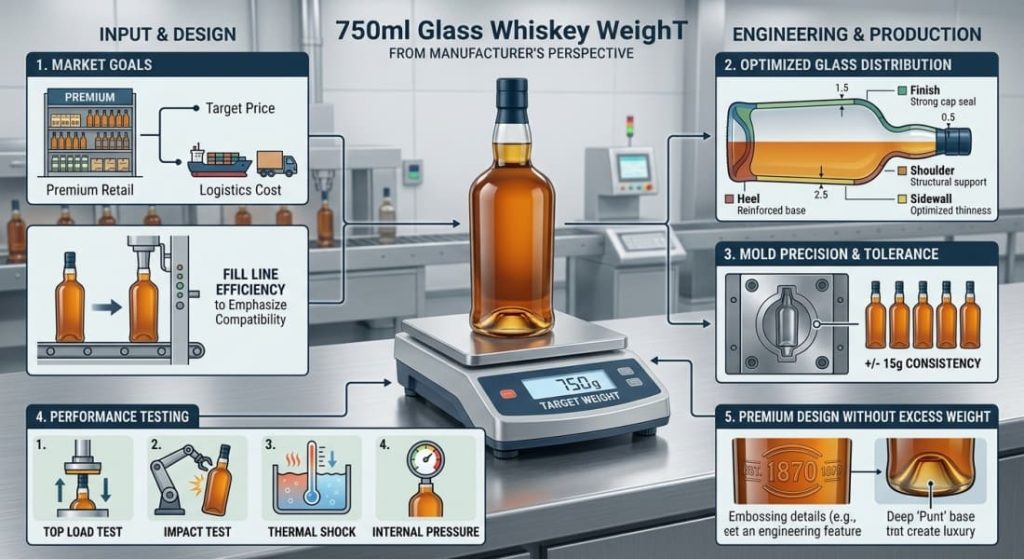
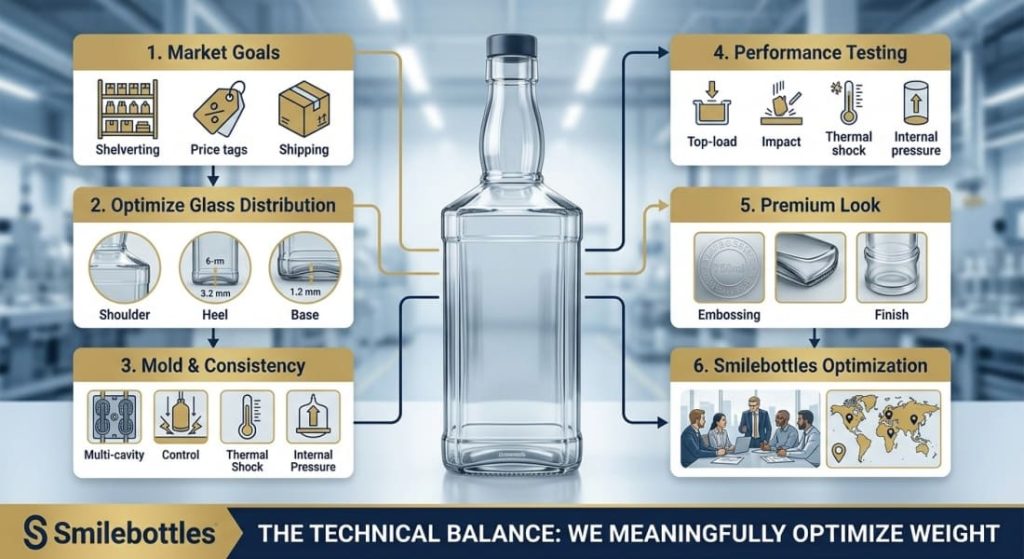
As a glass bottle manufacturer, we look at bottle weight as a technical balance, not a random number. Getting it right means balancing appearance, structural performance, production feasibility, and logistics.
Starting with Brand and Market Goals
Before we even talk about grams, we look at where the bottle will sit on a shelf, the target retail price, whether it needs to run on an existing filling line, and where it is going to be shipped. Those answers shape the weight target.
Optimizing Glass Distribution
A well-engineered bottle achieves strength without extra mass. The shoulder, sidewall, heel, and base each need the right thickness — too thin in the heel and the bottle cracks under top load, too thick in the sidewall and you are wasting glass.
Mold Design and Production Consistency
Weight tolerance matters just as much as the target weight. If bottles vary too much from unit to unit, filling lines slow down and pack-outs get messy. A reliable spirits bottle manufacturer should give you tight, controlled weight tolerances batch after batch.
Performance Testing and Durability
Top load resistance, impact resistance, thermal shock, and internal pressure are all tested during development. A bottle that passes these tests at a lower weight is a better bottle than one that only survives because it is thick.
Creating a Premium Look Without Unnecessary Weight
You can build a premium feel through shape, proportion, embossing, and finish — not just raw glass mass. A well-proportioned bottle with a sharp embossed logo often looks more expensive than a plain heavy one.
How Smilebottles Helps Customers Optimize Bottle Weight
When customers come to us for custom whiskey bottles, we usually walk through the same conversation: what is the brand positioning, what freight lane is this shipping on, what filling line will run it, and what price point does it need to hit. From there we can recommend a weight range and design direction that actually fits the project — not just whatever mold happens to be available.
FAQ Frequently Asked Questions About 750ml Whiskey Bottle Weight
Q1:How much does an empty 750ml whiskey bottle weigh?
A1:Most empty bottles fall between 450g and 900g. Lightweight designs sit at the lower end, and heavy premium bottles sit at the upper end.
Q2:How much does a full 750ml bottle of whiskey weigh?
A2:A full bottle usually weighs 1.2kg to 1.7kg, including the liquid, glass, closure, and label. Heavy-base bottles can go above 1.8kg.
Q3:How many 750ml bottles are in a barrel of whiskey?
A3:A standard American whiskey barrel holds roughly 200 liters after aging losses (angel’s share). That works out to around 250 to 270 bottles of 750ml, though the exact number depends on the barrel size, aging time, and how much whiskey evaporates during maturation. So when people ask how many 750ml bottles in a barrel of whiskey, the honest answer sits in that 250–270 range for a typical bourbon barrel.
Q4:Why are some whiskey bottles much heavier than others?
A4:Different base thickness, glass distribution, shape, and decoration. Premium branding is the biggest reason a bottle is deliberately made heavier than it needs to be.
Q5:What bottle weight is best for export shipping?
A5:For most export projects, a well-engineered lightweight or mid-weight bottle (500g–650g) gives the best balance of durability, freight cost, and brand appearance.
Q6:Does bottle weight affect container loading?
A6:Yes, and more than most buyers expect. Even 100g difference per bottle can decide whether your container hits its weight limit before it fills up on volume.
Conclusion
Bottle weight is one of those quiet details that ends up touching almost every part of a whiskey brand — the way it looks on the shelf, the way it feels in a customer’s hand, the way it moves through a container, and the way it lands in your cost sheet. Getting the weight right early saves a lot of headaches later.
If you are planning a new whiskey bottle project or reworking an existing design, Smilebottles can help you evaluate the right bottle weight for your branding, shipping, and production setup — including custom shapes, embossed designs, and closure options built around your specific market.