
Table of Contents
ToggleAuthor: SmileBottles Editorial Team
Estimated Reading Time: About 15 Minute
If you’re running a food brand — whether you make small-batch hot sauce in a rented kitchen, bottle honey from your own hives, or ship gourmet syrups to specialty grocers — the bottle you choose ends up doing a lot of work for you. It protects the product, shapes how customers pour it, sits on a shelf next to a dozen competitors, and quietly tells buyers something about your quality before they even taste what’s inside.
This guide walks you through what actually matters when you’re picking glass bottles for hot sauce, honey, syrups, dressings, and other specialty foods. You’ll get practical size recommendations, closure advice, and a few things most first-time buyers overlook until it’s too late.
Why Food Brands Keep Coming Back to Glass
Plastic is cheaper, lighter, and easier to ship. That’s the honest truth. But if you look at what’s on the shelves at Whole Foods, farmers markets, or any specialty grocer, glass still dominates the premium food space — and there are real reasons for that.
It Doesn’t Mess With Your Flavor
Glass is non-reactive. It won’t absorb the capsaicin from your habaneros, and it won’t leach anything into your product over time. For acidic products like vinegar-based hot sauces or citrus-forward dressings, that’s important. Your sauce tastes the same on month six as it did on day one.
It Handles Heat Better
A lot of food products are hot-filled — meaning you pour them into the container while they’re still hot from cooking or pasteurization. Food grade glass bottles handle that process without warping or off-gassing. Plastic can, sometimes, but you have to be careful about which resin you’re using and what temperature you’re filling at.
It’s Recyclable, and Customers Notice
More buyers are reading packaging before they buy. Glass is infinitely recyclable, and saying so on your label (or your website) matters to a growing chunk of your audience.

Things to Think About Before You Order Glass Packaging for Food
Before you get to the fun part of picking bottle shapes, there are a few practical questions worth answering. Getting these wrong is how brands end up with 5,000 bottles in a warehouse that don’t fit their filling equipment or leak during shipping.
How Thick Is Your Product?
Thin liquids like hot sauce and infused vinegars pour differently than thick honey or chunky salsa. If your product barely flows, you need a wide enough opening for it to actually come out. If it’s thin and runny, you probably want something that controls the pour so customers don’t drown their eggs in habanero sauce by accident.
How Are You Filling?
Hot fill, cold fill, hand-filled, machine-filled — all of these change what bottle and closure will work for you. If you’re running bottles through a filling line, the neck finish has to match your capping equipment. If you’re hand-filling in a commercial kitchen, you have more flexibility but still need to think about consistency.
How Will People Actually Use It?
A honey bottle with dipper is a completely different customer experience than a squeeze bottle. A hot sauce that shakes out drop-by-drop feels different from one that pours in a stream. Think about the moment your customer opens it at their table.
Where Will It Sit?
Retail shelves, restaurant tables, e-commerce boxes — each environment puts different demands on your packaging. E-commerce especially punishes weak closures because bottles get thrown around in transit.
Common Glass Bottle for Food Sizes and What They’re Actually For
Sizing is where a lot of new food brands overthink things. Here’s how the common sizes actually get used in the real world.
1 oz and 2 oz Bottles
These are your sampler sizes. 2 oz hot sauce bottles are popular for gift packs, trade show giveaways, subscription boxes, and “try before you commit” marketing. If you’re launching a new flavor, a small run in 2 oz lets people try it without dropping full price on something they might not like.
Honey brands use these sizes for wedding favors, hotel amenity kits, and holiday gift boxes. They’re not going to be your bread-and-butter SKU, but they open doors.
4 oz Bottles
4 oz hot sauce bottles are one of the most popular sizes in the entire hot sauce industry. They’re big enough to feel substantial on a shelf, small enough to price competitively, and they fit the “one bottle lasts a month or two” pattern that most home cooks fall into. If you’re launching a hot sauce line and you can only pick one size to start with, this is usually it.
5 oz Bottles
The 5 oz woozy bottles shape is basically the standard hot sauce silhouette — tall, narrow neck, with room for a full wrap-around label. 5 oz hot sauce bottles in the woozy style are what most craft hot sauce brands use because customers immediately recognize the shape and know what’s inside.
If you want glass hot sauce bottles with label panel, the woozy design gives you a nice flat front and back for your artwork.
8 oz Bottles
8 oz hot sauce bottles work for milder sauces that people use more of — think BBQ-style hot sauces, chipotle-based products, or anything that goes on more than a few drops at a time. Eight ounces is also a sweet spot for honey, barbecue sauce, marinades, and salad dressings. It’s a size that says “you’ll actually finish this before it expires.”
12 oz and 16 oz Bottles
Once you get into the 12 to 16 oz range, you’re in family-size territory. This is where a lot of honey, syrup, and dressing sales happen. It’s also common for restaurant supply and foodservice orders.
32 oz and Larger
Bulk sizes for foodservice, restaurant kitchens, and the “we buy honey by the pound” crowd. These are heavy, so keep shipping costs in mind — and make sure your closure can handle the weight when someone tips the bottle to pour.
A Rough Matching Guide
To make this easier, here’s roughly how sizes match up with product types:
|
Product |
Common Sizes |
|
Hot Sauce |
2 oz, 4 oz, 5 oz, 8 oz |
|
Honey |
8 oz, 12 oz, 16 oz |
|
Syrup |
8 oz, 12 oz, 16 oz, 32 oz |
|
Dressings & Marinades |
8 oz, 12 oz, 16 oz |
|
Samplers & Gift Sets |
1 oz, 2 oz |
If you need a hot sauce bottle size inches chart for label design or shelf planning, most suppliers can send you spec sheets with exact height, diameter, and neck dimensions for each bottle. Ask for them before you finalize your label artwork — you don’t want to design a label that’s a quarter inch too tall for your bottle.

Glass Bottle Shape and Neck Finish: What Actually Controls the Pour
The shape of your bottle isn’t just about looks. It changes how your product comes out and how customers feel about using it.
Why Shape Matters More Than You’d Think
Tall, narrow bottles (like the woozy style used for hot sauce bottles) control pour speed naturally. The narrow opening slows things down, which is what you want with a spicy product.
Round bottles or hexagon honey jars work well for honey because they show off the color and have wide openings for thick product to flow out. Hex shapes also stack well on shelves and have a nice traditional look that fits the honey category.
Wider bottles work for chunky salsas, thick BBQ sauces, or anything with visible ingredients you want customers to see through the glass.
What “Neck Finish” Actually Means
Neck finish is just the term for the top of your bottle — the opening, the threads, and how everything measures out. It matters because your cap has to match it exactly. A 28-400 neck finish needs a 28-400 cap. Mix them up and you’ll have leaking bottles or caps that won’t screw on.
When you’re sourcing bottles, always ask for the neck finish specification. And if you already have a preferred closure supplier, make sure the bottle you pick uses a finish they carry.
Narrow Neck vs. Wide Mouth
Narrow-neck bottles give you controlled pouring, which is what you want for oils, vinegars, and hot sauces. Wide-mouth bottles are easier to fill (both in production and by the customer refilling a squeeze bottle at home) and work better for thicker products.
Making Sure Bottle and Cap Actually Work Together
This sounds obvious, but I’ve seen brands order bottles and caps separately and discover the threads don’t quite line up. Always request a physical sample of both and test-fit them before placing a bulk order. If you’re buying from a supplier who handles both, ask them to confirm compatibility in writing.

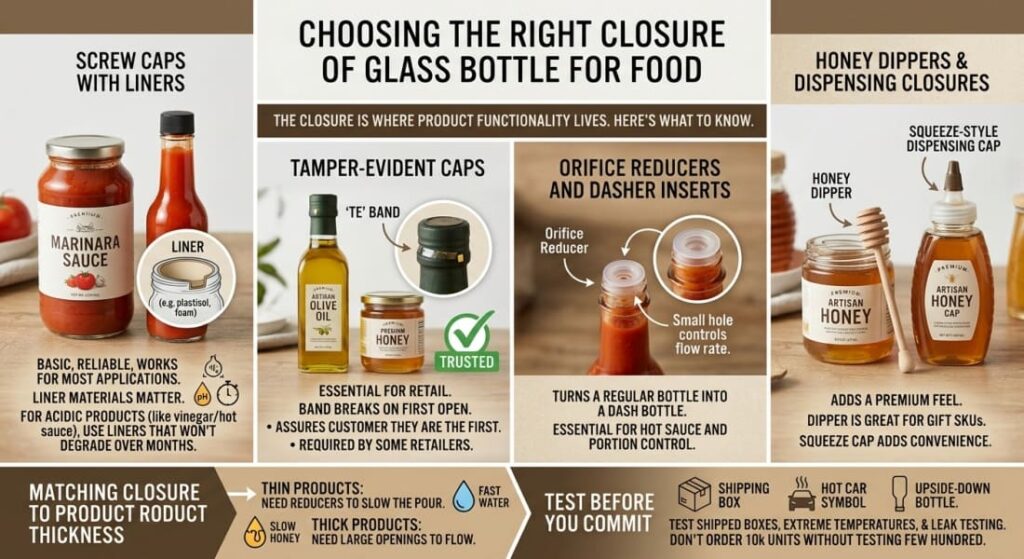
Choosing the Right Closure of Glass Bottle For Food
The closure is where a lot of the actual functionality of your packaging lives. Here’s what to know.
Screw Caps with Liners
Basic, reliable, works for most applications. The liner inside the cap is what actually creates the seal — different liner materials work better for different products. For acidic products like hot sauce, you want a liner that won’t degrade when it’s in contact with vinegar for months.
Tamper-Evident Caps
These are the caps with a band that breaks when someone opens the bottle for the first time. For retail food products, tamper-evident closures are basically expected. Customers want to know they’re the first person to open the bottle, and some retailers require them.
Orifice Reducers and Dasher Inserts
These are the little plastic inserts that fit inside the bottle neck, under the cap. They’re what turns a regular bottle into a hot sauce bottle — the small hole controls how fast the sauce comes out. If you’re making hot sauce, you almost certainly want one of these. They’re also useful for anything where portion control matters.
Honey Dippers and Dispensing Closures
For honey, you have options. Standard screw caps work fine, but a squeeze-style dispensing cap or an actual honey dipper accessory can make your product feel more premium. A honey bottle with dipper included is popular for gift-oriented SKUs and higher-priced artisan honey.
Matching Closure to Product Thickness
Thin products need something that slows the pour down. Thick products need a large enough opening to actually flow out. If your customer has to squeeze the bottle for 30 seconds to get honey out, that’s a design problem.
Test Before You Commit
Before you order 10,000 units, order a few hundred and actually ship them. Put them in boxes, drive them around, put them in a hot car, put them upside down for a week. Real-world testing catches problems that spec sheets don’t.
Clear vs. Amber Glass for food glass bottles
Both have their place. Here’s how to decide.
When Clear Glass Makes Sense
Clear glass shows off your product, and for a lot of food items that’s a huge selling point. Honey has a beautiful color that changes based on the flowers the bees visited — you want customers to see that. Same with infused oils, colorful hot sauces, and layered dressings.
Clear is the default choice for most food products where visibility helps sell the product.
When Amber Glass Makes Sense
Amber glass blocks UV light, which matters if you’re packaging something light-sensitive. Certain oils, extracts, and herbal products degrade when exposed to light. If you’re bottling something that includes fresh herbs, delicate oils, or ingredients that can oxidize, amber gives you an extra layer of protection.
Some brands also use amber for a specific aesthetic — it reads as “apothecary,” “traditional,” or “medicinal-quality” depending on the styling.
Which One’s Right for You
For most hot sauce, honey, syrup, and dressing products, clear works. Go amber when you have a real product-protection reason, or when your brand aesthetic specifically calls for it.
Best Glass Bottles by Product Category
Let’s get specific about what actually works for each product type.
Hot Sauce
The best bottles for hot sauce are almost always going to be a woozy-style bottle in the 5 oz range, with a dasher insert and a tamper-evident cap. That combination is basically the industry standard because it works — controlled pour, room for a full-wrap label, and a shape customers recognize.
Common sizes for sauce bottles glass in the hot sauce category run 2 oz for samplers, 5 oz for the main SKU, and 8 oz for milder sauces. If you’re buying glass hot sauce bottles wholesale, most suppliers will offer better per-unit pricing at 500+ units and even better at 1,000+.
The category term hot suace bottles (yes, people misspell it in searches all the time) covers this whole product family, and you’ll see it used loosely across supplier catalogs.
Honey
For glass bottles for honey, you have more shape variety than most other categories. Round jars, hexagon honey jars, muth jars, and dedicated honey bottles with squeeze tops are all common. The best packaging for honey depends on where you’re selling — hex jars fit farmers markets and gift shops, while squeezable bottles work better for grocery.
Common honey bottle sizes run 8 oz, 12 oz, 16 oz, and 24 oz for retail. Some brands also do 2 oz and 4 oz for gift sets and hotel amenities.
If you’re thinking about honey bottle packaging as a whole system, don’t forget about labels, closures, and shipping cartons — they all need to work together. And honey bottles glass in general benefit from clear construction so buyers can see the honey’s natural color.
Syrup, Dressings, and Marinades
Syrup glass bottles are usually taller and narrower — think classic maple syrup bottles. The shape controls pour speed, which matters because nobody wants half a bottle of syrup on their pancakes.
For glass bottles for syrup, common sizes run 8 oz to 16 oz for retail and 32 oz for foodservice.
Dressing bottles glass and glass bottles for salad dressing are usually round or squared bottles with wider mouths — dressings often have ingredients (herbs, cheese, chunky bits) that need room to pour. Look for something in the 8 oz to 16 oz range with a screw cap and a good liner for oil compatibility.
Gourmet and Specialty Foods
For infused oils, aged vinegars, dessert sauces, and gift-oriented products, the packaging should reflect what you’re charging. Custom shapes, embossed logos, wax dips, and premium closures all signal that the product inside is worth paying more for. These are usually smaller-run SKUs where per-unit cost matters less than presentation.
Customization Options of Glass Bottles
If you’re growing past the “starter bottle” phase, customization is where you can really differentiate.
Custom Shapes
Custom molds have real minimum order quantities (usually thousands of units and higher tooling costs), but a proprietary bottle shape is one of the strongest brand assets you can own. If competitors can’t buy the same bottle you use, that’s a moat.
Embossing and Decoration
Embossed logos on the glass itself feel premium and can’t be peeled off. Screen printing, frosting, and pressure-sensitive labels are more flexible if you’re testing different designs.
Closure Colors
Matching your cap color to your brand is a small detail that adds up. Black caps, colored caps, gold or copper finishes — all of these are usually available at reasonable minimums.
Private Label and OEM
If you’re a smaller brand, working with a supplier who can help with private label bottles takes a lot of complexity off your plate. They handle sourcing, sometimes decoration, and can consolidate bottles + caps + accessories into a single shipment.
Working with Smilebottles for Glass Food Packaging
At Smilebottles, we’ve been making glass food bottles for hot sauce brands, honey producers, syrup makers, and specialty food companies for years. Here’s what we can help with:
A range of food safe glass bottles across common sizes and shapes — from small samplers to family-size formats
Closure matching, so you don’t end up with bottles and caps that don’t fit
Custom decoration, including embossing, screen printing, and frosting
Wholesale pricing on glass sauce bottles wholesale orders, with better rates at higher volumes
Support for private label and OEM projects for growing brands
If you’re not sure exactly what you need, we can send samples and spec sheets so you can test-fit against your existing equipment before committing to a bulk order.

FAQ: Frequently Asked Questions About Glass Food Packaging
Q1:What size glass bottle is best for hot sauce?
A1:For most hot sauce brands, 5 oz is the standard size — it’s big enough to feel substantial and small enough to price accessibly. 2 oz works for samplers, 4 oz for a slightly smaller retail SKU, and 8 oz for milder sauces where customers use more per serving.
Q2:Are glass bottles safe for hot-filled sauces?
A2:Yes, as long as you use bottles rated for hot fill. Standard soda-lime glass handles most food hot-fill temperatures fine, but you should confirm with your supplier what temperature range their bottles can handle before running production.
Q3:Which bottle is best for honey?
A3:It depends on your market. Hex jars and muth jars work well for farmers markets and gift shops. Squeezable bottles are more practical for grocery. Round jars are the middle ground and work almost anywhere. Sizes usually run 8 oz to 16 oz for retail.
Q4:Do I need tamper-evident caps?
A4:For retail food products, yes. Most grocery buyers won’t stock products without tamper-evident closures, and customers expect to see that broken seal when they open the bottle for the first time.
Conclusion
Picking the right bottle isn’t just about looks. It’s about matching what you’re selling with how it’ll be filled, shipped, displayed, and used. The bottle affects your production process, your shelf presence, your unit economics, and your customer experience — all at once.
The good news is that once you get the basics right — the right size, the right shape, a closure that actually seals, and a look that matches your brand — you don’t have to think about it again for a long time. Get the packaging solid so you can focus on making the product itself the best it can be.
If you’re sourcing glass bottles for sauces, honey, or specialty foods and want to talk through what would work for your product, Smilebottles is happy to send samples and help you figure out what makes sense. No pressure — sometimes the best decision is just seeing a few options in person and holding them in your hand.