Table of Contents
ToggleAuthor: SmileBottles Editorial Team
Estimated Reading Time: About 15 Minutes
Starting a new spirits brand is an exciting journey. You have perfected your recipe, refined your distillation process, and mapped out your business plan. Now comes one of the most critical physical decisions you will make: deciding on your packaging. The bottle you choose is much more than just a vessel; it is the silent ambassador of your brand.
If you are wondering how to choose liquor bottles that will make your product fly off the shelves, you are in the right place. As an experienced glass liquor bottle manufacturer, Smilebottles has helped countless distilleries and importers bring their visions to life. In this comprehensive guide, we will walk you through everything you need to know—from understanding typical liquor bottle dimensions and decoding alcohol sizes names, to selecting closures and partnering with a reliable liquor bottle supplier.
Why Liquor Bottle Selection Matters for a New Brand
Before diving into the physical specifications of glass, it is crucial to understand why this decision carries so much weight. For a new setup brand, choosing the right packaging is a strategic move.
The Bottle Is Part of Your Brand Identity
When a customer browses a retail shelf, your bottle is the very first thing they notice. Long before they taste the liquid inside, the shape, weight, color, and closure communicate your brand’s personality. Whether you are launching a heritage bourbon in classic glass whiskey bottles or a vibrant modern gin in unique liquor bottles, the packaging sets the consumer’s expectations.
The Right Bottle Influences Customer Buying Decisions
Shelf impact matters. In crowded retail stores, bars, and duty-free channels, unique liquor bottles help new brands stand out. A consumer might pick up a bottle simply because it feels heavy, looks luxurious, or has an intriguing shape.
Bottle Choice Also Affects Cost and Logistics
Your packaging choice directly impacts your bottom line. Heavier glass increases freight costs. Selecting standard glass liquor bottles can reduce your initial mold and production costs, while custom glass liquor bottles improve brand recognition but require a larger budget and longer lead times.
Understanding Liquor Bottles: The Basics New Brands Should Know
As you step into the world of beverage packaging, understanding the fundamentals of glass containers will help you make informed purchasing decisions.
What Is a Liquor Bottle?
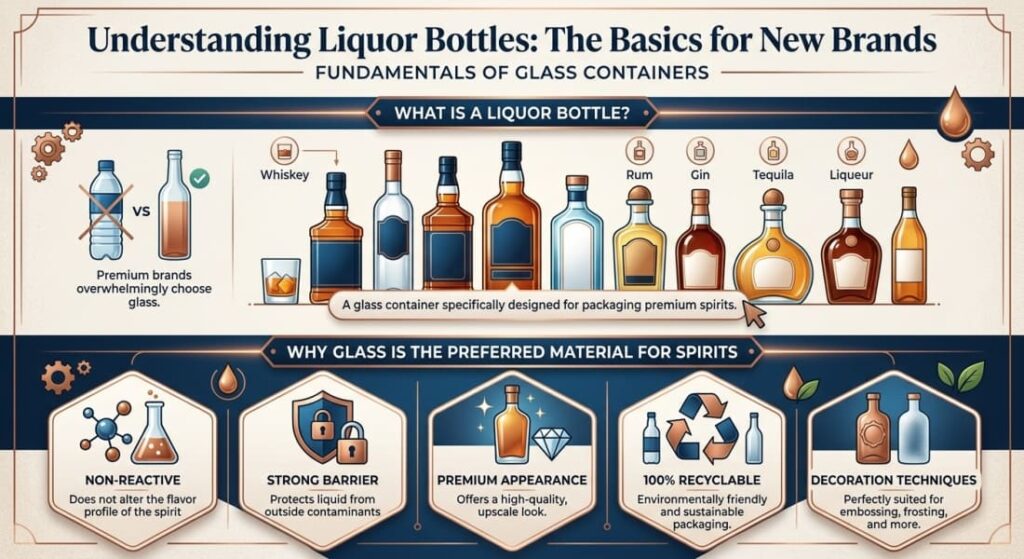
Quite simply, it is a glass container specifically designed for packaging spirits such as whiskey, vodka, rum, gin, tequila, and liqueurs. While plastic is sometimes used for cheaper, high-volume products, premium brands overwhelmingly choose glass.
Why Glass Is the Preferred Material for Spirits
Glass is non-reactive, meaning it will never alter the flavor profile of your carefully crafted spirit. It offers strong barrier properties, protecting the liquid inside from outside contaminants. Furthermore, it presents a premium appearance, is 100% recyclable, and is perfectly suited for various decoration techniques like embossing and frosting.
The Ultimate Guide to Liquor Bottle Sizes You Should Know
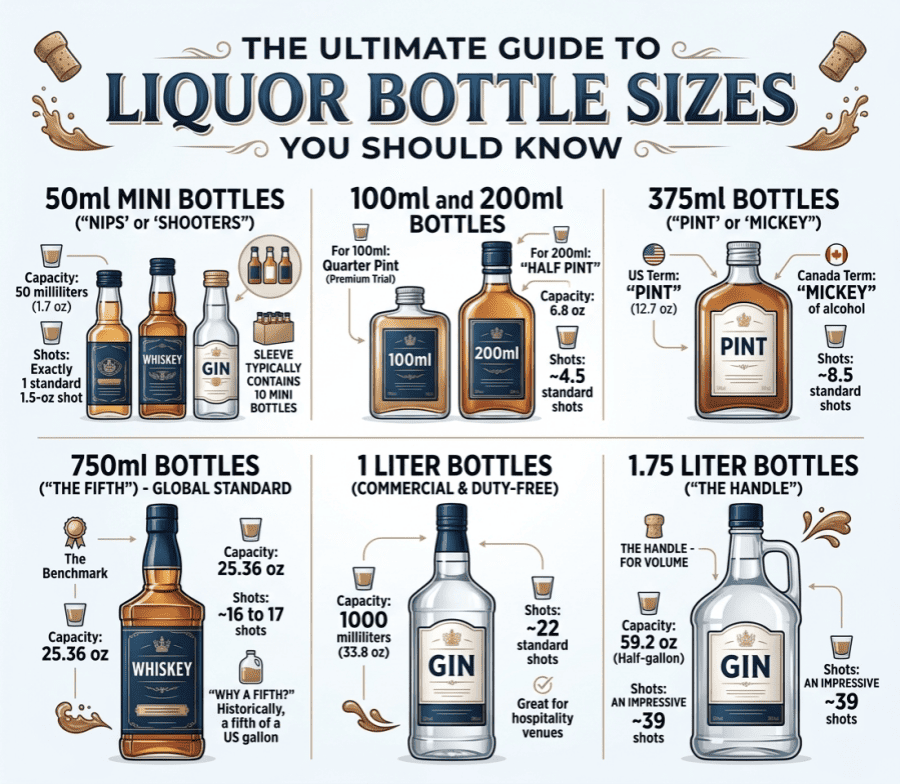
One of the most confusing aspects for new brand owners is navigating the various sizes of liquor bottles. Consumers and retailers use specific terminology, and understanding the math—like how many shots are in a fifth or how big is a handle of alcohol—is essential for pricing and market positioning. Let’s break down the standard liquor bottle sizes.
50ml Mini Bottles (Nips or Shooters)
Commonly known as “nips” or “shooters,” the 50ml bottle size is the standard for airline travel, hotel minibars, and promotional samples.
Capacity: 50 milliliters (1.7 ounces).
Shots: Wondering how many shots in a 50 ml? It holds exactly one standard 1.5-ounce shot, making it perfect for single servings.
Details: These small liquor bottles are often sold in multipacks. You might hear people ask how many nips are in a sleeve; typically, a sleeve contains 10 miniature bottles.
100ml and 200ml Bottles (Quarter and Half Pints)
Moving slightly up in size, we find the 100ml and 200ml options.
100ml: Often called a quarter pint, the 100 ml alcohol bottles are popular for premium trial sizes.
200ml: The 200ml bottle size is traditionally called a “half pint” of liquor. If you are asking how big is 200 ml or how many shots is 200 ml, it holds about 6.8 ounces, which equates to roughly 4.5 standard shots.
375ml Bottles (Pint or Mickey)
The 375 ml bottle is a highly popular size for gift sets and casual consumption.
Terminology: In the US, it is widely referred to as a “pint” of liquor. In Canada, it is famously asked, what is a mickey of alcohol? A mickey is a 375ml bottle.
Capacity: If you need to know 375 ml to oz, it translates to 12.7 ounces.
Shots: So, how many shots in 375 ml? You will get about 8.5 standard shots from this size.
750ml Bottles (The Fifth)
The 750ml liquor bottle is the absolute global standard for spirits and wine. When you look at an alcohol bottle sizes chart, this is the benchmark.
Terminology: This size is universally known as a “fifth.” But why is it called a fifth? Historically, it represented a fifth of a US gallon. Although we now use the metric 750ml, the name stuck.
Capacity & Math: If you are wondering how many oz in 750 ml, it is 25.36 ounces.
Shots: How many shots are in a fifth of alcohol? A standard 750ml bottle yields approximately 16 to 17 standard 1.5-ounce shots.
Comparisons: People often ask about 750ml vs 1 liter or fifth vs liter. A liter holds 33.8 ounces (about 22 shots), making it roughly 33% larger than a fifth.
1 Liter Bottles
The 1 liter alcohol bottle is primarily used in commercial settings like bars and restaurants, as well as duty-free shops.
Capacity: 1000 milliliters or 33.8 ounces.
Shots: How many shots in a liter? You can expect about 22 standard shots. It provides an excellent volume-to-cost ratio for hospitality venues.
1.75 Liter Bottles (The Handle)
When you want to sell volume, you use the 1.75-liter bottle, universally known as a “handle.”
Terminology: What is a handle of liquor? It is a large, 1.75L bottle that traditionally featured a built-in glass or plastic handle for easy pouring.
Capacity: It holds 59.2 ounces, which is equivalent to a half-gallon.
Shots: How many shots are in a handle of alcohol? You will get an impressive 39 standard shots.
Comparisons: When looking at a fifth vs handle, a handle contains more than double the liquid of a standard 750ml fifth.
Common Types of Liquor Bottles
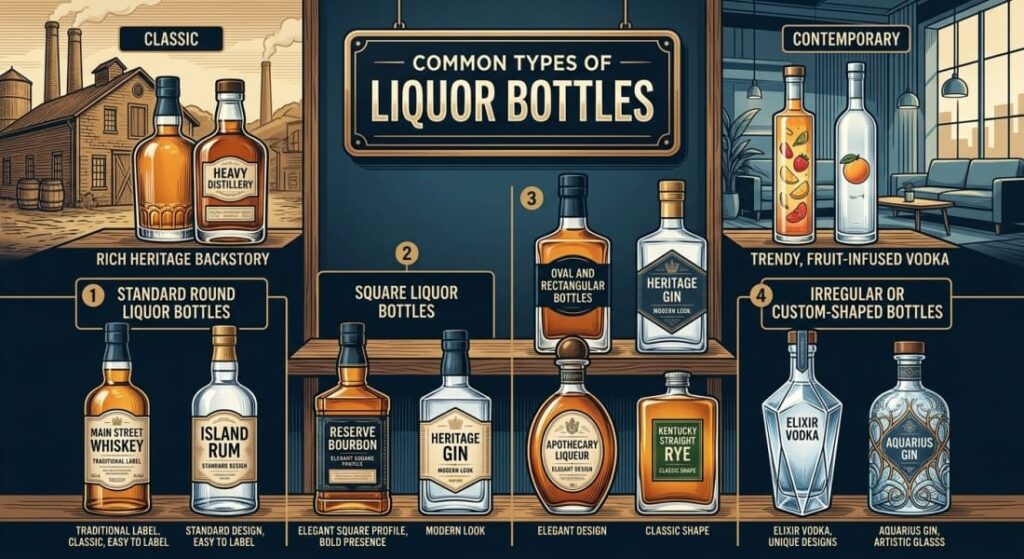
Beyond just size, the shape and style of your container dictate its market appeal. Understanding the different types of liquor bottles is vital for brand alignment.
Standard Round Liquor Bottles
Round liquor bottles are traditional, versatile, and highly cost-effective. They are easy to label, efficient to pack, and are the industry standard for mainstream whiskey, rum, and vodka.
Square Liquor Bottles
Square liquor bottles offer a modern, bold appearance. They are highly efficient when packing into cartons and create a very strong, commanding presence on a retail shelf. Many premium bourbon and gin brands favor square profiles.
Oval and Rectangular Bottles
These offer an elegant middle ground. Rectangular flasks are common for smaller sizes of whiskey bottles, while tall oval bottles are often seen in premium liqueurs and artisanal spirits.
Irregular or Custom-Shaped Bottles
If you want total market differentiation, unusual liquor bottles or custom shaped liquor bottles are the way to go. These require bespoke molds and higher upfront investments but deliver an unparalleled luxury aesthetic.
Classic vs. Contemporary Bottle Styles
Does your brand have a rich, heritage backstory? A classic, heavy-bottomed bottle will suit you best. Are you launching a trendy, fruit-infused vodka? A sleek, minimalist, contemporary design will speak directly to your target audience.
Liquor Bottle Neck Finishes and Closure Types
The way you seal your bottle is just as important as the bottle itself. The neck finish must match the aesthetic and functional needs of your product.
Cork Finish Bottles
Offering a traditional and premium image, cork top liquor bottles are the gold standard for aged spirits. Whether you use a natural cork, synthetic cork, or a wooden T-top, this closure provides the satisfying “pop” that consumers associate with high-quality whiskey, rum, and tequila.
Screw Top Bottles
Screw top liquor bottles are convenient, highly secure, and cost-effective. They are excellent for high-volume, practical, and modern brands, particularly in the vodka and gin sectors.
Bar Top Closures
Very popular in premium and craft spirits, bar top closures add tactile value and an upscale appearance to your product, blending the premium feel of a cork with modern sealing reliability.
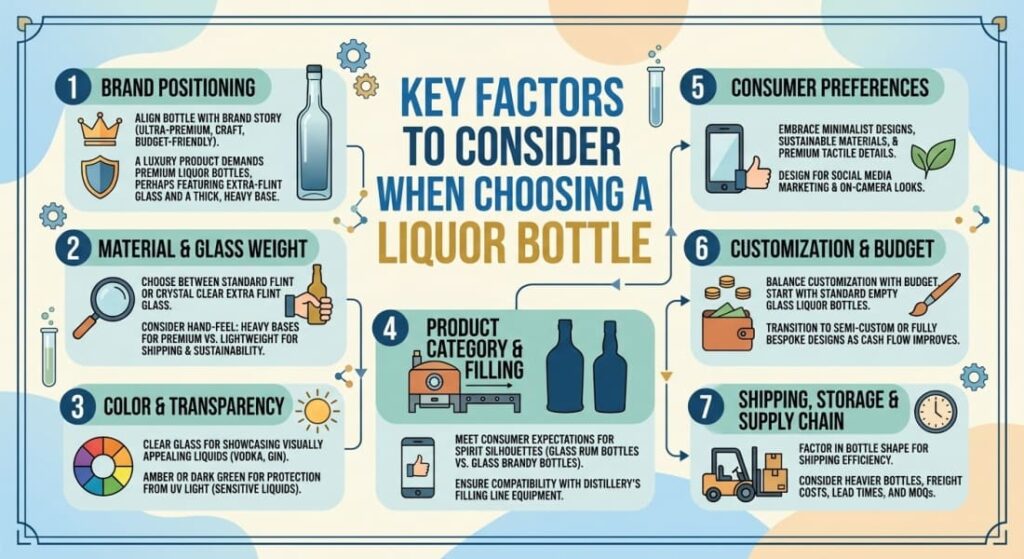
Key Factors to Consider When Choosing a Liquor Bottle
Selecting the perfect container requires balancing aesthetics, budget, and functionality. Here are the crucial factors you must evaluate:
1. Match the Bottle to Your Brand Positioning
Your bottle must visually align with your brand story. Are you ultra-premium, craft, or budget-friendly? A luxury product demands premium liquor bottles, perhaps featuring extra-flint glass and a thick, heavy base.
2. Choose the Right Material and Glass Weight
Standard flint glass offers great clarity for everyday products. Extra flint glass is crystal clear and used for luxury items. Remember that heavy-bottom bottles feel premium in the hand, but lightweight bottles reduce shipping costs and align better with eco-friendly sustainability goals.
3. Select the Right Bottle Color and Transparency
Clear glass is ideal for showcasing visually appealing liquids like vodka, gin, and certain tequilas. However, if your product is sensitive to UV light, amber or dark green glass is necessary for protection.
4. Consider Product Category and Filling Requirements
Different spirits have traditional expectations. For instance, consumers expect different silhouettes for glass rum bottles versus glass brandy bottles. Furthermore, your bottle’s opening must be compatible with your distillery’s filling line equipment.
5. Think About Consumer Preferences and Market Trends
Modern consumers care deeply about packaging. Minimalist designs, sustainable materials, and premium tactile details are currently trending. Additionally, how your bottle looks on camera matters for social media marketing.
6. Balance Customization with Budget
If you are operating on a tight budget, using standard empty glass liquor bottles keeps your startup costs low. As your cash flow improves, you can transition to semi-custom or fully bespoke designs.
7. Evaluate Shipping, Storage, and Supply Chain Efficiency
Bottle shape affects how efficiently your product fits into a shipping carton. Heavier or strangely shaped bottles will increase your freight costs. Always factor in Lead times and Minimum Order Quantities (MOQ) when planning your supply chain.
How Bottle Design Supports Branding and Marketing
Your packaging is your best marketing tool. It must tell your brand story at a glance.
Use Packaging to Tell Your Brand Story
Whether your brand represents local culture, deep craftsmanship, or modern innovation, your bottle design should reflect this. Liquor packaging design is the visual translation of your product’s soul.
Shape, Closure, and Decoration Build Perceived Value
A heavier glass bottle paired with a custom wooden closure allows you to justify a higher retail price. Tactile decorations, such as embossing, invite the consumer to touch the bottle, creating a physical connection with the brand.
Shelf Appeal Matters for New Brands
In a crowded liquor store, distinctive spirits packaging is what makes a customer stop and look. If your bottle fades into the background, your marketing efforts will struggle to convert into sales.
Custom Liquor Bottle Options for New Brands
Standing out often requires personalization. Here are the customization options available to elevate your packaging.
Embossing and Debossing
Adding a brand logo or intricate patterns directly into the glass creates embossed liquor bottles. This offers permanent, undeniably premium branding that cannot be peeled off or scratched away easily.
Surface Decoration and Treatments
Transform standard glass through various surface treatments. Frosted liquor bottles offer an elegant, icy look perfect for vodka. You can also utilize color spraying, electroplating for a metallic finish, or screen printing directly onto the glass.
Labels and Applied Branding Elements
Your liquor bottle labels must complement the glass. Choose from textured paper labels, transparent decals, metallic foils, or neck labels. Tamper-evident seals can also be customized to feature your logo.
Complete Packaging Solutions
Consider the entire unboxing experience. A cohesive presentation includes the bottle, closure, label, and secondary packaging like a branded carton or luxury gift box.
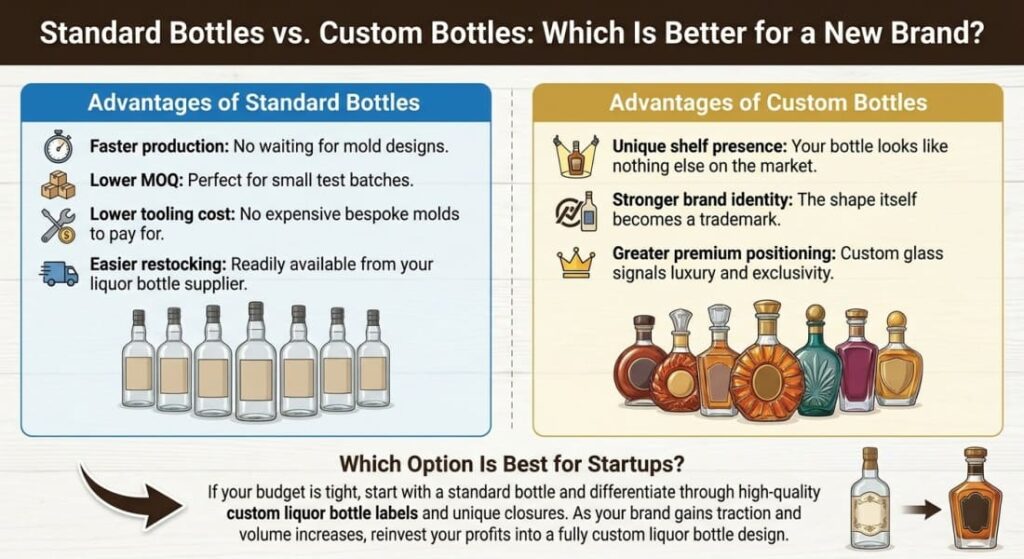
Standard Bottles vs. Custom Bottles: Which Is Better for a New Brand?
This is a common dilemma for startups. Let’s weigh the options.
Advantages of Standard Bottles
Faster production: No waiting for mold designs.
Lower MOQ: Perfect for small test batches.
Lower tooling cost: No expensive bespoke molds to pay for.
Easier restocking: Readily available from your liquor bottle supplier.
Advantages of Custom Bottles
Unique shelf presence: Your bottle looks like nothing else on the market.
Stronger brand identity: The shape itself becomes a trademark.
Greater premium positioning: Custom glass signals luxury and exclusivity.
Which Option Is Best for Startups?
If your budget is tight, start with a standard bottle and differentiate through high-quality custom liquor bottle labels and unique closures. As your brand gains traction and volume increases, reinvest your profits into a fully custom liquor bottle design.
Supply Chain, MOQ, and Quality Assurance
A beautiful bottle is useless if your manufacturer cannot deliver it on time or to the required quality standard.
Why Reliable Supply Matters for New Brands
Inconsistent supply will disrupt your bottling schedules, delay product launches, and ultimately damage your sales planning and retailer relationships.
Key Questions to Ask a Bottle Supplier
When vetting a liquor bottle manufacturer, ask:
What is your standard MOQ?
What are your lead times for production and shipping?
Do you offer in-house decoration and closure matching?
What are your quality control procedures?
Quality Standards to Check
Ensure your supplier conducts rigorous testing for glass consistency, dimensional accuracy, sealing compatibility, and impact resistance.
Common Mistakes New Liquor Brands Should Avoid
Learn from the errors of others to ensure a smooth launch.
Choosing Based Only on Appearance: A bottle might look stunning, but if it is too tall for a standard retail shelf, retailers won’t stock it.
Ignoring Filling Line Compatibility: Always send a sample bottle to your bottling facility to ensure it works with their machinery.
Underestimating Lead Times: Wholesale liquor bottles, especially custom ones, take months to produce and ship. Plan far in advance.
Overdesigning: Adding too many decorative elements (frosting, printing, embossing) can skyrocket your cost without necessarily adding value to the consumer.
How Smilebottles Supports New Liquor Brands
As a premier glass liquor bottle factory, Smilebottles is dedicated to turning your brand vision into reality. We don’t just sell empty glass; we provide comprehensive packaging solutions tailored to distilleries of all sizes.
What Smilebottles Can Offer
We provide an extensive catalog of standard wholesale glass liquor bottles ready for immediate production. For brands wanting exclusivity, our design-to-production service handles everything from 3D modeling and custom molds to final manufacturing. We also offer state-of-the-art decoration services, closure matching, and robust export packaging.
Why Work With an Experienced Bottle Manufacturer?
Partnering with Smilebottles means you benefit from transparent communication, expert design support, rigorous quality control, and stable delivery timelines. We help you control costs while maximizing your brand’s visual impact.
FAQ Frequently Asked Questions About Choosing Liquor Bottles
Q1:What is the best bottle shape for a new liquor brand?
A1:It depends entirely on your product and brand identity. Whiskey often performs well in classic round or sturdy square bottles, while modern gins and vodkas benefit from tall, sleek, and contemporary shapes.
Q2:Should I choose a standard bottle or a custom bottle?
A2:Startups with limited budgets should begin with standard bulk liquor bottles and use creative labeling to stand out. Brands with higher initial capital can opt for custom molds to secure an immediate, unique market presence.
Q3:What size is 375 ml of liquor?
A3:A 375ml bottle, often called a pint or a mickey, holds 12.7 ounces of liquid, yielding about 8.5 standard shots.
Q4:What is the difference between a fifth and a handle?
A4:A fifth is 750ml (about 17 shots), which is the standard size for spirits. A handle is 1.75 liters (about 39 shots) and is a large, volume-oriented bottle often featuring a grip handle.
Q5:Can bottle color affect liquor quality?
A5:Yes. If your spirit contains ingredients sensitive to UV light, prolonged exposure in a clear bottle can degrade the flavor. In such cases, amber or dark green glass is recommended.
Q6:How can I make my liquor bottle look more premium?
A6:Use heavier glass with a thick base, opt for a high-quality cork or bar top closure, utilize subtle embossing, and invest in high-end, textured labels.
Conclusion
Choosing the right packaging is a delicate balancing act of brand image, functionality, budget, and supply chain reliability. Whether you are searching for standard empty liquor bottles or developing a highly complex, bespoke container, your bottle is a powerful marketing tool that speaks to consumers before they ever take a sip. By avoiding common pitfalls and planning your supply chain carefully, you set your new spirits brand up for long-term success.
If you are ready to take the next step, contact Smilebottles today. As your trusted spirits bottle manufacturer, we are here to provide expert support in selecting, designing, and manufacturing the perfect glass bottles for your brand launch.