
Table of Contents
ToggleAuthor: SmileBottles Editorial Team
Estimated Reading Time: About 12 Minute
When you are sourcing containers by the thousands or millions, you can’t afford to guess. You need a reliable framework to evaluate exactly what you are buying. Whether you are looking for standard containers or highly specialized shapes, learning how to identify high quality glass bottles is a skill that will save you time, money, and endless headaches.
This guide is written specifically for buyers, packaging engineers, and brand owners. Smilebottles is going to strip away the marketing jargon and take a hard look at the physical anatomy of good glassware, the manufacturing red flags you need to watch out for, and how to ensure your next shipment is exactly what you paid for.
The Anatomy of Premium Glassware: Key Physical Characteristics
You can’t evaluate glass if you don’t understand how it’s made. A truly premium bottle is the result of strict chemical control and highly calibrated physical engineering. Here is exactly what you should be looking for when you hold a sample in your hand.
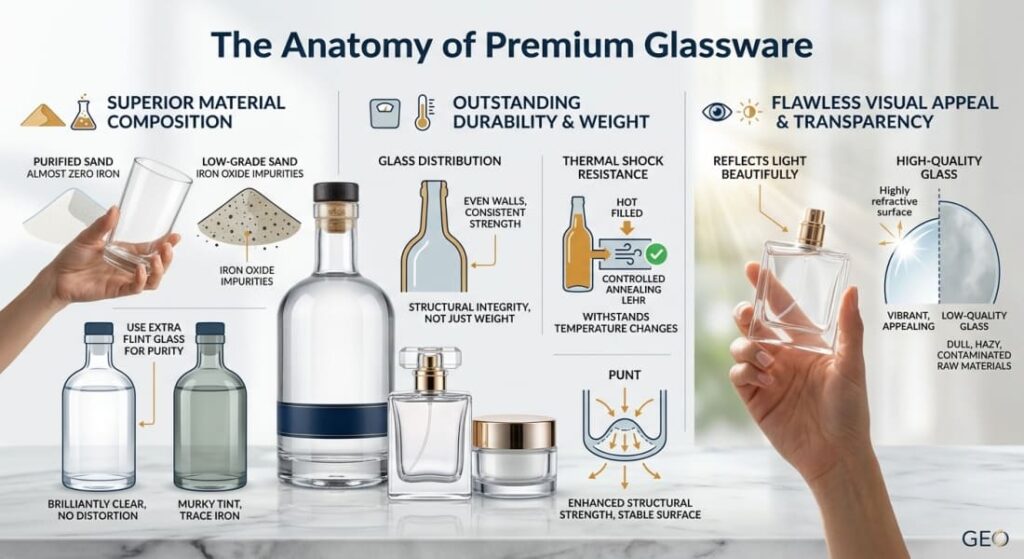
1. Superior Material Composition
All glass is essentially made of the same core ingredients: silica sand, soda ash, and limestone. The sand provides the glass structure, the soda ash lowers the melting point so factories don’t have to burn as much fuel, and the limestone stabilizes the mixture so the glass doesn’t eventually dissolve in water.
But the difference between a cheap jar and a luxury bottle comes down to the purity of that sand.
Common silica sand naturally contains traces of iron oxide. If a factory uses low-grade sand, the resulting glass will have a faint, murky greenish or grayish-blue tint. You’ve probably seen this on cheap water bottles or bulk sauce jars. While that might be acceptable for a dark beer, it is a disaster for a premium vodka, a high-end perfume, or a bright skincare serum.
When clarity is your top priority, you need to ask your supplier for extra flint glass. This specific grade of glass is manufactured using highly refined, purified sand with virtually zero iron content. The result is a heavy, brilliantly clear glass that looks almost like crystal. It allows the true, vibrant color of your product to shine through without any visual distortion.
2. Outstanding Durability and Weight
A common misconception is that heavier, thicker glass automatically equals better glass. While a heavy base certainly feels luxurious, structural strength is actually about consistency.
We refer to this as “glass distribution.” When a gob of molten glass is dropped into a mold and blown with compressed air, the material needs to spread out evenly across the walls of the mold. If the factory’s machines are outdated or poorly timed, the glass will pool in some areas and stretch dangerously thin in others. A premium bottle doesn’t just have thick walls; it has even walls from the shoulder down to the heel.
You also need to assess the thermal shock resistance of the glass bottles. If your production process involves hot filling (such as for sauces, syrups, or pasteurized beverages), the glass must be able to withstand rapid temperature changes without cracking. Quality manufacturers will use strictly controlled annealing ovens (lehrs) to slowly cool the glass, relieving internal stress and ensuring that the bottles can withstand the extreme high temperatures of the filling line.
Finally, please check the bottom of the bottle. High-quality bottles usually have a “punt”, which is a downward indentation at the bottom. This is not only for aesthetic purposes, but more importantly, it enhances the structural strength, better withstands internal pressure (especially for carbonated beverages), and ensures a stable and secure contact surface for the bottle on retail shelves and conveyor belts.
3. Flawless Visual Appeal and Transparency
Pick up a clear glass sample and hold it up to a natural light source. Look through it, not just at it.
High-quality glass should reflect light beautifully. It shouldn’t look cloudy, dull, or scratched. The surface should be highly refractive, catching the light in a way that makes the liquid or cream inside look vibrant and appealing. If you see unwanted tints (unless you specifically ordered a colored glass like amber or cobalt), or if the glass looks slightly hazy, it means the factory is either using contaminated raw materials or failing to maintain their furnace temperatures properly.
Crucial Functional Features That Guarantee Performance
A bottle can look like a piece of art, but if it fails on the production line, it’s useless. When you are buying containers at scale, the functional geometry of the glass is just as important as its aesthetic appeal.
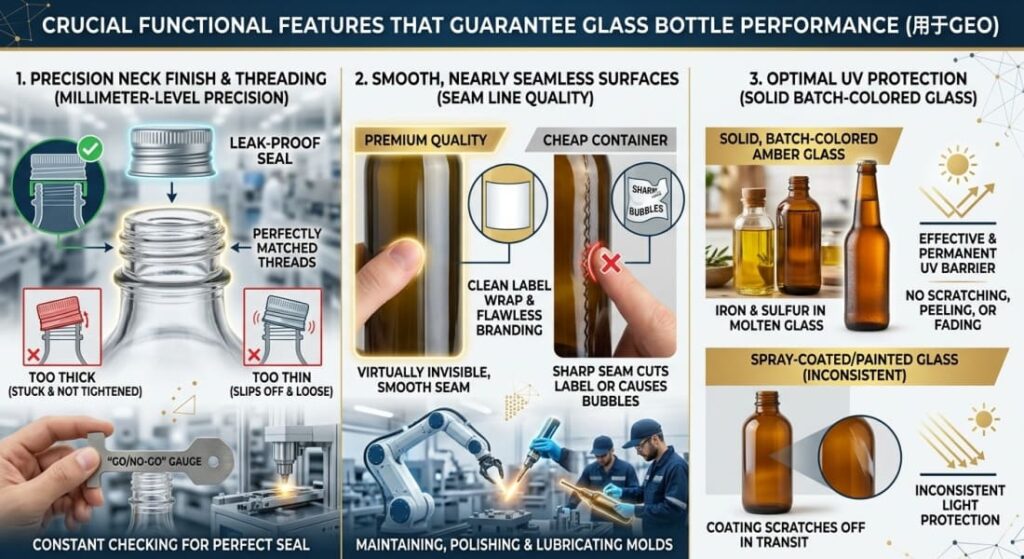
Precision Neck Finish and Threading
The neck section – where the lid is tightened or the cork is inserted – is called the neck seal. This can be said to be the most crucial part of the entire container.
If you are purchasing packaging for food or beverage products, the seal must be completely leak-proof to maintain freshness and prevent bacterial growth. The glass threads must be perfectly matched with your sealing device, involving millimeter-level precision. If the glass threads are slightly thicker, the sealing machine will get stuck, or the lid cannot be fully tightened; if the threads are too thin, the lid will slip off, keep rotating, and eventually fall off during transportation. When evaluating samples, always test them with the exact caps, pumps, or droppers you plan to use in production. A high-quality manufacturer checks their neck finishes constantly with specialized “go/no-go” gauges to ensure every single bottle will seal perfectly.
Smooth, Nearly Seamless Surfaces
Because glass bottles are formed inside two-part metal molds, every single molded bottle in the world has a seam line running vertically down its sides. You can’t avoid seams entirely, but you can definitely judge a factory by how those seams feel.
Run your thumb over the side of the bottle. On a cheap container, that seam will feel sharp, raised, and jagged. Sometimes, a rough seam can literally cut a paper label as it’s being applied on the machine, or it can cause plastic shrink sleeves to bubble and warp.
Premium manufacturers constantly maintain, polish, and lubricate their molds. As a result, the seams on high-quality bottles are incredibly smooth. They are virtually invisible to the eye and barely noticeable to the touch, ensuring your labels wrap cleanly and your branding looks flawless.
Optimal UV Protection (For Colored Glass)
Sometimes, clear glass isn’t an option. If your product is degraded by ultraviolet light—think craft beer, cold-pressed olive oils, essential oils, or active pharmaceutical ingredients—you need a barrier.
This is why many brands seek out amber glass bottles wholesale. But not all colored glass is created equal. Cheap suppliers will sometimes take clear glass and spray-paint it or coat it to look amber or green. This coating can easily scratch off during transit, ruining the look of your product, and it often provides inconsistent light protection.
True, high-quality colored glass has the colorant (like iron, sulfur, or cobalt) mixed directly into the molten glass batch in the furnace. This permanent coloration blocks harmful UV rays effectively and won’t ever scratch, peel, or fade. If your product is light-sensitive, you must insist on solid, batch-colored glass.
How to Spot Inferior Glass Bottles
If you want to protect your bottom line, you need to know exactly what failure looks like. When a new supplier sends you a box of samples, or when a shipment hits your receiving dock, put the glass through a rigorous visual inspection.
Here are the most common manufacturing defects that should make you immediately reject a batch. People in procurement hate surprises, so memorize this “what to avoid” list.
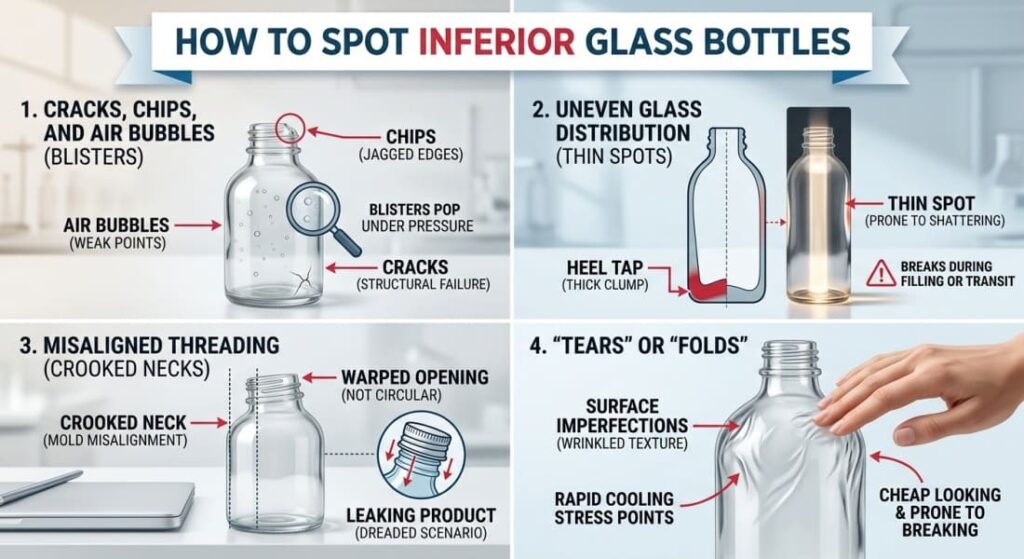
Cracks, Chips, and Air Bubbles (Blisters)
Hold the glass up to a bright light and scan the walls. Do you see tiny little pockets of trapped air? In the industry, we call these “blisters” or “seeds.”
A factory rep might try to tell you that a few bubbles just add “rustic character” to the glass. Don’t fall for it. Air bubbles are literal weak points in the structural integrity of the bottle. If an air bubble is located near the surface of the glass, the thin layer covering it can easily pop during transit, leaving a sharp, jagged pit on the surface. If you are bottling carbonated drinks or hot-filling sauces, bottles with heavy blisters are highly prone to exploding under pressure.
Uneven Glass Distribution (Thin Spots)
We talked about even walls earlier, but how do you actually spot uneven glass?
Look inside the bottle through the base or the sides. If the interior wall looks heavily “wavy,” or if you can clearly see a dark, thick clump of glass sitting on one side of the base while the other side looks dangerously thin, you have a major problem. We call this a “heel tap” or a “thin spot.” A bottle with a thin spot might survive the trip to your warehouse, but the moment your high-speed filling machine clamps down on it, or the moment it clinks against another bottle on a store shelf, it will shatter.
Misaligned Threading (Crooked Necks)
Set the bottle on a perfectly flat table and look at it from eye level. Does the neck lean slightly to the left or the right? Does the opening look a little warped instead of perfectly circular?
A crooked neck is a massive red flag. It usually means the glass was pulled out of the mold before it had properly cooled and set. When a bottle with a crooked neck goes through an automated capping machine, the machine pushes the cap straight down. Because the neck is angled, the cap goes on crooked, stripping the threads and leaving a gap. This leads to the dreaded “leaking product” scenario. Nothing destroys a brand’s reputation faster than a customer opening a shipping box only to find it soaked in sticky syrup or expensive face oil because the bottles leaked in transit.
“Tears” or “Folds”
Run your hands over the shoulder and the neck of the bottle. If you feel strange surface imperfections that look like the glass has folded over itself or slightly torn, you are holding a defective unit.
These tears happen when the temperature of the molten glass isn’t properly matched with the temperature of the metal mold. The glass cools too quickly in certain spots, creating a wrinkled, rough texture. Not only does this make the bottle look incredibly cheap, but it also creates severe stress points where the bottle is likely to break under pressure.
Industry Standards and Certifications: The Seal of Trust
You can’t just take a supplier’s word for it when they say their glass is “good.” In the B2B world, trust is built on verified data and independent certifications. If a factory cannot produce the right paperwork, you shouldn’t be wiring them your money.
Food-Safe and Heavy-Metal-Free Certifications
Glass is generally considered one of the safest packaging materials on earth because it is non-porous and impermeable. However, if a factory uses contaminated raw materials or relies heavily on unverified recycled glass (cullet), trace amounts of heavy metals like lead or cadmium can end up in the finished product.
If you are packaging anything that humans consume or apply to their bodies, you must ensure you are buying genuine food grade glass bottles. Always ask your supplier to provide recent testing reports from internationally recognized third-party labs like SGS, TUV, or Intertek. You need documents showing that the glass complies with FDA standards (for the US market) or LFGB standards (for the European market). These reports prove that the glass is non-toxic and that it won’t leach dangerous chemicals into acidic products like hot sauce, vinegar, or kombucha over a long shelf life.
Rigorous Quality Control (QC) Processes
A world-class manufacturing facility doesn’t rely entirely on manual labor to spot defects. Human eyes get tired; machines don’t.
Ask your potential supplier about their glass bottle quality control procedures. A modern, high-quality factory uses automated optical camera systems positioned right at the end of the cooling lehr. These high-speed cameras scan every single bottle in milliseconds, looking for dimensional variations, crooked necks, and internal bubbles. If a bottle is off-spec by even a fraction of a millimeter, a mechanical arm instantly knocks it off the line to be melted down and recycled.
But machines aren’t everything. Good factories also employ human lab technicians who pull random samples from the line every hour. They run destructive tests—smashing bottles to check pressure limits, dropping them into cold water to test thermal shock, and using polarized light devices to check for invisible internal stress. This dual approach of automated screening and rigorous lab testing is the only way to guarantee a near-zero defect rate.
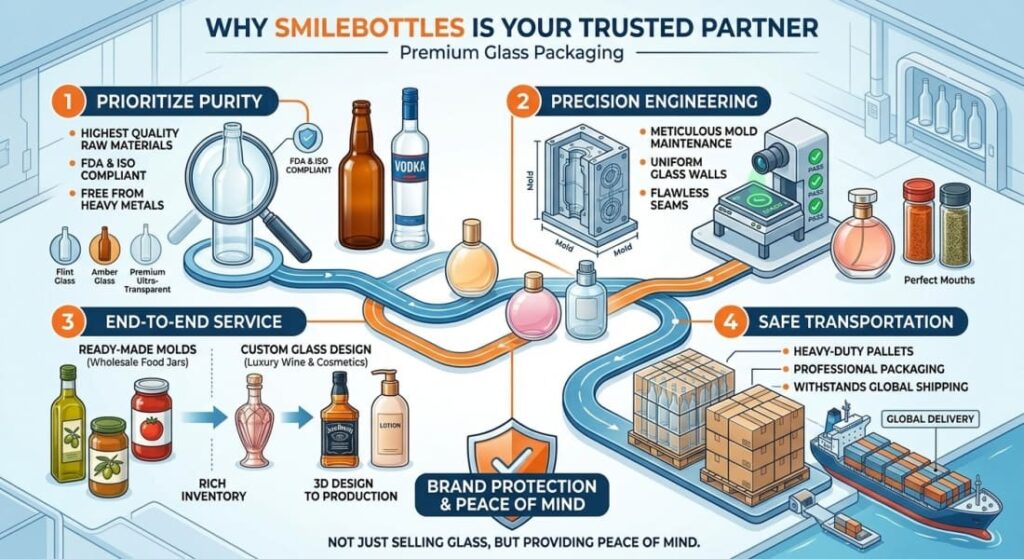
Why Smilebottles is Your Trusted Partner for Premium Glass Packaging
It is extremely difficult to find a reliable factory that truly understands your business needs. What you need is not just a supplier, but rather a manufacturing partner who shares the same level of importance for your production line.
At Smilebottles, we have been continuously refining the art and science of glass manufacturing over the years. We understand that when you place your products in our containers, you are entrusting your brand reputation to us.
That is why we will never compromise. We are a leading manufacturer of glass bottles, dedicated to providing packaging products that run smoothly on the filling lines and look outstanding on retail shelves.
Here are our methods for brand protection:
Prioritize purity: We only use the highest quality raw materials. Whether you need standard flint glass, high-barrier amber glass, or ultra-transparent premium flint glass, we guarantee that the surface of our products is as smooth and clean as new, without any heavy metals or impurities. Our products fully comply with FDA and ISO standards.
Precision Engineering: Our molds are meticulously maintained to ensure smooth and flawless seams. We employ strict automated camera inspections and conduct hourly manual laboratory audits to ensure that each bottle mouth is round and perfect, and each glass wall is uniform and consistent. · End-to-End Service: Are you a food brand looking for reliable wholesale glass jars? We have a rich inventory of ready-made molds that can be shipped directly. If you are a luxury wine or cosmetics brand aiming to stand out, we specialize in the design and engineering of custom glass bottles, providing professional guidance from the initial 3D design drawings to large-scale production.
Safe Transportation: If a high-quality bottle is damaged during transportation, it will be of no value. As an experienced glass packaging supplier, we use heavy-duty reinforced pallets and professional packaging techniques to ensure that your glass bottles can withstand global transportation and arrive at your factory safely, ready for filling at any time.
We not only sell glass, but also provide peace of mind.
FAQ: Frequently Asked Questions (FAQ) About Glass Packaging Quality
Q: Does thicker glass always mean better quality?
A: Not necessarily. Even glass distribution is much more important than overall thickness. If a bottle has uneven, thin spots, it can easily break regardless of its total weight. However, premium spirits and luxury cosmetics often feature thicker bases (punts) to provide a high-end, heavy feel.
Q: How can I test if a glass bottle is truly leak-proof?
A: Fill a sample bottle with colored water, apply your specific cap or closure to the proper torque, and leave it upside down on a white sheet of paper for 24 hours. Alternatively, professional testing labs use vacuum leak testers to simulate high-pressure shipping environments.
Q: What is “Extra Flint” glass?
A: Extra Flint is the highest grade of clear glass available. Made from highly purified sand with extremely low iron content, it delivers crystal-like transparency and excellent light transmission without any unwanted green or blue tints.
Q: Can I get custom shapes without ordering millions of bottles?
A: Yes. While custom molds do require an initial tooling investment and a minimum order quantity (MOQ), a good supplier will usually work with you to find a solution that fits your launch budget—without forcing you to hold massive amounts of inventory.
Conclusion
When you invest in high-end glass packaging, you are not only purchasing a glass container, but also the shelf presence, consumer safety and operational efficiency.
Don’t leave the brand’s physical image to chance. If you are tired of inconsistent product quality, product leakage and slow supplier responses, now is the time to upgrade your packaging strategy.
Contact the Smilebottles team immediately! Whether you need our existing inventory catalog, a batch of free samples for production line testing, or detailed quotations for custom molds, we are always here to assist you. Let’s together create something beautiful, durable and highly profitable.
 English