
Table of Contents
ToggleAuthor: SmileBottles Editorial Team
Estimated Reading Time: About 16 Minute
If you buy diffuser packaging for a brand, a distributor, or a retail line, this topic tells you something more important: your customers care about ease of use, safety, and product experience from the first touch.
That is why search phrases like how to open a reed diffuser bottle matter. They show real purchase intent behind the packaging decision. When people struggle with a cap, a stopper, or an inner plug, they remember the inconvenience. When the bottle opens smoothly and feels premium, they remember that too. This guide helps you understand how to open reed diffuser bottles safely, how to choose bottle and stopper designs that reduce user problems, and how to select glass packaging that supports your brand in a practical way.
Why opening experience matters when you buy reed diffuser bottles
Before you choose shape, finish, or decoration, it helps to look at why opening matters so much. A reed diffuser is simple by design. Your customer removes the cap, takes out the inner stopper, inserts reeds, and places the bottle in the room. That sounds easy, but in real use, small packaging details decide whether the experience feels smooth or frustrating.
A closure that is too tight can make the bottle hard to open. A stopper that fits poorly can leak during shipping or spill during setup. A neck opening that is too narrow may slow insertion of reeds. Even the bottle weight matters, because a light, unstable bottle is easier to tip over when the user pulls the stopper out.
That is why an article like this can do two jobs at once. It answers the practical user question, but it also helps you explain why bottle quality matters. When a buyer compares suppliers, they are not only choosing between shapes. They are also choosing between better fit, better sealing, better display value, and fewer complaints after sale.
How to open a reed diffuser bottle safely
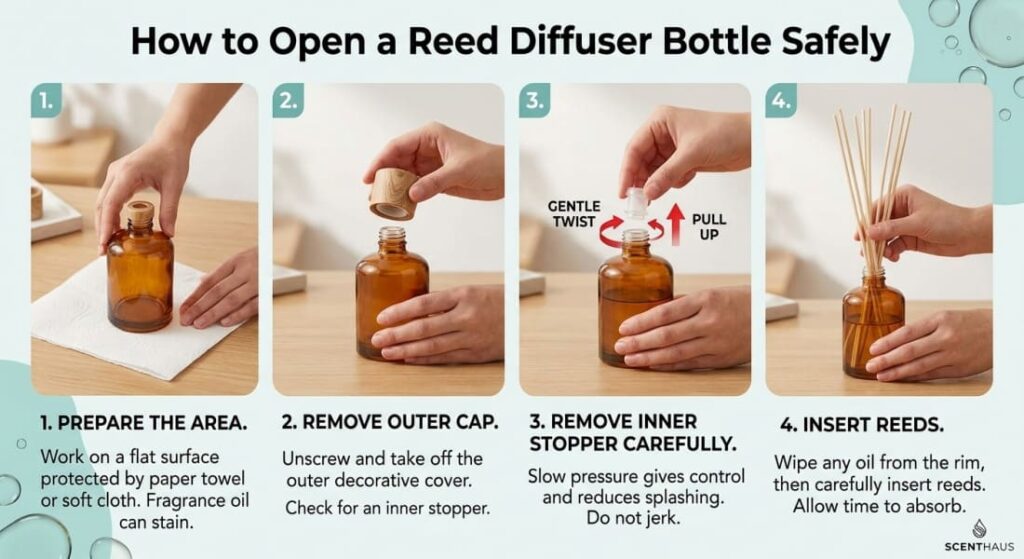
The cleanest way to open a reed diffuser bottle is simple, but you should do it with care. First, place the bottle on a flat surface and protect the area with a paper towel or soft cloth. Fragrance oil can stain wood, painted surfaces, and some fabrics, so setup should always happen on a safe surface.
Next, remove the outer decorative cap or lid. Some bottles use screw caps, some use a decorative overcap, and others use cork-style closures. Once the top cover is off, check whether there is an inner stopper or plastic plug. Many users do not expect that second seal, which is why they think the bottle is difficult to open.
Then remove the stopper slowly. Hold the bottle upright with one hand and pull the inner piece upward with a gentle twisting motion. If the stopper feels tight, do not jerk it out. Slow pressure gives you more control and reduces splashing.
After that, wipe the neck of the bottle if any oil appears around the rim. Insert the reeds carefully, then let them absorb the fragrance oil before flipping them. This method works for most standard retail bottles and also gives you a useful explanation to include on your packaging insert.
From a content point of view, this is the section that directly answers the core search intent. From a buyer point of view, it also shows you why closure design needs to be tested before mass production.
How different closure types affect the user experience
Not every diffuser opens the same way. If you buy bottles for a fragrance line, you should understand how closure type changes the way your customer interacts with the product.
Screw caps
A screw cap is one of the easiest systems to explain and one of the most familiar for consumers. The user twists the cap counterclockwise, removes the inner seal if there is one, and inserts the reeds. This style works well for refill bottles and standard retail products, especially when you want better sealing during transport.
Cork closures
Cork can feel natural and decorative, but it needs the right fit. If it is too loose, it may leak. If it is too tight, the user may struggle to remove it. A good cork closure should feel secure in transit and still release with a controlled twist-and-pull motion.
Plastic inner stoppers
Plastic stoppers are common because they protect the oil well. They also create one of the most common customer questions: how to remove diffuser stopper. In practice, the best design is one that gives a firm seal while still allowing the user to lift it out without tools.
Refill bottle closures
Refill bottles often use a stronger seal because they are meant for shipping and storage. This is where a clear opening guide matters. If your bottle will be sold as a refill, your customer will also care about how to refill reed diffuser without making a mess.
When you choose a closure system, you are not only choosing safety. You are also choosing how intuitive the product feels in the customer’s hands.

How to remove a stopper without spilling fragrance oil
A stopper is a small part, but it creates a big part of the user experience. Many people search how to remove reed diffuser stopper because the inner seal is often tighter than expected. That is not always a design flaw. In many cases, a tighter seal is there to reduce leakage during shipping. The real issue is whether the stopper can be removed cleanly once the product reaches the customer.
The safest method is to keep the bottle fully upright, hold it near the base, and use a soft cloth for grip. Pull with a steady upward motion while twisting slightly. This gives the stopper room to release gradually. Sudden force is what usually causes splashes, slips, or broken decorative parts.
If you sell a bottle with a decorative cap over an inner plug, you should make this clear in your product instructions. Many users think the product is defective because they remove the outer cap and still cannot access the oil. A simple insert or short printed guide can reduce confusion right away.
For wholesale buyers, stopper quality should be checked during sampling. Test whether the stopper comes out smoothly after filling. Test whether the same stopper remains tight after shipping vibration. Test whether the neck finish stays consistent from batch to batch. Those details affect complaint rate more than many buyers expect.
What to do when the cap or stopper is stuck
Even a good bottle can feel stuck if the fit is very tight, if the bottle was stored for a long time, or if residue gathered around the seal. That is why troubleshooting should be part of your article and part of your product thinking.
The first step is better grip. A rubber grip, a dry cloth, or gloves can help the user twist or pull more steadily. Direct hand pressure sometimes slips because fragrance oils can make surfaces smooth. The second step is patience. A slow twist-and-pull motion usually works better than sharp force.
If a cap is still difficult, a little warmth around the cap area may help loosen it, though the bottle should stay upright and dry. You should avoid rough tools that can chip the glass or deform the closure. Pliers and sharp metal tools often create more damage than solutions.
It matters for your product range because a difficult opening experience can make even a beautiful bottle feel low quality. When you sample products, ask not only whether the bottle looks premium, but also whether a first-time user can open it without stress.
How to set up, start, and refill a reed diffuser the right way
Opening the bottle is only the first step. After that, your customer needs to know how to set up a reed diffuser and how to start a reed diffuser properly. Good setup affects scent performance, appearance, and user satisfaction.
Once the bottle is open, the user should place the reeds into the oil and allow them to soak. Some fragrance oils move through reeds quickly, while others need more time. A few hours is often enough for the first absorption. After that, the reeds can be flipped if a stronger scent throw is needed.
One common question is should you flip reed diffuser sticks. In most cases, yes, but not too often. Flipping helps refresh the scent, but frequent flipping can make the oil evaporate faster. It can also increase the chance of drips on furniture. That means the right number of reeds and the right flipping frequency should be part of your usage advice.
Clear reed diffuser instructions also help reduce returns and negative reviews. If your customer understands setup, they are less likely to think the product is weak, leaking, or incomplete. This is especially important for brands selling online, where the package itself has to do more teaching.
Refill is another point buyers should not ignore. Customers often want a bottle they can reuse, so the product should make sense when they search how to refill reed diffuser. A refill-friendly design usually has a stable base, a neck opening that fits reeds easily, and a stopper that can be removed without damage. If you build those features into your packaging, you increase the long-term value of the product.
How to choose the right glass diffuser bottle for your brand
Once you understand the opening and setup experience, the next step is choosing the right bottle style. The right shape and finish should support both daily use and shelf appeal.
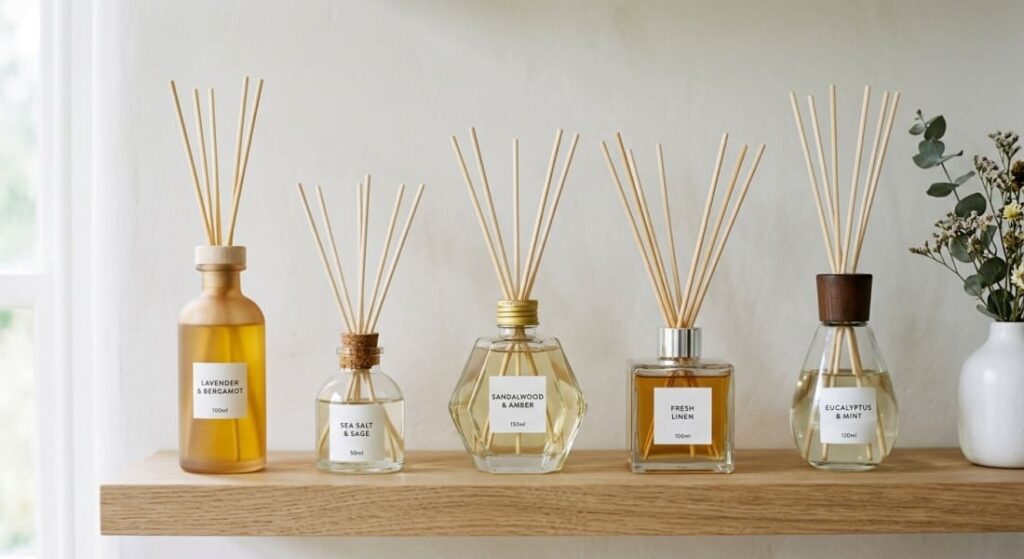
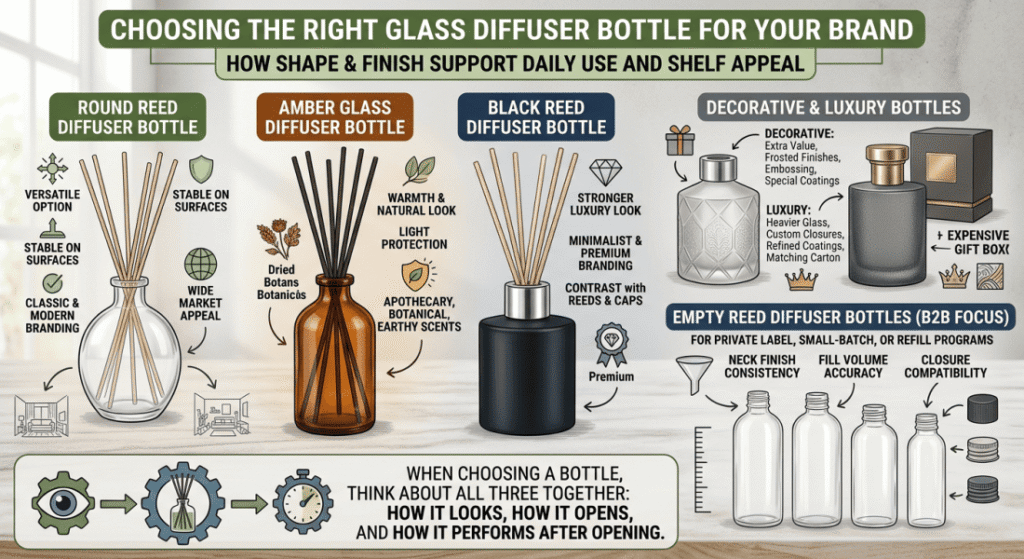
A round reed diffuser bottle is one of the safest and most versatile options. It is easy to place in different interior styles, usually stable on a flat surface, and works well for both classic and modern branding. If you want a shape that appeals to a wide market, round is often a strong starting point.
An amber glass diffuser bottle works well when you want warmth, a natural look, or some light protection for the oil. Many brands use amber for apothecary, botanical, or earthy scent lines. A black reed diffuser bottle gives you a stronger luxury look and can support minimalist or premium branding. Dark bottles also help create contrast with natural reeds and metallic caps.
If your line is more gift-focused or decorative, decorative reed diffuser bottles can add extra value. Embossing, special coating, frosted finishes, and custom shapes can make the product feel more intentional on a shelf. For higher-end collections, luxury reed diffuser bottles often combine heavier glass, refined coatings, custom closures, and matching carton design.
At the same time, not every customer wants a finished bottle. Some buyers specifically need empty reed diffuser bottles for private label filling, small-batch fragrance production, or refill programs. In that case, you should pay closer attention to neck finish consistency, fill volume accuracy, and closure compatibility.
When you choose the right bottle for reed diffuser use, you should think about three things together: how it looks, how it opens, and how it performs after opening. A good bottle needs all three.
Why reed diffuser packaging quality matters more than many buyers think
Bottle selection is only one part of the job. Full reed diffuser packaging includes the glass bottle, the closure, the inner stopper, the reeds, the label area, and the outer carton. If one part of that system is weak, the whole product experience suffers.
Good packaging protects the fragrance oil during shipping. It keeps the closure stable. It prevents leaks around the neck. It also supports the brand story through color, finish, and shape. From the customer side, packaging quality is often judged within seconds. A cap that scratches easily, a stopper that deforms, or a bottle neck with uneven finishing can make the product feel cheap before the fragrance is even tested.
For buyers, packaging quality should be checked in actual use, not only in a sample photo. Test how the stopper feels after filling. Test how the cap fits after repeated opening. Test whether the label area stays smooth and consistent. Test whether the reeds sit evenly in the neck. These are practical details, but they directly affect whether the product feels premium or ordinary.
What to look for when you source diffuser bottles wholesale
When you move from content research to sourcing, you need a buying checklist. Plenty of buyers search diffuser bottles wholesale or reed diffuser bottles wholesale because they want scale, but scale only works if the details are consistent.
Start with closure compatibility. Ask whether the cap, inner stopper, and neck finish are designed to work together. Then check bottle consistency. The same shape should maintain similar wall thickness, base balance, and opening dimensions across the batch. If you buy in larger quantities, those details matter more because even a small variation becomes a bigger problem at scale.
Next, think about decoration and positioning. If your brand targets a premium market, a plain bottle may not be enough. On the other hand, too much decoration can increase cost without adding real value. You need the right balance between clean design, practical use, and production efficiency.
If you are comparing glass diffuser bottles wholesale suppliers, you should also ask about sample lead time, customization options, carton protection, and minimum order quantities. A supplier should be able to support not only a bottle order but a repeatable packaging program.
Smilebottles fits naturally into this discussion because buyers usually want one partner who understands fragrance packaging from both a visual and functional angle. When you compare options, focus on whether the supplier can help you with bottle shape, color, neck finish, stopper fit, and consistent packaging results over time. That matters more than a low unit price alone.
Why Smilebottles Is a Reliable Choice for Glass Reed Diffuser Bottles
Once you understand how opening, setup, and closure design shape the user experience, the next step is choosing a supplier who takes those details seriously. Bottle sourcing is not only about price per unit. It is about whether the bottles you receive can support your product story, your quality standard, and your daily operations. This is where Smilebottles can be a practical partner for fragrance brands, wholesalers, and private-label clients who want dependable glass diffuser bottles without unnecessary complications.
Real experience in glass diffuser bottle manufacturing
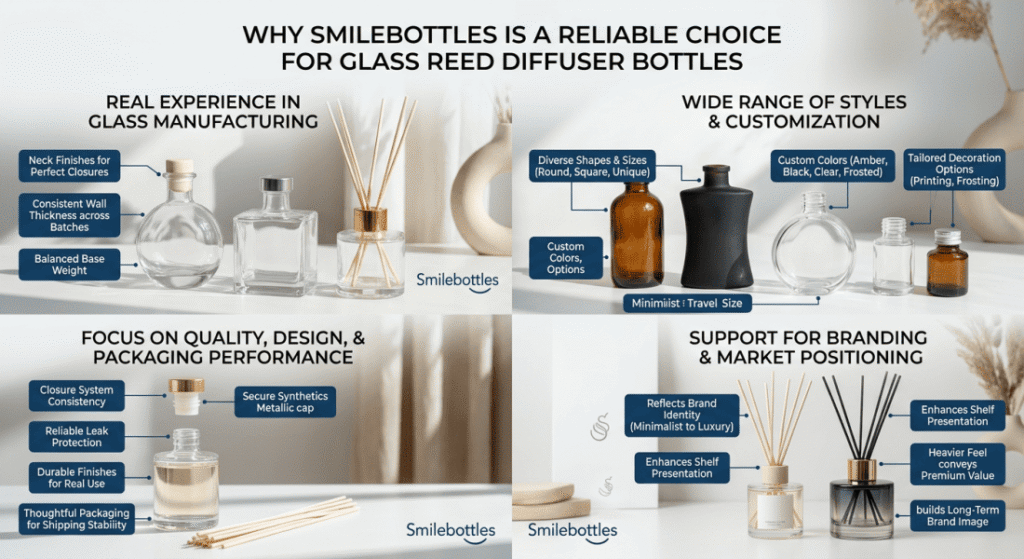
Reed diffuser packaging looks simple from the outside, but the production side has more detail than most buyers expect. Neck finishes need to match the closure system. Wall thickness needs to stay stable across a batch. Base weight needs to feel balanced when the bottle is filled with oil and reeds. Small production issues that look minor in a photo can turn into big problems when a customer opens the product at home.
Smilebottles has spent years focused on fragrance and home scent packaging, which includes reed diffuser bottles as one of the core categories. That focus matters, because a factory that makes many unrelated glass items may not pay close attention to the details that fragrance buyers care about. When your supplier already understands stopper fit, oil compatibility, shipping stability, and shelf presentation, you spend less time correcting problems and more time growing your product line.
A wide range of bottle styles and customization options
Reed diffuser buyers rarely want only one style. Some brands need a clean round bottle for everyday product lines. Others need amber or black glass for warmer, more premium collections. Some private-label clients want a custom shape that helps their scent stand out on a crowded shelf. A useful supplier should be able to support all of these directions without forcing every customer into the same mold.
Smilebottles offers different sizes, shapes, colors, neck finishes, and decoration options, so you can match packaging to your brand rather than the other way around. If you sell to a wellness audience, softer shapes and natural tones may fit better. If you sell to a luxury market, heavier glass and refined finishes usually make more sense. If you are building a private-label line, custom colors, coatings, and closures allow you to shape a look that feels truly your own. The point is not to add options for the sake of options. The point is to give you enough flexibility to design a product that fits your market.
Focus on quality, design, and packaging performance
Diffuser bottles are not display pieces alone. They hold fragrance oil, work with reeds, ship across long distances, and stay in homes for weeks or months. That means quality has to include more than clear glass and clean labels. It has to include stopper fit, closure consistency, leak protection, and durable finishing that holds up during real use.
Smilebottles pays attention to how the bottle performs after it leaves the factory. Closure systems are checked for a secure fit. Neck finishes are kept consistent so caps and stoppers work correctly across the batch. Bottles are packed with protection in mind, since fragile items need proper cushioning during transport. Those quiet details reduce complaints, reduce returns, and give your customers a smoother experience from the first opening to the final refill.
Support for branding and market positioning
Premium fragrance products depend heavily on how they look on the shelf and how they feel in the hand. A well-designed bottle helps your product tell its own story before the customer even smells the fragrance. Weight, finish, color, and closure all send a message about the brand behind the product.
Smilebottles works with brands that want to position themselves in different parts of the market, from clean minimalist lines to richer luxury collections. Whether you need bottles that feel light, natural, and casual, or bottles that feel heavier, darker, and more premium, the goal is the same: help your product stand out for the right reasons. That kind of support matters when you are trying to build long-term brand value rather than a single seasonal product.
If you are looking for a partner who understands reed diffuser packaging from both a design and a production angle, Smilebottles is one option worth reviewing. The most important thing is that you choose a supplier who treats packaging as part of the product experience, not just a container around it.
FAQ: Frequently Asked Questions About Opening and Choosing Reed Diffuser Bottles
Q1:How many reeds should you use?
A1:You should use the number that fits the bottle size and the scent strength you want. A smaller bottle may need fewer reeds, while a larger bottle or a larger room may need more. Too many reeds can make the oil evaporate faster than expected.
Q2:Should you always flip the reeds after setup?
A2:Not always right away. Let the reeds absorb the oil first, then flip them if you want a stronger scent throw. After that, flip only as needed. Too much flipping can waste oil and create drips.
Q3:Is a decorative cap enough to seal the bottle?
A3:No. In most cases, the decorative cap is not the real seal. The real seal is the inner stopper, plug, or screw closure. That is why opening instructions should make both parts clear.
Q4:What bottle styles work best for private label fragrance brands?
A4:That depends on your market, but stable shapes, reliable stopper fit, and consistent decoration are usually more important than unusual shapes alone. A beautiful bottle still has to open and perform well.
Q5:Are reusable bottles a good choice?
A5:Yes, especially if your customers care about refill programs or long-term use. A bottle that is easy to clean, easy to open, and easy to refill gives you more value over time.
Conclusion
When you look closely, the question is not only how to open a reed diffuser bottle. The real question is what kind of bottle gives your customer a smooth, clean, and satisfying experience from the first use onward. Opening, setup, refill, and daily handling all matter.
If you buy for a fragrance brand, a retailer, or a wholesale program, you should treat usability as part of product quality. A well-made bottle opens without drama, holds fragrance securely, presents your scent well, and supports repeat use. That is the standard you should expect when you choose your next diffuser bottle line.
 English