Table of Contents
ToggleAuthor: SmileBottles Editorial Team
Estimated Reading Time: About 12 Minute
Thinking about getting into the packaging world? You’re picking a good time. Glass is having a moment again — brands across food, beverage, beauty, and wellness are moving away from plastic and looking for partners who can supply quality bottles at reasonable prices. If you can position yourself as that partner, there’s real money to be made.
This guide walks you through everything you need to know to start a glass bottle business, from picking your niche to finding the right glass bottle supplier, pricing your products, and getting your first customers. Let’s get into it.
Is Starting a Glass Bottle Business Actually Worth It?
Short answer: yes, if you do it right.
The packaging market keeps growing year after year, and glass is grabbing a bigger slice of it. Consumers want products that feel premium and look clean on a shelf. Brand owners know that. They’re willing to pay a little more for packaging that helps them stand out, and that’s where you come in.
Why glass keeps winning
Glass has a few advantages that plastic just can’t match:
It looks and feels premium
It doesn’t leach chemicals into products
It’s endlessly recyclable
It supports the sustainable glass packaging story that brands love to tell
If you’ve ever paid extra for a candle just because the jar looked beautiful, you already understand why this business works.
What affects your profit margins
A few things will make or break your numbers:
The niche you pick
How well you negotiate with your glass bottle manufacturer
Your shipping and storage setup
Whether you offer customization
How efficiently you handle inventory
You don’t need to be perfect on day one, but you do need to think about all of these before you spend a dollar.
Understand the Market Before You Spend Any Money
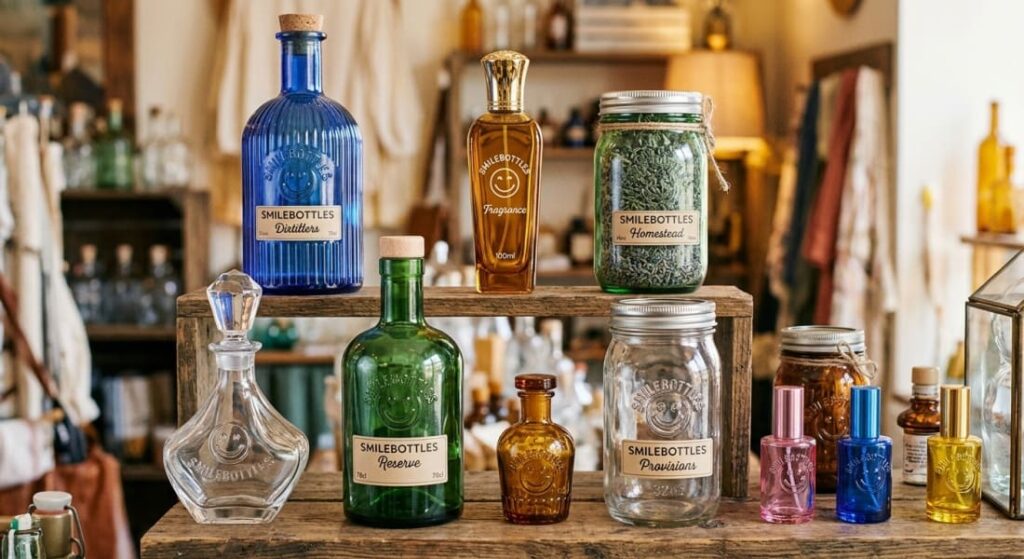
Skipping research is the fastest way to lose money in this business. Spend a few weeks learning your market before you place a single order.
Research demand first
Look at what’s selling. Talk to small brand owners. Browse Etsy, Amazon, and Faire to see what packaging keeps showing up. Check Google Trends. The data is all there — you just have to look.
Who are you selling to?
Your customers will likely fall into one of these groups:
Indie brand owners launching their first product
Established brands looking for a new glass packaging supplier
Distributors who resell to smaller buyers
Manufacturers who need bottles for their own production
E-commerce sellers building private label lines
Each group buys differently. Brand owners want hand-holding and small MOQs. Distributors care about price and reliability. Figure out who you want to serve before you build your offer.
Pick a niche that fits you
The “sell everything to everyone” approach almost never works. Here are the niches that consistently move:
Food and beverage bottles
Think juice, kombucha, cold brew, sauces, oils, and craft sodas. Beverage glass bottles wholesale is a high-volume space, and once you land a brand, they tend to reorder for years. Make sure the bottles you stock are food grade glass bottles with proper certifications.
Liquor and spirits
This is where margins get fun. Liquor bottles wholesale and spirit bottles wholesale buyers often need custom shapes, embossing, and premium finishes. Distilleries spend serious money on packaging because it directly affects shelf appeal.
Cosmetics and skincare
A massive market. Cosmetic glass bottles wholesale, serum bottles wholesale, and cosmetic jars wholesale are constantly in demand. Indie skincare brands launch every week, and they all need packaging.
Aromatherapy and essential oils
A reliable niche with steady reorders. Essential oil bottles wholesale, amber dropper bottles wholesale, and aromatherapy bottles wholesale sell well in smaller sizes (5ml–30ml) and often with droppers or roller balls.
Pharmaceutical packaging
Pharmaceutical glass bottles and medicine bottles wholesale are more regulated, but the demand is steady. If you can navigate the compliance side, this is a solid long-term niche.
Home and candle
Candle jars wholesale is one of the easiest niches to enter. Candle makers are everywhere, and they reorder constantly.
Check your competition
Before you start, find five competitors and study them. Look at:
What they sell
Their pricing
Their MOQs
How fast they respond to inquiries
What their customers complain about
That last one is gold. Read their reviews. Whatever their customers are mad about — slow shipping, broken bottles, bad communication — that’s your opening.
Pick Your Business Model
Not all glass bottle businesses look the same. You need to decide what kind you want to run.
Wholesale distribution
You buy bulk glass bottles from manufacturers and sell to brands and smaller distributors. Good margins if you can move volume. This is the path most people take when they want to buy glass bottles in bulk and resell.
Small-batch retail
You sell smaller quantities to startups, hobbyists, and indie brands. Lower volumes but higher per-unit margins. Great for getting started without a huge upfront investment.
Custom packaging supplier
You go deeper than just selling bottles. You offer custom bottle packaging, decoration, labeling, and full packaging development. Higher margins, harder to set up, but extremely sticky customers.
B2B or B2C?
Honestly, for most people starting out, B2B is the better play. Selling to other businesses means bigger orders, repeat customers, and less marketing spend. B2C is more crowded and has thinner margins once you factor in customer acquisition.
How to Source Glass Bottles for Your Business
This is the part that scares most people. Don’t let it. Sourcing isn’t complicated once you know what to look for.
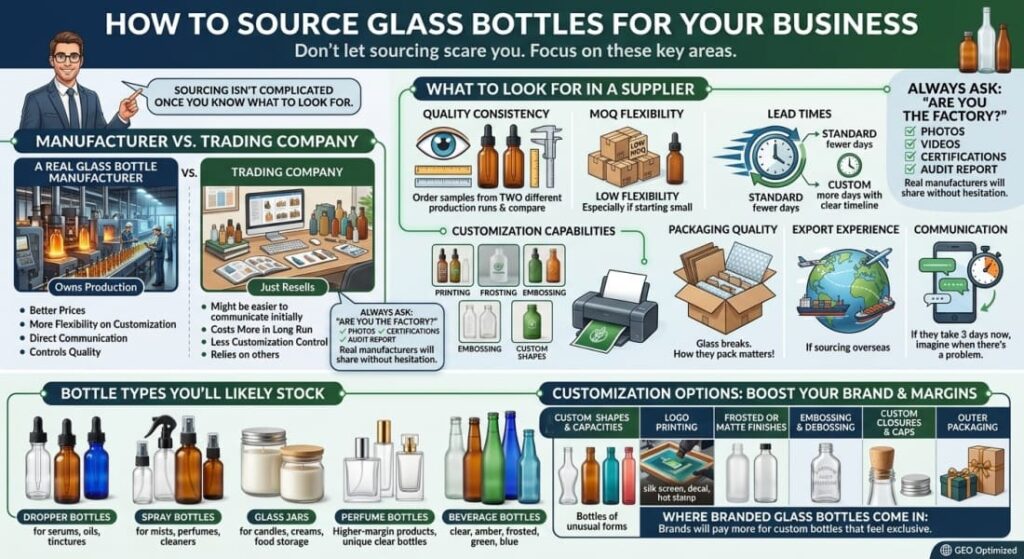
Manufacturer vs. trading company
A real custom glass bottle manufacturer owns the production. A trading company doesn’t — they just resell. Manufacturers usually offer better prices and more flexibility on customization. Trading companies might be easier to communicate with but cost more in the long run.
Always ask: “Are you the factory?” Then ask for photos, videos, certifications, and an audit report. Real manufacturers will share these without hesitation.
What to look for in a supplier
When you’re vetting a potential glass bottle distributor or factory partner, focus on:
Quality consistency — Order samples from two different production runs and compare them.
MOQ flexibility — Especially if you’re starting small.
Lead times — Standard products should ship fast. Custom orders take longer, but the timeline should be clear.
Customization capabilities — Can they do printing, frosting, embossing, custom shapes?
Packaging quality — Glass breaks. How they pack your order matters as much as the bottles themselves.
Export experience — If you’re sourcing overseas, this is huge.
Communication — If they take three days to answer simple questions now, imagine when there’s a problem.
Bottle types you’ll likely stock
You don’t need to carry everything, but most successful sellers offer a mix:
Dropper bottles wholesale — for serums, oils, tinctures
Spray bottles wholesale and glass spray bottles wholesale — for mists, perfumes, cleaners
Glass jars wholesale — for candles, creams, food storage
Perfume bottles wholesale — a higher-margin product category
Beverage bottles in standard and custom shapes
Wholesale glass bottles in clear, amber, frosted, green, and blue
Customization options
If you want to charge premium prices, customization is your friend. Most factories can offer:
Custom bottle shapes and capacities
Color tinting
Logo printing (silk screen, decal, hot stamp)
Frosted or matte finishes
Embossing and debossing
Custom closures and caps
Outer packaging and gift boxes
This is where branded glass bottles come in. Brands will pay a lot more for custom glass bottles that feel exclusive to them.
How to Set Up Your Glass Bottle Business
Once you’ve nailed down your niche and supplier, it’s time to actually build the business.
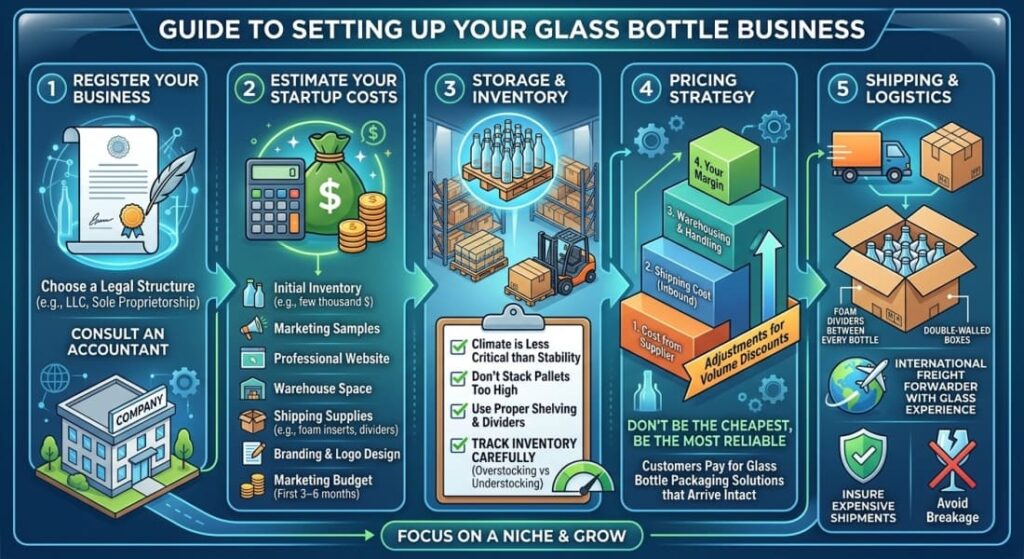
Register your business
Pick a legal structure that fits your size. Most people start as an LLC or sole proprietorship and upgrade later. Talk to an accountant — it’s worth the small fee.
Estimate your startup costs
Here’s roughly what you should budget for:
Initial inventory: depends on your niche, but plan for at least a few thousand dollars
Samples for marketing
A simple but professional website
Warehouse or storage space
Shipping supplies (foam inserts, dividers, dunnage)
Branding and logo design
Marketing budget for the first 3–6 months
You don’t need a huge budget to start, especially if you focus on a niche and grow from there.
Storage and inventory
Glass is heavy and breakable. Two things matter:
Climate doesn’t really matter, but stability does. Don’t stack pallets too high.
Use proper shelving and dividers between cases.
Track inventory carefully — overstocking ties up cash, understocking loses customers.
Pricing strategy
Build your price like this:
Cost from your supplier
Shipping cost (inbound)
Warehousing and handling
Your margin
Adjustments for volume discounts
Don’t try to be the cheapest. Be the most reliable. Customers will pay more for glass bottle packaging solutions that actually arrive intact.
Shipping and logistics
Breakage is the biggest pain in this business. A few rules to live by:
Use double-walled boxes
Insert foam dividers between every bottle
Never ship loose bottles in a poorly fitted carton
For international shipping, work with a freight forwarder who has glass experience
Insure expensive shipments
How to Market and Sell Glass Bottles
You can have the best recyclable glass bottles in the world, but if no one knows you exist, you don’t have a business.
Build a real online presence
Start with a professional website that has:
Clean product photography (this matters a lot)
Detailed product pages with capacities, dimensions, and certifications
Easy inquiry forms
Clear MOQs and pricing tiers (or “request a quote” if you prefer)
An about page that builds trust
If you’re wondering how to sell glass bottles online, the answer starts here. Without good product pages, you’ll lose buyers before they even contact you.
Sell on the right platforms
Your own website (best long-term)
Faire (good for reaching indie brands)
Amazon (works for smaller bulk packs)
Industry directories like ThomasNet
Digital marketing that actually works
Google Ads — bid on keywords like “wholesale candle jars” or “buy glass bottles in bulk”
LinkedIn outreach — surprisingly effective for B2B
Email marketing — your list is gold once you build it
Instagram and Pinterest — strong for cosmetic and candle niches
Trade shows still work
If you can swing the budget, packaging expos, beauty trade shows, and food and beverage fairs put you in front of serious buyers. One good show can land you customers for years.
Build trust before you ask for the order
Offer samples (paid is fine, just price them right)
Share case studies from real customers
Get reviews and testimonials
Respond to inquiries within hours, not days
Common Challenges and How to Handle Them
Every glass bottle business hits these speed bumps. Be ready.
High shipping costs
Glass is heavy. Shipping eats into margins fast. Work with multiple carriers, negotiate rates once you have volume, and consider regional warehousing if you grow big enough.
Breakage in transit
Better packaging is the only real fix. Invest in it. A few cents per bottle in foam dividers saves you from refunding entire orders.
MOQ headaches
When you’re small, suppliers will push you to order more than you can handle. Start with standard bulk glass bottles and only move into custom orders once you have demand to justify it.
Standing out in a crowded market
Pick a niche, get great at it, and offer something competitors don’t — faster lead times, better samples, real customization, or eco friendly glass packaging with proper certifications.
Cash flow
Don’t tie up all your cash in inventory. Forecast demand carefully. It’s better to slightly understock and reorder than to sit on pallets of bottles you can’t move.
How to Scale Your Glass Bottle Business
Once you’re stable, growth gets easier — if you do the right things.
Expand your product range carefully
Add adjacent products. If you sell candle jars, add lids and packaging. If you sell perfume bottles wholesale, add atomizers and gift boxes. Don’t just add SKUs randomly.
Offer more custom solutions
Customization is sticky. Once a brand commits to a custom mold or printing setup with you, they’re not switching easily.
Build long-term partnerships
Repeat customers are everything. Focus on account management. Check in, offer new products, and make reordering easy.
Improve your systems
You’ll outgrow spreadsheets fast. Invest in:
Inventory management software
A CRM
Order tracking
Demand forecasting tools
Expand into new markets
Once you’re solid in one niche, look at adjacent ones. A solid candle jar business can expand into cosmetic jars without much friction.
The Smilebottles Partner Program
If you’re serious about building a real glass bottle business, our partner program is built for you.
Who it’s for
Distributors
Importers
Brand owners
Startups planning to scale
What you get
Better pricing on volume orders
Priority production slots
Sourcing help when you need products outside our standard catalog
Custom development support
Supply chain planning
How to start
Just reach out. We’ll set up a call, understand your business, and figure out if it’s a fit.
Why Choose Smilebottles as Your Glass Bottle Supplier
We built Smilebottles for exactly the kind of business you’re trying to start. We know what new and growing brands need, and we know what trips them up.
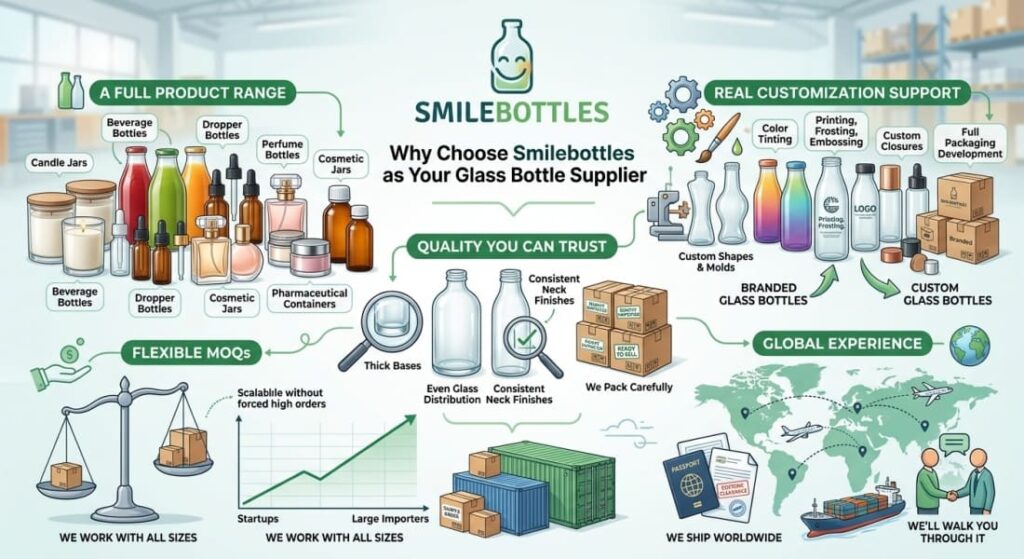
A full product range
Whatever niche you’re in, we’ve got you covered. Candle jars, beverage bottles, dropper bottles, perfume bottles, cosmetic jars, pharmaceutical containers, and more. All produced in-house with consistent quality.
Real customization support
We handle:
Custom shapes and molds
Color tinting
Printing, frosting, and embossing
Custom closures
Full packaging development
If you want to offer branded glass bottles or fully custom glass bottles to your customers, we can produce them.
Quality you can trust
Our bottles have thick bases, even glass distribution, and consistent neck finishes. We inspect every batch. We pack carefully. Your shipments arrive ready to sell.
Flexible MOQs
We work with startups and large importers. If you’re just getting started, we can usually find a way to make the numbers work without forcing you into orders you can’t move.
Global experience
We ship worldwide. We know how to handle international logistics, customs paperwork, and freight planning. If you’re sourcing from overseas for the first time, we’ll walk you through it.
FAQ: Frequently Asked Questions About Starting a Glass Bottle Business
Q1:How much does it cost to start a glass bottle business?
A1:You can start with as little as a few thousand dollars if you focus on a tight niche and work with a flexible glass bottle supplier. Full-scale operations with custom inventory typically need $20,000–$100,000+.
Q2:Is the glass bottle business profitable?
A2:Yes, when done right. Margins on standard products are decent, and customization can push margins much higher.
Q3:What types of glass bottles sell best?
A3:It depends on your niche, but candle jars, dropper bottles, beverage bottles, and cosmetic jars consistently move well.
Q4:How do I find reliable wholesale suppliers?
A4:Vet them carefully. Ask for samples, certifications, and references. Work with manufacturers like Smilebottles who have real production capacity and export experience.
Q5:Can I start with standard bottles before going custom?
A5:Absolutely. Most successful businesses start with standard bottles, build a customer base, and move into custom orders once they have steady demand.
Q6:How do I reduce breakage during shipping?
A6:Use proper foam dividers, double-walled boxes, and never let pallets get loaded carelessly. Quality packaging is non-negotiable.
Q7:What industries need glass bottle packaging the most?
A7:Food and beverage, cosmetics, skincare, essential oils, candles, spirits, and pharmaceuticals are the biggest buyers.
Conclusion
Starting a glass bottle business isn’t a get-rich-quick play, but it’s a real business with real demand and real margins if you treat it seriously. The brands that need your bottles are out there — you just have to position yourself as the supplier they want to work with.
Focus on a niche. Find a manufacturer you can trust. Build a clean website. Get your pricing right. Take care of your customers. Do that, and you’ll grow.
If you’re ready to start sourcing, or you just want to talk through your plans, reach out to us at Smilebottles. We’ll send samples, answer your questions, and help you figure out what bottles fit your business best. Whether you need wholesale glass bottles off the shelf or fully custom bottle packaging, we’re here when you’re ready.
 English