
Table of Contents
ToggleAuthor: SmileBottles Editorial Team
Estimated Reading Time: About 16 Minute
If you are buying bottles for food, beverages, cosmetics, essential oils, medicine, spirits, or candles, bottle quality is not just about appearance. A poor-quality bottle can leak, crack, break during transport, damage your brand image, or create trouble on your filling line. A good bottle, on the other hand, protects your product, supports your packaging design, and helps you avoid many unnecessary losses.
So, how do you identify a high-quality glass bottle before placing an order?
In simple terms, you need to check the glass clarity, surface finish, neck accuracy, wall thickness, base stability, sealing performance, defect level, and the supplier’s quality control ability. If you are planning to buy custom glass bottles, wholesale glass bottles, or bulk glass bottles, these checks become even more important because small quality problems can turn into big costs when the order quantity is large. This guide will walk you through the key points you should review before choosing the right glass bottles for your product.
Why Glass Bottle Quality Matters More Than You Think
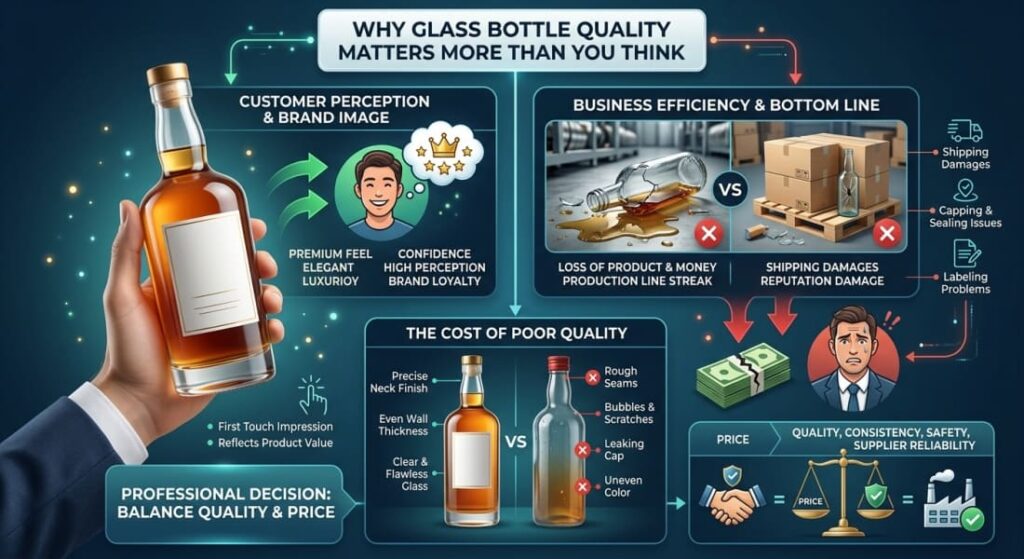
When your customer picks up your product, the bottle is often the first thing they touch. Before they taste the drink, smell the perfume, open the sauce, or use the skincare formula, they already have an impression from the packaging.
A clean, solid, well-made glass bottle gives people confidence. It tells them the product inside is also carefully made. But if the bottle has scratches, bubbles, rough seams, uneven color, a loose cap, or leakage, your product may feel cheap even if the formula or content is excellent.
Bottle quality also affects your business behind the scenes. If bottles break during shipping, you lose product and money. If the neck finish is not accurate, your caps may not seal properly. If the wall thickness is uneven, the bottle may break during filling or capping. If the bottle surface is poor, your label may wrinkle or your printing may look messy.
This is why professional buyers rarely choose bottles by price alone. Price matters, of course, but quality, consistency, safety, and supplier reliability matter just as much.
Quick Answer: How Do You Identify High-Quality Glass Bottles?
You can identify high quality glass bottles by checking whether the glass is clear and consistent, the surface is smooth, the neck finish matches your closure, the wall thickness is even, the base is stable, and the bottle has no serious cracks, chips, stones, or deformation. You should also test the bottle with your actual cap, pump, cork, dropper, or sprayer before placing a large order.
A good bottle should:
Look clean and uniform under bright light
Stand flat without shaking or leaning
Have a smooth rim with no chips
Match the closure correctly
Have even glass distribution
Feel solid but not poorly balanced
Support labels, printing, coating, or other decoration
Pass leakage tests
Arrive with safe export packing
Come from a supplier with clear quality control standards
If the bottle performs well in these areas, you are much closer to making a safe buying decision.
Start with the Basic Properties of Glass Bottles
Before you judge whether a bottle is good or bad, it helps to understand the main properties of glass bottles that make glass such a popular packaging material.
Glass is non-porous, so it does not absorb smells or flavors easily. It has strong barrier performance, which helps protect your product from air and moisture. It is also recyclable and has a clean, premium feel that many customers prefer.
Depending on the product, glass can help protect: Flavor, Aroma, Color, Purity, Product stability, Brand appearance, Shelf life
When buyers talk about the properties of glass bottle packaging, they are usually thinking about strength, safety, transparency, chemical resistance, recyclability, and how well the bottle works with the product inside.
For example, a juice bottle needs good sealing and food-contact safety. A perfume bottle needs clean appearance and decoration quality. An essential oil bottle may need UV protection. A medicine bottle needs stricter safety and consistency. A spirits bottle may need a heavy base and a refined finish.
Check the Glass Clarity and Color Consistency
The first thing you usually notice is the appearance of the glass. For clear bottles, the glass should look bright, clean, and transparent. It should not look gray, cloudy, dirty, or full of visible marks.
Hold the bottle under natural light or a strong white light. Turn it slowly. Look through the body, shoulder, base, and neck. A few tiny bubbles may be acceptable in some standard production, but large bubbles, stones, dark spots, and strange lines are not good signs.
For amber, green, blue, black, or other colored bottles, color consistency is very important. If you place ten bottles side by side, they should look like they belong to the same batch. Big color differences can make your finished products look unprofessional on the shelf.
This matters even more for cosmetics, spirits, perfume, and gift products. Customers expect premium glass bottles to look clean and consistent from every angle. If the bottle is part of your brand image, the glass appearance cannot be treated as a small detail.
Look Carefully at Glass Bottle Wall Thickness
One of the most important technical points is glass bottle wall thickness. Many buyers only check whether a bottle feels heavy, but weight alone does not prove quality.
A high-quality bottle should have balanced glass distribution. The wall should not be thick on one side and thin on the other. Uneven wall thickness can create weak points, especially around the shoulder, heel, base, and neck. These areas take pressure during filling, capping, packing, and transportation.
You can do a basic check by holding the bottle against the light and looking at the sidewall from different angles. If one area looks obviously thinner or darker, the glass distribution may not be even. You can also compare several samples to see if the weight and shape feel consistent.
If your products are shipped long distances, sold online, or packed in large cartons, you should pay more attention to strength. Good durable glass bottles are not simply thick bottles. They are bottles with the right structure, good forming quality, proper annealing, and safe packing.
A bottle can look strong but still break easily if the glass stress is not controlled well. That is why supplier quality control matters, not just bottle design.

Inspect the Bottle Neck Finish Before Anything Else
The neck is one of the most important parts of the bottle. If the body looks beautiful but the neck is wrong, the whole bottle may fail in real use.
The bottle neck finish refers to the top opening area of the bottle, including the thread, rim, sealing surface, diameter, and closure-matching structure. The glass bottle neck finish must match the closure you plan to use, such as a screw cap, aluminum cap, pump, sprayer, dropper, cork, swing top, or tamper-evident cap.
You should never approve a bottle without testing it with your real closure.
Here is what you need to check:
Does the cap screw on smoothly?
Is the closure too loose or too tight?
Does the pump sit straight?
Does the dropper fit securely?
Does the cork seal well?
Is the rim smooth and chip-free?
Is there any leakage after filling?
Can the bottle pass upside-down or side-laying tests?
A small neck problem can cause serious trouble. You may face leaking cartons, rejected goods, damaged labels, customer complaints, or filling line delays.
For food, beverage, cosmetic, and pharmaceutical packaging, the neck finish should always be checked carefully before mass production.
Check the Rim and Sealing Surface
The rim is easy to ignore, but it directly affects sealing. A good rim should be smooth, clean, even, and free from chips.
Run your finger gently around the rim. It should not feel sharp, rough, cracked, or uneven. If the bottle uses a cap with a liner, the liner needs a flat and stable sealing surface. If the rim has small chips, the seal may fail.
For sauces, juices, honey, jams, oils, medicine, and liquid cosmetics, this point is especially important. A poor rim can lead to leakage, contamination risk, air entering the bottle, or reduced shelf life.
If your product is filled hot or pasteurized, the seal becomes even more important. You should confirm with your supplier whether the bottle is suitable for your filling temperature and processing method.
Examine the Surface Finish
A high-quality glass bottle should have a clean and smooth surface. It should not have deep scratches, heavy scuffs, oil stains, rough mold marks, or obvious surface deformation.
Surface quality affects appearance, but it also affects decoration. If you plan to use labels, screen printing, frosting, coating, spraying, hot stamping, or shrink sleeves, the surface must be stable and suitable.
For labels, the label panel should be smooth and even. If the body is uneven, labels may wrinkle or lift at the edges. For printing, scratches and dust can affect the final result. For coating or frosting, surface contamination may cause poor adhesion.
Before confirming a bulk order, it is better to test your actual decoration method on real bottles. Do not rely only on plain samples. A plain bottle may look acceptable, but problems can appear after decoration.

high glass bottles
Make Sure the Bottle Stands Stable
Place the bottle on a flat table and check whether it stands firmly. A good bottle should not rock, shake, or lean to one side.
An unstable base can cause problems during filling, labeling, packing, and shelf placement. On an automated line, bottles that do not stand properly may fall over or move unevenly. In retail, unstable bottles look careless and may create safety problems.
You should also check the base for cracks, heavy mold marks, sharp edges, or uneven glass distribution. The heel and base area are common stress points, so they need to be strong and well-formed.
If your bottle has a thick base, check whether the glass looks clean and even. A heavy base can give a premium feel, especially for spirits, perfume, and luxury products, but only when it is made well.
Understand Common Glass Bottle Defects
Knowing common glass bottle defects helps you inspect samples more confidently. Some defects only affect appearance, while others affect safety and performance.
Bubbles
Small bubbles may appear in glass production. In some cases, tiny bubbles are acceptable, especially if they are not concentrated and do not affect strength. But large bubbles, long bubbles, or bubbles near the neck and sealing area should be treated carefully.
Stones and Inclusions
Stones are hard particles or unmelted materials inside the glass. They are more serious than normal bubbles because they can create stress points. If you see stones in samples, you should ask the supplier how they control raw materials and melting quality.
Cracks
Cracks are never acceptable for normal packaging use. Even a small crack can grow during filling, capping, or transport. Check the neck, shoulder, heel, and base carefully.
Chipped Rims
A chipped rim can affect sealing and safety. This is especially serious for food, beverage, cosmetics, and medicine packaging.
Uneven Seams
Mold seams are normal in many bottles, but they should not be too sharp, rough, or visually unpleasant. Heavy seams can affect appearance and label application.
Deformation
If the bottle body, shoulder, or neck is out of shape, it may affect filling volume, labeling, closure fit, and packing.
Scratches and Scuffs
Light marks may occur during handling, but too many scratches make the bottle look used or low-grade. For premium packaging, surface marks should be controlled strictly.
How to Do a Simple Glass Bottle Quality Inspection
A professional lab test is useful for technical projects, but you can still do a basic glass bottle quality inspection with simple tools and careful observation.
1. Check the Bottle Under Good Light
Use natural daylight or a bright white lamp. Look through the bottle and turn it slowly. Check for bubbles, cracks, stones, dark spots, haze, and uneven color.
2. Compare Several Samples
Do not judge quality from one bottle. Compare at least 5 to 10 samples if possible. Check whether the height, weight, color, neck finish, and shape are consistent.
3. Test the Closure
Use your real cap, pump, dropper, cork, or sprayer. Tighten it properly. Fill the bottle with water or your real product. Turn it upside down, lay it on its side, and check for leakage.
4. Measure the Main Dimensions
If you have calipers or measuring tools, check the height, diameter, neck diameter, and capacity. Compare them with the supplier’s specification sheet.
5. Check the Base
Place the bottle on a flat table. Make sure it stands steady. Look at the bottom for cracks, uneven glass, or sharp marks.
6. Test Labels or Printing
If you plan to decorate the bottle, test labels, printing, coating, or other finishing methods before bulk production. This can save you from expensive mistakes later.
7. Review Packing
A good bottle still needs good packing. Check cartons, dividers, pallets, wrapping, and loading method. Many breakage problems happen because of poor packing, not because the bottle itself is weak.
Food, Beverage, and Safety Requirements for Glass Packaging
If your product touches food or drinks, you need bottles that meet food-contact requirements. For sauces, juice, milk drinks, coffee, tea, honey, jam, oil, vinegar, spirits, and similar products, you should ask whether the supplier can provide food grade glass bottles suitable for your market.
You may also see the term food safe glass bottles. In practical purchasing, this means the bottle should be safe for direct contact with food or beverages under the intended use conditions. Depending on your sales region, you may need FDA-related documents, EU food-contact compliance, LFGB testing, or other local reports.
Special Points for Pharmaceutical Glass Bottles
If you are buying pharmaceutical glass bottles, the quality requirements are usually stricter than standard packaging. Medicine, supplements, tinctures, and health-related products may need better dimensional control, chemical resistance, cleanliness, and sealing performance.
What Makes a Reliable Glass Bottle Supplier?
A reliable glass bottle supplier should do more than send you a price list. You need someone who can help you confirm details, solve problems, and keep quality stable from sample to shipment.
Before you choose a supplier, ask:
Do they understand your product category?
Can they provide samples?
Can they match the right closure?
Can they provide bottle drawings or specifications?
What tolerance range do they follow?
How do they inspect bottles during production?
What is their defect control process?
Can they support decoration?
How do they pack bottles for export?
What happens if quality issues appear?
Good communication is part of quality. If a supplier avoids questions, gives unclear answers, or cannot provide basic details, you should be careful.
If you work directly with a glass bottle manufacturer, you may have better control over bottle design, mold development, production schedule, and technical standards. If you work with a distributor or trading partner, make sure they also understand quality control and can communicate clearly with the factory.
Where Smilebottles Fits Into Your Selection Process
When you choose glass packaging, you need clear information, practical samples, and steady support from the first idea to the final shipment. Smilebottles works with buyers who need stock bottles, customized bottle designs, decoration options, and packaging solutions for different industries.
If you are developing a new product, you can start by confirming the bottle size, shape, closure, color, decoration, and packing method. If you already have a product line, you can compare samples and improve details such as sealing performance, label area, bottle weight, or shipping protection.
The most important step is sample confirmation. Once you approve the right sample and document the key specifications, production becomes much easier to control.
You do not need to choose the most expensive bottle. You need to choose the bottle that fits your product, your filling process, your brand position, and your customers’ expectations.

FAQ: Frequently Asked Questions About High Quality Glass Bottles
Q1:How can you tell if a glass bottle is good quality?
A1:You can check the clarity, surface finish, wall thickness, neck accuracy, base stability, and defect level. You should also test the bottle with your real cap or closure to make sure it seals properly.
Q2:Are heavier glass bottles always better?
A2:No. A heavier bottle may feel more premium, but good quality depends on balanced glass distribution, correct annealing, accurate dimensions, and proper sealing. A heavy bottle with an inaccurate neck can still cause problems.
Q3:What are the most serious defects in glass bottles?
A3:Cracks, chipped rims, stones, thin spots, unstable bases, and poor neck finish are serious defects. These problems can affect safety, sealing, and durability.
Q4:Why does the bottle neck finish matter?
A4:The neck finish determines how the closure fits. If it is not accurate, the bottle may leak, the cap may loosen, or the filling line may not work smoothly.
Q5:Should you inspect bottles before bulk shipment?
A5:Yes. For large orders, pre-shipment inspection is a smart step. It helps you confirm quality, quantity, packing, and decoration before the goods leave the factory.
Q6:What documents should you ask for when buying glass bottles?
A6:You may ask for specification sheets, test reports, food-contact documents, quality inspection records, packing details, and sample approval documents. The exact documents depend on your product and market.
Conclusion
Identifying a high-quality glass bottle is not difficult when you know what to look for. Start with the visible details: clarity, color, surface, rim, base, and shape. Then check the technical points: wall thickness, neck finish, closure fit, leakage, capacity, and packing.
Before you place a large order, request samples, test them properly, and ask the right questions. A little more time spent at the selection stage can save you from breakage, leakage, delays, and quality complaints later.
The right glass bottle should look good, work well, and fit your real business needs. When you choose with care, your packaging becomes more than a container. It becomes a quiet but important part of your product’s value.
 Portuguese
  English
  Russian
  Spanish (Chile)
  Spanish (Colombia)
  Spanish (Ecuador)
  Swedish
  Arabic
  French