Содержание
ПереключитьАвтор: Редакционная команда SmileBottles
Примерное время чтения: Около 15 минут
When you walk down any store aisle, the bottles that catch your eye usually have one thing in common — thoughtful decoration. Whether it’s a spirits brand with a heavy embossed logo, an essential oil bottle with a minimalist label, or a soda with a full-body shrink sleeve, the way a bottle is printed or labeled says a lot before the customer ever reads a word.
If you’re planning to order custom glass bottles for your brand, the decoration choice you make will shape how your product feels on the shelf, how well it survives shipping and refrigeration, and how much you’ll spend per unit. This guide walks you through the printing methods, label types, design considerations, and practical tips you need to make a smart decision — the kind of decision that saves you from reorders, complaints, and costly rework.
Why Custom Glass Bottle Decoration Matters
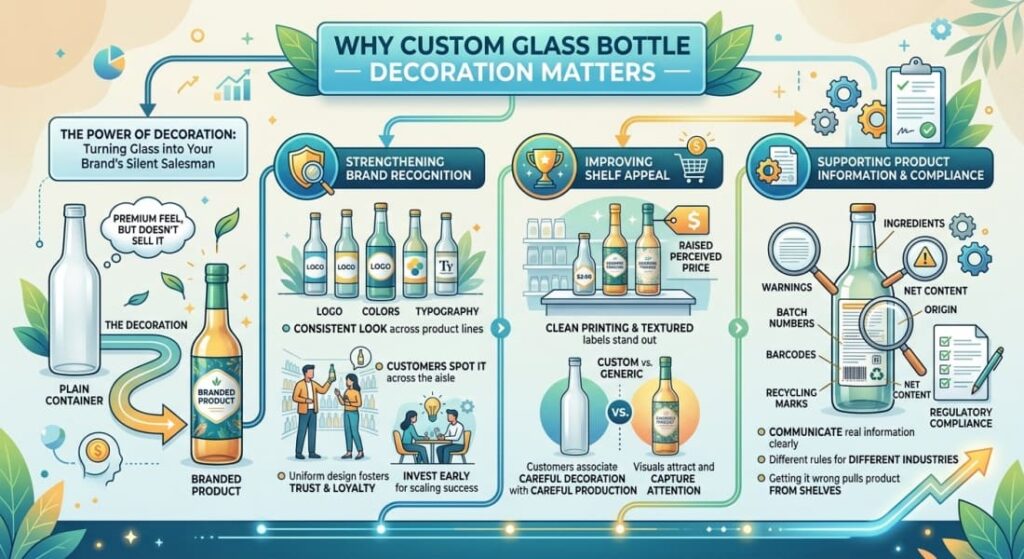
Glass already gives your product a premium feel. But glass alone won’t sell it. The decoration is what turns a plain container into a branded product that customers recognize and trust.
Strengthening Brand Recognition
Consistent decoration across your product line helps customers spot your bottle from across the aisle. When your logo, colors, and typography stay uniform, repeat buyers find you faster. This is why so many brands invest in glass bottle branding early — even before they scale up production.
Improving Shelf Appeal
A well-designed bottle can raise your perceived price point. Branded glass bottles with clean printing or textured labels often outperform generic packaging, even when the product inside is similar. Customers tend to associate careful decoration with careful production.
Supporting Product Information and Compliance
Beyond looks, your bottle needs to communicate real information — ingredients, warnings, batch numbers, barcodes, recycling marks, net content, and origin. Different industries have different rules, and getting this wrong can pull your product from shelves.
Glass Bottle Printing vs. Labeling: What’s the Difference?
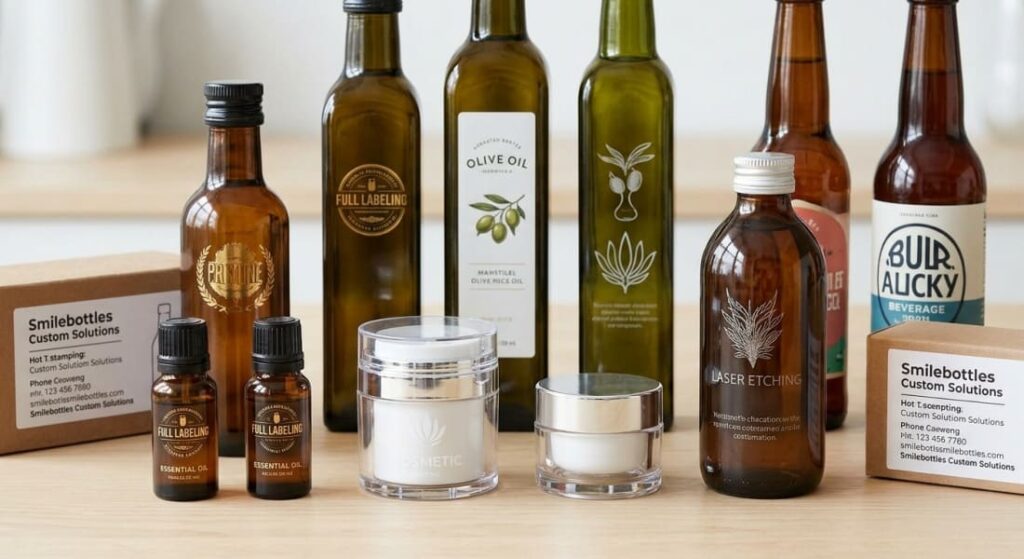
Before choosing a method, it helps to understand the two main paths: printing on glass bottles directly, or applying an adhesive label. Both work well — but they solve different problems.
When to Choose Direct Printing on Glass
Direct printing on glass bottles gives you a permanent, seamless finish. There’s no label edge, no peeling risk, and no worry about adhesive failing in cold storage. If you’re aiming for a premium look or a long product life, direct printing is often the better call. It also handles rubbing during transport better than most labels.
When to Choose Adhesive Labels
Labels are more flexible. You can change designs quickly, run smaller batches, and update information without retooling. For seasonal releases, promotional runs, or SKUs that change often, glass bottle labels are usually the smarter economic choice.
Quick Comparison
Factor | Direct Printing | Метки |
Appearance | Premium, seamless | Wide design range |
Долговечность | High | Depends on material |
Setup Cost | Higher | Lower |
Минимальный объем заказа | Better for larger orders | Suitable for smaller batches |
Design Flexibility | Умеренный | Very high |
Full-Body Coverage | Limited | Possible with shrink sleeves |
Update Speed | Slow (retooling) | Fast (reprint labels) |
If you’re still testing the market with a new product, start with labels. Once your design is locked in and volumes grow, glass bottle printing often becomes more cost-effective per unit.

Common Printing Methods for Custom Glass Bottles
You have several options when it comes to how to print on glass bottles. Each method has its sweet spot, and matching the method to your product is where most decisions go right — or wrong.
Screen Printing on Glass Bottles
Screen printing on glass bottles is the most common method for beverages, cosmetics, and personal care. Ink is pushed through a fine mesh onto the bottle surface, then cured with heat. The result is durable, resistant to rubbing, and holds up well in refrigerated environments.
Glass bottle screen printing works best for:
Logos and simple graphics
Solid colors (usually 1–4 colors)
Medium to large production runs
It’s less ideal if your design has complex gradients or photographic detail. For those, UV printing is usually the better path.
UV Printing on Glass Bottles
UV printing on glass bottles uses UV-cured inks and can reproduce full-color, high-detail artwork. If your label has fine gradients, small text, or multiple colors, UV printing gives you flexibility without paying for multiple screens.
This method also suits shorter runs, since setup is faster than traditional screen printing.
Laser Engraving Glass Bottles
Laser engraving glass bottles creates a permanent mark by etching the surface. There’s no ink, no adhesive, and no risk of fading. It’s a favorite for spirits, luxury cosmetics, and gift packaging where a subtle, high-end feel matters more than color.
Engraving works especially well on frosted or colored glass, where the etched area creates a soft contrast.
Hot Stamping and Frosting
Hot stamping adds metallic gold, silver, or colored foil accents — great for accent lines, logos, or borders. Frosting turns the glass matte, either fully or in patterns. These techniques often combine with printing or labels to create layered, premium packaging.
Labeling Options for Glass Bottles
If you’re going with labels, the material and format matter as much as the design. Here’s how to think about your options for labeling glass bottles.
Sheet Labels for Small Batches
Sheet labels come pre-cut on flat sheets and are usually applied by hand. They work for startups, test batches, and handmade products. If you’re launching under 1,000 units, sheet labels keep costs down.
Roll Labels for Automated Production
Roll labels feed through automatic labeling machines, giving you consistent placement at high speed. If you’re running thousands of bottles a day, roll labels are the standard. Most glass bottle label printing services offer roll formats as their default.
Laminated Labels for Wet or Rough Environments
Laminated labels for bottles add a clear protective film over the printed surface. This protects against water, oil, scratches, and scuffing during transport. If your bottles will sit in refrigerators, showers, or ice buckets, laminated waterproof labels for glass bottles are worth the small extra cost. Many buyers ask specifically for waterproof bottle labels when packaging drinks, personal care items, or anything used in humid conditions.
Shrink Sleeve Labels for Full-Bottle Branding
Shrink sleeves wrap the entire bottle in printed film that shrinks tight when heated. You get 360-degree coverage and full-color graphics, which makes them ideal for beverages and bold promotional packaging. They also work on irregular bottle shapes where flat labels won’t sit properly.
Clear Labels for a “No-Label” Look
Clear labels for glass bottles create the illusion that your design is printed straight onto the glass. Popular for premium spirits, kombucha, and cold-pressed juices, they’re a lower-cost alternative to direct printing when you still want a clean, minimal aesthetic.
Blank Label Templates for In-House Printing
If you print your own labels for small runs or variable info (batch codes, custom orders), blank templates give you flexibility without minimum order pressure.
Choosing the Right Label Adhesive
The adhesive matters more than most buyers realize. A label that looks perfect in the office can peel off in a cold-fill environment or slide during humid shipping. When you’re picking custom glass bottle labels, think about:
Cold-fill or refrigerated conditions
Moisture and condensation exposure
Bottle surface (frosted, coated, clear)
Whether you need permanent or removable adhesive
Always request adhesive samples and run a real-world test before locking in a large order.
How to Design Effective Labels and Artwork for Glass Bottles
Good glass bottle label design isn’t about cramming everything in. It’s about hierarchy, readability, and how the label sits on the curve of the bottle.
Focus on the Core Design Elements
Your logo should be the anchor. Around it, keep typography readable at arm’s length, and use color contrast that survives both bright store lighting and low-light bar settings. Group information logically — brand at the top, product name in the middle, details at the bottom.
Adapt the Design to Bottle Shape and Size
A design that looks great flat can distort on a curved surface. Narrow bottles need taller, slimmer labels. Wide bottles handle horizontal layouts better. Always ask your glass bottle supplier for the exact label panel dimensions and curve radius before finalizing artwork.
For small custom essential oil bottles, less is almost always more. Overcrowding a 10ml bottle makes it look cheap.
Choose the Right Label Material and Finish
Paper labels feel warm and craft-oriented — great for artisan spirits, honey, or organic products. Film labels resist moisture and hold up in tough conditions. Matte finishes feel modern and premium; glossy finishes pop under bright light.
Prepare Print-Ready Artwork
Send vector files (AI, PDF, or EPS), use CMYK or Pantone colors, and include a 3mm bleed with a safe zone for text. If you don’t provide print-ready files, most delays in glass bottle printing services come from artwork problems.

Compliance Requirements to Consider
Before you finalize any custom bottle packaging, run through the compliance checklist for your industry and target market.
Mandatory Product Information
Most markets require: Product name, Net content or volume, Ingredients or materials, Directions for use, Manufacturer or distributor information, Batch or lot number
Safety, Warning, and Traceability
Depending on the product, you may also need warning statements, child-safety instructions, tamper-evident features, expiration dates, and batch codes. Pharmaceutical and cosmetic products often have the strictest rules.
Market-Specific Regulations
Food and beverage, cosmetics, essential oils, and pharmaceuticals all have their own labeling standards. Exporting? Check the destination country’s rules early — a label that works in the US may not meet EU or Japanese requirements.
Custom Glass Bottle Tips by Industry
Different industries need different decoration strategies. Here’s how to think about it based on what you’re selling.
Personal Care and Aromatherapy
For lotions, serums, and custom essential oil bottles, moisture resistance is critical. Bathrooms are humid, and oil residue can lift cheap adhesives. Go with laminated or film labels, or consider direct printing for a cleaner, longer-lasting look. Dark amber or frosted glass usually pairs well with minimalist typography.
Beverages
Beverage bottles face refrigeration, condensation, and ice buckets. Shrink sleeves and screen printing hold up best. If you’re using labels, always specify waterproof adhesive. Neck labels and tamper evidence can add value for premium drinks.
Pharmaceuticals and Healthcare
Readability comes first. Use high-contrast, clear labels with durable adhesives. Batch codes and dosage information must stay legible for the full shelf life. Keep decorative elements minimal — regulators don’t love clutter.
Food, Sauce, and Specialty Products
Oil, vinegar, and sauce bottles get messy. Use oil-resistant label materials and strong adhesives. Nutrition panels and ingredient lists need to stay readable even after wiping down the bottle.
How to Choose the Best Customization Method for Your Product
Here’s a simple framework for narrowing down your choice when you’re looking at personalized glass bottles for your line.
Based on Your Budget
Labels usually have lower setup costs. Direct printing pays off at higher volumes because there’s no per-unit label cost.
Based on Production Volume
Under 1,000 units: sheet labels or digital printing
1,000–10,000 units: roll labels or UV printing
10,000+ units: screen printing or shrink sleeves become more economical
Based on Durability Needs
Wet or refrigerated environments: laminated labels or direct print. Luxury and gift use: engraving, frosting, or hot stamping.
Based on Branding Goals
Minimalist premium: screen print or laser engraving
Bold and colorful: shrink sleeve or UV print
Frequent design changes: labels
If you’re not sure, ask your custom glass bottle manufacturer for samples in two or three methods so you can compare them side by side.

glass wine bottles
Common Mistakes to Avoid
Even experienced buyers make these mistakes. Watch for them.
Choosing decoration without considering end use. A beautiful paper label falls apart in an ice bucket.
Ignoring bottle shape. Flat labels don’t sit well on strongly curved or tapered bottles. Always match the label format to the bottle geometry.
Using the wrong adhesive. Cold-fill products need cold-adhesive labels. This is a common failure point.
Overcrowding the design. More information doesn’t mean better communication.
Skipping sample testing. Always approve a physical sample under real-use conditions before running full production. Photos and mockups miss too much.
How Smilebottles Supports Custom Glass Bottle Printing and Labeling
As a glass packaging manufacturer, Smilebottles works with brands across beverages, cosmetics, essential oils, and specialty foods. Our approach is to help you match the right decoration method to your product, not push a one-size-fits-all solution.
Custom Bottle Decoration Options
We handle screen printing, UV printing, laser engraving, hot stamping, frosting, and full labeling services for customized glass bottles and jars. Bottle sizes range from small 5ml essential oil bottles to larger beverage and food containers.
Support from Sampling to Mass Production
You get help with artwork review, adhesive selection, sample confirmation, and production QC. If you’re new to sourcing custom printed glass bottles, we walk you through file preparation, Pantone matching, and testing so nothing gets lost in translation.
Why Brands Work With Us
Reliable production, honest lead times, flexible MOQs for growing brands, and hands-on communication when something needs adjusting.
Часто задаваемые вопросы: Frequently Asked Questions About Custom Glass Bottles
Вопрос 1:What is the best printing method for glass bottles?
A1:It depends on your design and volume. Screen printing is best for durable, simple graphics at scale. UV printing suits detailed, full-color artwork and shorter runs. Laser engraving works well for premium, permanent branding.
Вопрос 2:Are printed glass bottles more durable than labeled bottles?
A2:Generally yes. Directly printed bottles resist peeling, water, and rubbing better than most adhesive labels. However, high-quality laminated labels can perform very close to direct printing for most everyday uses.
Вопрос 3:What label material works best for wet or refrigerated bottles?
A3:Film-based waterproof labels with strong, cold-resistant adhesive. Laminated finishes add extra protection against condensation and handling.
Вопрос 4:What information should be included on a glass bottle label?
A4:At minimum: product name, net content, ingredients or materials, manufacturer details, batch code, and any required warnings or usage instructions. Check your target market’s regulations for specifics.
Вопрос 5:How do I choose between screen printing and shrink sleeves?
A5:Screen printing gives a clean, premium feel with limited colors. Shrink sleeves cover the whole bottle with full-color graphics and work well on unusual shapes. Choose sleeves for bold visual impact, screen printing for a minimalist premium look.
Вопрос 6:Can custom labels and printing be combined on one bottle?
A6:Absolutely. Many premium brands combine a screen-printed logo with a paper label for the ingredients panel, or add hot-stamped accents over a printed base. Combining methods is a common way to create layered, high-end packaging.
Заключение
The right decoration for your custom glass bottles depends on how the product will be used, how many units you’re running, what your brand needs to communicate, and what your budget allows. There’s no single best method — only the best fit for your specific situation.
If you take one thing away from this guide: always test a physical sample under real-world conditions before committing to a large order. A bottle that looks great on your desk needs to survive the warehouse, the truck, the shelf, and the customer’s bathroom or fridge.
When you’re ready to move forward with your custom glass bottle labels or printed packaging, work with a supplier who’s willing to walk through the details with you — from adhesive tests to Pantone proofs. That’s where good packaging decisions turn into products that actually sell.
 Russian
  English
  Spanish (Chile)
  Spanish (Colombia)
  Spanish (Ecuador)
  Swedish
  Arabic
  French
  Portuguese