Table of Contents
ToggleAuthor: SmileBottles Editorial Team
Estimated Reading Time: About 12 Minute
When you are building a premium water brand, the first thing your customers touch isn’t the water itself—it’s the bottle. Choosing between different types of glass bottles for water might seem simple at first, but if you want to ensure product safety and brand success, you need to understand the technical and aesthetic differences between your options.
Whether you are launching a new line of refreshing carbonated drinks or a pure, high-end mountain water, this guide Smilebottles will walk you through everything you need to know about selecting sparkling water glass bottles and still water glass bottles. From pressure resistance to sustainable manufacturing, we will help you make the right choice for your business.
Understanding the Core Difference: Sparkling Water vs. Still Water
Before you pick a bottle shape or a cap type, you have to look at what’s going inside. The physical properties of your product dictate the structural requirements of the glass.
Sparkling Water vs Still Water: The Pressure Factor
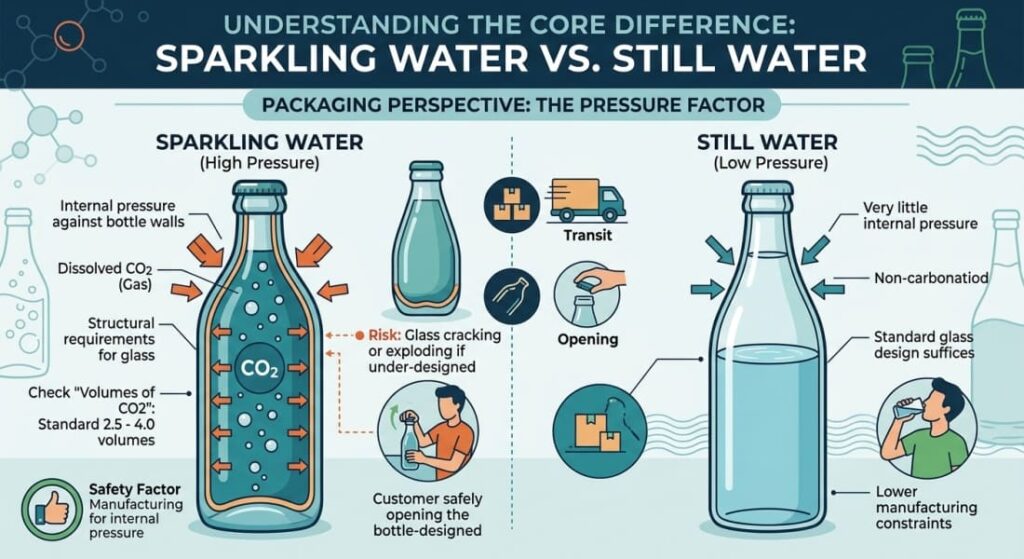
The most significant difference lies in carbonation. Sparkling water contains dissolved carbon dioxide (CO2) gas, which creates internal pressure against the walls of the bottle. Still water, on the other hand, is non-carbonated and exerts very little pressure.
When you compare carbonated water vs still water from a packaging perspective, you aren’t just looking at the bubbles. You are looking at safety. If you put highly carbonated water into a bottle designed only for still water, you risk the glass cracking or even exploding during transit or when the customer opens it.
As a buyer, you should always check the “volumes of CO2” your product requires. Standard sparkling water usually sits between 2.5 to 4.0 volumes of CO2. This measurement tells us, as your manufacturer, how much internal pressure the bottle must be able to withstand.
Technical Requirements for Sparkling Water Glass Bottles
If you are sourcing bottles for a carbonated product, your checklist needs to be more technical. You can’t just go for the thinnest, lightest glass if you want to maintain carbonation and safety.
Pressure Resistance and Wall Thickness
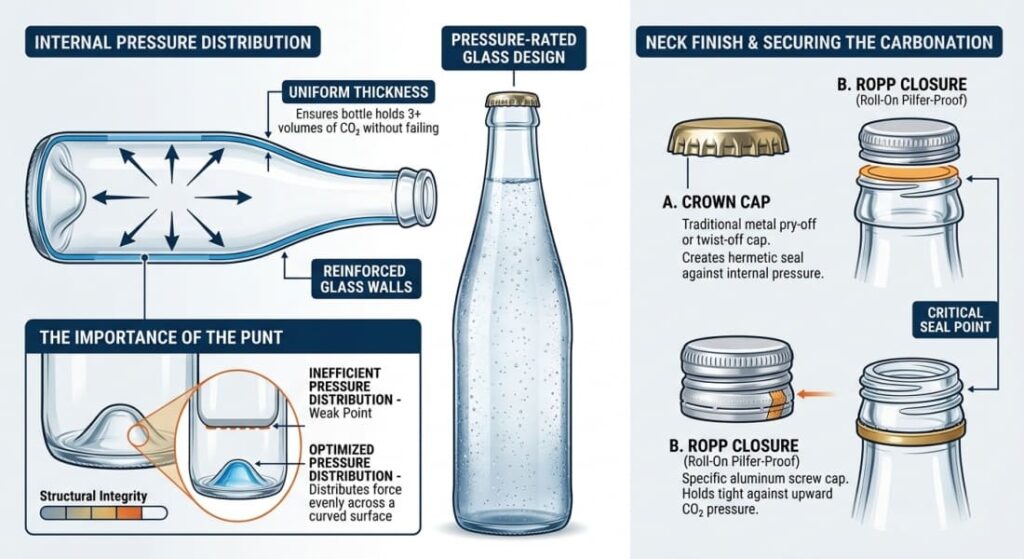
Carbonated drinks require a “pressure-rated” bottle. During the glass bottle manufacturing process, we ensure that the glass distribution is even. For sparkling water, the walls are generally thicker than those used for still water. This thickness provides the structural integrity needed to hold the gas inside without the glass failing.
The Importance of the Punt (The Bottom of the Bottle)
Have you ever noticed that many sparkling water or wine bottles have a deep indentation at the bottom? This is called a “punt.” While it helps with handling, its primary job is to strengthen the bottle’s structure. The curved shape of a punt helps distribute the internal pressure more effectively than a flat bottom. If your brand focuses on high-carbonation levels, choosing a design with a reinforced base is a smart move.
Neck Finish and Sealing
For carbonated products, the seal is everything. If the cap doesn’t fit perfectly, your water will go flat before it reaches the customer. Most sparkling water glass bottles use either a crown cap (the traditional metal pry-off or twist-off cap) or a specific type of aluminum screw cap called an ROPP (Roll-On Pilfer-Proof) closure. These are designed to hold tight against the upward pressure of the CO2.
Designing Elegant Still Water Glass Bottles
Still water allows you more creative freedom because you aren’t fighting internal pressure. You can focus more on aesthetics, weight, and the “hand-feel” of the bottle.
Focus on Clarity and Purity
For still water, customers often associate clarity with purity. You likely want “Super Flint” or high-clear glass to show off the quality of your water. Since there is no gas, you can use slimmer shapes, square designs, or even bottles with very thin necks that wouldn’t be possible for carbonated drinks.
Lightweighting for Efficiency
If you are looking to reduce your carbon footprint and shipping costs, lightweight glass bottles are an excellent choice for still water. Because the bottle doesn’t need to be thick to resist pressure, we can reduce the amount of glass used in production. This makes the bottles easier to transport and more cost-effective when you are buying bulk glass water bottles for large-scale distribution.
How to Choose the Right Bottle for Your Product
As a buyer, you have a lot of variables to balance. Use the following steps to narrow down your search:
Step 1: Identify Your Filling Process
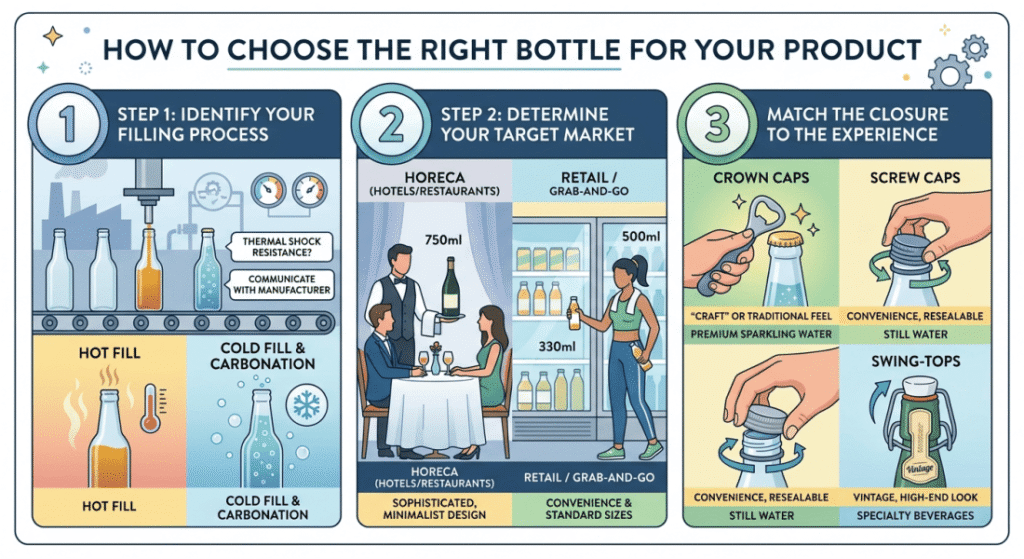
Are you filling the water cold or using a hot-fill process? Are you carbonating the water at the point of bottling? You need to communicate your filling line specs to your custom glass bottle manufacturer to ensure the glass can handle the thermal shock (sudden temperature changes).
Step 2: Determine Your Target Market
If you are selling to high-end hotels and restaurants (the Horeca sector), you might want a 750ml bottle with a sophisticated, minimalist design. For retail or “grab-and-go” convenience, a 330ml or 500ml bottle is usually the standard.
Step 3: Match the Closure to the Experience
Crown Caps: Give a “craft” or traditional feel, often used for premium sparkling water.
Screw Caps: Provide convenience, allowing the customer to reseal the bottle. This is essential for larger still water bottles.
Swing-tops: Offer a vintage, high-end look, though they are more expensive and harder to fill on high-speed lines.
The Manufacturing Side: Behind the Scenes
Understanding the glass bottle manufacturing process helps you appreciate the quality of the product you are buying. It starts with raw materials—sand, soda ash, and limestone—melted at extremely high temperatures.
Melting: The materials are heated to about 1,500°C.
Forming: The molten glass is cut into “gobs” and dropped into molds. This is where the “Blow and Blow” or “Press and Blow” methods determine the thickness and shape.
Annealing: This is a crucial step for you to know. The bottles are slowly cooled in a “lehr” (a long oven) to relieve internal stresses. If this isn’t done correctly, the bottle will be brittle.
Inspection: Every bottle should go through an automatic and manual inspection to check for cracks, bubbles, or uneven glass distribution.
As a professional manufacturer, Smilebottles ensures that every batch meets these rigorous standards before they reach your warehouse.
Sustainability: Why Glass is the Future
Environmental impact is no longer an afterthought; it is a core part of the buying decision for your customers. Glass is one of the most sustainable glass water bottles options because it is 100% recyclable and can be recycled infinitely without losing quality.
Eco Friendly Water Bottles Glass Benefits:
Non-Toxic: Unlike plastic, glass doesn’t leach chemicals into the water, especially when stored for long periods or exposed to heat.
Consumer Preference: Modern shoppers are actively looking for plastic-free packaging. Using glass immediately elevates your brand’s “green” credentials.
Refillable Systems: Many of our clients are moving toward “circular” models where bottles are collected, washed, and refilled. Glass is the only material durable enough to handle this repeatedly.
By choosing sustainable glass water bottles, you aren’t just following a trend; you are future-proofing your business against increasing plastic regulations.
Logistics: Buying Wholesale Glass Water Bottles
When you are ready to scale, you need to think about the move from small batches to wholesale glass water bottles. Logistics can be the most expensive part of the glass business if not managed correctly.
Shipping and Breakage Risk
Glass is heavy and fragile. When you purchase bulk glass water bottles, how they are packed is just as important as how they are made. You should look for a supplier that uses:
Strong, fumigated pallets.
Proper dividers to prevent bottles from hitting each other.
Shrink-wrapping to keep the load stable during sea freight.
Managing MOQs (Minimum Order Quantities)
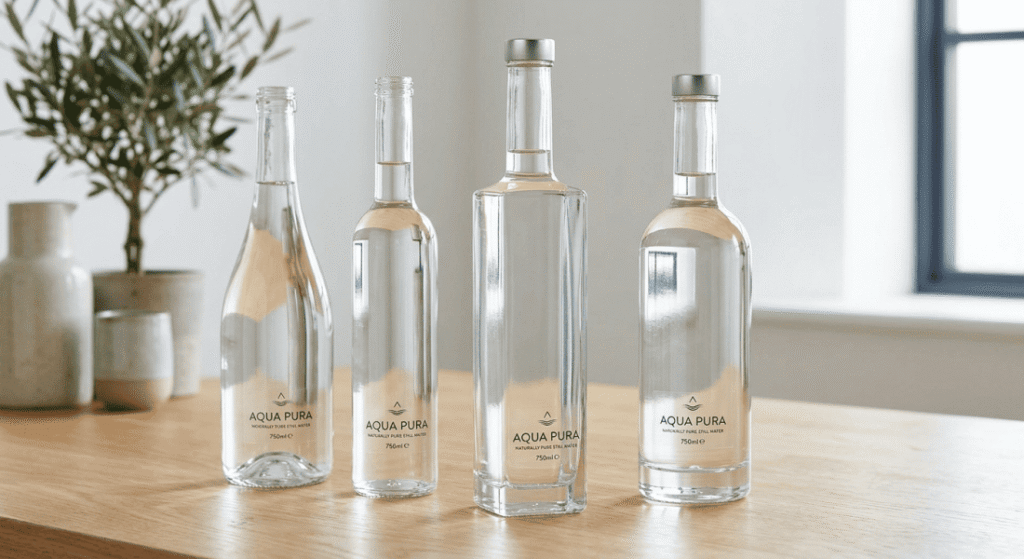
Most manufacturers have an MOQ for custom designs. However, for standard shapes, you might be able to find more flexibility. If you are a startup, look for a custom glass bottle manufacturer that offers a range of “stock” bottles that can be customized with unique labels or screen printing to give you a custom look without the high cost of a new mold.
Customization: Making Your Brand Pop
In a crowded market, your bottle needs to tell your story. As a custom glass bottle manufacturer, we see the best results when brands use a combination of shape and decoration.
Embossing: Having your logo raised on the glass itself creates a tactile experience that screams luxury.
Frosting: Great for still water to give a “cool and refreshing” look.
Color Coating: While clear glass is standard, using light blues or greens can help your brand stand out on the shelf.
ACL Printing: This is “Applied Ceramic Labeling,” where the design is baked onto the glass. It won’t peel or scuff during transport like a paper label might.
Why Smilebottles is Your Best Partner For Glass Water Bottles
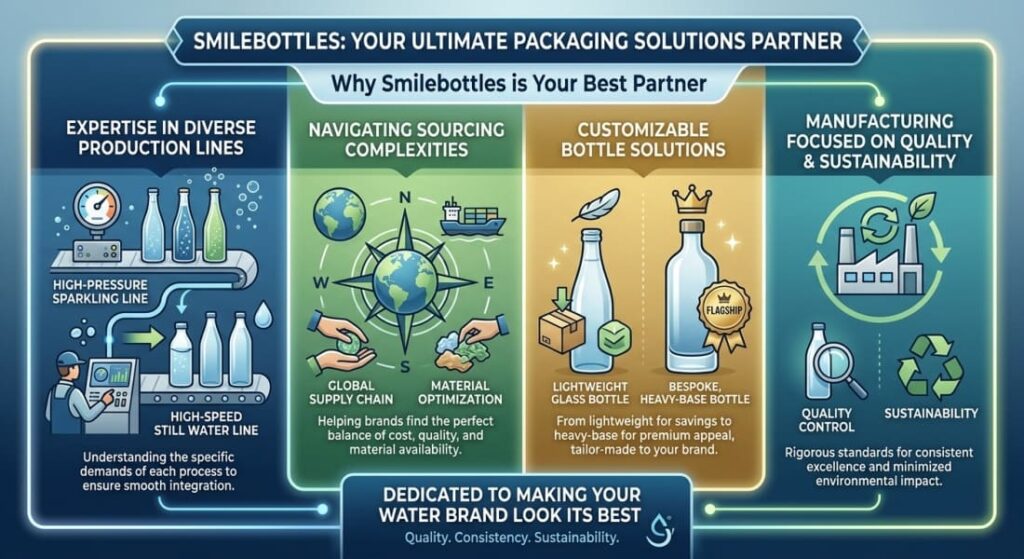
At Smilebottles, we don’t just sell glass; we provide packaging solutions. You need a partner who understands the difference between a high-pressure sparkling line and a high-speed still water line.
We specialize in helping brands navigate the complexities of sourcing. Whether you need lightweight glass bottles to save on shipping or a bespoke, heavy-base bottle for a flagship product, we have the expertise to deliver. Our glass bottle manufacturing process is focused on quality, consistency, and sustainability. When you work with us, you are getting a partner dedicated to making your water brand look its best.
FAQ: Common Questions from Water Brand Buyers
Q1: Can I use the same bottle for both sparkling and still water?
A1: Yes, but you must choose a bottle that is pressure-rated for sparkling water. You can safely put still water in a sparkling bottle, but you cannot safely put sparkling water in a thin still water bottle.
Q2: How do I know if a bottle is high quality?
A2: Look for glass clarity (no yellow or green tint in clear glass), consistent wall thickness, and a smooth neck finish. Always ask your supplier for a pressure test report if you are bottling carbonated water.
Q3: What are the benefits of lightweight glass bottles?
A3: They reduce shipping costs, decrease the environmental impact of transport, and often lower the unit price. They are ideal for still water brands focused on high-volume retail.
Q4: Why should I choose glass over PET plastic?
A4: Glass provides a better barrier against oxygen and CO2, meaning your water stays fresh and bubbly longer. Plus, from a branding perspective, glass is always perceived as higher quality than plastic.
Q5: How do I start a custom bottle project?
A5: You should start with a 2D technical drawing or a 3D model. If you don’t have one, a good custom glass bottle manufacturer can help you design the shape based on your brand requirements.
Conclusion
Choosing between sparkling water glass bottles and still water glass bottles is a decision that affects your production safety, your shipping budget, and your brand’s reputation. By understanding the technical needs of your liquid—whether it’s the pressure resistance required for carbonated water vs still water or the desire for eco-friendly water bottles glass—you can choose a packaging solution that scales with your business.
Remember, the bottle is the “home” for your water. It should protect the taste, ensure safety, and look beautiful on the table. If you are ready to take the next step and explore bulk glass water bottles or unique custom designs, we are here to help.
If you are looking for a reliable partner to supply your next batch of glass bottles, contact Smilebottles today. We can help you find the perfect balance of design, durability, and sustainability for your water brand.
 English