
Innehållsförteckning
VäxlaFörfattare: Redaktionen för SmileBottles
Beräknad lästid: About 16 Minute
You finish a fragrance you love, and you’re left holding the bottle. It’s still heavy, still pretty, and it feels wrong to throw it in the trash. If you’ve ever wondered what to do with empty perfume bottles, you’re not alone. Most people have a few sitting on a dresser or tucked in a drawer, waiting for a decision.
The question matters even more if you run a business. If you own a fragrance brand, a gift shop, or a candle or body care line, you watch your perfume bottles empty out at scale, through testers, samples, returns, and old stock. Collectors even have a name for these bottles: perfume empties. Some people trade them, some people repurpose them, and some brands now design their packaging around what happens after the last spray.
This guide covers your realistic options: recycling, cleaning, refilling, reusing at home, using bottles in a business setting, and judging whether an older bottle is worth keeping. If you buy bottles for your own products, you’ll also find practical points that can help you choose packaging that’s easier to reuse later.
What Can You Do With Empty Perfume Bottles?
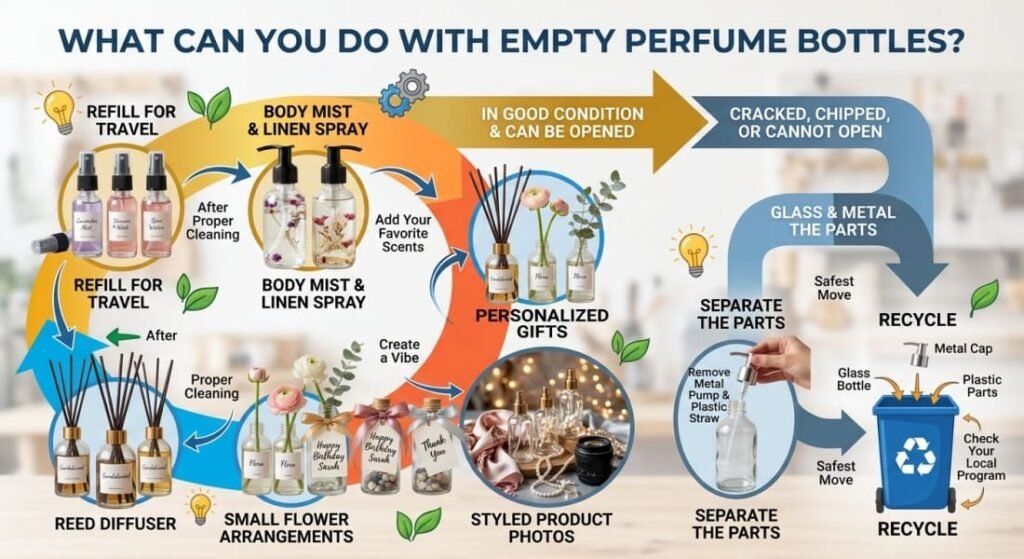
Here’s the short answer. You can recycle, refill, reuse, decorate, or repurpose an empty perfume bottle. The right choice depends on three things: what the bottle is made of, what condition it’s in, and how the top is attached.
Empty glass perfume bottles in good condition are usually worth keeping. After a proper cleaning, you can use them for travel fragrance, body mist, reed diffusers, small flower arrangements, gifts, or styled product photos. If a bottle is cracked or chipped, or it can’t be opened, the safest move is usually to separate the parts and recycle what your local program accepts.
Why Empty Perfume Bottles Are Worth Keeping
Most glass perfume bottles are made far better than they need to be. Brands often use thick glass, heavy bases, and careful finishing, because the bottle is part of what you’re paying for. That thick glass doesn’t wear out when the fragrance runs out. A well-made bottle can last for decades.
Design is another reason. Luxury perfume bottles often have sculpted glass, weighted caps, or hand-applied details that took real effort to produce. Even mid-range brands now put a lot of thought into shape and color. Many decorative perfume bottles look just as good empty as they did full, and some look better once you stop worrying about the liquid inside.
Then there’s waste. Glass takes a very long time to break down in a landfill. When you keep empty perfume bottles in use, whether you refill them, turn them into decor, or pass them on to someone who collects them, you cut down on waste in a simple and practical way.
For businesses, a good bottle has value beyond its first use. A beautiful empty bottle can still work in gift sets, product photography, store styling, or refill programs. That’s one reason more brands now treat the bottle as a long-term asset rather than a throwaway container.
What Are Perfume Bottles Made Of?
Before you decide anything, it helps to know what you’re actually holding. A typical perfume bottle isn’t one material. It’s several parts put together.
The glass body holds the fragrance. It’s usually soda-lime glass, sometimes with a frosted, sprayed, or metallized finish on the outside. The spray pump (also called the atomizer) is made of plastic, a small metal spring, and often a metal ferrule that grips the neck of the bottle. A metal collar often sits around the neck to hide the pump fitting. The cap might be plastic, zinc alloy, wood, or another material, and it often has a magnet or an inner plastic sleeve. Some bottles also have decorative add-ons like ribbons, metal plates, stones, or glued-on charms.
This mix of materials is why perfume bottles can be tricky to recycle and why some are easier to reuse than others. Empty perfume spray bottles with removable parts are simple to take apart and clean. Bottles with glued or crimped parts take more effort. In general, glass bottles are much easier to clean, refill, and reuse than plastic ones, because glass doesn’t absorb fragrance oils the way many plastics do.
Can You Recycle Empty Perfume Bottles?
So, are perfume bottles recyclable? The glass body often is. Glass is accepted by many curbside and drop-off programs, and it can be recycled again and again without losing quality. The other parts are where things get complicated. A spray pump combines plastic, metal, and sometimes rubber, and most sorting systems can’t separate those materials.
Recycling rules vary a lot from one city or country to another. Some programs accept all glass containers. Others only take certain colors, and some don’t want coated or heavily decorated glass at all. Before you drop a bottle in the bin, check your local guidelines. Your council or waste provider usually has a searchable list online.
If you’re learning how to recycle perfume bottles the right way, the steps are simple. First, use up or properly get rid of any leftover fragrance. Take off the cap and any loose decorations. Remove the pump if you can do it safely. Give the bottle a quick rinse. Then sort each part into the right stream based on your local rules.
Which Parts Can Usually Be Recycled?
The glass body is the part most likely to be accepted, especially if it’s clear or a standard color and doesn’t have a heavy coating. The paper box and cardboard insert your perfume came in are almost always recyclable with paper and card. In some areas, a plain plastic cap with no metal inside can go in with plastics. Check the resin code on the cap if there is one.
Which Parts May Not Be Accepted?
Spray pumps are the most common problem. They’re small, they mix materials, and most facilities treat them as general waste. Metal collars may be accepted with metal recycling in some places but not others. Bottles with glued-on stones, fabric, or metal plates are harder to process. So is glass with a thick painted or metallized coating.
Can perfume bottles be recycled with the pump still attached? In most cases, they shouldn’t be. A bottle with the sprayer still on often gets pulled out during sorting or contaminates the glass stream. If you can’t remove the pump without breaking the glass, ask your local provider what they prefer. Some will tell you to put the whole thing in general waste.

Why Glass Boston Round Bottles Are Often the First Choice
Plastic has its place, which we’ll cover below. Even so, many brands choose glass first, especially for premium or sensitive products. Here’s why.
Glass Doesn’t React with Most Formulas
Glass is non-porous and chemically stable. It doesn’t absorb oils or fragrances, and it doesn’t leach compounds into the product. This is a big deal if you sell essential oils, which can break down some plastics over time, or products with alcohol, acids, or strong botanical extracts. Your formula stays the way you made it, and the scent stays clean.
Amber Glass Helps Protect Light-Sensitive Products
Many natural ingredients degrade when they’re exposed to light. Vitamin C serums, certain plant oils, herbal extracts, and some medicines all fall into this group. Amber glass blocks most UV light, so it helps extend shelf life and keeps the product working the way it should. That’s why amber has been the standard for pharmacies for so long.
A Premium Look Without Extra Decoration
Glass simply feels more valuable to most customers. A plain amber Boston round with a well-designed label can look high-end without any fancy printing or custom molding. For small and growing brands, that’s an easy way to look professional on a modest budget.
Easy to Clean, Refill, and Reuse
Glass can be washed and sterilized, and it holds up well to repeated use. Many customers keep their bottles for DIY blends, refills, or storage. This gives your packaging a longer life and keeps your brand in front of the customer after the product is gone.
When Should You Reuse, Recycle, or Throw a Perfume Bottle Away?
Can you reuse perfume bottles safely? Most of the time, yes. But not every bottle deserves a second life, and a few simple checks will help you decide.
Reuse the bottle if it’s clean, intact, and opens easily. Refill it only if it was designed to be opened and closed again. Recycle it if reuse isn’t practical and your local program accepts the materials. Throw it out carefully if the glass is damaged or the bottle can’t be cleaned properly.
Signs a Bottle Is Good for Reuse
Run your finger carefully around the neck and the base. A good bottle has no chips or cracks and sits flat without wobbling. After cleaning, it shouldn’t hold onto a strong smell. If the top unscrews or lifts off and goes back on firmly, that’s a strong sign the bottle can be used again. A clean, smooth neck also matters, because a rough neck can cut you or let fragrance leak.
Signs a Bottle Should Not Be Reused
Any visible crack, even a hairline one, is a reason to stop. Glass with a crack can break when you’re washing it or when the temperature changes. A rusted or stuck pump usually means the bottle has been sitting a long time, and the inside may be harder to clean than it looks. A sticky film or a sharp chemical smell that won’t go away after several washes is another warning sign. Bottles with sharp edges or loose decorative parts are better used as decor, or recycled, rather than handled every day.
How to Open a Perfume Bottle
Before you can clean, refill, or fully recycle a bottle, you need to get inside it. Knowing how to open a perfume bottle depends on how the top is attached. There are three common types.
Screw-neck bottles are the easiest. The pump screws onto a threaded neck, just like the lid on a jar. Hold the bottle firmly and turn the collar counterclockwise. Many refillable designs use this style.
Stopper bottles use a glass or plastic stopper that pushes into the neck, and sometimes there’s a short dropper rod attached. A gentle twist while you pull usually works. If the stopper is stuck because of dried fragrance, put a few drops of warm water around the edge and let it sit before you try again.
Crimped bottles are the most common type for designer fragrances, and the hardest to open. The pump is pressed onto the neck with a metal ferrule so it can’t be removed by hand. If you want to know how to remove perfume spray top parts on a crimped bottle, the usual method is to carefully pry under the metal ring with a flat tool or pliers and work your way around the neck a little at a time. Wrap the bottle in a thick towel, wear gloves and eye protection, and take it slowly. Glass necks can crack when you apply too much force.
Keep one thing in mind: once you take a crimped pump off, you can’t crimp it back on at home. The bottle can still be used for decor, as a reed diffuser, or with a cork or glass stopper, but it won’t spray again the way it did before.
How to Clean Empty Perfume Bottles Properly
Cleaning is the step everything else depends on. Fragrance is made of alcohol and oils, and those oils cling to glass. A quick rinse with water won’t get rid of them.
Step 1: Empty the Remaining Perfume
If there’s fragrance left, use it up, give it to a friend, or pour it into a small atomizer for travel. Perfume contains a lot of alcohol and is flammable. If you have a large amount to get rid of, check your local rules for household chemicals instead of pouring it down the drain.
Step 2: Remove the Cap, Pump, and Decorative Parts
Take everything off that comes off. Put the cap and pump aside if you plan to reuse them. Remove ribbons, tags, or anything that shouldn’t get wet. Now you’re working with bare glass, which makes the next steps much easier.
Step 3: Rinse With Warm Water
Fill the bottle with warm water, shake it, and pour it out. Repeat this a few times. Use warm water, not boiling. Thick glass can crack from a sudden temperature change, and perfume bottles are often quite thick at the base.
Step 4: Wash With Mild Soap or Alcohol
Add a drop of mild dish soap and some warm water, then shake well. If the bottle still smells strong after that, rubbing alcohol works much better than soap, because it dissolves the fragrance oils. Fill the bottle about a quarter of the way with 70% isopropyl alcohol, shake, let it sit for 10 to 15 minutes, and pour it out. For a narrow neck, a pipe cleaner or a small bottle brush helps you reach the shoulders inside the bottle.
Step 5: Remove Lingering Odor
If you’re trying to figure out how to remove perfume smell from bottle interiors that still smell after washing, try a soak. A mix of warm water and white vinegar, or warm water with a spoonful of baking soda, can sit inside the bottle overnight. For stubborn film, add a small spoonful of uncooked rice along with the liquid and shake hard. The rice acts as a gentle scrubber. Some bottles need two or three rounds, especially older ones.
Step 6: Dry the Bottle Completely
Turn the bottle upside down on a rack or a clean towel and let it air dry for at least 24 hours. A narrow neck traps moisture, so give it more time than you think it needs. Any water left inside will dilute whatever you put in next, and over time it can cause cloudiness or odor.
Can You Refill Empty Perfume Bottles?
Can you refill perfume bottles at home? Some, yes. Others, not really. It comes down to the closure.
Refillable Perfume Bottles
Refillable perfume bottles are designed to be opened and filled again. They usually have a screw-on pump, a removable cap with a threaded neck, or a bottom-fill valve in the case of some travel atomizers. Many fragrance brands now sell refill pouches or larger refill bottles, so you can refill perfume bottles you already own instead of buying a new one each time.
If you’re learning how to refill perfume bottle atomizers with a screw neck, the method is simple. Unscrew the pump, place a small funnel in the neck, pour slowly, leave a little air space at the top, and screw the pump back on firmly. A dropper or a small syringe also gives you good control when the opening is narrow. Wipe the threads before you close the bottle, so it seals properly.
A perfume spray bottle refillable through a screw-on pump is much easier to live with than a crimped one. You can clean it fully between fills, change the fragrance, and replace the pump if it wears out.
Non-Refillable Perfume Bottles
Crimped bottles and many sealed designer bottles weren’t made to be opened. You can force them open as described above, but you’ll lose the original spray function, and there’s a real chance you’ll damage the glass. If refilling is your main goal, it’s usually easier to move the fragrance into a proper refillable atomizer.
Best Uses for Refilled Perfume Bottles
Small bottles are perfect for travel. You’ll notice mini perfume bottles empty much faster than full-size ones, and that makes them great candidates for refilling. Empty mini perfume bottles in the 5 ml to 15 ml range fit easily in a handbag or carry-on bag. Besides perfume, you can fill a refillable bottle with body mist, a diluted essential oil blend, a linen spray, or a pillow spray. Label each bottle so you don’t mix up contents later, especially if you use different blends.
Creative Ways to Reuse Empty Perfume Bottles at Home
If you have a shelf full of old perfume bottles, you probably already know they’re too nice to throw away. Here’s what to do with old perfume bottles when refilling isn’t the plan. These ideas are simple, and most of them take less than an hour.
Use Them as Home Decor
The easiest way to get started with how to reuse old perfume bottles is to group them. Three or five bottles of different heights look intentional on a vanity tray, a bathroom shelf, or a bookcase. If you’re looking for perfume bottle decoration ideas, try sorting by color, for example all amber or all clear glass, or place them on a windowsill where light can shine through the glass. Vintage-style bottles look great on a mirrored tray. Modern square bottles work well on a clean, minimal shelf.
You can also decorate perfume bottles yourself. Wrap the neck with thin ribbon or twine, add a small handwritten tag, or use glass paint or frosting spray for a soft matte look. Just keep any paint on the outside if you might use the bottle for something else later.
Turn Them Into Mini Flower Vases
A tall bottle with a narrow neck makes a lovely perfume bottle vase for a single stem. Try one fresh rose, a sprig of lavender, eucalyptus, or a dried flower that will last for months. A few small bottle vases along a dining table or bedside table look charming and cost almost nothing. Remember to change the water every couple of days if you’re using fresh flowers.
Make a Reed Diffuser
A heavy bottle with a stable base makes a great perfume bottle diffuser. Fill it about one-third full with reed diffuser base mixed with fragrance oil, add five to eight reed sticks, and flip the reeds every week or so to refresh the scent. Bottles with a slightly wider neck work best, because the reeds need room to spread a little. It’s a nice way to keep a familiar bottle in use, and it works well in bathrooms, entryways, and guest rooms.
Store Small Items
Bottles with wide mouths or removable stoppers can hold small things like beads, sequins, seed packets, tiny rolled notes, or sea glass from a trip. Clear glass is best here, so you can see what’s inside at a glance.
Use Them in DIY Gifts and Crafts
There are plenty of perfume bottle craft ideas for gifts and special occasions. You can fill a cleaned bottle with homemade room spray and tie on a handwritten label for a thoughtful gift. Small bottles can become wedding favors, holiday ornaments with a loop of ribbon, or part of a handmade bath set. A perfume bottle diy project doesn’t have to be complicated. Sometimes a clean bottle, a good label, and a nice cord are all you need.
glass perfume bottles
How Businesses Can Repurpose Empty Perfume Bottles
If you’re on the business side, empty bottles can still be useful, and they can also teach you a lot about your packaging.
Gift Sets and Limited Editions
Leftover or slightly imperfect bottles can work as decorative pieces in curated gift boxes or seasonal sets, where they add weight and visual appeal. Some brands keep a small stock of past designs for anniversary sets or loyalty rewards.
Product Photography and Store Styling
Empty bottles are perfect for photo shoots, because you don’t risk wasting product or spilling it under hot lights. They’re also useful in retail spaces as dummy units on shelves and window setups, especially for high-value fragrances that you’d rather not leave out full.
Testers and Refill Programs
Many brands now run refill programs, where customers bring back the original bottle and pay less for a refill. This only works if your bottle can be opened and cleaned easily, which is a good reason to think about closures early in the design process. If you’re collecting perfume bottle packaging ideas, a refill-friendly design is one of the most useful and practical places to start.
Sustainable Brand Storytelling
Branded perfume bottles that customers keep long after the fragrance is gone continue to remind people of your brand every day. A bottle designed for reuse supports a clear, honest sustainability message, and customers notice that. One practical note: if you plan to fill reused bottles with product for sale, think carefully about hygiene, cleaning standards, and local labeling rules. For most commercial filling, new bottles are the safer choice. Reused bottles are better suited to decor, photography, and customer refill programs.
When you need a lot of small glass perfume bottles for samples, discovery sets, or travel sizes, plan how they might be reused from the start. A 5 ml or 10 ml screw-neck bottle can serve as a sample first and a refillable travel bottle later.
How to Choose Better Perfume Bottles for Reuse and Sustainability
If you buy bottles for your own fragrance line, everything above leads to one practical point: the choices you make now decide what your customers can do with the bottle later.
Start with the closure. A screw-neck bottle, for example with a standard 18/415 thread, is much easier to clean and refill than a crimped one. If you prefer the look of a crimped sprayer, you can still offer refills in a separate format. Just make that decision on purpose.
Look at how the parts come apart. Sustainable perfume packaging usually means fewer mixed materials glued together and more parts that separate by hand. A cap with a removable insert or a collar that slips off makes recycling much simpler for the person who ends up with the bottle.
Think about glass quality and finishes. A thicker base and even wall thickness make a bottle last longer and survive more cleaning cycles. If you plan to use coatings, ask whether they can handle repeated contact with alcohol. Eco friendly perfume bottles may also contain recycled glass content, which is worth asking about if sustainability is part of your brand message.
Design is where custom perfume bottles really help. A distinctive shape, a frosted finish, or screen printing directly on the glass can make a bottle something people want to keep, which naturally extends its life. Custom glass perfume bottles with printed logos instead of paper labels also hold up better through cleaning and refilling.
When you’re sourcing wholesale perfume bottles, ask for samples and test them with your actual fragrance. Check for leaks, test the spray pattern, and see how the finish holds up after a few weeks of contact with the liquid. Ask about minimum order quantities, how consistent the neck size is from batch to batch, and how pumps and caps are matched to the bottle. A good perfume bottle manufacturer will explain these details clearly and share test results without you having to push for them.
It also helps to work with a perfume bottle supplier who can provide the glass, pump, and cap as one matched set, so you’re not trying to fit parts from different sources together. If you also need boxes, inserts, or gift packaging, a full-service perfume packaging supplier can save you a lot of coordination. For larger runs, wholesale glass perfume bottles ordered with a clear spec sheet covering capacity, neck finish, glass weight, and finish will give you far more consistent results than choosing from photos alone.
Why Smilebottles Is a Reliable Choice for Perfume Glass Bottles
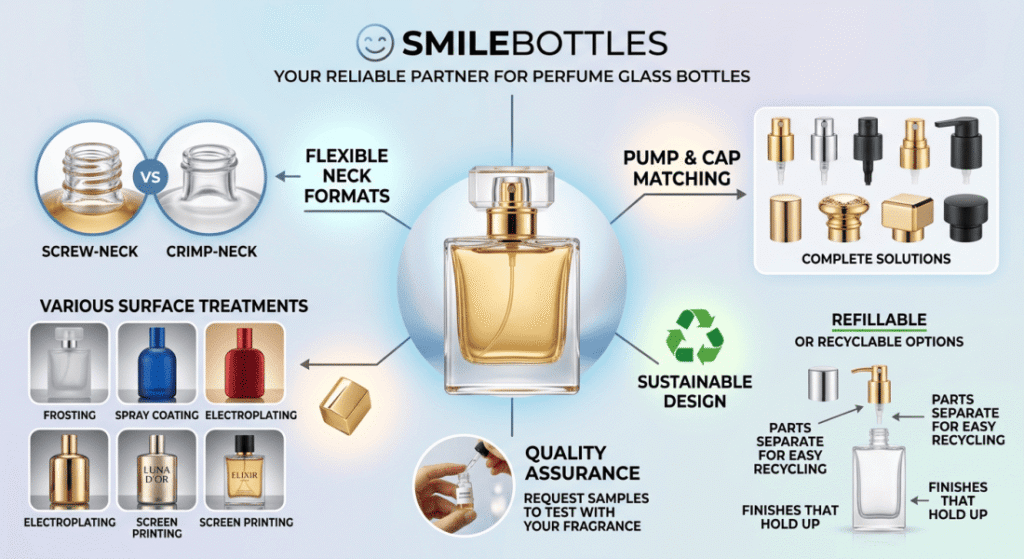
Smilebottles manufactures glass perfume bottles for fragrance brands, from small startups to established lines. If you’re planning a new product, the team can help you choose between screw-neck and crimp-neck formats, match pumps and caps to your bottle, and select finishes such as frosting, spray coating, electroplating, or screen printing.
If refillability or recyclability matters to your brand, those goals can be built into the design from the start. That includes things like closure type, how the parts separate, and finishes that hold up over time. You can request samples to test with your fragrance before you place a full order, which is the most reliable way to know a bottle will work for you.
FAQ: Frequently Asked Questions About Empty Perfume Bottles
Q1:Can all perfume bottles be recycled?
A1:Not as a whole. The glass body is often recyclable, but spray pumps, metal collars, and glued-on decorations usually need to be removed first. Some coated or heavily decorated glass isn’t accepted at all. Always check your local rules.
Q2:Can you refill any perfume bottle?
A2:No. Bottles with screw-on pumps or removable stoppers are easy to refill. Crimped bottles can be pried open, but they won’t spray again the way they did originally.
Q3:How do you get the smell out of an empty perfume bottle?
A3:Rinse with warm water, wash with mild soap, then soak in rubbing alcohol to dissolve the fragrance oils. For stubborn smells, a vinegar or baking soda soak overnight usually helps. Repeat if needed, and let the bottle dry completely.
Q4:Can you put essential oils in an old perfume bottle?
A4:Yes, as long as the bottle is clean and dry. Glass works well for essential oils. Dilute strong oils before using them on your skin, and label the bottle clearly.
Q5:What should you do with a broken perfume bottle?
A5:Wear gloves, wrap the pieces in newspaper or put them in a sturdy box, and label it as broken glass. Many recycling programs don’t accept broken glass in curbside bins, so check your local rules or put it in general waste.
Q6:Should you remove the spray pump before recycling?
A6:In most cases, yes. Pumps mix plastic and metal and can contaminate the glass recycling stream. If you can’t remove the pump safely, ask your local waste provider what to do.
Conclusion
An empty bottle doesn’t have to be the end of the story. Most glass perfume bottles can be cleaned, refilled, turned into something useful, or recycled properly once you separate the parts. The best choice depends on how the bottle is built, what condition it’s in, and what your local recycling program accepts. If you’re a buyer or a brand owner, it’s worth thinking about this from the start. A bottle that opens easily, comes apart cleanly, and looks good enough to keep will stay in use much longer. It’s better for your customers, better for your brand, and it means fewer bottles end up in a landfill.