
Table of Contents
ToggleAuthor: SmileBottles Editorial Team
Estimated Reading Time: About 15 Minute
If you buy bottles for capsules or pills, you already know the size decision can get messy fast. One supplier talks in cc. Another sends a dram chart. Your formulator wants more cotton in the pack. Marketing wants a shorter bottle for the shelf photo. Then the first sample fill comes back and the count looks nothing like the estimate.
That is the normal process, not the exception.
This guide is for buyers, brand owners, and sourcing teams who need to choose glass pill bottles with fewer surprises. You will get plain explanations of common pill bottle sizes, how to match them to real capsules and tablets, what to check before a bulk order, and where teams usually waste time. No fluff. Just the stuff that helps you pick packaging that fills well, ships clean, and looks right when a customer opens the pack.
Why Glass Still Makes Sense for Capsules and Pills
Plastic is everywhere, so people assume it should be the default. Sometimes it should. But glass keeps winning for a lot of supplement and pharmacy-style products, and the reasons are pretty straightforward.
Better protection for sensitive formulas
Glass gives you a strong barrier against moisture and oxygen when the cap and liner are right. If you are packing herbal capsules, vitamin blends, or anything that hates humidity, that barrier matters. A lot of buyers stick with glass medicine bottles for this reason alone. They do not want to find out six months later that the pack did not hold up in storage.
Less worry about material interaction
Glass is stable with most formulas. You do not sit there wondering whether the bottle is pulling odor out of the product or affecting taste. For coated tablets and more delicate blends, that peace of mind is worth something.
It looks like a serious product
You can put the same capsules in plastic and glass, and the glass version usually feels higher quality. Retail buyers notice. End customers notice too. If your brand sits in a premium or clinical lane, glass pill bottles do part of the selling before anyone reads the label.
Easier sustainability story
Glass is recyclable, and customers understand that without a long explanation. Just do not oversize the bottle and call it “eco.” If the jar is half empty, you wasted glass, label space, and freight.
Amber or clear depends on the formula
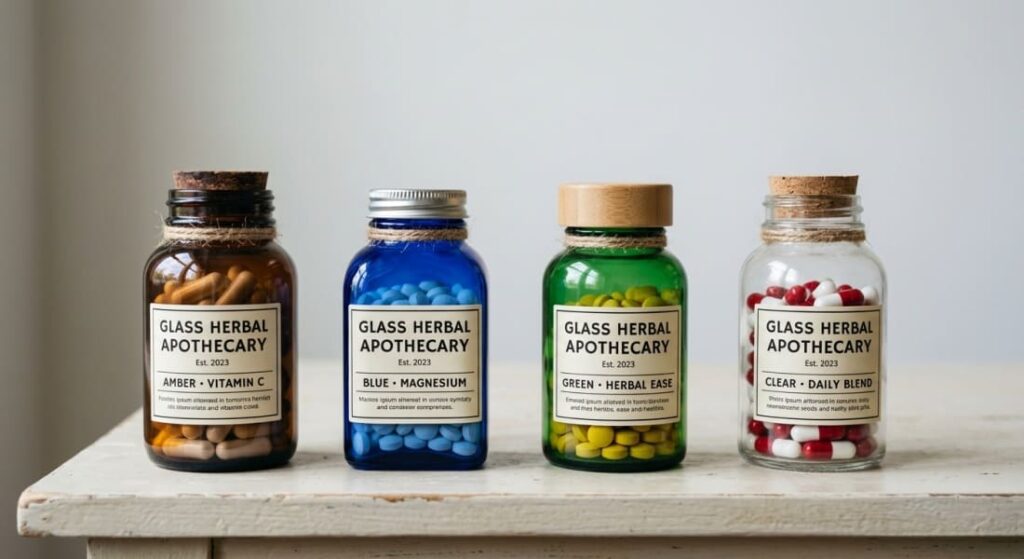
Amber glass pill bottles are the practical choice when light is a concern. They are common for a reason. Clear glass pill bottles work when the product is stable and you want a clean look on shelf. If you are torn, let stability testing decide. Do not pick clear just because it photographs nicely.
Start With the Capsule or Tablet, Not the Bottle Catalog
This is where a lot of orders go wrong. Someone picks a bottle first because the price is good or the shape looks familiar. Then the product does not fit the way they expected.
Know your capsule size
Capsule sizes usually run from 000 down to 5. In supplements, 00 and 0 show up constantly. Smaller sizes are more common for lower doses. If you are comparing glass capsule bottles, remember that “60 count” means very little until you know the capsule size.
Also look at bottle shape, not just volume. A wide jar and a tall narrow bottle can both say 120 cc and still pack differently. People sourcing capsule glass packaging get burned by this when they only compare the number on the spec sheet.
Tablets are not all the same
Round tablets, oblong caplets, thick coatings, bigger specialty tabs — they settle differently. Two tablets with similar weight can need different bottle body diameters. That is why pill bottle dimensions should be checked against samples or drawings, not guessed from count alone.
Softgels and gummies need extra room
Softgels scuff when packs are too tight. Gummies often need a wider mouth and stronger moisture control. If your line mixes capsules, tablets, and softer formats, one bottle style probably will not cover everything well.
Charts are estimates, not guarantees
Any fill chart is a starting point. Final count changes with:
product shape
bulk density
cotton or filler
desiccant size
cap and liner style
how much headspace you leave
hand fill vs machine fill
Even finished packs with sealed capsules of glass bottles can come in under or over the estimate once every insert is in. If you skip the sample fill, you are guessing with real money.
Common Glass Bottle Sizes for Pills and Capsules
When buyers search for medicine bottle sizes or compare pill bottle size options, they usually want the same thing: what is standard, and what count can it hold?
Capacities you will see all the time
In day-to-day sourcing, cc and ml get used almost interchangeably. Older pharmacy language still pops up too. The sizes you will handle most often look like this:
20–30 cc for samples, travel kits, low counts
60 cc for many 30-count products
75–100 cc for mid-count retail packs
120 cc for a big share of mainstream supplement bottles
150–200 cc for higher counts
250–500 cc for value packs and bulk presentations
A 30ml bottle size for medication makes sense when you need something compact — starter packs, clinic samples, travel SKUs, or lower-count products. Just check the neck finish. Small bottles can limit your cap options faster than you expect.
A practical size chart for planning
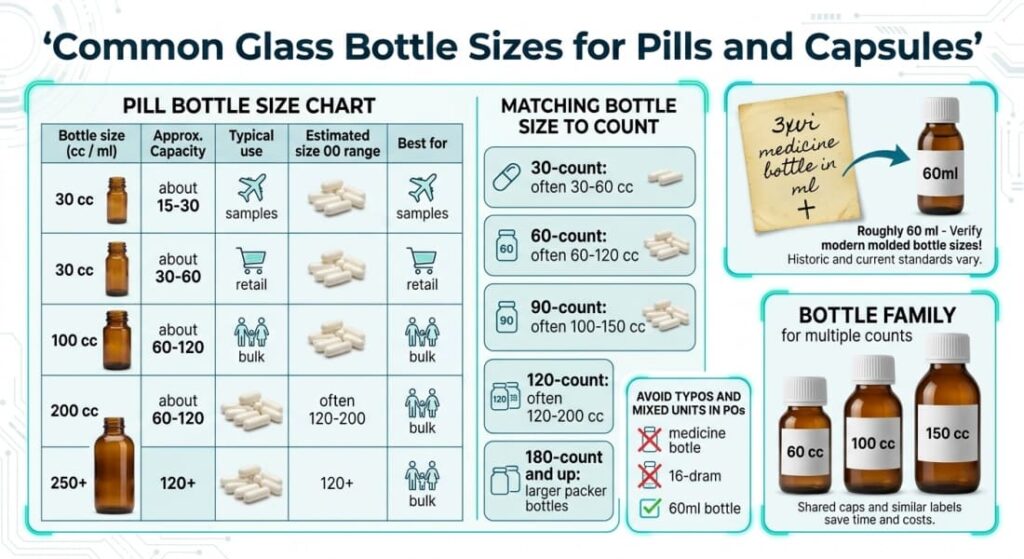
Use this pill bottle size chart early in sourcing. It also works as a capsule bottle size chart if capsules are your main format. These ranges are approximate. Your product may land higher or lower.
|
Bottle size |
Approx. capacity |
Typical use |
Estimated size 00 range |
Best for |
|
30 cc / 30 ml |
Small |
Samples, travel, low counts |
about 15–30 |
Trial and compact SKUs |
|
60 cc |
Medium-small |
Common 30-count packs |
about 30–60 |
Daily vitamins, herb capsules |
|
100 cc |
Medium |
Standard retail |
about 60–90 |
Capsules and smaller tablets |
|
120 cc |
Very common |
Core supplement lines |
about 60–120 |
Everyday capsule products |
|
150 cc |
Medium-large |
Higher retail counts |
about 90–150 |
90- and 120-count packs |
|
200 cc+ |
Large |
Value sizes |
120+ |
Family packs and bulk retail |
If your team still has old pharmacy paperwork, you may also need a dram pill bottle size chart. A lot of older buyers still think in drams. The same thing happens with pill vial sizes. Convert the units first, then confirm with a physical sample. Do not build artwork off a conversion table alone.
Matching bottle size to count
A simple way to shortlist:
30-count: often 30–60 cc
60-count: often 60–120 cc
90-count: often 100–150 cc
120-count: often 120–200 cc
180-count and up: larger packer bottles
If you sell multiple counts of the same formula, try to keep one bottle family where you can. Shared caps and similar label layouts save more time than they get credit for.
Old pharmacy notes can confuse new orders
Every so often a buyer forwards a sheet with something like 3xvi medicine bottle in ml on it. That is old apothecary shorthand pointing toward a 16-dram style vial, roughly around 60 ml. Roughly is the important word. Historic vials and modern molded bottles do not always match cleanly. When documents mix old labels with current prescription vial sizes, slow down and verify.
This also happens when one person is sourcing pharmaceutical packaging bottles while someone else is pulling retail supplement jars from a different catalog. The products may look similar, but mouth width, panel height, and closure standards can differ.
And if you inherit a messy spreadsheet with typos like medicine bottle, do not pass that language into a PO. Clean up the units and names first. Bad specs create bad shipments.
How to Choose the Right Bottle Size Without Going in Circles
You do not need a complicated framework. You need a repeatable order of operations.
1. Measure the actual product
Start with the capsule, tablet, or softgel you are packing. Get length, diameter, thickness, or the supplier drawing. If size varies a little by batch, note the range. Good calls on pill bottle dimensions come from measurements, not memory.
2. Lock the count for commercial reasons
Count is not only a packing decision. A 30-count can lower the barrier for first purchase. A 90-count can fit subscription plans. A 120-count can look like better value on shelf. Decide what you are selling, then find the bottle. Do not force a sales plan around leftover bottle stock unless the fit is genuinely good.
3. Leave room for headspace and inserts
Headspace is not wasted space. It gives product room to settle and keeps tablets from grinding against each other. It also leaves space for cotton, desiccants, or freshness packs. Overfilled bottles cause more damage and more complaints than slightly taller bottles do.
This matters even more with small glass pill bottles. People try to cram the full count in because the bottle looks “about right,” then capping gets ugly.
4. Choose the neck finish and cap together
A bottle can hold the product and still fail if the neck is wrong. Neck finish decides whether you can run regular screw caps, child-resistant caps, metal lids, tamper-evident parts, or induction liners. If your channel expects a certain closure, approve bottle and cap as a pair.
5. Think about freight and shelf presence at the same time
Larger bottles can push up shipping cost and reduce units per carton. Smaller bottles may ship cheaper but look weak on shelf if the proportions are off. Check:
how the bottle feels in hand
whether the label has enough room
units per inner carton
cartons per pallet
whether the pack looks underfilled after settling
A bottle can be technically fine and still commercially awkward.
6. Read your label copy before you approve the silhouette
Supplement facts, warnings, ingredients, barcode, brand design, maybe a second language — all of that needs space. If your legal copy is long, a slightly larger bottle with a cleaner panel is usually better than tiny text on a smaller jar.
What Separates Decent Bottles From Trouble Bottles
Two bottles can look similar in a catalog and run very differently on a line. When you source pharmaceutical glass bottles, look past the shape.
Consistent glass quality
You want even walls, clean finishes, and a low defect rate. Rough necks and inconsistent glass distribution create sealing problems and breakage. Serious pill bottle manufacturers can talk about inspection and tolerances without dodging the question.
Dimensions that hold up on filling equipment
If you are using more than a slow manual setup, height, body diameter, and neck tolerance matter. When those drift, caps sit wrong and torque gets inconsistent. Ask for drawings. Order samples. Do not trust a thumbnail image.
Light protection where needed
If the formula is light-sensitive, amber should be in the plan from the beginning. Secondary packaging helps, but the bottle is your first layer.
Caps that actually seal
A surprising number of freshness complaints come from closure mismatch, not bad glass. Check liner type, fit, torque range, and whether you need induction sealing.
Clean packing and traceable quality control
If you sell into stricter channels, ask how bottles are packed and what documentation you can get. A decent supplement packaging manufacturer understands both brand presentation and production constraints.
Customization That Actually Matters
You do not need custom everything. You need the right changes in the right places.
Color and finish
Amber remains the workhorse for protection. Clear is clean and simple. Some brands use green or other tints, but those are secondary choices. Protection first, looks second.
Bottle style
Round packer bottles stay popular because they fill and label without drama. Wide-mouth versions help with larger tablets and manual packing. More classic profiles can work if you want a traditional look. Pick the style that handles well on your line, not just the one that looked good in a flat design mockup.
Labels and decoration
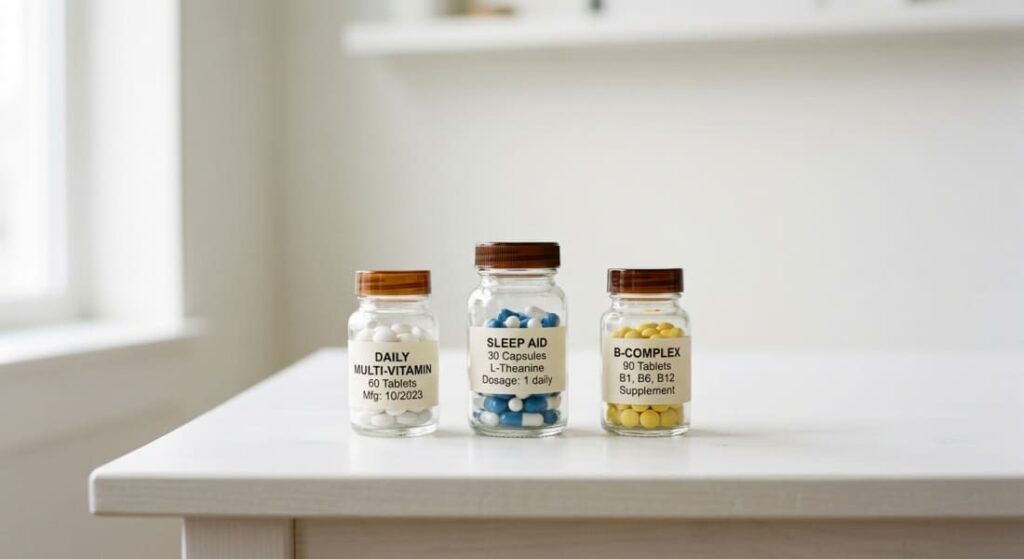
Most brands still get the best results from well-designed pressure-sensitive labels. Printing directly on glass can make sense at higher volumes. Either way, keep the required text readable. A beautiful bottle with cramped copy becomes a compliance problem later.
Closure options
Common choices include:
standard screw caps
child-resistant caps
tamper-evident systems
lined caps for moisture control
metal caps when you want a more premium feel
If one bottle has to serve more than one market, make sure the neck finish can support the closures you need.
Custom molds
Custom tooling makes sense when your volume is there and the shape gives you a real edge in shelf recognition or packing efficiency. If you are still early, a standard bottle with the right color, cap, and label is usually the better move.
Accessories change the fill
Cotton, desiccants, shrink bands, and induction seals all take space. Include them in sampling or your test results will not match production.
Mistakes Buyers Make Over and Over
Buying on volume alone
The number on the drawing is only a starting point. Shape and pack-out decide whether the count truly fits. Two different 120 cc bottles can perform differently with the same capsule.
Ignoring headspace
If the bottle looks stuffed full in a still photo, it may be too full for shipping. Tablets chip. Softgels scuff. Capsules dent.
Approving the bottle before the cap
This one causes so many delays. Always approve them together.
Choosing clear glass for the wrong formula
Clear can look great and still be the wrong material choice for light-sensitive products.
Forgetting the label panel
Narrow panels force bad layouts. Review actual copy length first.
Trusting photos too much
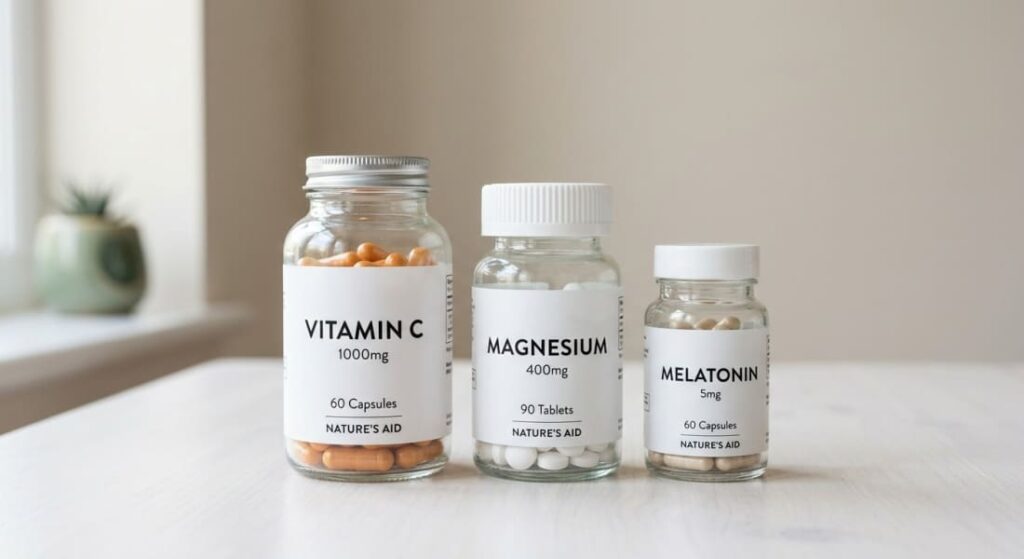
A picture of a pill bottle helps with style shortlisting. It does not tell you how the pack fills, seals, or ships. Run real product, real inserts, and the real cap.
Chasing the lowest unit price
Cheap bottles get expensive when finishes vary, deliveries slip, or seals fail. For wholesale programs, consistency matters as much as price.
Glass vs Plastic: Which Should You Use?
There is no universal winner.
Glass usually wins on inertness, shelf feel, premium presentation, and a simpler recyclability story. Plastic usually wins on weight, drop resistance, and freight cost. If your product needs to feel solid and trusted, glass is often worth the extra care. If you are building lightweight mailer packs at huge volume, plastic may still fit selected SKUs.
Plenty of companies use both. They keep glass capsule bottles for core retail lines and use plastic for promotions or travel minis. That is fine when each choice has a reason behind it.
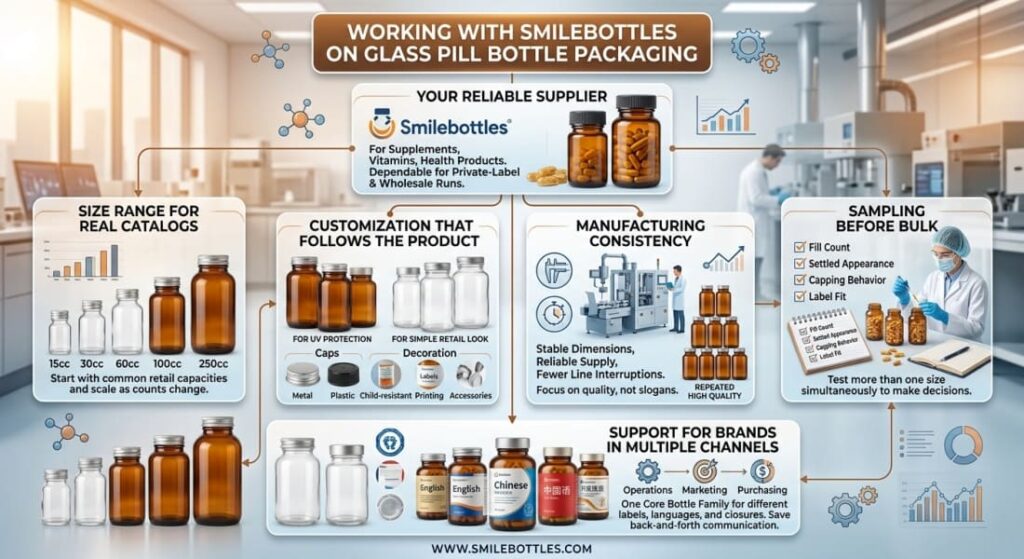
Working With Smilebottles on Glass Pill Bottle Packaging
Once you know the size range, material, and closure, you still need a supplier who can deliver the same pack repeatedly. Smilebottles works with buyers who need dependable glass pill bottles for supplements, vitamins, and related health products, including private-label and wholesale runs.
Size range for real catalogs
You can start with common retail capacities and move up or down as counts change. That helps when your lineup mixes compact SKUs and larger value packs.
Customization that follows the product
Color, caps, decoration, and accessories should match the formula and channel. Whether you need amber glass pill bottles for protection or clear bottles for a simple retail look, the pack should be built around use conditions.
Manufacturing consistency
Most buyers are not looking for slogans. They want stable dimensions, reliable supply, and fewer line interruptions. That is the standard that matters when you compare pill bottle manufacturers.
Sampling before bulk
Sampling is where charts turn into decisions. If you are comparing capsule packaging bottles across several SKUs, test more than one size at the same time. Write down fill count, settled appearance, capping behavior, and label fit.
Support for brands selling in more than one channel
If you need one core bottle family to handle different labels, languages, or closures, get that clear early. It saves a lot of back-and-forth between purchasing, operations, and marketing.
FAQ: Frequently Asked Questions About Buyers Ask Before Ordering
Q1:What is the most common glass bottle size for capsules?
A1:There is no single answer, but 60 cc, 100 cc, and 120 cc come up all the time. Your capsule size and count decide which one fits.
Q2:How many capsules fit in a 120 cc bottle?
A2:For size 00, many teams plan somewhere between 60 and 120. Shape, inserts, and headspace can move that number a lot. Test your own product.
Q3:Are amber bottles better for supplements?
A3:Often yes, especially when light protection matters. If the formula is stable and visibility helps the brand, clear glass can still be right.
Q4:Can the same glass bottles work for pharmaceuticals and nutraceuticals?
A4:Yes. Buyers use pharmaceutical glass bottles in both areas. What matters is glass quality, seal integrity, cleanliness, and label requirements in your market.
Q5:What closures work best?
A5:Depends on the channel. Standard screw caps are common for supplements. Child-resistant and tamper-evident options matter when the market expects them.
Q6:Is glass better than plastic for vitamins?
A6:Glass is often stronger on presentation and inertness. Plastic is lighter and tougher in rough transit. Choose by SKU.
Conclusion
The right bottle size does more than hold capsules or tablets. It protects the product, keeps the label readable, helps capping stay consistent, and affects what someone thinks when they pick up your pack. That is why pill bottle sizes deserve a real process, not a rushed catalog click.
If you are comparing glass medicine bottles for a new line, replacing mixed suppliers, or setting up cleaner wholesale packaging, keep the decision practical. The best bottle is the one that fits your product, runs without drama, ships cleanly, and makes the brand look intentional.
When you are ready to go from notes to samples, Smilebottles can help you sort common capacities, closure options, and bulk supply needs for capsules, tablets, and related health products. Bring your count targets, product samples, and channel requirements. From there, you can narrow faster and choose glass pill bottles that work in production, not just on a planning sheet.
 English