



Table of Contents
ToggleAuthor: SmileBottles Editorial Team
Estimated Reading Time: About 13 Minutes
In the competitive world of beauty and skincare, the vessel that holds your product is almost as important as the formula itself. As a brand owner or procurement manager, you are constantly balancing aesthetics, functionality, and preservation. You want packaging that screams luxury while ensuring the active ingredients inside remain potent. This is where the glass airless pump bottle enters the conversation.
At Smilebottles, we understand that choosing the right packaging is a strategic business decision. This guide is designed to walk you through everything you need to know about this premium packaging solution, helping you make an informed choice for your next product launch.
Introduction: The Intersection of Luxury and Preservation
Have you noticed the shift in the market? Consumers are becoming increasingly educated about ingredients. They know that Vitamin C oxidizes, and they know that Retinol degrades when exposed to air. Consequently, they are demanding packaging that protects their investment. Simultaneously, the demand for sustainable cosmetic packaging has never been higher.
This creates a unique challenge for you: How do you provide a high-performance delivery system that is also eco-friendly and luxurious? The answer lies in the glass airless pump. Unlike standard plastic options, glass offers weight, clarity, and a premium tactile experience that elevates your brand’s perceived value. When you combine the nobility of glass with the technical superiority of an airless system, you get a powerhouse packaging solution.
In this guide, we will explore the mechanics, benefits, and purchasing considerations of glass airless pump bottles, ensuring you have the knowledge to select the perfect container for your skincare line.
What Is a Glass Airless Pump Bottle?
Before we dive into the technicalities, we need to define the product clearly. You might see terms like airless container or bottle airless thrown around, but what do they actually mean in the context of glass manufacturing?
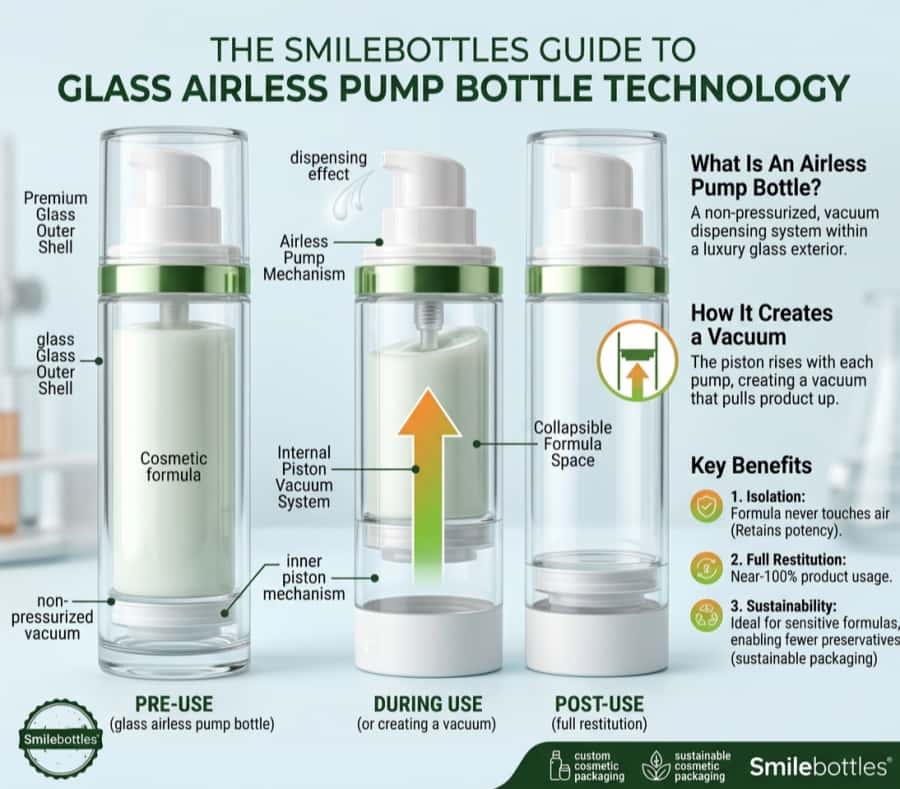
A glass airless pump bottle is a non-pressurized vacuum dispensing system housed within a glass exterior. Unlike a traditional pump bottle, which relies on a dip tube to pull product up (and allows air to enter the bottle to replace the dispensed liquid), an airless system isolates the product from the environment completely.
When your customer asks, “what is airless pump bottle technology doing for my cream?” the answer is simple: It is creating a vacuum. The system usually consists of a glass outer shell and an inner mechanism (often a pouch or a piston system) that collapses or rises as the product is dispensed. This ensures that the formula never touches the air until the moment it is applied to the skin.
How Does the Airless Pump Mechanism Work?
Understanding the airless pump mechanism is crucial when you are explaining the value proposition to your stakeholders or customers. It is not just a bottle; it is a machine.
When you press the actuator (the pump head), the following sequence occurs:
The Vacuum Effect: The pump creates a vacuum effect that draws the product upward.
The Piston Rise: Inside the bottle, there is a small plate (piston) at the bottom. As product is dispensed, this piston moves upward, pushing the remaining product toward the nozzle. Alternatively, some airless containers cosmetics use a collapsing bag system inside the glass.
No Backflow: Once the actuator is released, the valve closes immediately. No air is sucked back into the bottle to fill the void.
This mechanism solves the “dip tube problem.” In a standard bottle, once the product level drops below the tube, the remaining product is trapped. With a bottle airless pump, the piston pushes every drop up, ensuring a near 100% restitution rate. This is a massive selling point for high-end serums where every milliliter costs money.
Key Advantages of Glass Airless Pump Bottles
Why should you choose a glass essential pump over a cheaper plastic alternative or a standard jar? The benefits are multifaceted, impacting both the formulation stability and the consumer experience.
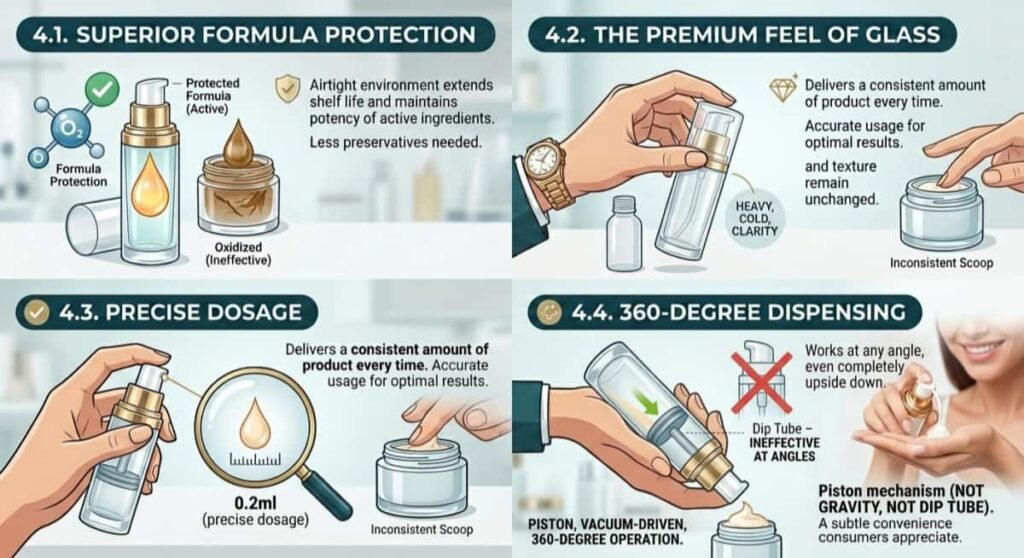
Superior Formula Protection
The primary enemy of active skincare ingredients is oxygen. Oxidation turns expensive creams brown and renders serums ineffective. Airless cosmetic packaging provides an airtight environment. This is critical for natural and organic brands that wish to use fewer artificial preservatives. By keeping air out, you extend the shelf life of the product significantly.
The Premium Feel of Glass
Plastic can feel utilitarian. Glass feels expensive. When a customer picks up cosmetic airless bottles made of glass, the weight conveys quality. Glass is also chemically inert, meaning it will not react with your formula, ensuring the scent and texture remain exactly as your chemists intended.
Precise Dosage
A high-quality airless pump bottle delivers a consistent dosage (e.g., 0.2ml per pump). This allows you to instruct your customers precisely on how to use the product (“two pumps for full face coverage”), ensuring they get the intended results from your skincare regimen.
360-Degree Dispensing
Because the system relies on vacuum rather than gravity, airless bottle cosmetic designs often work upside down or at an angle. This is a subtle convenience feature that consumers appreciate, even if they don’t consciously notice it.
Limitations and Considerations
As a transparent cosmetic packaging manufacturer, Smilebottles believes in being honest about potential challenges. While glass airless pump bottles are superior in many ways, there are factors you must consider.
Manufacturing Complexity
The engineering required to fit an airless engine inside a rigid glass bottle is complex. This often means the unit cost is higher than a standard dip-tube bottle. You must weigh this against the higher retail price point you can command with luxury packaging.
Weight and Shipping
Glass is heavier than plastic. When you order wholesale airless bottles, you need to account for slightly higher shipping costs. However, the trade-off is the sustainability factor—glass is infinitely recyclable, which appeals to the eco-conscious consumer.
Common Applications: Who Needs This Packaging?
Is this packaging right for your specific product line? We see airless pump bottles for skincare trending in specific categories.
High-Active Serums
If your product contains Vitamin C, Retinol, or peptides, an airless container is virtually mandatory. These ingredients are unstable. Using a jar or a standard pump exposes them to air daily, degrading them rapidly.
Natural and Organic Lotions
Brands focusing on “clean beauty” often reduce parabens and preservatives. Without these heavy preservatives, the formula is vulnerable to bacteria and mold introduced by fingers in jars or air in bottles. Airless cosmetic containers act as a shield, maintaining hygiene without aggressive chemicals.
Luxury Foundations and Primers
It is not just for skincare. We see a surge in cosmetic airless bottle usage for liquid makeup. It prevents the foundation from oxidizing (changing color) in the bottle and ensures the customer can use every last drop of the product.
How to Choose the Right Glass Airless Pump Bottle
You are ready to source. But how do you select the right airless bottle for your brand? Here is a checklist for your procurement process.
Viscosity Matters
The airless pump mechanism works best with fluids that have some viscosity (creams, lotions, gels). If your product is as thin as water, you may need a specialized spray pump. If it is a thick clay mask, the vacuum might struggle to pull it. Always test your formula with samples from your custom cosmetic packaging supplier.
Customization and Branding
Your packaging is your billboard. When looking for custom cosmetic bottles, ask about decoration options. Can the glass be frosted? Can it be spray-coated in your brand colors? At Smilebottles, we offer hot stamping, screen printing, and metallization to ensure your glass airless pump aligns with your brand identity.
Volume and Sizing
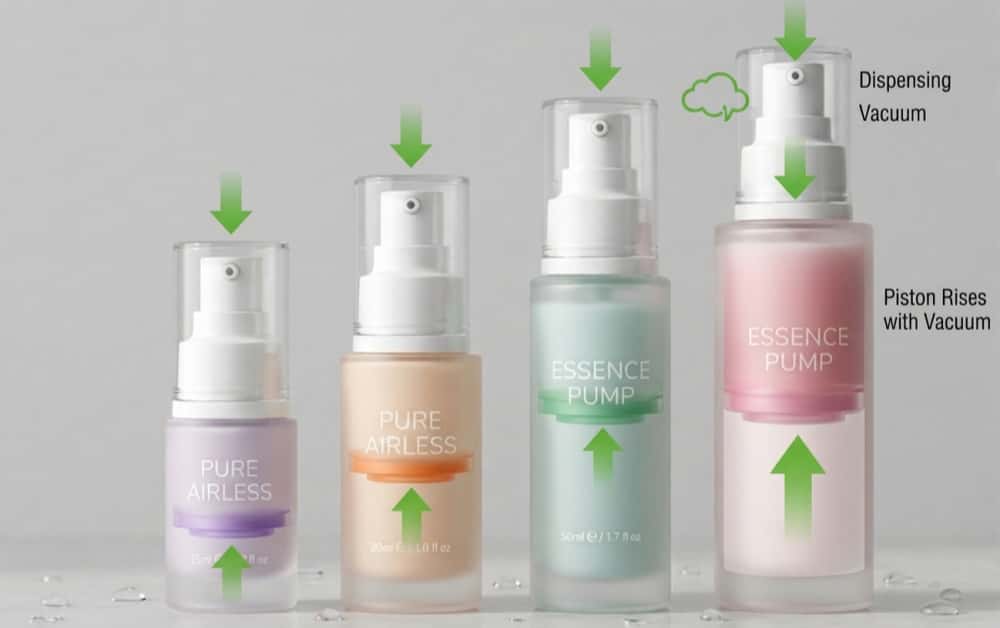
Standard sizes for airless pump bottles are 15ml, 30ml, and 50ml.
15ml: Ideal for eye creams and potent spot treatments.
30ml: The industry standard for serums and foundations.
50ml: Perfect for daily moisturizers and night creams.
Sustainability Credentials
If your marketing angle is eco-friendly, ensure you are buying sustainable packaging. Ask if the inner plastic components are recyclable or if the pump can be easily separated from the glass for recycling.
Why Choose Smilebottles for Your Packaging Needs?
When you search for a partner to supply your glass airless pump bottles, you aren’t just buying glass; you are buying reliability.
At Smilebottles, we specialize in helping businesses like yours scale. As a dedicated cosmetic packaging manufacturer, we understand the nuances of the what is an airless pump bottle conversation. We don’t just sell off-the-shelf; we help you engineer a solution.
Quality Control: We rigorously test our vacuum systems to ensure no leakage and smooth piston movement.
Customization: We offer extensive custom cosmetic packaging options to make your bottle unique.
Scalability: Whether you need a small trial run or are ready to order wholesale airless bottles by the container load, we have the production capacity to meet your timeline.
FAQ Frequently Asked Questions About Glass Airless Pump Bottles
To further assist you in your decision-making, we have compiled answers to the most common questions we receive from clients regarding airless containers for cosmetics.
Q1: Can I refill a glass airless pump bottle?
A1: Generally, airless pump bottles are designed for single use to maintain the sterile vacuum environment. However, new innovations are emerging with refillable cartridge systems inside the glass, which is a growing trend in sustainable cosmetic packaging.
Q2: Why does the pump stop working?
A2: If an air bubble gets trapped during the filling process, it can interrupt the vacuum. This is why professional filling equipment is crucial. As your supplier, we can guide you on the best filling techniques for our airless bottle designs.
Q3: What is the difference between a standard pump and an airless pump?
A3: A standard pump uses a tube and allows air in. An airless pump bottle uses a vacuum and a rising piston, keeping air out.
Q4: Is glass better than plastic for airless bottles?
A4: For luxury and chemical stability, yes. While plastic is lighter, glass airless pump bottles offer a more premium user experience and better compatibility with aggressive formulas that might react with plastic.
Future Trends in Airless Packaging
The industry is moving fast. As you plan your future product lines, keep an eye on “Hybrid Airless” systems. These combine the heavy, luxurious feel of glass essential pump designs with replaceable inner cartridges. This allows the customer to keep the beautiful glass outer shell and simply buy a refill, significantly reducing waste.
Furthermore, we are seeing a demand for “Mono-material” pumps, where the spring and internal mechanism are made of compatible polymers to make recycling easier. As a forward-thinking cosmetic packaging manufacturer, Smilebottles is constantly innovating to bring these sustainable technologies to your catalog.
Conclusion
Choosing the right packaging is about balancing protection, perception, and price. The glass airless pump bottle represents the pinnacle of this balance for the modern cosmetic brand. It protects your formula like a vault, looks like a jewel on the vanity, and dispenses with precision.
If you are ready to elevate your product line with airless cosmetic packaging, Smilebottles is here to guide you. We invite you to browse our catalog, request samples, and feel the difference that quality glass manufacturing can make for your brand.


