



Table of Contents
ToggleAuthor: SmileBottles Editorial Team
Estimated Reading Time: About 14 Minutes
You have put the work into the hive. You have harvested, filtered, and prepped your liquid gold. Now comes the decision that determines whether a customer picks your product off the shelf or keeps walking: the packaging. For honey brands, commercial beekeepers, and food packers, the container isn’t just a vessel; it’s your primary marketing tool. When a customer holds a jar with honey, they are judging the weight, the clarity, and the quality before they ever taste a drop.
At Smilebottles, we understand that sourcing glass honey jars is a balance between aesthetics, logistics, and cost. This guide is written for you—the buyer—to help you navigate the industry standards, avoid common sourcing mistakes, and find the perfect packaging to scale your business.
What Is a Honey Jar?
You might ask, what is a honey jar exactly? Can’t you just use any glass container? Technically, yes, but commercially, no. A dedicated honey container is engineered specifically for high-viscosity, hygroscopic liquids.
Honey absorbs moisture from the air. If the packaging fails, the honey can ferment or degrade. A true honey jar is designed with a specific neck finish (usually specifically for twist-off lug caps) that creates a hermetic, airtight honey jar seal.
Furthermore, the glass itself matters. Unlike standard masonry jars used for pickling, glass jars for honey are often designed with clearer glass (flint glass) to showcase the amber color of the product, and they have wider mouths to allow for easy dipping of honey dippers or spoons.
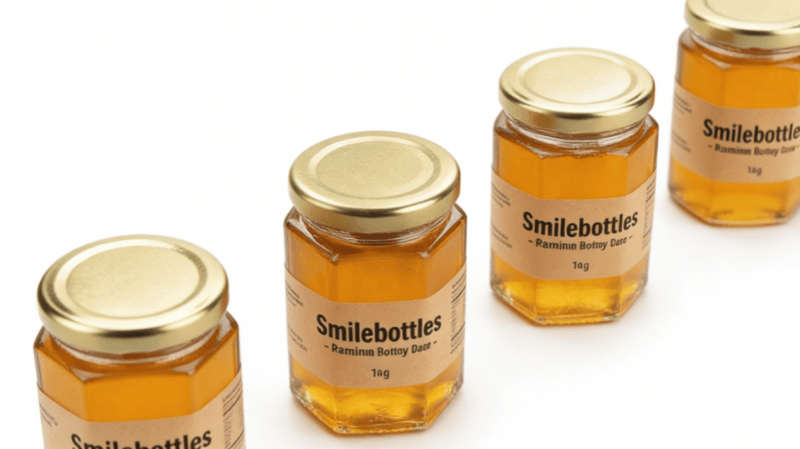
Why Glass Wins the Battle Against Plastic
In the packaging world, you have two main choices: plastic (PET) or glass. While plastic is cheaper to ship, glass jars remain the undisputed king for premium honey brands. Here is why you should stick with glass.
Chemical Purity and Taste
Honey is acidic. Over time, plastic can leach minute chemicals into the honey or, conversely, the plastic can absorb the aroma of the honey. Food-grade glass jars are non-porous and impermeable. They are chemically inert. This means the honey tastes exactly the same two years from now as it did on the day you bottled it. When you market your product as “pure” or “raw,” using food safe glass jars reinforces that promise to your customer.
Shelf Presence and Perception
Imagine your product sitting next to a competitor’s. Theirs is in a cloudy squeeze bottle; yours is in a sparkling glass vessel. Which one commands a higher price? Consumers associate weight and clarity with quality. High-quality honey jar images used in your online marketing always look better when the light is refracting through glass rather than dull plastic.
Heat Tolerance
If you pasteurize your honey or bottle it hot to delay crystallization, you need heat-resistant glass jars. Glass can withstand the filling temperatures required for commercial processing without warping or melting, which is a significant risk with lower-grade plastics.

Deciding on the Shape: Branding Your Product
The shape of the jar serves two purposes: logistics (how it fits in a box) and psychology (how it makes the customer feel). At Smilebottles, we see trends shift, but a few core shapes dominate the market.
The Classic Round Jar
This is the industry standard. The classic honey jar is cylindrical, simple, and efficient.
Pros: It is the easiest shape to label automatically. It maximizes shelf space.
Cons: It is very common, so it’s harder to stand out unless you have a spectacular label.
Hexagon Honey Jars
If you want to signal “premium” or “gift-worthy,” look at hexagon honey jars. The six-sided shape mimics the natural honeycomb cell. This isn’t just a design gimmick; the angles catch the light differently, making the honey inside glow. These are incredibly popular for farmers’ markets and boutique brands.
Square Jars
Square jars offer a modern, architectural look. They pack very tightly for shipping (no wasted space between jars). A square jar feels substantial in the hand and offers flat panels that are great for display, but be careful with labeling machines—you need equipment that can handle flat surfaces, not just round ones.
Novelty and Character Shapes
Sometimes you need to grab attention instantly. The bear-shaped honey jar is iconic. While often associated with squeeze bottles, the glass version adds a nostalgic, high-end twist that plastic can’t match. Similarly, a honeybee bottle—often featuring embossed bees on the glass surface—tells the customer what the product is without them even reading the text. These are excellent for impulse buys.
Navigating Honey Jar Sizes: A Commercial Breakdown
Sizing is tricky because honey is sold by weight (net weight), but jars are often measured by fluid capacity (water weight). Honey is denser than water, so a “12 oz fluid jar” holds much more than 12 oz of honey by weight. You need to be precise here.
The “Sample” and “Favor” Market (1 oz – 4 oz)
There is a massive market for mini honey jars and bulk orders. Why? Weddings, corporate gifts, and hotel breakfast trays.
If you are looking for 2-oz honey jars wholesale, you are likely building a sampler pack or a wedding favor product line. These small jars have high margins but require precise filling equipment.
The Retail Sweet Spot (8 oz – 16 oz)
The 12-oz honey jar is perhaps the most common size in US retail. It’s manageable for the consumer and fits standard pantry shelves. When you search for glass honey jars for supermarkets, this is the volume you should prioritize.
Bulk and Family Sizes (1kg and up)
For heavy users, bakeries, or wholesale clubs, you need honey storage jars that can hold weight. The 1kg honey jar is a standard in international markets. With these larger sizes, the durability of the glass becomes even more critical to prevent breakage during shipping.
Closures: Why the Lid Matters as Much as the Jar
You cannot talk about the glass without talking about the seal. We often see buyers source glass from one place and lids from another, leading to leaks. We strongly recommend buying glass honey jars with lids as a matched set to ensure the “finish” (the thread on the glass) matches the cap perfectly.
Metal Lug Caps vs. Continuous Thread
Most professional honey packaging uses “Lug” caps (twist-off). These require a specific glass finish. Inside the metal lid, there is a plastisol liner. When you hot-fill the honey or apply steam capping, this liner softens and then cools to form a vacuum seal. This is what gives the customer that satisfying “pop” when they open the jar.
Plastic vs. Metal
While plastic lids exist, metal lids (gold, black, or white) are the standard for wholesale glass honey jars. They look more professional and handle the heat of sealing better.

Sourcing Strategy: How to Buy Bulk Honey Jars
If you are a growing business, you are likely moving from buying a few cases to buying pallets. You might be searching for “honey jars near me” hoping to save on shipping. However, local distributors are often just middlemen.
Working with a Manufacturer vs. a Distributor
To get the best price on bulk honey jars, you usually need to go to the source. As a manufacturer, Smilebottles can offer honey jars wholesale pricing that distributors can’t match.
The Distributor Route: Good for small quantities (10-50 cases). You pay a premium for immediate availability.
The Manufacturer Route: Essential for scalability. If you need 2 oz honey jars wholesale by the thousands, ordering direct ensures you get consistent batches and custom packaging options.
Logistics and Breakage
Glass is heavy and fragile. When you order jars with lids, ask about the packing method. Are they carton-packed (safest) or pallet-packed with dividers (cheapest)? We prioritize secure packaging to ensure your honey jars arrive ready to fill, not broken.
Customization: Standing Out on the Shelf
The market is crowded. If you use the exact same classic honey jar as the generic store brand, you are fighting a price war. Customization allows you to fight a brand war.
Custom Decoration
You don’t always need a custom mold. We can take standard glass jars and apply screen printing, frosting, or even hot stamping. Imagine your logo fired directly onto the glass—no paper label to peel off or get sticky.
Custom Molds
For larger brands, creating custom honey jars is the ultimate differentiator. We can design a jar that is unique to your company—perhaps with your logo embossed on the shoulder or a specific ergonomic grip.
Why Smilebottles is Your Best Partner for Glass Honey Jars?
You have choices when it comes to packaging. But Smilebottles isn’t just a vendor; we are a partner in your production line. We specialize in wholesale glass honey jars and understand the specific needs of the apiary industry.
From ensuring our glass is 100% food safe glass jars certified to helping you design a custom honey jars mold that captures your brand’s essence, we handle the heavy lifting. Whether you need a standard 12 oz honey jar or a unique honeybee bottle, we deliver quality that reflects the hard work you put into your honey.
Your honey is premium. Your packaging should be too.
Ready to upgrade your packaging? Contact Smilebottles today to discuss your project and get a quote on your next shipment.

FAQ Frequently Asked Questions About Glass Honey Jars
Here are the questions we hear most often from our B2B clients.
Q1: Can I use these jars for hot-fill honey processing?
A1: Yes. Our heat resistant glass jars are designed to withstand standard pasteurization and hot-fill temperatures. However, always avoid “thermal shock”—don’t put a freezing cold jar directly under a boiling hot filler.
Q2: Do you sell the jars and lids together?
A2: Yes. We supply honey jars with lids to ensure a perfect fit. We can also supply the lids separately if you already have the glass, but buying them as a unit is safer for seal integrity.
Q3: How do I prevent honey from leaking during shipping?
A3: The key is the liner in the cap. Ensure you are using a plastisol-lined lug cap and that it is applied with the correct torque. Using an airtight honey jar combination is the only way to guarantee no leaks.
Q4: What is the best jar for raw honey?
A4: Raw honey crystallizes faster. We recommend wide-mouth glass jars for honey (like straight-sided jars) so your customers can easily scoop out the crystallized honey with a spoon. Narrow necks are a nightmare for raw honey consumers.
Conclusion
Choosing the right honey jars is a balance of aesthetics, functionality, and economics. You need a container that looks great on the shelf, protects your product, and fits your budget.
Don’t settle for generic packaging. Whether you need standard honey jars wholesale or a fully bespoke design, Smilebottles is ready to assist you. Contact us today to request a quote or free samples. Let’s find the perfect glass honey jars to make your brand shine.


