



Table of Contents
ToggleAuthor: SmileBottles Editorial Team
Estimated Reading Time: About 16 Minutes
Whether you are launching a new line of artisanal pickled vegetables, running a large-scale food manufacturing brand, or sourcing packaging for wholesale distribution, the containers you choose will make or break your product. Packing highly acidic foods requires precision. You need containers that preserve flavor, ensure absolute food safety, prevent leaks, and look incredibly appealing on grocery store shelves. If you are a business owner or buyer researching the best packaging solutions, you are in the right place. In this comprehensive guide, we will walk you through everything you need to know about pickle jars. From choosing the right material and lid type to understanding the supply chain benefits of working with a reliable packaging partner like Smilebottles, this guide is designed to help you make the smartest purchasing decisions.
What Are Pickle Jars? (And What Makes Them Different from Regular Jars)
At first glance, you might think any glass or plastic container can hold preserved foods. However, the science of pickling demands highly specific environments. When you invest in pickling containers, you are buying a specialized product designed to withstand harsh, acidic brine (usually vinegar or salt-based) over extremely long periods.
True jars for pickling are engineered with non-reactive materials. If you use a substandard container made from low-grade metal or cheap reactive plastics, the acid in the brine will leach chemicals from the packaging directly into your food. This not only destroys the taste of the product but also creates severe health hazards and guarantees product recalls for your brand.
For this reason, the global food industry heavily relies on pickled food glass storage. Glass is inherently impermeable and chemically inert, meaning it will never interact with the vinegar or spices inside. Furthermore, modern glass jars for pickles are built with specific thermal shock margins. This means they can handle the high heat required during the hot-fill canning process or sterilization without shattering on your production line.
Types of Pickle Jars You Should Know
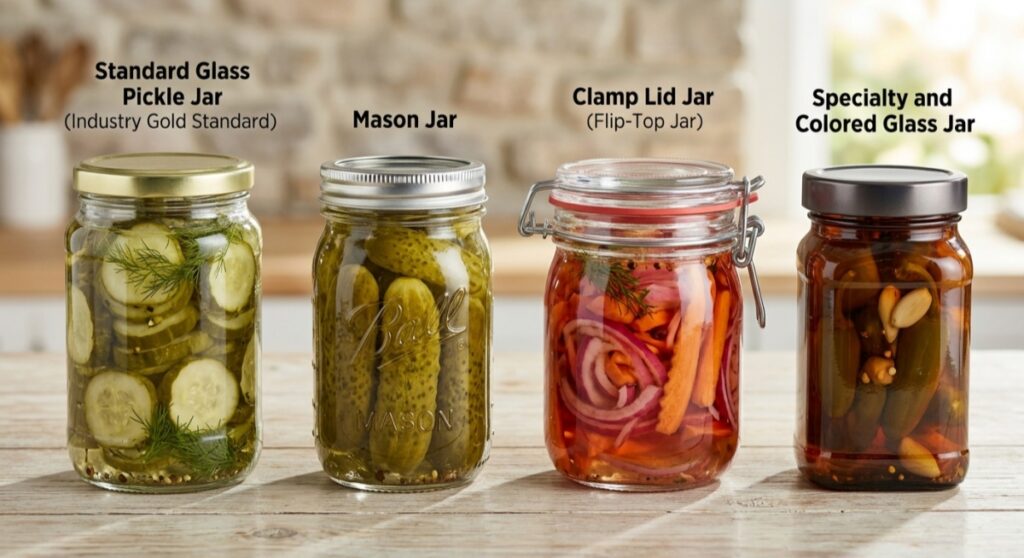
When stocking your inventory or designing your product line, you must choose a jar style that aligns with both your production capabilities and your consumer’s aesthetic preferences. Here are the main types you should consider.
Glass Pickle Jars (The Industry Gold Standard)
Standard glass pickling jars are the backbone of the preserved food industry. They usually feature a simple, cylindrical, or slightly squared design with a continuous thread neck finish (perfect for screw-on metal lids). Because they are standard in the industry, these glass jars for pickling are incredibly easy to run through automated filling and capping machines. If you are producing large volumes, standard glass pickle jars offer the best balance of cost-efficiency, durability, and consumer trust.
Mason Jars
Originally patented in the 1850s, the mason jar remains a powerhouse in both the home-canning and commercial artisanal markets. Mason jars for pickling are highly recognizable by their distinct branding, heavy glass walls, and unique two-piece lid system (a flat sealing lid and a threaded metal band). Many boutique brands prefer mason jars for pickles because they instantly communicate a “homemade,” rustic, and premium artisanal vibe to retail shoppers.
Clamp Lid Jars (Flip-Top Jars)
Often associated with European designs, clamp lid jars feature a glass lid attached to the jar via a wire bail, using a rubber gasket to create an airtight seal. While they are slightly more expensive and harder to automate on massive commercial filling lines, they are phenomenal for high-end, premium retail products. Consumers love them because the jars are highly reusable for kitchen storage, adding secondary value to your product.
Specialty and Colored Glass Jars
This is where your brand can truly stand out. While clear glass is traditional, colored glass jars are rapidly gaining market share. As a buyer, you should understand that colored glass (such as amber, green, or custom tinted glass) provides vital UV protection. UV light can degrade the vibrant colors of pickled vegetables over time and alter the flavor profile of delicate spices. Furthermore, from a branding perspective, presenting your product in uniquely colored bottles, pickle enthusiasts will immediately notice your product differentiating itself from a sea of clear jars on the supermarket shelf.
Pickle Jar Sizes Explained: Choosing the Right Capacity
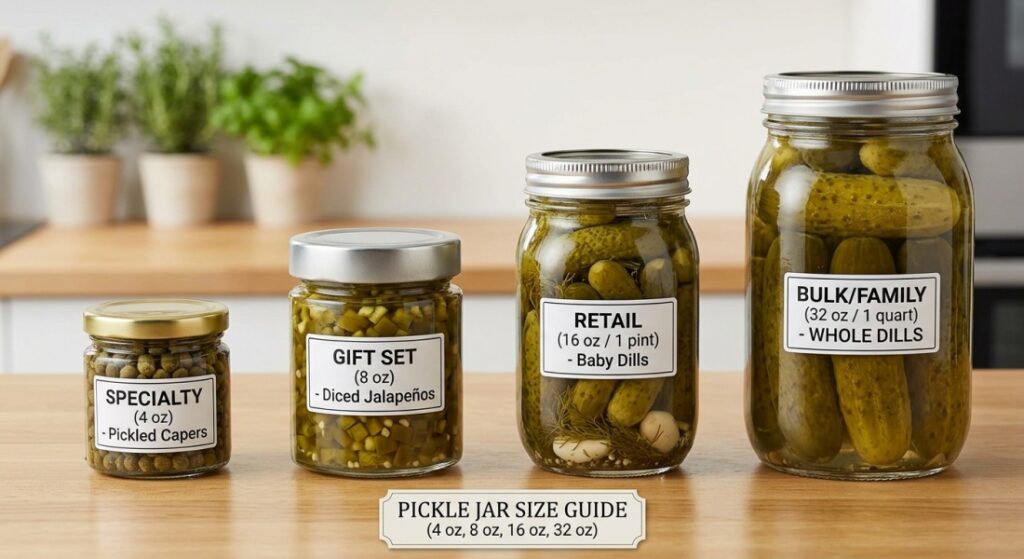
Selecting the correct pickle jar sizes is a strategic decision that affects your shipping costs, retail shelf placement, and consumer pricing strategy. You must match the size of the container to the consumption habits of your target audience.
Small Capacities (4 oz to 8 oz)
These small sizes are rarely used for large vegetables like cucumbers. Instead, they are the ideal pickling jars for specialty items: pickled capers, diced jalapeños, gourmet relishes, or pickled garlic cloves. They are also perfect for sample packs or premium gift sets.
Medium Capacities (16 oz to 24 oz)
The 16 oz (pint) and 24 oz sizes are the absolute sweet spot for retail. When you look for the best jars for pickling standard cucumbers, asparagus, or carrots, this is what you want. They perfectly fit on average refrigerator shelves and hold enough product for a family without going bad before it can be consumed.
Large Capacities (32 oz to Half-Gallon)
The 32 oz (quart) jar is excellent for bulk buyers, large families, and club-store packaging. If your business sells to restaurants, diners, or catering companies, you will likely be sourcing half-gallon or gallon-sized jars for pickles. Large-format jars require wider mouths so kitchen staff can easily reach in with tongs to retrieve the food.
Can You Use Mason Jars for Pickling?
A frequent question from consumers and startups scaling their business is whether standard mason jars are truly viable for commercial pickling. The short answer is yes. Using mason jars for pickling is a fantastic choice for small to medium-batch producers.
The primary advantage is the two-piece lid. During the heat processing stage of pickling, the flat lid allows air to escape the jar as the contents expand. As the jar cools, a deep vacuum seal is formed, pulling the lid down tightly. This guarantees a highly secure, tamper-evident seal that extends shelf life.
However, if you are scaling up to a massive, highly automated factory line, standard mason jars might slow down your machinery due to the two-piece lid application. In those cases, a standard one-piece lug lid or continuous thread lid on a traditional pickle glass jar is more efficient.
Key Features to Look for When Choosing Pickle Jars
When you evaluate different packaging suppliers, you cannot afford to base your decision on price alone. To ensure your food product reaches the consumer safely and beautifully, you must evaluate the following critical features.
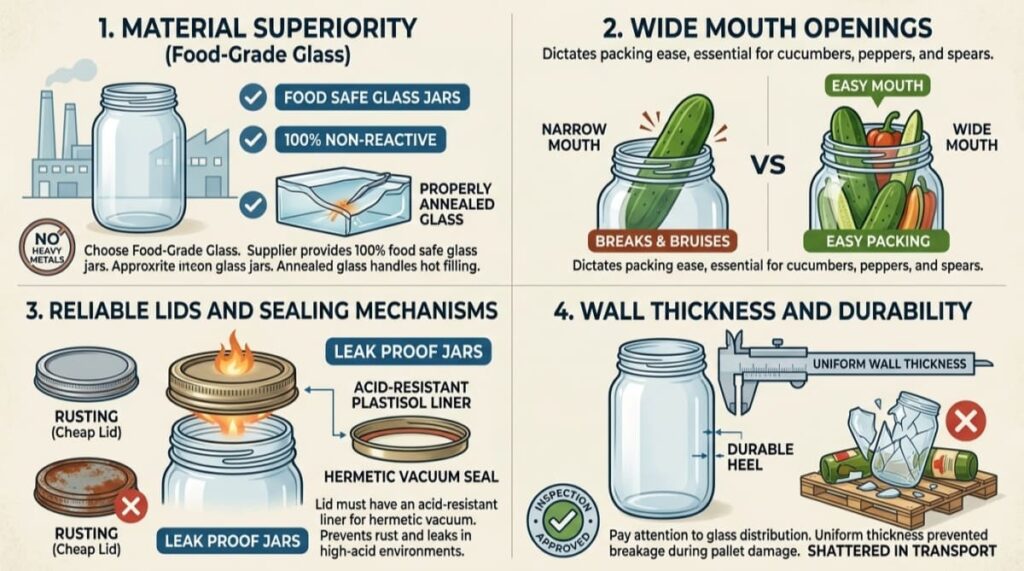
1. Material Superiority (Always Choose Food-Grade Glass)
You must ensure your supplier provides 100% food safe glass jars. High-quality glass does not contain heavy metals or toxic impurities. When you source a jar for pickle, glass must be properly annealed in the factory to relieve internal stresses, making it strong enough to handle temperature fluctuations during hot filling.
2. Wide Mouth Openings
The opening of your glass pickling jar dictates how easily your product can be packed—either by hand or by machine. Pickled cucumbers, whole peppers, and thick vegetable spears require wide-mouth jars. A narrow mouth will cause your product to break or bruise during the packing process, leading to a cloudy brine and unappealing appearance.
3. Reliable Lids and Sealing Mechanisms
The glass container is only half of the equation; the seal is the other. Your pickle jar lid must feature an acid-resistant plastisol liner. When heated, this liner softens and molds to the rim of the glass, creating an absolute hermetic vacuum. If you want truly leak proof jars, you must source high-quality pickling jars with lids specifically designed for high-acid, hot-fill environments. Buying a cheap pickle bottle with a non-acid-resistant lid will lead to rust on the inside of the cap, ruining the entire batch.
4. Wall Thickness and Durability
Whether you are buying a standard container or a custom pickle glass design, pay attention to the glass distribution. The walls and base (the heel) of the jar must have uniform thickness to prevent breakage during transport. A shattered glass pickle container inside a wholesale pallet can destroy surrounding labels and cause massive inventory loss.
Why Glass Pickle Jars Are Better Than Plastic
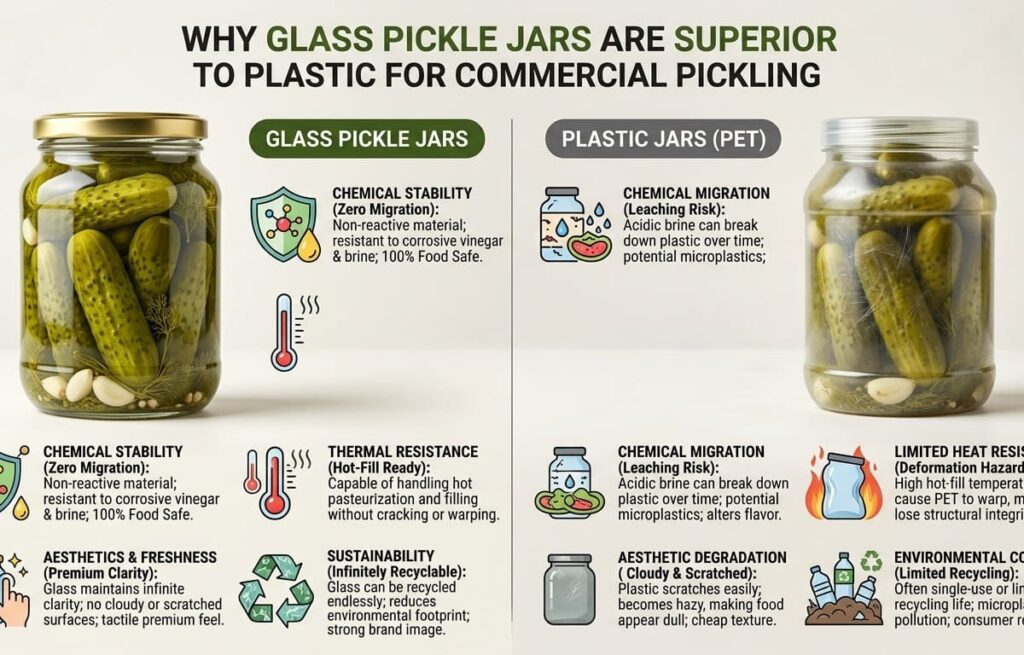
In the modern packaging industry, some manufacturers are tempted to use PET plastic to save on shipping weight. However, when it comes to pickling, choosing a glass jar for pickle production is vastly superior to plastic.
Chemical Stability: Vinegar and fermented brine are highly corrosive. Over time, acidic liquids can slowly break down the structural integrity of plastic, causing microplastics and chemical polymer tastes to leach into the food. A jar for pickle glass construction ensures zero chemical migration.
Thermal Resistance: Most commercial pickling requires hot-filling or pasteurization to kill bacteria. Glass can withstand these high temperatures effortlessly. Plastic, unless heavily specialized (and expensive), will warp, melt, or lose its structural integrity under high heat.
Aesthetics and Freshness: Plastic scratches easily during transit and eventually becomes cloudy, making the food inside look unappetizing. A premium glass jars for pickle maintains brilliant clarity for years. When consumers tap a glass jar, it feels hefty, premium, and trustworthy.
Sustainability: Consumers are heavily rejecting single-use plastics. Glass is 100% infinitely recyclable without loss of quality. Brands that package their products in glass pickle jars can legitimately market their eco-friendly choices to environmentally conscious buyers.
Tips for Using and Maintaining Pickle Jars
Whether you are advising your end-consumers or managing your own pilot-testing kitchen, understanding the proper maintenance of a glass pickling jar is vital for food safety.
Proper Sterilization
If you are running a home business or testing recipes, knowing how to sterilize pickle jars is the most important step to prevent botulism and food spoilage.
1 Wash your jars for pickling in hot, soapy water to remove dust or factory debris.
2 Place the jars in a large pot of boiling water for at least 10 minutes (add more time if you are at a high altitude).
3 Do not boil the metal lids with plastisol liners for too long, as boiling can ruin the rubber seal. Instead, simmer the lids in hot water (around 180°F) for 10 minutes to soften the sealing compound.
4 Keep the jars hot until the exact moment you are ready to fill them with hot brine. Pouring hot brine into a cold jar will cause thermal shock, shattering the glass.
Storage for Maximum Shelf Life
Once the jars are sealed and cooled, press down on the center of the lid. If it does not pop up, you have successfully created an airtight vacuum. Store your sealed pickle jars with lids securely in a cool, dark, and dry warehouse or pantry. Light and heat are the enemies of preserved foods. If you are not using our UV-protective colored jars, ensure boxes are kept away from direct sunlight to prevent the vegetables from softening and losing their bright colors.
Commercial Sourcing: Why Smilebottles is Your Best Choice for Pickle Jars
If you are a purchasing manager, business owner, or brand director looking to buy in bulk, finding the right manufacturing partner is critical. Sourcing from unverified vendors can result in inconsistent jar capacities, misaligned threading that causes leaks, and massive supply chain delays.
This is where Smilebottles steps in. As a premier custom glass jars manufacturer, we specialize in high-quality glass packaging solutions tailored directly to food brands and wholesale distributors.
Unmatched Quality Control
When you buy wholesale pickle jars from Smilebottles, you are investing in rigorously tested containers. We understand that a single faulty pickle jar can cost your business thousands of dollars in recalls. Our production lines utilize automated optical inspection to detect the tiniest micro-fractures, ensuring every glass pickle jar that leaves our facility has perfect wall thickness, smooth rims, and flawless threading for your lids.
Colored Glass Leadership
Smilebottles is an industry leader in manufacturing colored glass containers. If your brand wants to stand out, our beautifully tinted glass jars offer unmatched aesthetic appeal and critical UV-light protection. This ensures your pickled foods look premium on the shelf and retain their peak flavor longer than products stored in clear glass.
OEM and Custom Mold Capabilities
Standing out in the competitive food market often requires unique packaging. If you want a custom-designed container with your brand logo embossed directly on the glass, we can make it happen. As a direct manufacturer, we offer end-to-end OEM and ODM services. From creating 3D prototypes to manufacturing the exact mold for your bespoke pickle jars, we bring your specific brand vision to life without the exorbitant middleman fees.
Seamless Wholesale Supply Chain
We know that businesses require reliable, on-time deliveries. Whether you need a few pallets or several shipping containers of the best pickle jars, we have the manufacturing scale to meet your demands. We handle secure palletization and wholesale freight logistics, ensuring your bulk order arrives at your bottling facility safely and ready for your production line.
FAQ Frequently Asked Questions About Pickle Jars
As an expert manufacturer, we encounter many questions from buyers scaling their operations. Here are the most common inquiries to further guide your purchasing process.
Q1 What size jar is best for pickling?
A1 For standard consumer retail, the 16 oz (pint) and 32 oz (quart) sizes are the absolute best sellers. They provide ample space for vegetables while fitting easily into household refrigerators.
Q2 Can I reuse glass pickle jars commercially?
A2 While consumers love reusing jars at home, commercial brands cannot legally or safely reuse recycled containers for selling new food products due to sanitation laws and the risk of micro-fractures from previous use. You should always source new, steriliable jars for commercial production to guarantee safety.
Q3 Do pickle jars need to be 100% airtight?
A3 Absolutely. If the seal on your container is compromised, airborne bacteria and oxygen will enter the jar, causing the food to mold, ferment improperly, or spoil completely. This is why pairing an excellent jar with a high-quality plastisol-lined lid is non-negotiable.
Q4 Are colored glass jars safe for pickling?
A4 Yes. The color in our Smilebottles glass is not painted on; it is integrated directly into the raw glass material during the high-heat melting process. It is completely food-safe, non-reactive, and will never leach into your brine.
Q5 Can I run your standard jars on my automated capping machine?
A5 Yes. Our standard continuous thread (CT) and lug-neck glass containers are strictly manufactured to international industry tolerances, ensuring they run seamlessly on fast-paced automated filling, capping, and labeling lines.
Conclusion
By prioritizing high-quality, food-grade glass, ensuring you have the right acid-resistant lids, and selecting the optimal size for your market, you set your product up for lasting success. Never underestimate the power of premium aesthetics—upgrading to a beautifully designed, UV-protective colored jar can be the exact differentiator that allows you to command a premium price on the retail shelf. If you are ready to elevate your packaging strategy and source the finest custom or bulk containers on the market, look no further. Partner with a trusted manufacturer who understands your precise business needs. Explore the comprehensive wholesale and custom options at Smilebottles today, and let us provide the perfect glass solutions to help your food business thrive.


