



Table of Contents
ToggleAuthor: SmileBottles Editorial Team
Estimated Reading Time: About 14 Minutes
When you are ready to package your brew, the vessel you choose is just as important as the liquid inside. As a brewery owner or brand manager, you aren’t just buying glass; you are buying shelf presence, customer experience, and logistical efficiency.
At Smilebottles, we understand that navigating the world of beer bottle sizes can be complex. The size of your bottle dictates your label design, your case packaging, your shipping costs, and ultimately, how your customer enjoys your product. This guide will walk you through everything you need to know about selecting the right packaging, from the standard size beer bottle to specialty formats, ensuring you make the best decision for your brand.
Introduction — Why Beer Bottle Size Matters More Than You Think
You might think that a bottle is simply a container, but in the competitive beverage market, the beer bottle volume plays a psychological role in consumer purchasing.
Why does this matter? Because the size you choose affects every stage of your product’s lifecycle:
Customer Perception: A heavy, large-format bottle screams “premium” and “shareable,” while a standard 12 oz beer bottle suggests a sessionable, single-serve refreshment.
Product Freshness: The headspace and total volume influence how long your beer stays carbonated and fresh once opened.
Distribution: Does your bottle fit on a standard retail shelf? Can it be served easily at a bar?
Costs & Logistics: Heavier, larger bottles increase freight costs. The dimensions of a beer bottle determine how many cases fit on a pallet.
Compliance: You must adhere to country-specific standard volumes to avoid legal headaches.
Choosing the right format is a balancing act between your brand vision and your bottom line.
Common Beer Bottle Sizes Around the World
To make the right choice, you first need to understand the landscape. While there are infinite custom options, most of the world relies on a few key beer packaging sizes. Using these standards often makes sourcing caps, labels, and boxes much easier.
Standard Single-Serve Bottles
For the vast majority of beers—lagers, IPAs, pilsners—the single-serve bottle is king.
The Global Standard: 330ml
In Europe and Asia, the 330ml beer bottle is the absolute standard. It is compact, easy to handle, and holds just enough beer to be consumed while still ice cold. If you are exporting to international markets, this is likely the volume you will need to target.
The North American Icon: 355ml (12 oz)
If your primary market is North America, the typical beer bottle size is slightly larger. The 12 oz beer bottle is deeply ingrained in American beer culture. It is the format consumers expect when they grab a six-pack from the fridge.
The “Longneck” vs. The “Stubby”
Within these volumes, shape matters. The longneck beer bottle is the industry standard—tall, slender, and easy for bartenders to grab. Conversely, the stubby beer bottle (shorter and wider) offers a retro, nostalgic feel that can help your brand stand out on a crowded shelf, even if the volume remains the same.
Larger “Share” Formats and Premium Packaging
When you move into high-ABV beers, barrel-aged stouts, or table beers meant for dining, you need to look at larger formats.
The 500ml European Standard
The 500ml beer bottle is incredibly popular in the UK and Germany (often for wheat beers and ales). It offers a “proper pint” experience. It sits at a sweet spot between a single serve and a sharing bottle.
The Bomber (650ml)
In the craft beer revolution, the bomber beer bottle (approx. 22 oz) became a staple for limited releases. It is a brilliant format for encouraging consumers to try a new, more expensive SKU without committing to a full six-pack.
The 750ml Large Format
Often referred to as the “champagne style,” the 750ml beer bottle is the ultimate premium statement. If you are brewing a Saison, a wild ale, or a beer meant for cellaring, this is the size of choice. It implies that the liquid inside is as sophisticated as wine.
Regional Standards and Labeling
It is vital to note that what is considered a regular beer bottle size varies by region. A 330ml bottle might look “small” to a US consumer used to 355ml, while a 355ml bottle might cause labeling compliance issues in strict EU markets. Always confirm the legal “fill volume” requirements of your target destination before ordering molds.

Understanding Beer Bottle Dimensions
When you are setting up your filling line or ordering cartons, you aren’t just asking “how much does it hold?” You are asking: how big is a beer bottle physically?
Critical Measurements
The beer bottle dimensions include height, body diameter, and neck finish.
For example, if you look at the famous industry benchmark, the Budweiser bottle dimensions are roughly 229mm in height with a diameter of about 60mm. This sets the expectation for a size of standard beer bottle in the mass market. If your bottle is significantly wider or taller than this average beer bottle size, you may need to adjust your shelf spacing or shipping crates.
Knowing the exact size of a bottle of beer helps you calculate:
Pallet efficiency: How many layers can you stack?
Label panel height: How much room do you have for your brand art?
Filling head adjustment: Do you need change parts for your machine?
How to Choose the Right Beer Bottle Size (Decision Checklist)
So, how do you decide? Do you go with a standard beer bottle volume or something custom? Use this checklist to guide your purchasing decision.
Start with Your Sales Channel
Where will your beer be sold?
Retail Shelves: If you are selling in supermarkets, stick to a standard size beer bottle. Retailers design their shelves for standard heights. A bottle that is too tall might not fit; a bottle that is too wide might reduce the number of facings you get.
Bars and Restaurants: On-premise consumption allows for more variety. A unique shape or a larger 500ml beer bottle can command a higher price point on a menu.
E-commerce: If you ship directly to consumers, weight is your enemy. You want a bottle that is durable but optimized for shipping weight.
Match Bottle Size to Beer Style
Your beer style should dictate the packaging.
Light Lagers & IPAs: These are best consumed fresh and cold. The 330ml beer bottle or 12 oz option is ideal because the beer is finished before it gets warm or flat.
Imperial Stouts & Sours: These are sippers. A 375ml or 750ml beer bottle is appropriate here, as the consumer expects a slower drinking experience, often shared with friends.
Build Your Pricing Strategy Around Size
The size of standard beer bottle options you choose will anchor your price.
Volume Pricing: A 650ml beer bottle allows you to sell a single unit at a higher price point than a single 12 oz bottle, often resulting in a better margin per ounce of liquid.
Perception of Value: A Belgian beer bottle with a cork and cage finish instantly elevates the perceived value, allowing you to charge a premium price that far exceeds the additional cost of the packaging.
Production Compatibility
Before you fall in love with a specific budweiser bottle size look-alike or a custom shape, check your machinery.
Can your labeler handle a tapered body?
Does your filler have strict height limitations?
If you choose a stubby beer bottle, do you have the right star wheels to move it down the line?
Avoiding expensive change-parts is often why breweries stick to a typical beer bottle size.
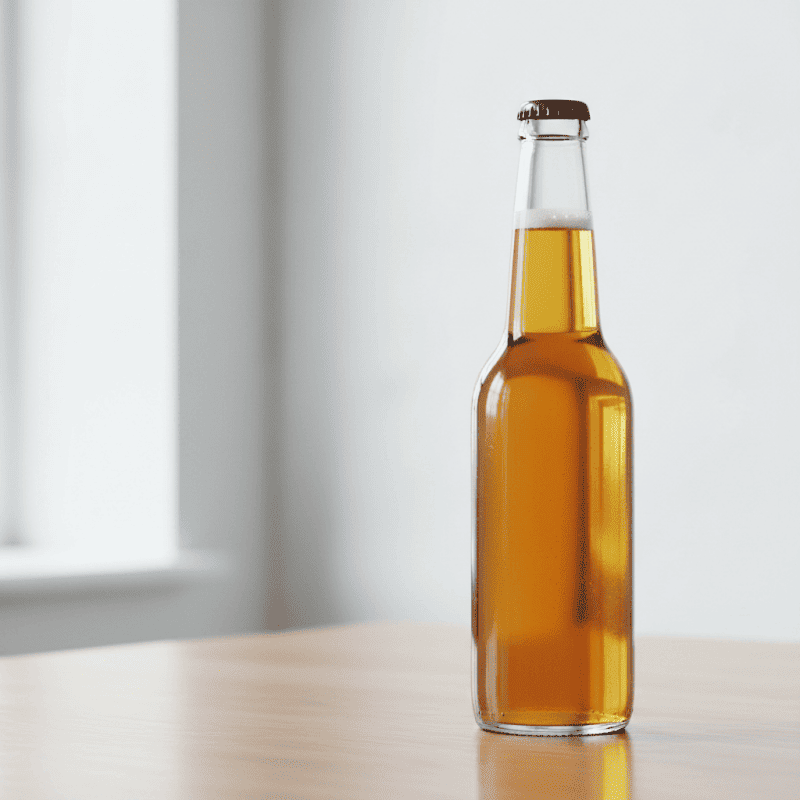
Bottle Size vs. Bottle Shape, Neck Finish, and Closure
Choosing the volume is only half the battle. As a beer bottle manufacturer, we know that the silhouette of the bottle defines your brand identity.
Popular Beer Bottle Shapes
Longneck: The industry workhorse. It implies reliability and familiarity.
Vichy: Common in Europe, slightly shorter and stouter than the American longneck.
Belgian: With a bulbous neck and sloping shoulders, this shape screams “craft” and “heritage.”
Champagne: Used for the 750ml beer bottle, this requires a different closure but offers maximum pressure resistance for highly carbonated brews.
Closures by Product Positioning
The finish of the bottle must match the size.
Crown Cap (26mm): The standard for almost every regular beer bottle size. It is cost-effective and creates a perfect seal.
Swing-top: Often seen on 500ml or 750ml bottles, this implies reusability and an old-world aesthetic.
Cork & Cage: Mandatory for high-pressure, bottle-conditioned beers in large formats.
Color Matters
While sizing is key, don’t forget color. Amber glass offers the best protection against UV light (which causes skunking). Clear (flint) or green glass is often used for marketing purposes but requires you to be more careful with light exposure.
Recommended Bottle Sizes by Use Case (Quick Picks)
If you are looking for a quick recommendation, here is how we typically advise our clients:
Best for 6-packs and high-volume retail: 12 oz beer bottle (North America) or 330ml beer bottle (Global).
Best for Pubs and “Value” positioning: 500ml beer bottle.
Best for Limited Release / High ABV: bomber beer bottle (650ml).
Best for Gifting and Cellaring: 750ml beer bottle (Champagne style).
Best for Nostalgia Brands: stubby beer bottle.
Mistakes to Avoid When Choosing Beer Bottle Sizes
In our experience as a beer bottle supplier, we see breweries make avoidable errors during the selection process.
Ignoring Local Norms
If you launch a 330ml beer bottlein a market that exclusively drinks pints, consumers might feel short-changed. Conversely, exporting a non-standard beer bottle sizeto a country with strict recycling or deposit schemes can get your product delisted.
Forgetting Label Real Estate
You might love the shape of a Belgian beer bottle,but have you checked the label panel area? Curved bottles can be a nightmare for applying stickers without wrinkles. Always check the technical drawing for the flat label area dimensions.
Neglecting Logistics
A heavy, thick-walled bottle feels premium, but it eats into your shipping margins. Calculate the weight of a full pallet. A custom beer bottlesdesign that is 2mm wider than average might mean you fit one less case per layer on a pallet, increasing your freight cost per unit significantly.
Overlooking Oxidation
If you package a delicate New England IPA in a large 650ml beer bottle, the last glass might be warm and oxidized by the time the consumer gets to it. Match the volume to the drinking speed.
Why Choose Smilebottles for Your Beer Bottle Supply
Finding the right packaging partner is just as important as the packaging itself. At Smilebottles, we are more than just a glass beer bottle supplier; we are your packaging consultants.
Wide Range of Beer Bottle Sizes and Styles
Whether you need a classic longneck beer bottle, a unique stubby beer bottle, or a premium 750ml beer bottle, we have the molds ready. We offer an extensive catalog that covers every standard beer bottle volume used in the global market today.
Quality Consistency and Safety Standards
We know that a bottle bursting on the line is a disaster. Our manufacturing process ensures consistent glass distribution, pressure ratings, and dimensional accuracy. When you ask how big is a beer bottle from our production line, the answer is “exactly as specified,” every single time.
Customization Options
Do you want to stand out? We specialize in custom beer bottles. From embossing your logo directly onto the glass to creating a proprietary shape that defines your brand, we can bring your vision to life. We also offer wholesale beer bottles with various decoration options like screen printing and frosting.
Support for Growing Breweries
We work with businesses of all sizes. Whether you are a startup needing guidance on the average beer bottle size for your first run, or a large brewery looking for reliable wholesale beer bottles to scale up, our team is here to support your logistics, pallet configuration, and design needs.
FAQ Frequently Asked Questions About Beer Bottle Sizes (Quick Answers)
Here are the most common questions we get regarding beer bottle sizes.
Q1. What is the most common beer bottle size?
A1:Globally, the 330ml beer bottle is the most common. In the United States, the 12 oz beer bottle (355ml) is the standard.
Q2. Is 330 ml the same as 12 oz?
A2: No. A 330ml beer bottle is approximately 11.2 ounces. A 12 oz beer bottle is approximately 355ml. While they look similar, the fill levels differ.
Q3. Which bottle size is best for craft beer?
A3: It depends on the style. For core range beers, the standard size beer bottle (330ml/12oz) is best. For special releases, the bomber beer bottle (650ml) or 750ml formats are preferred.
Q4. How big is a bottle of beer in terms of dimensions?
A4: The dimensions of a beer bottle vary by shape. A standard longneck is usually around 225-230mm tall. If you use budweiser bottle dimensions as a reference, you are looking at roughly 60mm in diameter.
Q5. What size is a “bomber” bottle?
A5:A bomber is a large format bottle, typically a 650ml beer bottle (22 oz). It is very popular in the craft beer scene for sharing.
Q6. What is the best bottle size for shipping beer safely?
A6: Compact, single-serve bottles like the 330ml beer bottle are generally safer and more efficient to ship than large formats because they have a higher structural integrity relative to their size and fit into standard dividers easily.
Q7. Do different sizes need different caps?
A7: Surprisingly, no. Most sizes, from the small 250ml up to the 500ml beer bottle and even many bombers, use the standard 26mm crown cap. However, the 750ml beer bottle often uses a cork or a larger 29mm crown cap.
Q8. Can I order custom beer bottles with unique dimensions?
A8:Yes. As a manufacturer, Smilebottles can create molds to your specific beer bottle dimensions. However, customization usually requires meeting a higher Minimum Order Quantity (MOQ).
Q9. What is the difference between beer bottle volume and brimful capacity?
A9:The beer bottle volume (e.g., 330ml) is the amount of liquid mentioned on the label. Brimful capacity is the total volume if filled to the very top lip. You need headspace for carbonation, so the physical bottle is always slightly larger than the liquid volume.
Q10. How do I switch my production line to a different size?
A10: Switching from a typical beer bottle size to a larger format usually requires changing the star wheels, guide rails, and filling height on your machine. Always consult your equipment manual before ordering new glass.
Conclusion
Choosing the right beer bottle sizes is a strategic business decision. It is about understanding your customer’s drinking habits, your distributor’s requirements, and your production capabilities.
Whether you stick to the industry standard 330ml beer bottle for ease of use or choose a distinctive stubby beer bottle to make a splash on social media, the key is consistency and quality.
At Smilebottles, we help you navigate these choices. As a leading beer bottle supplier, we provide the expertise, the variety, and the logistical support to ensure your beer reaches the consumer in perfect condition. Don’t settle for generic packaging—choose the bottle that tells your brand’s story.
Ready to find the perfect vessel for your brew? Contact Smilebottles today to discuss your project, request samples of our standard-size beer bottle options, or start designing your own custom beer bottles. Let’s raise a glass to your success!


